2026年10月12日星期一

Accessible Hotel Lighting: Switches, Contrast and Reach

Most lighting specifications are written for a guest who can see the room clearly and reach a switch without thinking about it. Many hotel guests are not that guest: older eyes need contrast rather than simply more light, a guest using a walking aid needs the control within reach, and a guest with low vision needs to find the switch by touch.

This guide is for the people who settle those details before the fittings are ordered: the designer writing the specification, the procurement team comparing quotations for the same room, and the owner's representative signing off the mock-up. It covers what accessibility changes in the drawing and in the fixture.

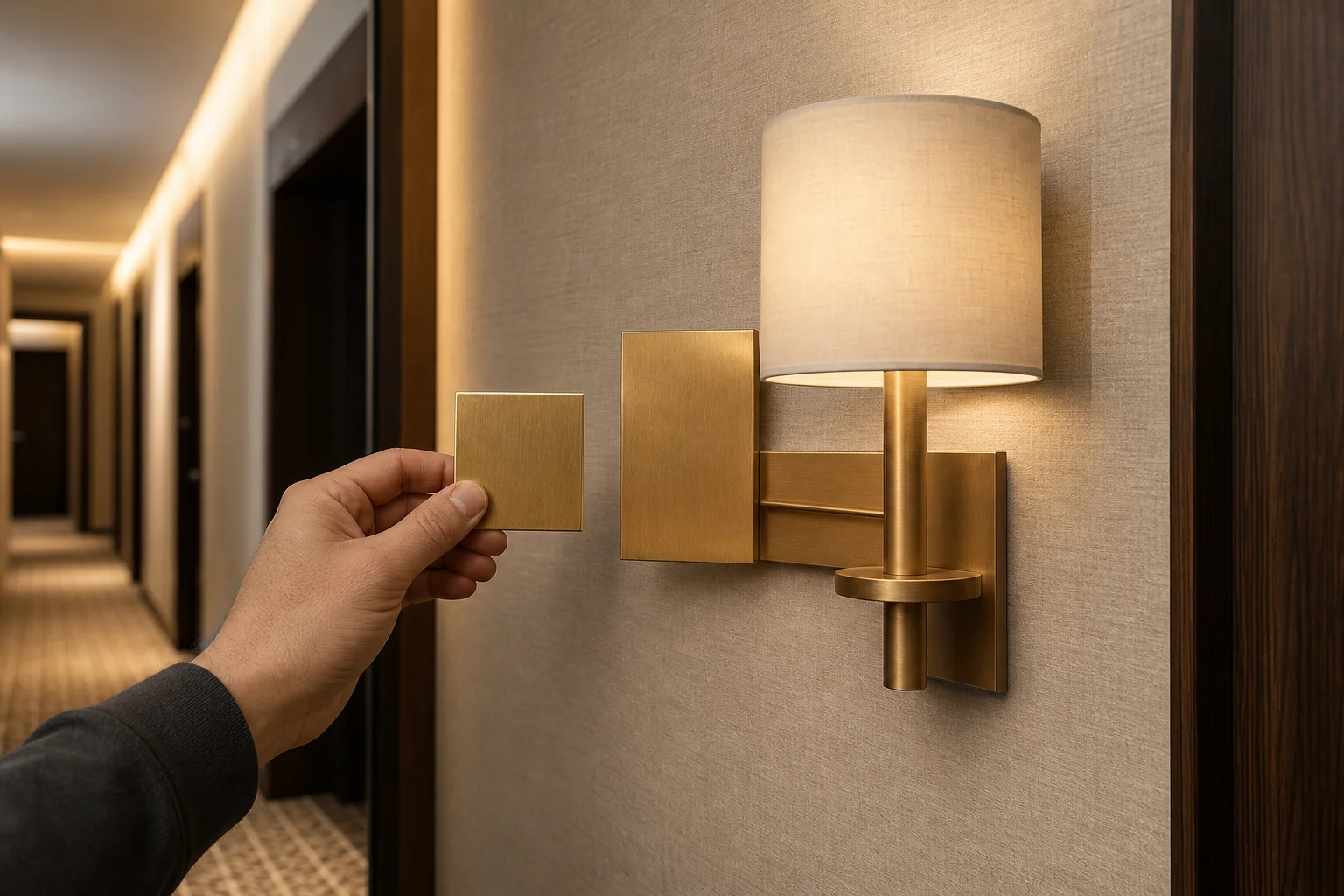
Wall-mounted hotel bedside reading lamp beside a contrasting wall switch plate
Reach and contrast decide whether a bedside control is usable, and both are settled on the drawing rather than by the fitting.

Accessibility is a design standard, not a product certificate

Accessibility requirements for hotels are set by a national or regional design standard, and they govern how a building performs rather than which mark a fixture carries. In the United States the instrument is the accessibility standard attached to the Americans with Disabilities Act; other markets write an equivalent into local building regulation. A compliance schedule is checked in the building, a product certificate on the light itself.

That changes what a supplier can responsibly promise. A manufacturer can supply a plate that steps away from its wall, a control that can be operated without looking, a dimmer that behaves at low output, and a fixture that shields its own source, but it cannot certify a corridor as accessible. The useful question is not whether a pendant is compliant on its own, but whether the parts that touch the requirement are documented well enough for sign-off.

Reach decides where the control can live

Reach is the constraint that most often forces a design change, because it is settled by the drawing and not by the fitting. The applicable standard states a reach range for controls, and a switch outside it is inaccessible however well it is finished.

Three consequences follow. At the bed, the control must be usable from a seated or lying position on the side the guest actually sleeps, decided before the joinery is drawn: a bedside light whose only switch sits on the shade can end up unreachable once the bed is against the wall. Physical operation also beats surface: a rocker has an edge that can be found without looking, while a flush touch pad offers no tactile reference. A control should also avoid sitting behind a bedside table or under a floating vanity edge, where it can be seen but not reached.

Accessibility constraintWhat it changes in the drawing or the fittingWhat to verify before handover
Control reachPlacement of every switch and dimmer the guest operatesReach each control from the bed and from a seated position, with joinery installed
Control identificationPlate tone and sheen against the wall, plus a tactile or backlit elementFind and operate the control in the dimmest state the room is used in
Glare controlShielding, baffles or a diffusing shade on fixtures near eye heightLook toward each source and its image in polished surfaces
Task lightingA dedicated light at bedside, mirror, desk and wardrobe instead of higher ambientCheck each task point against the level the designer specified
Egress separationDecorative elements moved clear of exit signage and emergency devicesConfirm emergency devices operate independently of decorative dimming
Room-to-room consistencySame control layout and fixture family in accessible and standard roomsWalk an accessible room and a standard room back to back

Contrast is how a switch becomes findable

A switch finished to match its wall exactly is a common design choice and a common accessibility failure. Requirements are usually expressed as a contrast between control and background, because contrast, not brightness alone, is what lets an older or low vision guest find the plate.

This is where finish decisions collide with guest experience. Satin brass on cream polished plaster, or dark bronze on dark timber veneer, reads well in a render and disappears at night. The fix is rarely a different fitting: it is a plate that steps away from the wall in tone or sheen, plus a tactile element such as a raised bar. A guest should be able to find the control in a dark room.

Glare is an accessibility issue, not a comfort preference

As the eye ages the lens scatters more light, so a bright source against a dark background produces veiling glare and the guest sees less rather than more. A specification that treats glare as a matter of taste will fail precisely the guests the requirement exists to protect.

In practice that means shielding any bare lamp at or near eye height, using baffles or a diffusing shade rather than an exposed source, and watching the polished surfaces a seated guest faces. A mirror light that throws its own image into the eyes of someone at the vanity is a glare defect, and so is a bedside lamp reflected in glass.

An accessible room is not a different lighting scheme. It is the same scheme with reach, contrast and glare resolved before the fittings are ordered.

Light levels belong to the project, not to the datasheet

Lighting levels are set by the designer of record against the standard in force, which is why a manufacturer should not publish one universal target figure for a guest room. What a supplier can document is the behaviour that delivers those levels: output and distribution, shielding, dimming range and colour quality. Accessibility work then happens at the task points, because lifting a whole ceiling to fix the bedside produces glare elsewhere.

Nothing decorative may obscure the egress route

Accessibility and life safety are separate requirements, and they meet on the corridor wall. Decorative rhythm must never cover, crowd or outshine exit signage and emergency lighting, and a corridor that reads as an evenly decorated tunnel is a wayfinding failure as much as an aesthetic one. A readable route comes from a sequence of cues, not from even spacing alone.

Two drawing rules follow. Where a decorative element and an exit device compete for the same position, the exit device wins and the decorative element moves. And dimming must not reach the emergency devices at all: they stay on their own circuit, so a scene change late at night cannot touch the route out.

What to write into the specification

Most accessibility problems in lighting are settled by documentation rather than hardware:

  • Place every control inside the reach range the project's standard sets, and show the reach from the bed and from a seated position on the drawing.
  • Nominate each plate finish against the wall it sits on, as a contrast statement rather than a swatch on its own.
  • Require tactile identification on every control the guest must find in the dark.
  • Require shielding or a diffusing shade on any fixture mounted at or near eye height.
  • Keep emergency and exit devices on circuits separate from decorative dimming.
  • Keep the fixture family and control layout consistent between accessible and standard rooms, so spares stay common.

FAQ

Can a supplier certify a hotel lighting scheme as accessible?

No. The requirement applies to the building and is verified against the design standard in force for the project. A supplier can document reach, contrast, shielding and control behaviour for the parts it makes, which is what the design team needs for its compliance statement.

Does accessibility mean brighter rooms?

Not usually. Older guests tend to lose contrast sensitivity and glare tolerance before light sensitivity, so better contrast, better shielding and better light at the task point often achieve more than raising overall output.

Where should a bedside light switch be positioned?

Within the reach range the project's standard sets, measured from a seated position on the side of the bed where the guest sleeps. Confirm it after the joinery is installed, not on the drawing alone.

Are touch dimmers a problem for accessibility?

They can be. A flush touch pad gives no tactile edge, so a guest who cannot see it clearly may struggle to switch a light off. A rocker, or a pad in a defined surround, is easier to find and operate.

Do accessible rooms need different light fittings from standard rooms?

Usually a different placement and control treatment rather than different fittings. Keeping one fixture family across both room types simplifies spares and makes the differences in reach and contrast explicit.

The takeaway

Accessibility in hotel lighting is mostly decided on the drawing and in the finish schedule, not on the crate. Put every control within reach of the position the guest actually uses, nominate each plate against its wall so the switch can be found without light, shield anything that would sit in a guest's eyesight, and keep decorative dimming away from the egress route. Document those four things and the room becomes usable without the scheme changing character.

Zerouno Lighting (ZeroUNO) manufactures hospitality decorative lighting in Zhongshan, China, including wall lights, bedside reading lights and alabaster-bodied pieces for hotel projects. Custom work begins with a single-piece approval sample, and every order carries a two-year warranty with a 48-hour response on service questions. Learn more at zerounolighting.com.

About the author

Sonny Yu is Sales Manager at Zerouno Lighting in Zhongshan, working with hotel owners, designers and procurement teams on bespoke decorative lighting. He writes about the decisions that are cheap to correct on a drawing and expensive to correct on a finished wall.


2026年10月11日星期日

Alabaster Lighting Manufacturing: From Block to Shade

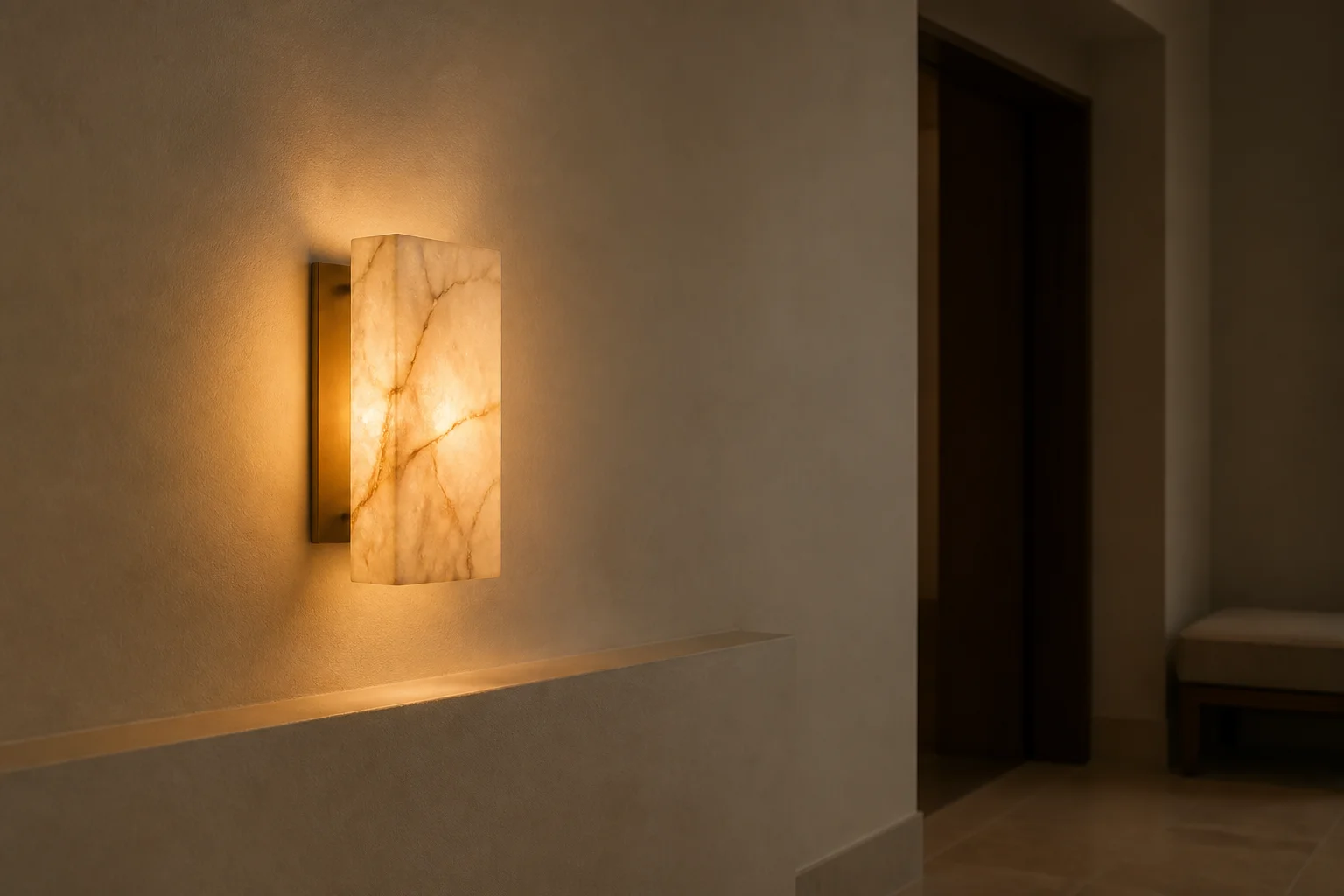
A translucent stone shade is judged twice: in a sample room under a work light, and on a corridor wall at night. Between those moments sits a workshop process most specifications never mention, and it decides whether the shade glows evenly or reads as a grey slab.

This guide is for the people approving that process from a distance: the designer writing the stone specification, the procurement team comparing two suppliers quoting the same shape, and the owner's representative signing the sample off. It follows one alabaster body from block to lit inspection bench.

Wet alabaster blank, turned body on the lathe and a finished lit shade on a workshop bench
Polishing removes the last fraction of the wall by hand, so two shades turned from one block can still disagree under a light.

Why alabaster is worked wet, from the first cut to the last

Alabaster is a soft stone, and soft stone behaves badly worked dry. Dry cutting or sanding throws fine dust that is hard to contain, and generates heat at the tool edge; on a brittle translucent material that heat starts a hairline crack which stays invisible until the shade is switched on. So the whole sequence runs wet, and the same water darkens the stone and makes veining and density readable, which is why judgement calls on a block are made wet.

Reading the block face before anything is cut

Alabaster is worked block by block, so the first production decision is a reading of the stone rather than a machine setting. A face is cut across, wetted and examined for how evenly light will pass, whether veins will show as dark lines under backlight, and where density shifts.

That reading settles two things: the orientation of the body inside the block, because a shade ground perpendicular to the banding behaves differently from one ground across it, and whether the whole run comes from this block. A single block is the most effective consistency tool available, and asking for one costs nothing at this point.

Cutting oversize, then turning a body in passes

The blank leaves the block oversize. Water-jet cutting takes that first pass because it removes material without the heat and shock of a saw. Everything after this stage removes material, so the oversize allowance is the last real room the workshop has.

Turning then runs in many light passes rather than a few deep ones. Each pass takes a small layer, is checked, and is followed by another; deep cuts on a soft layered stone are how a body ends out of round, or how a thin section fails later at a load point.

Passes also let the workshop respond to what the block contains: a hidden hairline or a harder inclusion shows up mid-turn, and the usual answer is to reduce the remaining wall and move the piece to a smaller body rather than patch the surface. Ask how a workshop handles that, because the answer shows whether the stone or the schedule is driving the order.

Production stageWhat it protectsWhat it means for the buyer
Reading the wet block faceOrientation and evenness of glowAsk which block supplies the run
Oversize water-jet blankStock removed without heat or shockLater stages only remove material
Turning in light passesWall integrity and fixing marginAsk what happens when a flaw appears mid-turn
Hand wet polishingEven surface and final wallThe stage most responsible for batch tone
Metal seatingEvery structural load pathLoad should always travel through metal
Lit inspection per pieceFaults the dry surface hidesThe only check that sees the finished glow

Hand wet-polishing is where the glow is decided

Polishing decides how the finished shade looks, and it is the stage with the least machinery in it. Each piece is worked by hand under running water through a descending series of grits, turning a scratched surface into a soft even face. Two things are managed at once: the surface, because scratches scatter light unevenly and appear as dull patches once the fitting is switched on; and the wall, because polishing removes material, and a face worked slightly thinner reads lighter under backlight.

That second point is the one buyers rarely see coming. Two shades can share a profile, be cut from the same block and turned on the same lathe, and still disagree under a work light, because the last fraction of wall came off each piece by hand. It cannot be polished back on. Ask a workshop how it manages batch tone: an honest answer describes a check on the light bench, not a promise about the lathe.

The metal carries the load, never the stone

Alabaster does not hold a thread, so no part of a stone body carries its own weight or the weight of the fitting. The metal frame takes the load and the stone sits inside it: a collar at the neck, discreet pins or a pressed seat at the base, and a bracket at the wall or canopy.

The production consequence is that turning does not finish at a profile but at a mating surface. The collar has to meet the turned body along a line that neither rocks nor pinches, which is why the two parts are fitted together on the bench rather than finished separately and assembled later. Ask where the load is carried and what is left at the mounting edge, and the answer should describe a metal part in every load path.

Wall thickness is the trade-off you have to rank

There is no single correct wall thickness, because the figure that makes a shade glow evenly is rarely the figure that makes its fixing margin safe. A workshop can grind towards one or the other, or towards a middle it can hold across a batch, but not all three at once.

The trade-off therefore has to be settled before the first cut. Thickness is removed in stages, so the decision is unrecoverable: the same blank becomes a brighter thinner-bodied shade or a quieter heavier one, and the choice is made once. Turning leaves the wall thicker than the finished piece needs, and the last of it goes at the polishing bench.

Thickness is the one decision this process cannot reverse. Choose the end of the range before the first cut, not after the first shade is lit.

What to inspect in the lit sample, and what a repeat order changes

The sample bench is where all of this becomes evidence. Switch the fitting on, then check:

  • Light the piece rather than judging it switched off: veins and uneven patches show under transmission that the surface conceals.
  • Look at the fixing margin at the top edge, where the wall is thicker and the metal takes the load.
  • Check the wall at the rim and near the base, since a piece that thins towards a load point has been polished past its margin.
  • Compare tone against the approved master in the same room, at the brightest and dimmest setting.
  • Ask which block supplied the sample, and have the answer written into the order.

On a repeat order only two variables move: the block, and the hand at the bench. Profile, metal, seat and load path are fixed by the drawings and the approved sample. The useful question is therefore not whether a second delivery matches the photographs, but whether it sits inside the agreed tolerance band and matches the tone of the phase beside it.

FAQ

Why is alabaster cut and polished wet rather than dry?

Wet working holds the dust down, keeps the tool edge and the stone cool on a brittle material, and darkens the face so veining and density can be read.

Does an alabaster shade need a metal frame?

Yes. Alabaster will not hold a thread, so the frame takes the load and the stone sits inside it. Every load path should be metal.

Why do two shades from one order look slightly different when lit?

Block variation and the hand at the polishing bench. Manage both with a single-block request and a tolerance band, not one master sample.

Can the wall thickness be changed after the sample is approved?

Only downwards. Material is removed stage by stage, so a body can be ground thinner but not returned to thicker; a change to the target wall means a new body.

How long does a custom alabaster lighting order take?

Custom work begins with a single-piece approval sample, and a production run typically takes 25 to 35 days from the approved drawing. Lead time is confirmed on the quotation, since block selection and inspection come first.

The takeaway

An alabaster shade is made by removal, so every stage narrows the options rather than adding to them. Read the block wet, cut oversized, turn in light passes and polish by hand, knowing the polishing bench decides the tone of the batch. Let metal carry every load, settle the wall trade-off before the first cut, and inspect the sample lit rather than switched off. Buyers who ask which block is running, and which end of the thickness range is held, get a batch that keeps its tone.

Zerouno Lighting (ZeroUNO) manufactures hospitality decorative lighting in Zhongshan, China, including alabaster-bodied pendants, wall lights and table lamps. Custom pieces start from a single-piece approval sample. Learn more at zerounolighting.com.

About the author

Sonny Yu is Sales Manager at Zerouno Lighting in Zhongshan, working with hotel owners, designers and procurement teams on bespoke decorative lighting. He writes about how a fixture is actually produced, because the workshop decisions behind a stone body are the ones that show up on the wall.

2026年10月10日星期六

Reading a Lighting Lifetime Claim: L70, L80 and Rated Hours

Somewhere in the lighting specification there is a number that looks like a promise: L70 at 50,000 hours, or 50,000 rated hours. It gets copied into the schedule because it is the only lifetime evidence on the page, then into the maintenance manual as though it were a warranty. Neither use is what the number was made for.

This guide is for the people who have to decide whether that line is usable: the owner's representative reviewing a submittal, the designer writing the specification, and the procurement team comparing two suppliers quoting the same figure. It covers what the number measures, where the extrapolation stops being evidence, what quietly invalidates it, and what to ask for instead of a bigger number.

LED module clamped in a laboratory test fixture beside its driver and a light meter
Rated hours come from a short laboratory test of the light source, not from watching a finished fitting for years.

A rated-hours figure is a projection, not a measurement

No manufacturer has watched a fitting for fifty thousand hours before selling it. A rated-hours figure comes from a short laboratory test of the light source, run at controlled drive currents and case temperatures, then projected mathematically out to the number on the datasheet. The test is real. The projection is an inference drawn from it.

Two consequences follow. The figure belongs to the light source and its test conditions, not to the finished fitting it is installed in. And the useful question is never what the number is, but what was measured, under what conditions, and how far past the measurement the projection ran.

L, B and C are three different things wearing one label

A lifetime claim is usually written as a compact code, and each element answers a different question.

L is lumen maintenance: the point at which light output has fallen to a stated percentage of its initial value, so L70 means seventy per cent, L80 eighty, L90 ninety. It describes fading, not failure. A fitting at L70 still lights the room; it simply emits less than it did.

B is abrupt failure, the percentage of a sample that has stopped working at that same point. C is catastrophic failure, where the loss is not a fade but a component giving out. An L figure alone says nothing about either, which is why a claim without a B or C figure is only half a statement.

How to read a claim line

Work down this table when a submittal arrives. The right-hand column is the part that turns a copied number into a checkable one.

Element of the claimWhat it statesWhat it does not stateAsk for
Rated hours, for example 50,000 hA time point from a laboratory projectionWhich conditions produced it, and whether your fitting matchesThe test report behind the number
L70, L80 or L90The share of initial light output remainingWhether any units also failedThe B and C figures from that projection
Test drive currentThe current the sample was run atThe current your driver suppliesMeasured current against your driver rating
Case temperatureThe temperature the sample was held atThe temperature inside your enclosureIn-situ measurement, or a thermal test
Sample sizeHow many units were testedWhether the spread was uniformThe spread, not only the average
Projection ratioHow far past the measured data the figure extendsHow much is measured and how much inferredThe measured duration and the multiplier applied

Where the projection stops being evidence

The projection method does not run indefinitely. Extrapolating from a few thousand measured hours out to tens of thousands multiplies the trend and the uncertainty together, so the method caps the projection at a stated multiple of the duration actually measured, and requires the test to have run long enough to be worth extrapolating at all. This is where two suppliers' identical numbers can mean different things, because a figure built on a shorter test with a larger multiplier is a weaker statement than the same digits built on a longer one. Ask for the measured duration and the multiplier separately; that pair tells you how much of the number is observation and how much is arithmetic.

Three mismatches that quietly void a claim

A claim travels with the conditions it was produced under. Move the fitting away from those conditions and the number no longer describes it.

  • Drive current. A source tested at a gentle current and then driven harder in the finished fixture runs hotter and fades faster. The claim belongs to the tested current.
  • Case temperature. This is the mismatch that hides best, because the sample is often held cool in a controlled jig while the installed fitting sits in a sealed decorative enclosure with no airflow. The same source run hotter will not follow the same curve.
  • Optics, driver and assembly. Changing the driver, the diffuser material or the thermal path changes how hard the source works. The claim belongs to the tested assembly, not the family name.

None of this implies bad faith. A laboratory result reused on a product that is not the laboratory sample simply stops describing it.

Rated hours are not a warranty

The two terms sit next to each other in a submittal and mean different things. Rated hours are a technical projection about light output across a population; a warranty is a commercial undertaking about a specific unit failing within a stated period, and it carries an owner, a remedy and a route to claim.

Fading is not failure, so a fitting can sit inside its warranty while its light output has fallen well past the projected level. It can equally fail in year one, long before any rated figure, and still be a warranty matter rather than a broken projection. Read the exclusions before leaning on the figure.

A rated-hours figure answers one narrow question: how fast does this source fade under one set of laboratory conditions. It does not answer how long the fitting will work in your building, and it was never designed to.

What to write into the specification instead

The productive move is to specify the evidence rather than the number. Requiring a larger figure just gets you a larger figure; requiring a documented one gets you a submittal you can check.

  • Require the light-source test data and the projection that follows from it, not a bare figure on a datasheet.
  • Require the test to name its drive current and case temperature, and the fitting's own operating conditions to be declared beside them.
  • Require the measured duration and the projection multiplier, so the ratio of observation to inference is visible.
  • Require the housing and thermal design to stay fixed after sample approval, or require re-testing if it changes.
  • Require the maintenance consequence to be stated, since the practical output of a projection is a replacement plan, not a guarantee.

Where a project depends on long service life, the honest answer is usually a maintenance and spares plan: know the fade rate you accepted, know where the drivers are, and hold stock of the parts that will actually need changing.

FAQ

Does L70 mean the fitting stops working?

No. It marks the point where light output has fallen to 70 per cent of the initial value. The fitting still operates; it simply produces less light.

Is a 50,000-hour rating the same as a warranty?

No. A rating is a technical projection about light output across a population. A warranty is a commercial undertaking about failure of a specific unit within a stated period. They are separate documents making separate promises.

Can I compare two suppliers' rated hours directly?

Only if the test conditions match. The same figure can rest on different drive currents, case temperatures and measured durations. Compare the test report, not the last line of the datasheet.

The fitting uses a different driver from the one tested. Does the claim still hold?

Not automatically. A driver change alters the current the source sees and the heat it produces, so the projection no longer describes the delivered fitting. Ask for the conditions to be re-declared, or the assembly re-tested.

What do B and C add to an L figure?

They describe failure rather than fading. B is the percentage of the sample that has stopped working at the same time point, and C describes catastrophic component loss. An L figure alone cannot say how many units failed.

The takeaway

Treat a rated-hours figure as a bounded projection and read it as evidence rather than a promise. Take the code apart, because L describes fading while B and C describe failure, and the three are not interchangeable. Ask for the measured duration, the drive current, the case temperature and the projection multiplier, then set those against how the fitting will actually run. Write the required evidence into the specification instead of demanding a bigger number, and keep the rated figure and the warranty in separate compartments, since only one arrives with a remedy.

Zerouno Lighting (ZeroUNO) manufactures hospitality decorative lighting in Zhongshan, China, including bespoke brass, glass, fabric and stone-bodied fixtures. Orders begin with a single-piece approval sample, and products carry a two-year warranty with a 48-hour response. Learn more at zerounolighting.com.

About the author

Sonny Yu is Sales Manager at Zerouno Lighting in Zhongshan, working with hotel owners, designers and procurement teams on bespoke decorative lighting from first drawing to final handover. He writes about the paperwork behind a lighting order, where the difference between a checkable claim and a copied number decides how a submittal is read.

2026年10月8日星期四

Hotel Lighting Punch List: Closing Out Installation Defects

A lighting package is usually the last trade finished and the first to be walked. By the time the fixtures are up, the corridors are painted and the opening date has stopped moving, the review that decides whether the lighting is accepted happens in rooms that already look complete. That is the worst moment to find that the list has no structure.

This guide is for the people who run that walk and then have to close it: the project manager running the review, the owner's representative who signs acceptance, and the supplier answering every line. It covers how to classify an item before arguing about it, which items should stop acceptance, and how to write a line that can actually be closed.

Brass finish sample held against a mounted wall sconce in a finished hotel corridor
The approved sample is the reference the walk is judged against, not a memory of it.

A punch list is a triage document, not a complaints form

By the time the walk happens everyone is tired and the instinct is to work down one queue in the order things were noticed. That order records the walk, not the work. A scuff on a lobby panel and a ballroom scene that will not hold on the control panel are both lighting items, yet they have different owners, different evidence and a different cost of delay.

Sort every line into one of five families first. The family decides who can close it and whether the room can stay in use meanwhile.

FamilyTypical itemsClosed byClosed with
Visual and alignmentShade out of level, visible seam, glare from a seatInstaller and designerPhotograph against the approved sample
Electrical and controlScene will not recall, flicker at the low end, driver humElectrical contractor and supplierEvery scene tested in the hotel's own conditions
Finish and product evidenceTone drift against master, transit bruise, missing partSupplierReplacement or written acceptance
Access and maintainabilityNo route to the driver, canopy that will not openContractor and designerA demonstrated service route, recorded
Documentation and handoverMissing as-built, no spares list, unrecorded driver locationsSupplier and contractorThe issued document set

Two rules follow. An item cannot be closed by a party who does not own it. And the evidence in the last column closes the line, not the opinion of whoever is standing closest to it.

Sort the disposition before you argue the severity

Within its family, every line also needs a disposition, better written during the walk than decided later by email.

  • Blocking. Safety, operation, installation integrity or a room that cannot be used as intended.
  • Repair. A real defect, contained and not affecting use.
  • Documentation gap. The hardware is right and the paper is missing.
  • Preference change. The work matches the approved sample and the requirement has moved.
  • Deferred. Agreed for a later phase, with a date and an owner.

These are not degrees of severity. A documentation gap is not a defect, a repair is not a reason to hold a floor, and a preference change is not part of the contract at all.

Which items stop acceptance, and the order to work the list

A blocking item is not the ugliest item on the list. It is the item that stops the room doing its job: a night or emergency route that cannot be controlled, an unverified fixing, a missing part that prevents a group being commissioned, or work that contradicts the approved drawings.

Each blocking item needs an owner, a date, the evidence that will show it fixed and how it will be re-tested. Without the last, the line returns on the next walk. Work the list in order: blockers first, then anything touching water, power or a load path before a finished ceiling is re-opened, then control behaviour scene by scene while the controls contractor is still on site, then visual items at the guest's eye level, and documentation and preferences last.

A preference is not a defect

The most corrosive line on a punch list reads like a defect but is a change of mind. The fixture was made to the approved sample and hung where the drawing shows it, and now the owner wants it lower. Left unclassified, it is argued as a quality failure, and every other item loses credibility with it.

Handle it as a change request instead: priced, scheduled and approved separately, with the original installation closed as compliant. The same discipline applies to finish opinions, where the useful question is whether a piece deviates from the approved master sample or simply reads differently in this room. Only the first is the supplier's to answer.

A punch list is a record of what was agreed, not a negotiation reopened at handover. A line that cannot name the approved reference it fails is a preference, and preferences have their own route.

How to write a line so it can be closed

Most items that stay open for months are badly written rather than difficult. A line reading corridor lights flicker cannot be closed, because nobody can tell when it is fixed. A complete statement carries five fields.

  • Location. Room, wall, level or fixture tag, precise enough to find without a guide.
  • Symptom. What is observed, in plain language, without guessing at the cause.
  • Condition. Which scene, dimming level or time of day, since many faults appear at one end of the range.
  • Reference. The drawing, sample or approved document the work is measured against.
  • Closure test. What will be seen when it is right, so the item can be signed off without discussion.

Where a fault could sit at more than one layer, say so. A symptom can come from the fixture, the driver, the wiring, the control system or the scene programming, and naming the layer to check first stops two trades pointing at each other.

Access and maintainability are defects too

A fixture that nobody can service is not finished, however good it looks on the day. If the driver sits behind a sealed panel, if the canopy cannot be opened without dismantling the shade, or if the access equipment will not reach the fitting once the furniture is in, the item is open regardless of its appearance. Confirm the route in, the position of every consumable part and the cleaning method housekeeping will actually use; all three are cheap to settle while the site is open.

The close-out file that survives staff turnover

The people who close the last items are rarely the people who will maintain the lighting. A close-out is finished only when the file behind it can be read by someone who was not on the walk.

  • As-built drawings and the room schedule, marked with what was installed.
  • A scene list in plain language, mapped to the control groups that deliver it.
  • Driver and lamp positions, so a replacement does not begin with a search.
  • Approved sample and finish codes, so a later order can be matched.
  • The spares list with quantities and storage location.
  • The cleaning method per material, and the warranty boundaries that give a failure an owner.

Then attach an owner, a date, a photograph, a severity and a closure rule to every item still open. Final acceptance is a controlled record, and the moment it becomes a set of memories the argument restarts at the first staff change.

FAQ

What is a punch list in a lighting package?

The structured record of everything to be corrected, confirmed or documented before the lighting is accepted. Each line carries an owner, a date, evidence and a closing test.

Which items should block final acceptance?

Those that stop the room working as designed: night routes that cannot be controlled, unverified fixings, missing parts and work that contradicts the approved drawings. Cosmetic and documentation items are tracked to closure instead.

Who should attend the lighting walk?

The owner's representative, the designer, the main contractor, the electrical contractor and the supplier. Each sees a different risk: operability, design intent, installation sequence and what can be corrected at the factory.

Why do punch-list items stay open for months?

Usually because the line was written as a complaint rather than a record. Without a location, a condition, an approved reference and a closure test, nobody can demonstrate the item is finished.

What happens to items found after handover?

They follow the warranty route rather than the punch list. Keep the approved sample codes, driver positions and spares list from handover, because those let a fault be diagnosed and a replacement matched.

The takeaway

Treat the lighting walk as triage: sort every line into its family and disposition before anyone argues about severity, and let only genuine blockers stop acceptance. Write each item with a location, a condition, an approved reference and a test that closes it, and route preferences to a change request rather than a defect list. The fixtures are the easy part; the record decides whether the list ever closes.

Zerouno Lighting (ZeroUNO) manufactures hospitality decorative lighting in Zhongshan, China, including bespoke brass, glass, fabric and stone-bodied fixtures. Each order begins with a single-piece approval sample, the reference a punch list is measured against, and products carry a two-year warranty with a 48-hour response. Learn more at zerounolighting.com.

About the author

Sonny Yu is Sales Manager at Zerouno Lighting in Zhongshan, working with hotel owners, designers and procurement teams on bespoke decorative lighting from the first drawing to final handover. He writes about the closing stages of a lighting order, where the difference between a defect and a change of mind decides how quickly a project is signed off.

2026年10月7日星期三

Cleaning Hotel Lighting by Material: A Housekeeping Guide

A hotel lighting package is usually maintained by the same person, with the same trolley, in the same fifteen minutes per room. That routine was built for bathrooms and floors; applied to the fittings themselves it becomes a slow chemical decision repeated hundreds of times a year. A fixture that arrived flawless can be dulled, clouded or streaked long before anything mechanical has failed.

This guide is for the people who own that outcome: housekeeping managers, chief engineers and the procurement teams who close out a lighting package. It sets out one routine per material family, the products that must never reach each surface, and the handover pack that stops the procedure drifting back to whatever is on the trolley.

Cleaning kit with a soft cloth, brush and neutral cleaner beside a brass wall light and a glass pendant
One trolley, six surfaces: the cloth and the bottle have to change with the material, not with the room.

Why a finish schedule and a cleaning trolley never agree

A cleaning trolley is standardised on purpose: one glass spray, one cream cleanser, one disinfectant, one pile of cloths, chosen for ceramics, glass, stainless steel and floors. A lighting package is the opposite. One guest room can hold lacquered brass, raw brass, powder-coated steel, a fabric shade, a glass diffuser and a stone panel, and those six surfaces tolerate six different things.

Nobody writes the join down. Procurement describes a finish by appearance, such as antique brass or matte black, and says nothing about what the surface can survive. Operations lists chemicals and cloths by area, not by material. Neither names the other, so the first person to push a trolley through the room makes a judgement the specification never gave them. The loss is almost always to chemistry or abrasion, and it is cumulative: one wipe proves nothing, while the same wipe daily for three years decides whether a finish still reads as the approved sample. Which chemistries attack which finishes belongs to a separate piece on finish durability; this article starts from the material and ends with the routine.

The cleaning routine by material family

Work down this table at handover and every time housekeeping is trained. The middle and right columns are the ones that matter on the trolley.

MaterialRoutineApproved methodKeep away
Glass shade or diffuserDust weekly, wipe monthlyNeutral soap, barely damp cloth, dried at onceAbrasives, scouring pads, direct spray
Crystal pendantsDust weekly, soft brushDiluted mild soap on the cloth, top downAmmonia, soaking, alcohol on plated parts
Lacquered brass and bronzeDust plus a damp wipeSoft damp cloth, dried at onceMetal polish, abrasives
Raw or unlacquered brassDust, polish when neededMild polish, applied evenly, buffed one wayAbrasive pads, patchy spot polishing
Powder-coated steelDamp wipeMild soap, rinsed and driedSolvents, alcohol sprays, degreasers
Fabric shades and diffusersVacuum monthly, spot clean if neededBrush attachment on low suction, foam blotted onSoaking, rubbing, wet cloths from the bathroom
Opal acrylic diffusersDust, then a damp wipeMild soap and water, soft clothAlcohols, ammonia, dry rubbing
Stone, alabaster and marbleDry dust onlySoft dry cloth, barely damp if needed, dried at onceStanding water, acidic cleaners, abrasives

If the full table will not fit on a wall, cut it to one line per material and laminate that.

Glass and crystal are not the same job

Both are transparent and both show every mark, but the assembly around them differs. A glass shade takes a neutral soap and water wipe without complaint; crystal is much the same mineral family, yet pendants hang on wire, pins and plated links, and those fail first. The quickest way to shorten a chandelier's life is to spray a glass cleaner directly at it, because the product runs down through the crystal and onto the mounting, taking the lacquer or plating with it. Put the product on the cloth instead, steady the pendant with one hand, and work downwards from the top. Frosted, etched and printed glass takes a soft dry cloth only.

Metal: the lacquer line decides the product

The most common housekeeping error in a hotel corridor is brass polish on lacquered brass. Appearance gives no warning, because a lacquered and an unlacquered fitting can be specified in the same tone; behaviour does. Raw brass tarnishes and can be brightened with a mild polish. Lacquered brass does not tarnish, and each pass of polish removes a little of the film protecting it, in streaks that follow the cloth.

The test is safe and slow: watch the piece for a month. Still bright with dusting alone means it is coated, and needs only a damp wipe; a warm haze means it is raw, and can be polished evenly and infrequently with a mild product and a soft cloth, finishing in one direction. A darkened bronze that looks dull to a new cleaner is usually the approved colour, and polishing it back to brightness is a defect.

The question is not whether the fixture is dirty. It is whether the surface is coated. Polishing a lacquered fitting is not a stronger clean, it is a slower removal.

Fabric shades and diffusers: dry first, always

Textiles are the surfaces most often damaged by water, because a wet cloth from the bathroom is the closest thing to hand. Dust is the routine enemy and comes off with a vacuum brush attachment on low suction, worked from the top rim downwards; do that monthly in public areas and most shades need nothing else. Where a mark has to go, ask the supplier for a tested method and try it on the inner face first.

  • Never immerse a shade or diffuser, even a removable one. The frame inside is usually steel and the weave loses its shape while it dries.
  • Blot rather than rub, which works the mark into the weave.
  • Spray onto the cloth, never onto the shade, so no liquid reaches the fitting below.
  • Record which shades were spot cleaned, so a later patch is not read as a manufacturing fault.

Stone and translucent stone: water is the only real risk

Stone-bodied fixtures take a dry dusting as their whole routine. A soft dry cloth lifts dust without moving anything else, and a barely damp cloth is the limit when a mark has to go, because translucent stone is porous and stays in contact with water it cannot shed. Keep abrasives away as well: they dull the face, and a dulled face spreads light less evenly than the approved sample did. Standing water, acidic cleaners and soaking cloths are the three habits to write out of the procedure explicitly.

Writing the routine into the handover pack

A cleaning routine survives on paper or not at all. The person who washes a fixture in year three rarely attended the handover, and contractors who deep clean between seasons have no reason to know what the fitting is made of. Four items belong with the maintenance documents:

  • A single page per material family, in the language the housekeeping team reads, with the approved method and the products to avoid.
  • The approved product list with dilution, so a replacement can be checked against it rather than guessed.
  • The cloth and tool list, because the wrong cloth does damage that looks like wear.
  • A named contact for questions, so an unusual mark becomes a message rather than an experiment.

The routine breaks at three predictable moments: a new housekeeping starter, a change of contractor, and a seasonal deep clean.

FAQ

Can one spray cover glass, crystal and metal?

No. A product that is safe on a glass diffuser may strip lacquer from a brass base and dull a plated mounting. Use a neutral cleaner on glass and stone, and water with a soft cloth on metal.

Why did lacquered brass go patchy in one area?

Usually repeated polishing on the side that catches marks, such as the switch side of a backplate. Each pass removes a little of the clear film, and once it thins unevenly the surface reads as patchy under light.

Can a fabric shade be washed or dry cleaned?

Only by the supplier's tested method. Most shades are spot cleaned in place, because immersion softens the weave and attacks the steel frame inside. A badly marked shade is usually cheaper to replace than to restore.

Is a damp cloth safe on alabaster or marble?

Barely damp, and dried immediately. Dry dusting is the routine. Water left standing on translucent stone is the most common way a stone fixture loses its surface.

The takeaway

Decorative lighting is damaged by the routine more often than by the guests. Match one cleaning method to each material family, keep polish away from anything lacquered, keep water away from textiles and stone, and put the product limits where the trolley is loaded. Ask the supplier for the material list and the tested method at handover, laminate one page per material, and brief it again whenever the cleaning team changes. That page usually decides whether a finish still matches its sample or is replaced early.

Zerouno Lighting (ZeroUNO) manufactures hospitality decorative lighting in Zhongshan, China, including brass, glass, fabric and stone-bodied fixtures built to project schedules. Each order starts with a single-piece approval sample, and products carry a two-year warranty with a 48-hour response window. Learn more at zerounolighting.com.

About the author

Sonny Yu is Sales Manager at Zerouno Lighting in Zhongshan, working with hotel owners, designers and procurement teams on bespoke decorative lighting, from the material call through to the approval sample and the maintenance documents that follow it.

2026年10月6日星期二

Alabaster vs Marble in Hotel Lighting: What You Buy

Stone is the material that most often disappoints a hotel lighting package, and rarely for the reason the buyer expects. The fixture arrives the right size with the metalwork finished as approved, somebody switches it on, and the piece reads as a warm glowing panel in one place and a flat grey slab in another. Nothing is broken. The buyer ordered a different stone from the one they thought they were ordering, because the word on the schedule covers at least three materials.

This guide is for the people who write and approve a stone lighting package: owners, designers, procurement teams and the project managers who sign the mock-up off. It covers the two questions that identify the stone, the naming confusion behind most disputes, and the clauses worth settling before the order rather than after the crates are open.

Translucent stone wall sconce glowing warm amber on a hotel corridor wall, with fine veining visible through the shade
A translucent stone shade is the light source, not a diffuser over one: where the stone is ground thicker, the lit face is darker.

Two questions identify the stone before you read the spec

Stone fixtures are sold under a short list of words, and those words are applied loosely. Ask two questions of the piece itself before reading a specification line.

The first is whether light passes through the stone or around it. Switch the fixture on. If the stone turns into the light source and glows, it comes from the alabaster family and the panel is the optical element. If the stone stays dark while the light arrives from a separate diffuser or an exposed lamp, the stone is present for mass and surface, and it is almost certainly marble, never meant to be backlit.

The second is what the fixture hangs its light on, because the base list tends to follow the material. A thin translucent panel needs a compact, low-heat source close behind it, so these pieces are generally built around small lamp bases or an integrated LED board, while structural stone carries larger, heavier holders without difficulty. Read the base list as a clue, then confirm it with the light-through test.

Alabaster, calcite alabaster and marble are three different purchases

In the lighting trade, alabaster usually means gypsum alabaster: soft enough that a fingernail will mark it, translucent through a thin section, and soluble in water over time. Marble is a metamorphic limestone, harder, capable of a polish alabaster cannot take, and effectively opaque at the wall thickness a fixture uses. The two behave in opposite ways, and the care routine for one damages the other.

The third material causes most of the arguments. Calcite alabaster, also sold as onyx marble or banded travertine, is a carbonate mineralogically closer to marble yet translucent like alabaster, and it is routinely sold under either name; a heavily banded amber slab presented as alabaster is often this material. It is not inferior, just a different purchase, and it belongs on the schedule under its own name.

Question to askGypsum alabasterCalcite alabaster (onyx marble)Marble
Does light pass through it?Yes, thin sectionYes, often stronglyNo, at fixture thickness
HardnessSoft, marks easilyIntermediateHard, takes a deep polish
Behaviour in waterSlowly dissolvesDepends on the stoneStable
Role in a fixtureThe glowing panelThe glowing panel, bandedBase, column, bracket
Matching a later pieceDifficultDifficultDifficult

If a supplier answers "alabaster" to every question, ask instead whether it is gypsum or calcite, and whether that can be confirmed on the cut face in writing.

What the stone decides about weight and anchorage

Weight is the constraint that surprises project teams, because it rarely appears on the line that matters. Specifications for stone fixtures tend to publish canopy or backplate dimensions rather than net and packed weight, and a slab-bodied fixture is heavier than its size suggests.

The fixing principle follows from the material. Gypsum will not hold a thread, so the metal carries the load and the stone is seated within it rather than bolted through it. That is why the mounting margins and edges of a panel are left thicker than the glowing centre, and why the backplate is the part to check against the real substrate. Stone is ground and hand-finished rather than moulded, so a stated diameter is a working target, and any dimension a neighbouring trade depends on should be raised before production so the allowance can be confirmed in writing.

No two pieces are identical, and that has to be managed

Veining, colour density and banding change from block to block, so a stone order cannot promise that production will repeat the approved sample exactly. Handled badly, this becomes a corridor of thirty wall lights where no two neighbours agree. Handled well, it becomes one of the few materials that genuinely looks natural at scale.

  • Ask whether every piece can come from a single block. It is the most effective clause available and it costs one sentence.
  • Approve the stone appearance, metal finish, dimensions and lit effect together, never from a product photograph alone.
  • Set a tolerance band rather than one master, so adjacent pieces in a repeated run sit inside the band.
  • Record which block supplied which delivery phase, so a later topping-up order matches the right batch.
The sample approves a range, not a copy. Write the range into the order and the material stops being a defect conversation.

Backlit stone shows its own thickness

Translucent stone is a diffuser made of the building material itself, and it reports on its own body. Where a panel is polished slightly thicker the lit face is darker, and where a vein crosses it reads as a dark line under backlight however fine the surface finish is. Neither is a fault and neither can be polished out, because both are the material rather than the work.

The workshop controls only the trade-off, and the buyer has to rank the goals. A panel can be ground towards the most even glow, the highest light output, or the strongest wall and edge, but not all three at once. Say which wins before the stone is cut, because the choice is made in tenths of a millimetre and is not recoverable afterwards.

The dry-location limit and how to care for the stone

Gypsum alabaster and water are not compatible, so a translucent stone fixture belongs in dry interior locations. A stone sconce specified for a shower zone is a scheduling error that shows up as surface loss in the first year. Wet-area protection ratings are a separate subject, set by the zone rules of the project rather than by the stone.

  • Dust with a soft dry cloth as the routine.
  • For a deeper clean, use a barely damp cloth and dry the surface immediately; standing water is the thing to avoid.
  • Keep abrasive cleaners away. Abrasives dull the surface, and a dulled surface spreads light less evenly than the approved sample did.
  • Keep the fixture out of long periods of direct sunlight, which fades the tone.
  • Record the approved cleaning method with the maintenance schedule so housekeeping is not guessing.

Finish selection on the metal parts is a separate decision, and stone often shares a room with wood, glass and metal details that each carry their own rules.

FAQ

How do I tell alabaster from marble?

Switch it on. If the stone glows, it is from the alabaster family; if it stays dark while something else emits the light, it is structural stone, almost certainly marble. Hardness confirms it: gypsum alabaster marks with a fingernail, marble does not.

Is onyx marble real marble?

Usually not, in the sense the name suggests. Material sold as onyx marble or banded travertine is commonly calcite alabaster, closer to marble in composition but translucent like alabaster. Ask for the mineral description.

Can alabaster be used in a hotel bathroom?

Not in a wet zone. Gypsum alabaster dissolves in water over time, so translucent stone belongs in dry interior locations. Keep it out of the splash path and confirm the zone rules with the project lighting designer.

Will the second delivery match the first?

Not exactly, and that is normal for natural stone. Manage it with a single-block request, an approved tolerance band rather than one master sample, and a record of which block supplied which delivery phase.

What should I settle before I place a stone lighting order?

Whether the stone is gypsum alabaster, calcite alabaster or marble; whether every piece can come from one block; the net and packed weight of the model; the mounting substrate behind the backplate; and which dimension must be held exactly.

The takeaway

Stone fixtures fail on identification, not on craft. Ask whether light passes through the stone or around it, then confirm whether the material is gypsum alabaster, calcite alabaster or marble, because the three behave differently in water, under load and under backlight. Treat weight and anchorage as the real engineering constraint and let the metal carry the piece. Approve a range rather than a copy, keep translucent stone out of wet zones, and put the approved cleaning method into the maintenance schedule.

Zerouno Lighting (ZeroUNO) manufactures hospitality decorative lighting in Zhongshan, China, including stone-bodied wall lights and pendants built to project schedules. The company was founded in 2013 and supplies single-piece approval samples before a production run. Learn more at zerounolighting.com.

About the author

Sonny Yu is Sales Manager at Zerouno Lighting in Zhongshan, working with hotel owners, designers and procurement teams on bespoke decorative lighting, from the material call to the approval sample.

2026年10月5日星期一

Hotel Exterior Lighting: How Facade Fixtures Survive

A guest room fixture is judged by the guest. A facade fixture is judged by the weather, and the weather is not a polite critic. On an exterior specification the visible part of the brief, the shape and the finish and the way the light washes a wall, is settled on a drawing. What never appears on that drawing is what decides whether the fitting is still doing the job in year five: how water leaves the housing, how the finish behaves under ultraviolet light and salt, and whether anyone can service the fixture without hiring a platform.

This guide is for the owners' representatives, facade consultants and procurement teams who sign off exterior lighting on a hotel. It covers the loads an exterior fitting actually carries, which material and finish decisions move the durability needle, how mounting and access decide the maintenance bill, and what to record at handover so the second phase of a project matches the first.

Hotel facade lighting: wall mounted exterior lanterns on stone cladding at dusk
A facade fitting is read at street distance, so a finish that chalks or streaks under ultraviolet light is visible to every passer-by.

Why an exterior fixture fails long before an interior one does

Indoors, a decorative fixture lives in a controlled environment. The temperature is stable, rain never reaches it, ultraviolet light is filtered by glass, and cleaning is done by staff following a schedule. Outdoors all four protections disappear at once, and they fail in a predictable order.

Water arrives first, driven sideways by wind through joints and cable entries, and condenses inside the housing as the fitting heats and cools. Electronics fail before anything else does, because the driver sits behind the seal. Then the finish follows: coatings chalk, plated surfaces dull unevenly, and any plastic part that is not ultraviolet stabilised starts to yellow. Fixings go last and matter most, because a corroded bracket is a safety issue rather than an appearance one.

The visible result is worse outdoors than in. A tired finish inside a guest room is noticed by one guest at a time; the same finish on a facade is read from the street by everybody, and it reads as a maintenance failure rather than a design choice.

What durability actually means on a specification

Durability is not a single property and cannot be bought with a single number. An ingress protection rating describes dust and water entry under defined test conditions, and it is a sensible starting point, but it says nothing about how a coating survives three summers, how a fixing behaves in coastal air, or whether water can escape once it is inside. Treat the rating as an entry ticket, not as a warranty.

Four separate properties decide whether an exterior fitting lasts, and each one is askable at submittal stage.

PropertyWhat it protectsWhat to ask for
Ingress protectionDriver, wiring and connectionsThe rating plus the position of every entry point
Corrosion resistanceHousing, brackets and fastenersThe coating system and the grade of each fixing
Ultraviolet stabilityFinish colour and plastic partsThe stabilised grade of any diffuser or gasket
Mechanical integrityThe fixture's attachment to the buildingDesign wind load and the anchor type per substrate

Water, wind and thermal movement: the three loads that open a housing

An exterior housing is attacked from three directions, and a specification that answers only one of them will still fail.

Water enters through joints, cable entries and screw threads, and it also forms inside from condensation as the fitting cycles between warm and cold. A cavity that cannot drain will eventually hold water. Weep holes help only if they sit where wind does not push rain into them and remain clear after finishing.

Wind rarely breaks a fixture; it works it loose. The design case for a bracket is a gust rather than the weight of the fitting, and repeated movement loosens fasteners and fatigues the seal around them. The joint between fixture and facade is where this shows up first.

Thermal movement separates materials that expand at different rates. A dark housing in direct sun runs far hotter than the air around it, which shortens the working life of the driver inside, and the same heat cycling opens hairline gaps at the joints between the housing and its mounting plate.

Treat the seal as the last line of defence rather than the first. A housing that drains will outlast one that only tries to stay dry.

Materials and finishes that survive the exposure

Most exterior durability failures are one component failing ahead of the rest. Aim the specification at the weak link rather than at the whole fixture.

ComponentWhere it failsWhat to specify
HousingPainted mild steel corrodes at cut edges and fixing pointsA corrosion-resistant alloy with a documented coating system
FastenersStandard steel fixings rust and stain the cladding belowA marine-grade stainless fixing for every bracket and cover
GasketsCheap rubber hardens and loses its seal within a seasonA UV-stable elastomer, sized so it is compressed rather than squeezed
DiffusersUntreated plastics yellow and go brittle in sunlightA UV-stabilised grade, with the trade-off between impact and clarity stated
Plated finishPlating dulls unevenly near salt and after harsh cleaningA coating thickness, plus a written cleaning regime and a named cleaner to avoid

Mounting and access decide the maintenance bill

A fixture that is never serviced will not last, however good its components are. The cost of reaching it is set at design stage, not at the first failure.

  • Match the anchor to the substrate. Stone cladding, metal panel, render and timber take different fixings, and the wrong one either pulls out or cracks the facade.
  • Watch what runs off the fixture. Water leaving a bracket carries dissolved metal with it, and the streak it leaves on pale cladding outlives the warranty.
  • Put the driver where someone can reach it. A driver sealed inside a facade unit turns a five-minute replacement into a scaffold visit.
  • Standardise the family. One fixture type per elevation keeps the spare parts list short and the second phase identical to the first.
  • Point cable entries down and leave a drip loop. The seal at the entry matters more than the seal at the gland.

Handover: what to record so year five looks like year one

Durability is partly a documentation problem. The decisions that protect a facade are only useful if the people maintaining the building can find them.

  • An as-built record of what was installed, elevation by elevation, with the fixing used in each substrate.
  • A physical finish reference for every surface, dated, plus the cleaning products approved for it and the ones to avoid.
  • A spares position covering what actually fails: the drivers, the gaskets and the diffusers, not the housings.
  • A short inspection cadence that looks at brackets, gaskets and cable entries after the storm season.

FAQ

Is a high ingress protection rating enough for a hotel facade?

It covers water and dust entry, and it is the right place to start. It does not cover coating durability, fixing corrosion or ultraviolet ageing, so the rating should be one line in the specification rather than the whole argument.

Should exterior fixtures be aluminium, steel or brass?

All three can work. What decides the outcome is the coating or plating system and the grade of the fixings, together with how close the building sits to salt water. In a coastal environment the fixing grade matters more than the housing metal.

Why do exterior finishes fade unevenly?

Because they are not exposed to the same conditions. A surface washed by rain sheds salt and pollution; a sheltered face under an overhang keeps them. Cleaning that is uneven, or that uses an unsuitable product, widens the difference.

How do we keep facade fixtures serviceable without scaffolding?

Decide the access route during design. Mounting from inside the building, hinged or removable fronts, and keeping fixings within reach of a platform all remove the problem before it exists. Once the facade is closed, access is a cost.

Do exterior lighting circuits need surge protection?

Outdoor runs are more exposed than indoor ones, so protection is normally part of the electrical design. Confirm the arrangement with the project electrical engineer rather than assuming the fixture covers it.

The takeaway

An exterior lighting specification is decided by three things that never appear on the render: how water leaves the housing, how the finish and fixings behave under ultraviolet light and salt, and how far someone has to climb to change a driver. Specify the weak component rather than the whole fixture, keep the seal as a backstop and give the housing a drainage path, and settle the access route while the facade is still open. Then record the installed configuration, the approved finishes and the spares, so the property's second phase and its fifth year both look like its first.

Zerouno Lighting (ZeroUNO) manufactures hospitality decorative lighting in Zhongshan, China, including exterior and facade fixtures built to project drawings. The company has been producing since 2013, supplies single piece samples for approval, and supports its fittings with a two year warranty and a 48 hour response window. Learn more at zerounolighting.com.

About the author

Sonny Yu is Sales Manager at Zerouno Lighting in Zhongshan, where he works with hotel owners, facade consultants and procurement teams on the specification, sampling and delivery stages of bespoke exterior lighting packages.

Custom Lighting Sample Costs, Tooling and Payment Terms

On a stock order, the money moves after the unit exists. On a custom order it moves before: the drawing, the sample and the tooling are all paid for while nothing saleable has been built. That is the part of a hotel lighting package procurement teams find hardest to place on the quotation.

This guide is for the procurement leads and owners' representatives who set those orders up. It covers what is normally chargeable at each stage, what a paid sample buys, and how to sequence the milestones so the project does not pay twice.

A hand-built lighting sample on a workshop bench beside a finish reference tile
The approval sample is the artefact the order is measured against.

Why a custom order carries costs a stock order does not

A catalogue fixture has already been designed, tooled and sampled by the maker, at the maker's risk, before anybody buys it; all of that sits inside the unit price.

A custom order reverses it. The project needs a shape that is in nobody's range, so development is paid for by this order alone. Three things fall into that category, each a separate commercial event with its own approval and its own place in the cash flow: the drawing that turns a specification into something a workshop can build, the sample that proves the drawing, and the tooling that makes the approved shape repeatable.

None of those charges is unusual. Trouble starts when they are bundled into one figure, because a lump sum conceals that the sample is paid before the drawing is frozen, and the tooling before production is released.

What a paid sample is actually buying

An approval sample is not a preview and not a marketing photograph. It is one unit, built to the approved drawing in the approved finish, and it does three jobs.

  • It tests what a drawing cannot show. Arm geometry, how a shade behaves under real light, how a finish reads across a curved section and the reach of the switch are settled in the hand.
  • It becomes the reference. Once signed, it is what production is compared against and what a later phase is matched to.
  • It converts a discussion into a decision. A signed sample ends the argument about whether the fitting looks right, which would otherwise reappear at handover.

That is why a sample is normally chargeable: it consumes design time, materials and a production slot that would otherwise be building saleable units. On many projects the charge is credited back against the order, which is worth confirming in writing rather than assuming.

What is normally chargeable, stage by stage

Read the table as a cash-flow map rather than a price list. What matters at each stage is who is exposed, and whether the charge moves to the order or stays with the project.

StageWhat it coversNormally chargeable?What it protects
Shop drawingSpecification turned into a buildable drawing with tolerancesOften absorbed; separate when the design belongs to the projectThe dimension at the fixing
Approval sampleOne unit in the approved drawing and finishUsually charged; commonly credited against the orderFinish tone, geometry, shade behaviour
Second sample roundA rebuild after the drawing or finish changesCharged again; the first sample is supersededThat the revised drawing was built
ToolingMoulds, jigs and frames outside standard diametersSeparate, or amortised across the unitsThe profile that repeats the shape
ProductionUnits built to the retained sampleUnit priceThe delivered package
Packing and documentsLabelling, transit protection, export paperworkPer the agreed trade termArrival condition and paper trail

What makes a sample approvable the first time

Sample rounds are sequential: each is built after the previous one is reviewed, so every extra round pushes the production slot rather than running beside it. Most repeat rounds follow an approval that was never fully decided.

  • Freeze the drawing first. A sample built against an open drawing tests nothing.
  • Approve the finish physically. Judge it against a retained sample in the light of the room, not on a screen.
  • Check the interfaces. Switch reach, cable exit, mounting plate and driver access are what the room has to live with.
  • See it beside its neighbours. A fixture approved alone can still look like a different job beside the rest of the property.
  • Name one approver and a date. Approval by committee with no signatory is the commonest reason a sample sits unconfirmed while the schedule runs.
A sample is expensive next to the drawing it should have been checked against, and cheap next to the change order it prevents.

If the design also changes a control, a charging function or a mounting height, settle those before the sample is built: a change to a part means a new sample, a change to a drawing does not.

Tooling, seen from the payment schedule

Tooling in decorative lighting usually means cast or extruded parts, forming jigs, and frames outside standard diameters. It is a one-off cost attached to one configuration, invoiced at a fixed point in the schedule.

Two questions keep it predictable, and both are financial. Is the tool charged as its own line or spread across the unit price, and if it is spread, what does the unit price become once the tool has been paid for? And when is it invoiced? Tooling is normally payable before production is released, so the project funds the shape before it funds the units.

Where a second phase may order the same line, record which tools belong to this configuration and when their cost was covered. That note answers whether a repeat quotation is charging for the same tool twice.

Payment milestones in a custom order

A custom order carries more financial exposure for both sides than a stock order, and the milestone structure is how that exposure is shared. In outline it follows the risk: something when the order is placed and the production slot is committed, something before production is released to cover materials and tooling, and the balance as the goods are ready or shipped, against documents.

Three habits protect the buyer's position.

  • Tie each milestone to an event, not a date. On approval of the sample, on release to production and against shipping documents are checkable; a calendar date is not.
  • Name what the payment releases. A production milestone is the buyer's last point of control before materials are consumed.
  • Keep documents in the balance stage. If the final payment is released against a document set, the packing list, inspection record and agreed certificates arrive before the money does.

It also helps to know which stage a change lands in. A revision approved after production is released is not a revision; it is a change order, and it will be priced as one.

What to keep on file once the sample is approved

The commercial value of an approval is realised only if the evidence survives the people who made it. Three records belong with the order file.

  • The approved sample, or a photographic record with the drawing version it was built against. Without the version number, a finish dispute has no anchor.
  • The finish reference: a physical tile for every finish used across the property, dated and identified by line.
  • The commercial schedule: what was charged, what was credited, and which tools belong to this configuration.

It is the difference between a second phase that repeats cleanly and one that renegotiates the same development twice.

FAQ

Is a hotel lighting sample always charged for?

Not always, but it is normal on custom work. Development consumes design time, materials and a production slot, so a supplier who samples free is absorbing that cost elsewhere or pricing it into the units.

Is the sample charge refunded when the order follows?

Commonly it is credited against the production order rather than refunded, and the distinction matters: a credit reduces the balance, while a refund would leave the sample cost standing.

Should tooling be a separate line or amortised into the unit price?

Both are workable. A separate line keeps the unit price comparable across suppliers and makes a repeat order easier to price honestly.

How many sample rounds should a project allow for?

Budget for one and treat any further round as a schedule event. The number is driven by how many decisions are still open when the drawing is issued.

Can the sample stage be skipped to save time?

Only where the fixture is a catalogue item taken as it is. On a custom line, skipping the sample moves the same verification to the site, where a wrong finish costs far more to correct.

The takeaway

A custom lighting order pays for development before it pays for product, and the drawing, the sample and the tooling are three separate events rather than one lump. Treat the sample as a purchase that earns its cost back by ending the argument early. Then tie every milestone to an event rather than a date, record what was charged and what was credited, and keep the approved sample and finish references with the order file.

Zerouno Lighting (ZeroUNO) manufactures hospitality decorative lighting in Zhongshan, China, including bespoke fixtures built to project drawings and approved samples. Founded in 2013, the company supplies single piece samples for approval and works to a 25 to 35 day production window on custom pieces. Learn more at zerounolighting.com.

About the author

Sonny Yu is Sales Manager at Zerouno Lighting in Zhongshan. He works with hotel owners, designers and procurement teams through the commercial stages of a bespoke lighting package, from the first sample to the final payment documents.

2026年10月4日星期日

Hotel Bar Lighting: Layering, Reflections and Glare Control

A bar is the one room in a hotel where the guest faces the light. Everywhere else the lighting sits above or beside the viewer. At the counter the guest sits level with the back bar, looking straight into the source, the display and their own reflection in a polished top. A specification that reads well on a plan, with a tidy row of pendants over the counter, becomes a line of bright discs once somebody sits down.

This guide is for the teams who settle a bar package: owners, food and beverage operators, designers and procurement. It covers why the seated sightline decides everything, how the counter and back bar behave as mirrors, and how to split the room into layers that survive a full shift.

Hotel bar counter with pendant lights above and a lit back bar of glassware
A counter lit for the plan rather than for the stool reads as a row of bright discs.

Why a bar is the hardest room in the hotel to light

Most hotel lighting assumes a viewer who is standing, walking or lying down, with light arriving from above or the side. A bar removes that assumption three times over.

First, the guest looks at the light: a seated patron faces the back bar, so anything behind the bartender sits in their field of view for the length of a drink. Second, the room holds two sightlines at once, because a guest on a stool sits near counter height while someone standing looks over it into the working well. Third, the room changes character inside one shift, from afternoon lounge to night venue, with the same staff and no time for a reset.

Light a bar for the person on the stool, not for the drawing. If a seated guest can point at the source, the layer is in the wrong place.

The counter and the back bar are mirrors, not surfaces

A bar is built from reflective surfaces. A polished counter mirrors whatever hangs above it, and a mirrored or glass-backed back bar doubles every source in the room. That is why a fixture which looks discreet in a showroom can read as a glare point once the room opens: the guest sees the source itself, plus its copy in the counter and its copies down the back bar.

The fix is rarely to dim everything. Move the layer, shield the source, or change the angle so the reflection falls outside the guest's view.

Reflective elementWhat the seated guest seesWhere to fix it
Polished counter topA copy of every pendant aboveSet the source outside the counter's reflective angle
Mirrored or glass back barEach source repeated down the wallReduce visible sources; recess or shield the display light
Lit bottle displayA bright field behind the bartender's headLight the shelf edge; keep the bright zone below eye line
Glossy counter frontReflections of stools and floor lightControl the floor layer off the counter front
Hanging glassware rackSparkle scattered across the counterLight it evenly as a feature, or leave it unlit

Three layers, three jobs

Treat a bar as three separate systems rather than one lighting design. Each has a different job, a different level and a different owner in the conversation.

  • Ambient layer: carries the room, warm and low, from open to close.
  • Display layer: lights the back bar and bottle display. It is a merchandising decision as much as a lighting one, and the layer most likely to end up in the guest's eyes.
  • Task layer: lights the bartender's working surface at the well and the bench, so measures are read accurately.

Settle the split on the drawing: a separate circuit per layer, a task light aimed at the working surface rather than into the room, a visible gap between ambient and display levels, and a shield on any source in a guest's line of sight. Because the room runs from afternoon lounge to late session, the same layers also need scene recall and a control the bartender can reach without walking around the counter.

The bartender's light is a task light, not a downlight

The instinct is to hang a downlight over the counter and let it do both jobs, and it does neither well. Aimed down it lands in the eyes of anyone seated opposite; aimed wide it lights the room instead of the work. Give the work its own light: a shielded source aimed at the well and the bench, with the guest's view left alone.

The working layer also has to render honestly: a bartender reads the colour of a spirit and the clarity of ice, so the light over the well has to show those things as they are. That is settled by the source chosen at specification, not by a later adjustment on site.

Wear: what a bar does to finishes and controls

A bar is a working surface with alcohol in it. Finishes and controls that look identical on a sample board age differently inside one.

  • Spilled spirits and acidic mixers sit on plated trim around the well and are wiped, not rinsed.
  • Ice wells and glass chillers put condensation under and around nearby fittings.
  • Glass polish and sanitisers are chosen for the surface, not the material, and dull plating unevenly.
  • Citrus and grease from the working area settle on any metal inside splash distance.
  • Sticky residue collects on every control within reach of the counter.

Keep decorative finishes out of the splash zone, and route the room's controls where hands do not cross on the way to the well. Then record the approved cleaning products with the maintenance sheet, so nobody cleaning at two in the morning has to guess.

Commissioning the scene in one evening

Most bar lighting faults are visible within ten minutes of the room being used, so commission it that way.

  • Sit on a stool at three points along the counter and note every source you can see.
  • Stand at the bar and repeat, looking over the counter into the well.
  • Walk the perimeter and check the counter for reflected points of light.
  • Run each scene at the level it will be used at, not at full output.
  • Drop to the lowest scene and check for flicker, a colour step, or a source that stays bright when everything else falls.

Anything you can point at from a stool should be changed before the room opens, because it cannot be fixed from a ladder afterwards.

FAQ

Does a hotel bar need downlights over the counter?

Not directly above the guest. A downlight over the counter sits in the view of anyone seated opposite it. Where a fixture is needed there, keep it out of the seated field of view or put it on the working circuit.

How do you stop reflections in a polished bar counter?

Move the layer rather than lower the level. Set the source outside the counter's reflective angle, shield it, or shift it to the perimeter, so the guest sees a lit surface rather than a copy of the fixture.

Should the back bar be lit from within?

Usually yes, because a lit back bar reads as the room's feature and helps the bartender work. The risk is the field of light behind the bartender's head, so light the shelf edge and keep the bright zone below the guest's eye level.

Can the bartender and the guest share one dimmer?

They can share the room but not one layer. Give the working light its own circuit and a control within reach, and leave the ambient and display on the guest scene. Otherwise the room runs at whatever the brightest task needs.

What colour temperature suits a hotel bar?

Warm, and held in a narrow range, with the final figure confirmed by the project lighting designer against the standards that apply to the property. What matters more than the figure is that the room does not turn colder as it dims.

The takeaway

A bar is lit for a guest who is sitting down and facing the light. Illuminate surfaces rather than delivering light to a point, keep the source and its reflections out of the seated sightline, and give the bartender a task light aimed at the work instead of a downlight over the counter. Separate the ambient, display and working layers so each can be set on its own, and check the reflective pairs in the counter and back bar before fittings are chosen. Then commission the room from a stool, because the faults that matter are visible from there and nowhere else.

Zerouno Lighting (ZeroUNO) manufactures hospitality decorative lighting in Zhongshan, China, including bespoke counter pendants and back-bar fixtures made to project specifications. Founded in 2013, the company supplies single-piece samples for approval and works to a 25 to 35 day production window on custom pieces. Bar packages are usually dimension-led, so the approved sample settles more than the drawing does. Learn more at zerounolighting.com.

About the author

Sonny Yu is Sales Manager at Zerouno Lighting in Zhongshan, working with hotel owners, designers and procurement teams on bespoke decorative lighting and its approval samples. He writes about the sequence of a real project, from a room's lighting layers to the finish and control decisions that are hardest to change later.

Stock vs Custom Hotel Lighting: When the Catalogue Wins

On most hotel lighting packages, stock versus custom is settled line by line rather than once for the building. The bedside pendant, the corridor sconce, the desk lamp, the bathroom mirror light: each is a separate decision, and the person who has to defend it later is usually the procurement lead, not the designer who drew it.

This guide is for that person, and for the owners and designers beside them. It covers where a catalogue fixture wins, what the buyer gives up by choosing one, the hybrid route most projects miss, and the questions that settle the line.

Two boundaries first. Whether a fixture suits a specific room, and whether it meets the compliance regime that applies there, is carried on its own submittal. Final light levels belong to the project lighting designer, working to the standards that apply where the building stands.

Three identical brass hotel table lamps with off-white shades beside one bespoke brass wall sconce on a workshop bench
Three identical catalogue lamps, one bespoke sconce: the whole argument is which column a line belongs in.

Why the whole schedule should not be written as custom

A guest room schedule is rarely short. Across room types, public areas and back of house, a mid-size property can carry several dozen line items, most of them ordinary: a sconce that lines up with a joinery detail, a table lamp with a fabric shade, a pendant over a bedside table. Writing every one as custom adds three problems that have nothing to do with design quality: each line waits for its own drawing, sample and production slot; a hand-built line is harder to repeat later; and its parts exist only for this order.

The workable split is to reserve custom for the lines where the drawing cannot be met any other way, and to let a catalogue fixture carry the rest. Not "catalogue where it is cheaper", but "catalogue where nothing in the brief requires a new drawing".

Where a catalogue fixture genuinely wins

Read the schedule against the table below, criterion by criterion. Neither column is better; they fail differently, and in different places.

What the project is buyingCatalogue fixtureCustom fixture
Fit to the drawingClosest of the maker's sizesDrawn to the schedule dimension
Time to first unitAgainst stock, in daysAfter drawings, a sample round and a production slot
Change after awardLimited to finish and configurationPossible while the project is still open
Finish controlThe maker's regime, repeated reliablyMatched to a project sample
Repeat phasesDepends on the item staying in the rangeReproducible from the drawing and finish
Spares in year threeStandard parts, tied to the catalogueMade for this order; ask about a spares run
Signature piecesRarely convincing as a lobby one-offThe reason the line exists

Two rows carry most of the weight. Finish control lets a catalogue item sit beside a bespoke one without looking like a different job; repeatability decides whether phase two can be ordered without a conversation.

What choosing catalogue asks you to give up

A catalogue fixture is built to the maker's dimensions, and what the project usually loses is the interface, not the look.

  • Dimensions that round. A stem, arm or projection that lands near the drawing rather than on it, which shows where a fixture meets joinery, mirror or headboard.
  • A fixed interface. Switch position, port type, cable exit and mounting plate are decided by the maker.
  • Shade and diffuser families. Proportions and material follow the range, so a room needing a softer or flatter glow may need a different line.
  • Availability over time. A catalogue item can leave the range, leaving a later phase without an identical replacement.
  • Presence in public areas. The lines a guest looks at closely are rarely the lines a range serves best.

None is fatal, and all are cheaper to accept at specification stage than to find on site. If a line meets joinery, or a guest touches it every night, move it to the custom column rather than hoping the rounding stays invisible.

The hybrid route most projects miss

The choice is not binary. A catalogue body with a project finish, a standard lamp with bespoke shade proportions, a catalogue sconce on a project backplate: each lets a line keep the maker's tooling while the project controls what is seen.

Hybrid works only when specified as such. Four things belong in writing before the order.

  • Which parts of the bill of materials the maker will move, and which stay fixed.
  • How the finished interface is drawn and approved, so the installed fixture matches the submittal.
  • Which finish reference the project holds, so a later phase can be matched.
  • How voltage, plug configuration and any control requirement are confirmed for that line.

A modification is neither a bespoke fixture with the protection of a catalogue version, nor a catalogue item with the flexibility of a bespoke one. Ask which side of that line the modified item sits on.

Five questions that settle each line

Five questions per line take less time than one change order later.

  • Would a rounded dimension be visible? If a fixture meets joinery, a mirror edge or a headboard, the drawing usually wins.
  • Does the line carry an interface the building must match? Switch, port, cable exit and mounting height are interface decisions, not aesthetic ones.
  • How many phases are planned, and how far apart? A line that must reappear in eighteen months argues for a route that repeats.
  • What happens if one unit is damaged in year three? Ask about spares before the order, not after the incident.
  • Is this a line the guest looks at, or one they merely use? Design attention belongs where the eye goes.

If a line fails only the phase and spares questions, a reserve of units may beat a custom run. If it fails the first two, custom is usually the honest answer.

Where custom is genuinely unavoidable

  • Rooms with non-standard proportions: an oversized headboard, a vanity beneath a specific mirror, a suite with a change of level.
  • Fixtures that must integrate charging or controls at a set height or position relative to the bed.
  • Feature pieces sized to one ceiling, where the point is that nothing else looks like them, and finishes that must match a joinery or stone sample across the property.
  • A repeat phase where the original line has left the catalogue and the drawing is the only reference.

Mixing both routes in one property

Most packages end up mixed, and the risk is not the mix. It is that two sources of finish and two sources of spares get managed as though they were one.

The mixed package fails quietly, at the finish, long after the schedule stopped being anyone's problem.

Five habits keep it coherent.

  • Hold one approved finish reference for the property and freeze shades and diffusers early, since they read as a family.
  • Take spares from the same production batch as the installed units.
  • Record in the O&M file which lines were catalogue, which were bespoke, and who made each.
  • Agree in advance how a mid-project substitution is reviewed, so a swapped part is a decision, not a discovery.

FAQ

Can a catalogue fixture be modified to fit our drawing?

Often, within limits. Finish and a limited dimension change are commonly moved; the housing, mounting interface and control gear usually stay. Ask before the order, since an undrawn modification is not protected.

Do we still need a mock-up room if we choose catalogue fixtures?

Yes, though the scope changes. A mock-up proves the interface rather than the piece: mounting height, switch reach, glare from the bed, and whether the item sits beside the bespoke lines in the room.

Will the same catalogue item be available for a later phase?

Not guaranteed. Ranges are revised, and today's line may not be identical in eighteen months. For a line that must reappear, ask its expected shelf life or hold a reserve.

Is custom always the more expensive route?

Not always. The comparison depends on quantity, tooling and finishing more than on the label. Price both routes against the same scope, not on a verbal comparison.

Who should make the call, the designer or procurement?

Both, on different grounds. The designer owns design intent and the interface; procurement owns phase planning, availability and spares. A line only one has signed off will be reopened later.

The takeaway

Catalogue and custom are not competing philosophies; they are two routes with different failure modes. A catalogue fixture buys speed and repeatable finish, and asks the project to accept the maker's dimensions and interface. A custom line buys fit and design control, and asks the project to carry drawings, samples and spares. Decide it line by line, keep custom where a rounded dimension or a fixed interface would be visible, and hold one finish reference across both routes. What keeps a package coherent is somebody writing down which line took which route, and why.

Zerouno Lighting (ZeroUNO) manufactures hospitality decorative lighting in Zhongshan, China. Founded in 2013, the company builds made-to-order wall, table and floor fixtures to project drawings, from a single-piece sample for approval through to production, and works with project teams on the lines a catalogue item cannot serve. Learn more at zerounolighting.com.

About the author

Sonny Yu is Sales Manager at Zerouno Lighting, working with hotel owners, designers and procurement teams on bespoke decorative lighting packages. He writes about specification decisions from the supplier side: which lines genuinely need to be made for a building, and how a package stays coherent when it draws on more than one source.

Modular Chandelier Assembly: Site-Proof Part Numbering

A modular chandelier rarely fails on site because the fixture is wrong. It fails because the crate, the drawing and the ceiling stop agreein...