A modular chandelier rarely fails on site because the fixture is wrong. It fails because the crate, the drawing and the ceiling stop agreeing with each other. Forty arms arrive in three boxes, the base plate sits in a fourth, and the only person who knew which arm faced the window has moved on. Installation becomes trial fitting, and trial fitting scratches a finish that took weeks to match.
This guide is for the people who specify, buy or receive modular decorative fixtures for hotels: designers writing the specification, buyers chasing delivery, site managers who inherit the boxes. It covers what a module identifier must carry, why direction marks differ from position marks, how crate mapping ties boxes to build order, and the checks worth doing before the first lift.
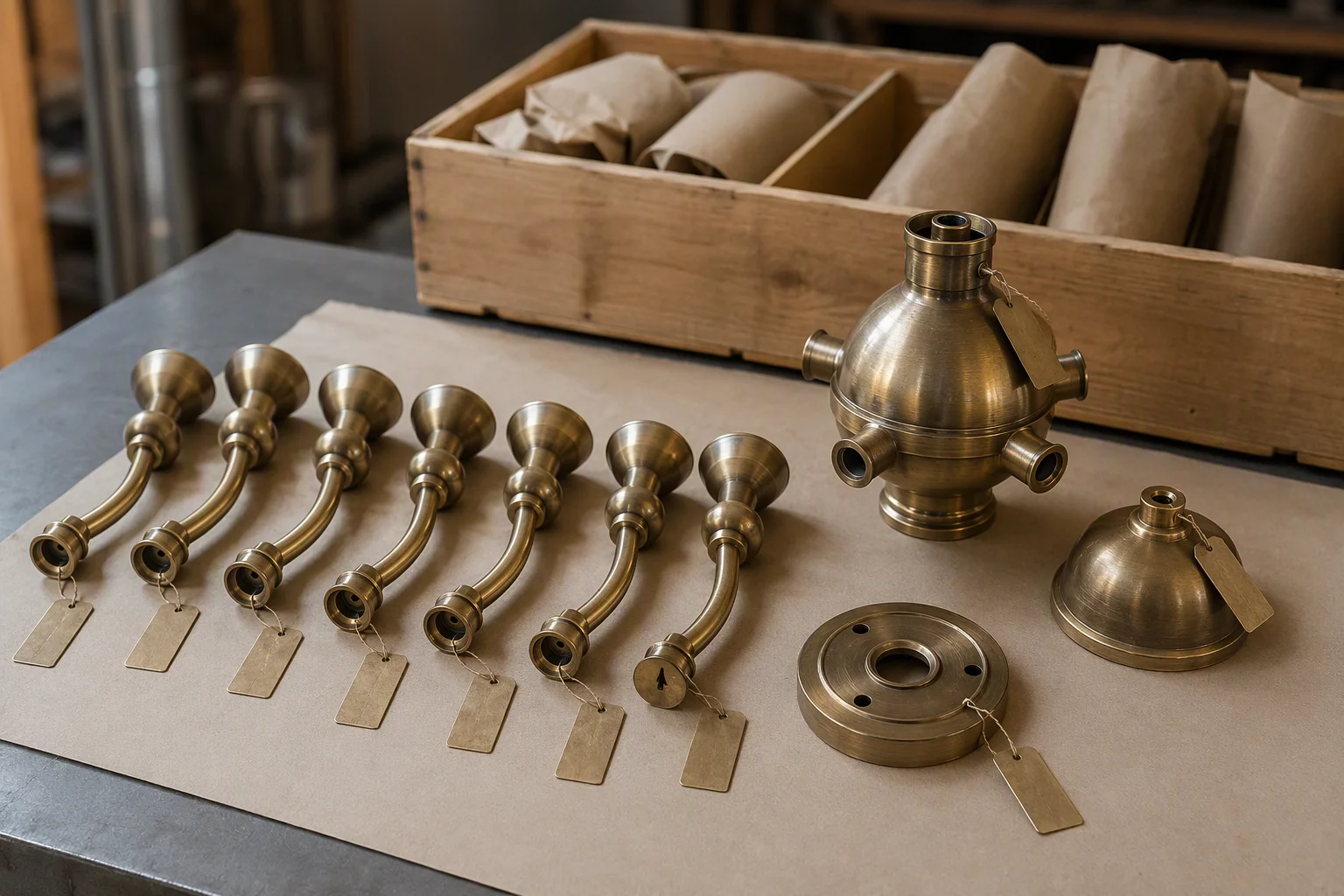 |
| Numbering and direction marks only earn their keep if both survive crating, freight and the walk to the ceiling. |
Where modular chandelier assembly numbering breaks down
Most schemes are designed at the factory bench, where the parts sit on one table and the person applying the marks designed them. They break at four points after that.
Packing. Crates are packed by size and weight, not assembly order, so the base plate often leaves in a different crate from its arms.
Unpacking. Labels sit on the face easiest to reach in the workshop, which is often the face that ends up against the crate wall.
Distribution. Crates get split by floor or by room, so one fixture's parts end up in three locations.
Handover. The crew receiving the goods rarely attended the mock-up. Meaning that lives in a conversation leaves with the person who had it.
The test is one question: could an installer who never spoke to the factory build the fixture from the marks alone? If the answer depends on a phone call, the scheme is documentation, not identification.
What a module ID has to encode
An identifier is not a serial number. It answers five questions at once, each read by a different person on site.
- Fixture tag, so two identical chandeliers in one lobby do not exchange parts: LOB-A and LOB-B, not "chandelier".
- Tier or level, because an arm for tier one fits tier three and looks wrong.
- Position within the fixture, counted in one stated direction from one stated start: clockwise from the cable entry works, left to right does not.
- Orientation reference, a separate mark dealt with below.
- Revision or batch letter, so a part made after a design change is distinguishable without measuring.
Keep the string short enough to write by hand, because replacements are when the scheme matters most. Avoid pairs that are misread in poor light or relayed wrongly by phone: O and zero, I and one.
Direction marks are the part installers actually need
Position tells an installer which arm; direction tells them which way round. On asymmetric fixtures many parts fit two ways and only one is right. A rotated arm still bolts up, still photographs acceptably from the lift, and is discovered when the room is lit and the throw runs the wrong way.
Use two independent cues: a physical one that cannot be removed, such as a stamped arrow or a notch at the reference point, plus a word that removes ambiguity, such as ROOM or WALL. Adhesive arrows rotate when the label is applied at an angle, and a word alone is unreadable behind a diffuser.
Direction marks should also reference the building. On a sloped ceiling, marking the room-facing side of the canopy and repeating it on the installation drawing stops a chandelier arriving level but rotated.
If two installers can look at the same mark and disagree about which way the arm faces, the mark has failed. The fixture is not at fault.
Crate mapping ties boxes to build order
A packing list says what left the factory; a crate map says how to build, starting from the assembly sequence: what must be on the floor first, what is needed only at the final lift, what should stay crated.
Make the manifest per fixture rather than per shipment, so a split delivery does not leave the site guessing which unit is incomplete. Designate a first-open crate with the hardware, template and installation sheet. Where weight limits split a fixture across crates, put a kit card in each naming the fixture tag, crate number and total crate count.
For repeated guest room fixtures, per-room kits repay the effort: forty identical pendants shipped in bulk are mixed within an hour of opening.
Marking methods that survive crating and handling
Choose the method from the surface it must sit on, not the cheapest option. A label that peels in transit is worse than none, because it leaves adhesive on a finished surface.
| Method | What it survives | Where it fails | Best used for |
|---|---|---|---|
| Stamped or engraved plate, mechanically fixed | Handling, stacking, most cleaning | Small parts with no flat face | Permanent IDs on structural parts |
| Laser etched into the metal | The life of the part | Dark or reflective finishes, where contrast is low | Small arms and connectors |
| Printed polyester label | Clean, flat, non-oily surfaces | Textured or oiled surfaces; edges lift first | Batch, room and crate references |
| Hang tag on wire or tie | Crating and transport | Anything the tag must stay attached to after unpacking | Hardware bags and loose components |
| Marker pen on tape | Very little | Heat, handling, any surface that gets wiped | Nothing that must be traced later |
Placement matters as much as durability. Marks belong on faces visible during assembly and covered only when the fixture is complete; crate labels on two adjacent faces.
Drawings and handover checks
A numbering scheme without a drawing is decoration. The sheet carries the same identifiers in an exploded view, sequenced in build order. One sheet per fixture type; a generic sheet covering several variants is where mistakes start.
Revision control is the part most often skipped. If the drawing is revised and the parts are not remarked, the site has two sources of truth. The letter belongs on the title block and on every affected part, with a line describing the change. After the mock-up, update to as-built and reissue.
Most failures are visible within the first hour of unpacking.
- Count components against the per-fixture manifest, crate by crate, before anything is unwrapped.
- Build one fixture flat on the floor using only the marks and the drawing.
- Read every mark at arm's length under the light actually available on site.
- Photograph marks and crate labels as found, so a missing part can be identified later.
- Agree the missing-part protocol in advance: a photograph of the mark, the fixture tag, the crate number and one named contact on each side.
A part that arrives unmarked is non-conforming, not a puzzle. Trial fitting to find where it belongs is how finishes get damaged.
FAQ
Should module IDs stay visible after installation?
No. Position and orientation marks belong on faces hidden once the fixture is closed. Keep one discreet service reference inside the canopy, so maintenance can identify the fixture without dismantling it.
Who should own the numbering scheme, the factory or the installer?
The factory proposes it, because it knows how the fixture is built and packed. The installer approves it at the mock-up, because it knows what is readable from a lift. One approved scheme is workable; two is how records stop matching.
What should happen when a component arrives unmarked?
Treat it as non-conforming and photograph it before handling it further. The fixture tag and crate number usually narrow the possibilities enough for the factory to identify the part from its packing record.
Is colour coding a substitute for numbering?
No, though it is a useful secondary cue. Colour is affected by site lighting, colour vision differences and any on-site refinishing. Alongside an identifier it speeds sorting; instead of one, it produces confident mistakes.
How does numbering change with many identical fixtures?
Add a room or zone prefix to the fixture tag and keep the manifest per fixture. Identical fixtures are where mixing is most likely and least visible, because every part fits every unit.
The takeaway
Assembly problems on site are usually identification problems, not manufacturing problems. A scheme that encodes fixture, tier, position and revision, adds a direction mark with two independent cues, and travels with a crate map built around the assembly sequence will survive crating, freight and a change of crew. Choose the marking method from the surface, keep drawing and parts on one revision letter, and check the marks in the first hour of unpacking. All of it has to be decided before the crates are sealed, because after that the scheme is whatever the labels say it is.
Zerouno Lighting (ZeroUNO) manufactures hospitality decorative lighting in Zhongshan, China, and has supplied custom fixtures for hotel projects since 2013. Custom work typically starts from a single-piece sample before a production run, with quoted lead times of 25 to 35 days depending on the specification. Learn more at zerounolighting.com.
About the author
Sonny Yu is Sales Manager at Zerouno Lighting, working with hotel owners, designers and procurement teams on decorative lighting for guest rooms and public areas. He writes about the details that decide whether a fixture reaches the ceiling on schedule.


没有评论:
发表评论