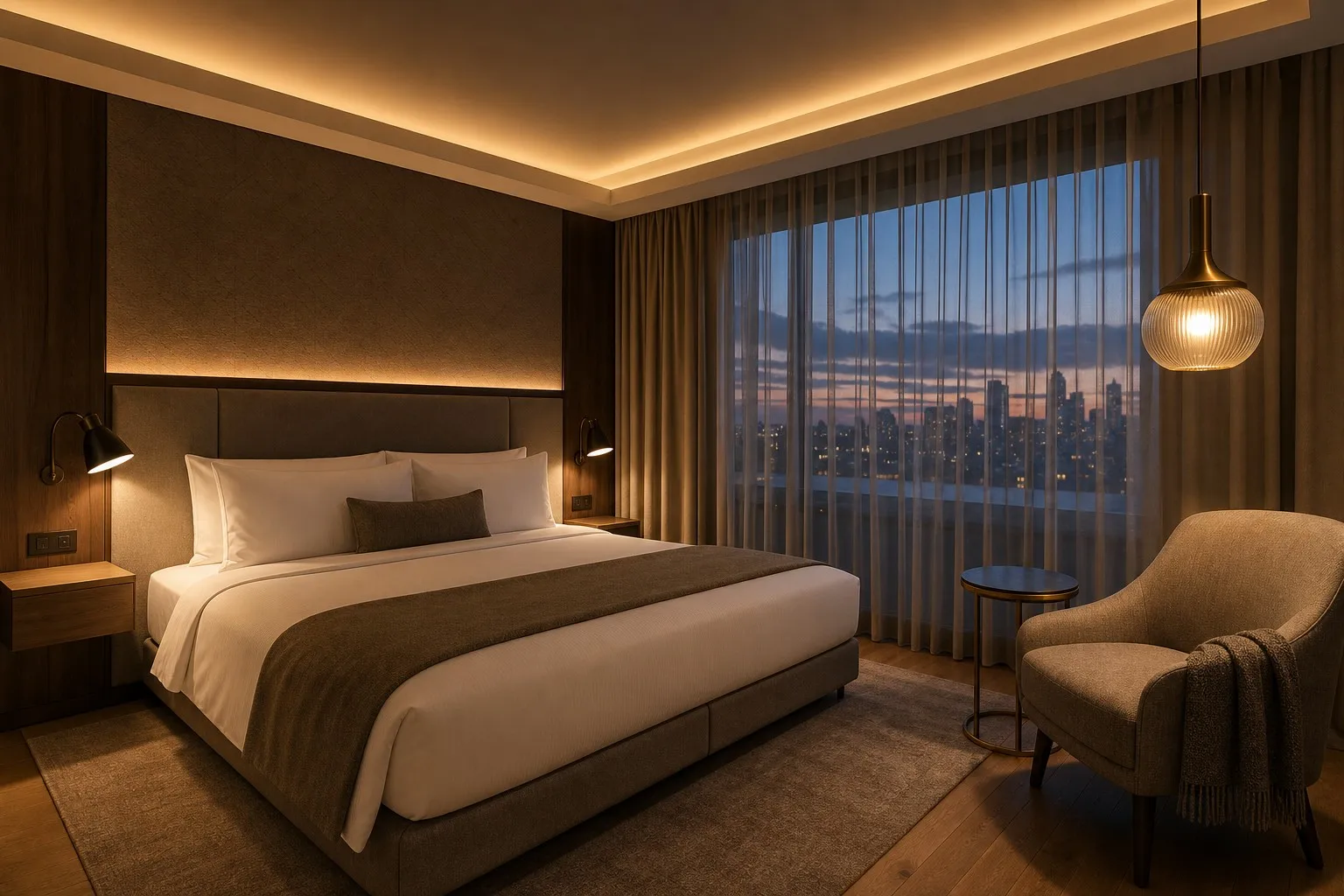
A guest room goes into refurbishment with a new headboard and a lighting plan that shows a slim wall light each side of the bed. Then the drawings come back: solid wall, no back box, a tiled bathroom on the far side, and a corridor that cannot be closed for chasing and inspection. Reopening that wall means dust control, electrical sign-off and rooms out of service for longer than the programme allows. So the conversation moves to rechargeable and plug-in wall lights.
This guide is for the hotel owner, project manager and procurement lead solving a lighting problem in a building that already exists. It covers the retrofit routes that avoid chasing the wall, what each commits the hotel to operationally, and how to sign the arrangement off before it is repeated across forty rooms.
 |
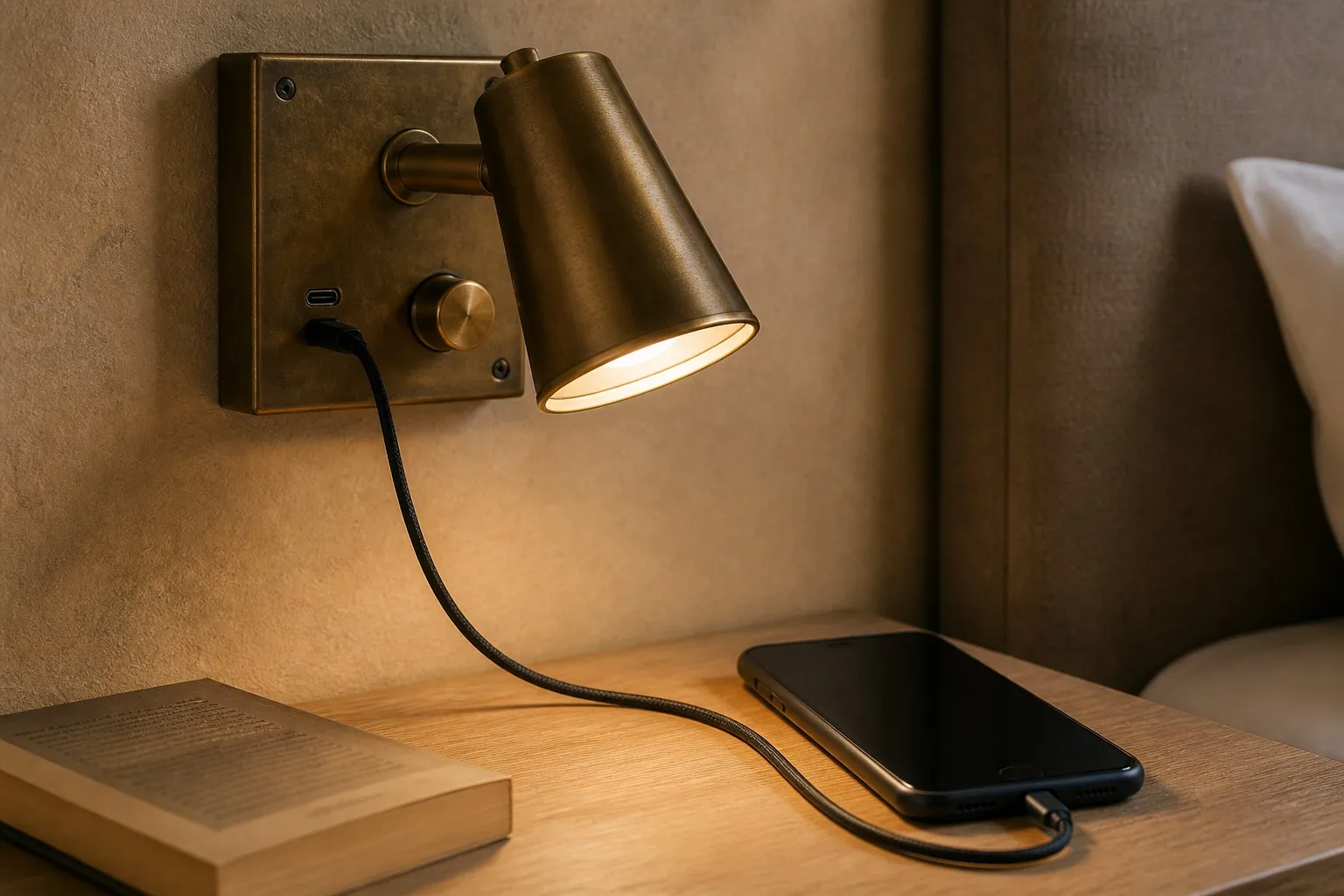
| The head lifts off the bracket to charge, which is what removes the need for a circuit at the bed position. |
Why a retrofit changes the lighting question
In a new build, the fixture is chosen first and the wiring follows the design. In a retrofit the order is reversed: the wall is fixed, the finishes are done, and the fixture has to live with conditions nobody designed it for. Three questions then move to the front of the specification.
- Power becomes an operating decision, not a technical footnote. If the light is not on the mains, someone has to charge it and keep it lit.
- The mounting detail decides whether the design is possible at all. Hollow plasterboard on steel studs, plaster over blockwork and a tiled wall are three different projects.
- The guest-handling case matters as much as the light. A fixture a guest can unhook or take away will not survive a year of operation.
The four ways to put light on an existing wall
The table compares the routes that avoid opening the wall, what each one needs from the building, and the consequence that follows. It does not replace a lighting design; it narrows the options before a designer is asked to approve one.
| Route | Power source | What it needs from the wall | Operational consequence |
|---|---|---|---|
| Rechargeable wall light with a removable head | Battery in the head, charged off the fixture | One fixing point; no cable, no back box | Charging location and spare rotation |
| Plug-in wall light | Cord to an existing socket | A socket within reach | Cord routing, socket sharing, appliance testing |
| Surface trunking to a wired fitting | Mains via surface containment | A containment run and an isolator | Visible containment accepted by the designer |
| Existing point re-aimed or repositioned | The circuit already there | Nothing new on the wall | Whether the result justifies no wall light |
| Light integrated into new joinery or a mirror | Local supply in the new unit | Joinery able to carry the fixture | Joinery lead time and maintenance access |
The power source stops being a technical footnote the moment the wall cannot be opened. It decides who charges, who cleans, how the fixture is replaced, and whether housekeeping can keep it lit at all.
What each power option commits the hotel to
The specification is only half the decision. The other half is the routine the option creates, and that routine stays with housekeeping for the life of the room.
Battery fixtures with a removable head
These work when the routine is designed. Someone has to own the charging, and there has to be a charged spare so a room is not dark while a unit sits on the dock. Capacity also falls over the years, so the fixture is a service part as well as a fitting, and the replacement reference belongs in the handover pack.
Plug-in fixtures
A plug-in wall light is the simplest route where a socket already exists, and the least predictable in operation. The cord has to run somewhere, and a cord across a walk path or pinched behind a headboard is both a safety and a wear item. Sockets near beds are also the ones guests unplug to charge a phone, so the light is off when it is expected to work.
Wired fittings on surface containment
This option behaves most like a normal installation: no charging, no cords, no battery replacement. It is also the only one that leaves a permanent mark on the interior, so it needs the designer's agreement. Containment finish matters as much as fixture finish, because the two are seen together at close range.
Mounting and the wall you already have
Weight, substrate and hidden services decide whether a chosen fixture can actually be fitted, and they are checked in the room rather than on the plan.
- Identify the substrate before ordering fixings. Plasterboard on studs, plaster over blockwork and solid brick need different fixings.
- Assume services are in the wall until proved otherwise. Old conduit, water and drainage rarely appear reliably on refurbishment drawings, so confirm fixing positions with a detector before anyone drills.
- Check the lever arm, not only the weight. A fixture that projects from the wall loads its fixing differently from one that sits flush.
- Respect the compartment and the finish. Any penetration into a fire-rated or tiled surface belongs to the project team, not to an installer's judgement on the day.
- Confirm the switching reach. A light a guest cannot reach from the bed will be left off, and the retrofit will have spent its budget on a fixture nobody uses.
Where retrofit wall lights go wrong
- A cheap rechargeable unit is bought as a stop-gap for two rooms, then kept in service for years.
- No charging point is designed, so units get charged at a desk, behind a curtain or in a back office nobody controls.
- Battery fixtures are specified without a spare rotation, so a room stays dark for as long as a charge takes.
- A cord is routed across a walk path or pinched behind a headboard, and fails the first housekeeping inspection.
- No mock-up room is used, so the first forty rooms become the test.
A sign-off checklist for the first rooms
Run this in one completed room before the rollout, at night, with the person who will maintain the fixture.
- Inspect the finished room at night, not from a drawing or a sample board.
- Sit on the bed and confirm a guest can switch the light without getting up.
- Time the charging routine with housekeeping, including the swap of a spare unit.
- Walk the cord or containment route as a guest would, and check that nothing crosses a walk path.
- Check the fixing on the real substrate, including a pull test on the bracket.
- Record the spare part reference before the order is repeated.
FAQ
Does a rechargeable wall light need a mains connection at all?
No. A fixture with a self-contained battery and a removable head needs only a fixing point on the wall, which is what makes it usable where a circuit cannot be added. It still needs a charging location and a spare unit, agreed before the order.
How long does the battery last?
Runtime and service life depend on the fixture and on how the room is operated, so work from the figure stated for the specific model being quoted. Treat the battery as a service part with a replacement path rather than a permanent component.
Can a property mix plug-in and rechargeable lights in the same corridor?
Yes, and it often does, because rooms differ. Mixing types is fine while the finish and appearance stay consistent. What causes trouble is mixing them without telling the team which room has which.
Will a retrofit wall light look like a compromise?
Only when the power route is visible and unplanned. A removable head on a well-made bracket, or containment in a matching finish, reads as a deliberate detail. A cord taped along a skirting board never does.
The takeaway
In a retrofit the wall decides more than the fixture does. Where no circuit can be added, choose the power route first and the light second. Plan the charging location and the spare rotation with the fixture order, and confirm the substrate, fixing and cord route in a real room rather than on a drawing. Done in that order, a retrofit wall light is the version of the design the building could actually take.
Zerouno Lighting (ZeroUNO) manufactures hospitality decorative lighting in Zhongshan, China, and has produced project and custom fixtures since 2013, with a single-piece sampling stage so a retrofit fixture can be assessed in the room before a production run is released. Learn more at zerounolighting.com.
About the author
Sonny Yu is Sales Manager at Zerouno Lighting, working with hotel owners, designers and procurement teams on decorative lighting packages. He writes about the decisions that only surface once a building exists: power routes that cannot be chased, mounting conditions that are not on the drawing, and the housekeeping routines that decide whether a specification survives its first year.