On most hotel lighting packages, stock versus custom is settled line by line rather than once for the building. The bedside pendant, the corridor sconce, the desk lamp, the bathroom mirror light: each is a separate decision, and the person who has to defend it later is usually the procurement lead, not the designer who drew it.
This guide is for that person, and for the owners and designers beside them. It covers where a catalogue fixture wins, what the buyer gives up by choosing one, the hybrid route most projects miss, and the questions that settle the line.
Two boundaries first. Whether a fixture suits a specific room, and whether it meets the compliance regime that applies there, is carried on its own submittal. Final light levels belong to the project lighting designer, working to the standards that apply where the building stands.
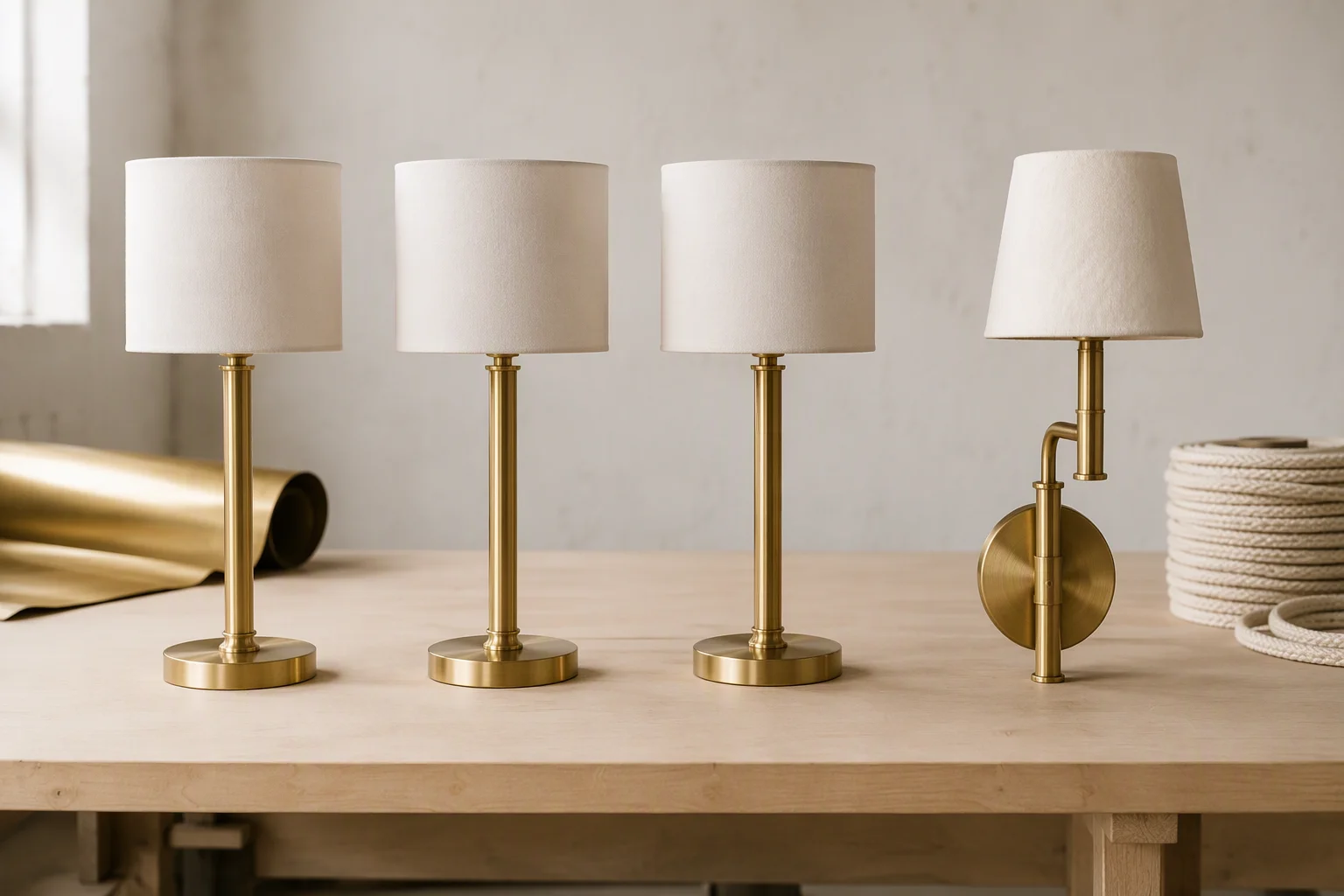 |
| Three identical catalogue lamps, one bespoke sconce: the whole argument is which column a line belongs in. |
Why the whole schedule should not be written as custom
A guest room schedule is rarely short. Across room types, public areas and back of house, a mid-size property can carry several dozen line items, most of them ordinary: a sconce that lines up with a joinery detail, a table lamp with a fabric shade, a pendant over a bedside table. Writing every one as custom adds three problems that have nothing to do with design quality: each line waits for its own drawing, sample and production slot; a hand-built line is harder to repeat later; and its parts exist only for this order.
The workable split is to reserve custom for the lines where the drawing cannot be met any other way, and to let a catalogue fixture carry the rest. Not "catalogue where it is cheaper", but "catalogue where nothing in the brief requires a new drawing".
Where a catalogue fixture genuinely wins
Read the schedule against the table below, criterion by criterion. Neither column is better; they fail differently, and in different places.
| What the project is buying | Catalogue fixture | Custom fixture |
|---|---|---|
| Fit to the drawing | Closest of the maker's sizes | Drawn to the schedule dimension |
| Time to first unit | Against stock, in days | After drawings, a sample round and a production slot |
| Change after award | Limited to finish and configuration | Possible while the project is still open |
| Finish control | The maker's regime, repeated reliably | Matched to a project sample |
| Repeat phases | Depends on the item staying in the range | Reproducible from the drawing and finish |
| Spares in year three | Standard parts, tied to the catalogue | Made for this order; ask about a spares run |
| Signature pieces | Rarely convincing as a lobby one-off | The reason the line exists |
Two rows carry most of the weight. Finish control lets a catalogue item sit beside a bespoke one without looking like a different job; repeatability decides whether phase two can be ordered without a conversation.
What choosing catalogue asks you to give up
A catalogue fixture is built to the maker's dimensions, and what the project usually loses is the interface, not the look.
- Dimensions that round. A stem, arm or projection that lands near the drawing rather than on it, which shows where a fixture meets joinery, mirror or headboard.
- A fixed interface. Switch position, port type, cable exit and mounting plate are decided by the maker.
- Shade and diffuser families. Proportions and material follow the range, so a room needing a softer or flatter glow may need a different line.
- Availability over time. A catalogue item can leave the range, leaving a later phase without an identical replacement.
- Presence in public areas. The lines a guest looks at closely are rarely the lines a range serves best.
None is fatal, and all are cheaper to accept at specification stage than to find on site. If a line meets joinery, or a guest touches it every night, move it to the custom column rather than hoping the rounding stays invisible.
The hybrid route most projects miss
The choice is not binary. A catalogue body with a project finish, a standard lamp with bespoke shade proportions, a catalogue sconce on a project backplate: each lets a line keep the maker's tooling while the project controls what is seen.
Hybrid works only when specified as such. Four things belong in writing before the order.
- Which parts of the bill of materials the maker will move, and which stay fixed.
- How the finished interface is drawn and approved, so the installed fixture matches the submittal.
- Which finish reference the project holds, so a later phase can be matched.
- How voltage, plug configuration and any control requirement are confirmed for that line.
A modification is neither a bespoke fixture with the protection of a catalogue version, nor a catalogue item with the flexibility of a bespoke one. Ask which side of that line the modified item sits on.
Five questions that settle each line
Five questions per line take less time than one change order later.
- Would a rounded dimension be visible? If a fixture meets joinery, a mirror edge or a headboard, the drawing usually wins.
- Does the line carry an interface the building must match? Switch, port, cable exit and mounting height are interface decisions, not aesthetic ones.
- How many phases are planned, and how far apart? A line that must reappear in eighteen months argues for a route that repeats.
- What happens if one unit is damaged in year three? Ask about spares before the order, not after the incident.
- Is this a line the guest looks at, or one they merely use? Design attention belongs where the eye goes.
If a line fails only the phase and spares questions, a reserve of units may beat a custom run. If it fails the first two, custom is usually the honest answer.
Where custom is genuinely unavoidable
- Rooms with non-standard proportions: an oversized headboard, a vanity beneath a specific mirror, a suite with a change of level.
- Fixtures that must integrate charging or controls at a set height or position relative to the bed.
- Feature pieces sized to one ceiling, where the point is that nothing else looks like them, and finishes that must match a joinery or stone sample across the property.
- A repeat phase where the original line has left the catalogue and the drawing is the only reference.
Mixing both routes in one property
Most packages end up mixed, and the risk is not the mix. It is that two sources of finish and two sources of spares get managed as though they were one.
The mixed package fails quietly, at the finish, long after the schedule stopped being anyone's problem.
Five habits keep it coherent.
- Hold one approved finish reference for the property and freeze shades and diffusers early, since they read as a family.
- Take spares from the same production batch as the installed units.
- Record in the O&M file which lines were catalogue, which were bespoke, and who made each.
- Agree in advance how a mid-project substitution is reviewed, so a swapped part is a decision, not a discovery.
FAQ
Can a catalogue fixture be modified to fit our drawing?
Often, within limits. Finish and a limited dimension change are commonly moved; the housing, mounting interface and control gear usually stay. Ask before the order, since an undrawn modification is not protected.
Do we still need a mock-up room if we choose catalogue fixtures?
Yes, though the scope changes. A mock-up proves the interface rather than the piece: mounting height, switch reach, glare from the bed, and whether the item sits beside the bespoke lines in the room.
Will the same catalogue item be available for a later phase?
Not guaranteed. Ranges are revised, and today's line may not be identical in eighteen months. For a line that must reappear, ask its expected shelf life or hold a reserve.
Is custom always the more expensive route?
Not always. The comparison depends on quantity, tooling and finishing more than on the label. Price both routes against the same scope, not on a verbal comparison.
Who should make the call, the designer or procurement?
Both, on different grounds. The designer owns design intent and the interface; procurement owns phase planning, availability and spares. A line only one has signed off will be reopened later.
The takeaway
Catalogue and custom are not competing philosophies; they are two routes with different failure modes. A catalogue fixture buys speed and repeatable finish, and asks the project to accept the maker's dimensions and interface. A custom line buys fit and design control, and asks the project to carry drawings, samples and spares. Decide it line by line, keep custom where a rounded dimension or a fixed interface would be visible, and hold one finish reference across both routes. What keeps a package coherent is somebody writing down which line took which route, and why.
Zerouno Lighting (ZeroUNO) manufactures hospitality decorative lighting in Zhongshan, China. Founded in 2013, the company builds made-to-order wall, table and floor fixtures to project drawings, from a single-piece sample for approval through to production, and works with project teams on the lines a catalogue item cannot serve. Learn more at zerounolighting.com.
About the author
Sonny Yu is Sales Manager at Zerouno Lighting, working with hotel owners, designers and procurement teams on bespoke decorative lighting packages. He writes about specification decisions from the supplier side: which lines genuinely need to be made for a building, and how a package stays coherent when it draws on more than one source.