A guest checks in, unpacks, walks into the bathroom and looks at the mirror. The lighting there tells them something the rest of the room did not: lines under the eyes sharpen, the mouth reads flatter, and a complexion that looked fine in the bedroom turns grey. Nothing has changed except the direction the light arrives from.
This guide is for the designer, project manager and procurement lead specifying vanity lighting for hotel bathrooms. It covers why the mirror is the hardest surface in the room to light, the geometry that decides whether a face reads well, how the fixture's tone relates to the rest of the guest room, and how to sign it off in a mock-up room before the order is released.
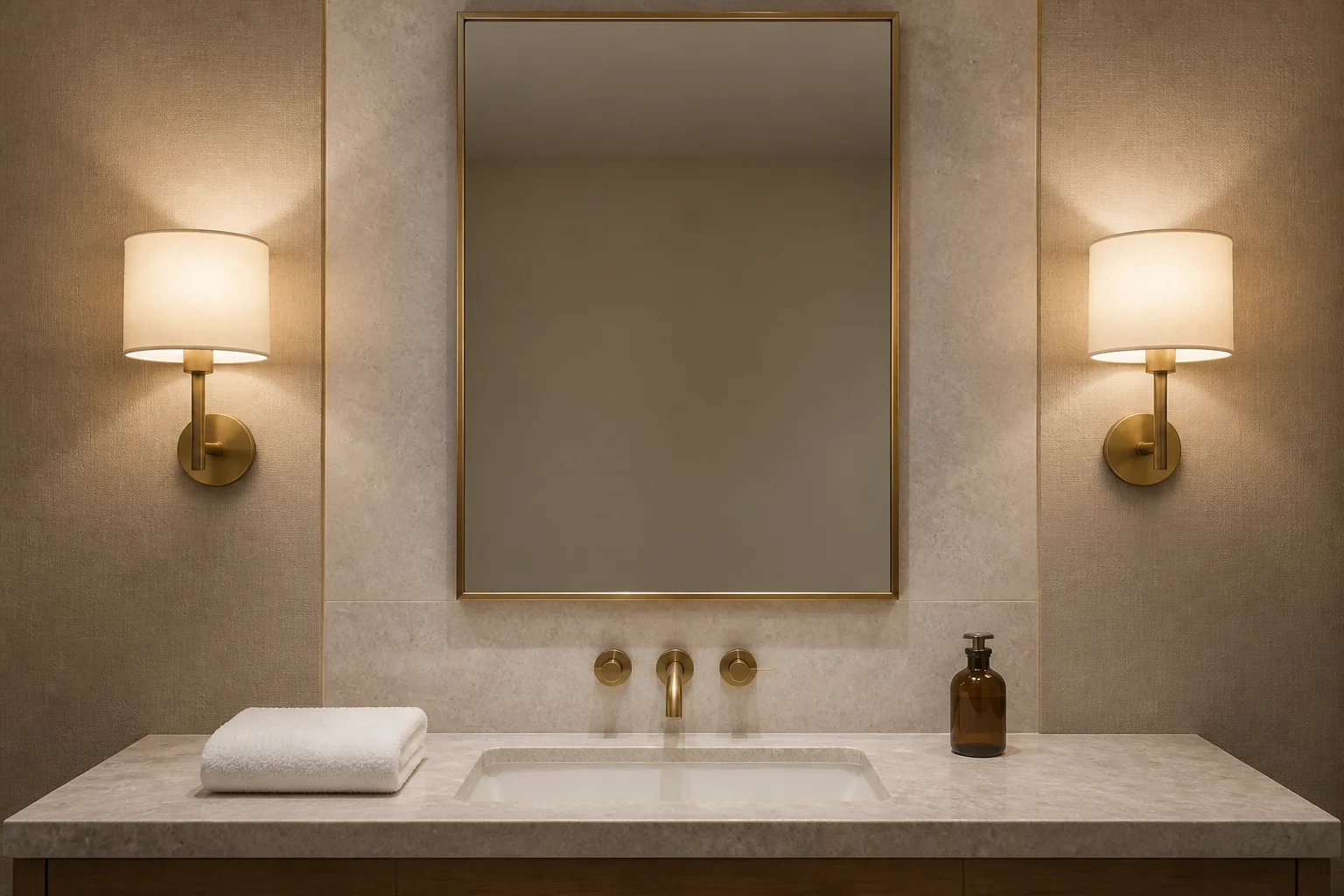 |
| Two matched fixtures at face height flank the mirror: the arrangement that fills shadows instead of creating them. |
Why the mirror is the hardest lighting task in the room
Every other lighting decision in a guest room is about an object. The vanity mirror is the only place where the guest looks at a surface that reflects, and then at the thing being lit. A fixture that lights the counter beautifully can still be the reason a guest looks tired in the photograph they take before dinner.
Three properties of a bathroom make the task harder than it looks on plan. The room is small, so a fixture close to the mirror dominates the light the guest receives. The surfaces are reflective, so a bright counter or polished tap bounces light upward and reads as glare. And the guest stands close to the glass, which turns small errors in light direction into large ones on the face.
The geometry rule: light the face, not the counter
The decision that governs everything else is where the fixtures sit relative to the guest's face. Light arriving from directly above travels down the cheekbones, into the eye sockets and under the nose, producing the shadow pattern guests associate with bad hotel bathrooms. It also drops the guest's own hands into shadow while they are shaving or applying something.
Light arriving from the sides, at roughly face height, reaches the cheeks and jaw at a shallow angle and fills shadows instead of creating them. This is why two modest fixtures flanking the mirror consistently outperform one larger fixture above it, even when the larger fixture delivers more light into the room.
Judge a vanity layout by what it does to a face at standing distance, not by how bright the counter looks in a photograph. The counter is easy to light; the face is the part guests remember.
Fixture positions and what each one actually does
The table compares the arrangements that appear most often in hotel bathrooms. Tone and output still have to be confirmed against the project's lighting design, which is why it describes behaviour rather than fixed values.
| Arrangement | Where the light lands | Effect on the face | What to watch |
|---|---|---|---|
| Single fixture above the mirror | Forehead and counter | Shadows in the eye sockets and under the nose; hands in shadow | The most common layout, and the one guests notice first |
| Two fixtures flanking the mirror | Both sides of the face | Even, flattering, little distortion of features | Needs wall space either side of the glass |
| Vertical fixture on one side only | Half the face | Strong side shadow; the unlit side reads flat | Workable only where the mirror is small |
| Mirror-integrated light | The face, from the glass plane | Direct and even, sometimes clinical | Light reflected off the counter can double up and glare |
| Ceiling fixture near the mirror | Floor and counter edge | Poor on the face; usually needs a second source | Tempting where the wall has no structure behind it |
Two fixtures flanking the mirror are the default for a reason, but they only work if both are lit and matched. A pair where one fixture reads warmer, dimmer or slightly different in finish is the mistake guests notice most often, and it is a specification problem rather than an installation one.
Colour tone: matching the face to the rest of the room
A guest moves between bedroom, wardrobe area and bathroom within a minute. A face that reads warm in one space and grey in the next is a complaint waiting to be written, and it almost always comes from the vanity light being specified in isolation rather than as part of the room's light family.
The practical rule is to hold one tone family across bedroom and bathroom and avoid a sharp step between them. Where the bathroom is specified cooler for the mirror's sake, that should be a deliberate decision signed off in the mock-up room rather than inherited from a stock specification. The final value belongs to the project's lighting designer, who can weigh it against the local standard and the finish palette.
Damp zones, cleaning and what they change
A vanity fixture lives in one of the least forgiving positions in a hotel: close to water, wiped daily by housekeeping, and warm for most of the night. Three consequences follow for anyone specifying it.
- Suitability for the location comes before style. A fixture intended for a wet or damp zone is built for that environment; one intended for a dry corridor is not. The zone decision is the project's to make against local requirements, and is best settled before finishes are fixed.
- Smooth finishes clean better than textured ones. Where a fixture sits within reach of a basin, a wipeable surface and a shade material that tolerates regular handling age better than open weaves and unsealed timber.
- Everything must be reachable. A lamp housekeeping cannot switch on, reach for or replace without a step ladder will be left off, and an unlit vanity fixture is worse than a smaller one.
A vanity lighting checklist for the mock-up room
The mock-up room is the cheapest place to find out that a layout does not work, and the only place where fixture, mirror, finish and a person appear together. Before sign-off, confirm each of the following.
- Stand at the mirror and look at the light on your own face, not at the fixture.
- Switch off every other light in the bathroom and repeat the check.
- Compare the bathroom tone against the bedroom's from the doorway, at night.
- Check that both fixtures are lit, matched and read identically at arm's length.
- Look for glare in the mirror, on the tap and on a polished counter at standing height.
- Reach for the switch and the shade the way housekeeping will, in shoes.
- Photograph a face at standing distance and review the image away from the room.
Where vanity lighting fails in renovation projects
- New fixtures are specified from a catalogue without checking what sits behind the existing wall.
- The mirror is replaced but the old lighting position is kept because the electrics were already agreed.
- A second, warmer fixture is added later, so the pair no longer matches and the mismatch becomes permanent.
- The spares allowance is set by fixture count rather than by the parts that wear: shades, diffusers, connections.
- The mock-up is treated as a visual sample rather than a working room, so nobody stands at the mirror.
FAQ
Are two small fixtures really better than one large one?
For lighting a face, yes. Two sources at the sides fill the shadows a single source above creates. The exception is a very narrow vanity with no wall space either side, where an integrated mirror light is the better compromise.
Should the vanity light match the bedroom lighting exactly?
The tone family should match; the fixture itself need not. Guests notice a step in tone between two rooms they walk between, not whether the two fittings share a design.
Which finish is easiest to live with?
A smooth, sealed finish that wipes clean without special products, in a tone that hides water marks better than mirror polish. That is usually settled by design intent and the housekeeping regime.
Can vanity lighting be added to an existing bathroom?
Sometimes. The limiting factor is what can be mounted and wired behind the mirror without disturbing the finish, so the position is best agreed before the tiling stage.
What should be checked before the order is released?
Fixture positions against the actual mirror size and standing height, the tone against the bedroom, damp-zone suitability, the spares that will be needed, and confirmation that both fixtures of each pair are identical in finish and output.
The takeaway
Vanity lighting fails for geometric reasons far more often than for output. Light the face from the sides, hold one tone family across bedroom and bathroom, choose a fixture suited to a damp and regularly cleaned position, and confirm it in a mock-up room with a person at the mirror. Two modest, well-matched fixtures will outperform a larger single source in exactly the place guests judge the room: their own reflection.
Zerouno Lighting (ZeroUNO) manufactures hospitality decorative lighting in Zhongshan, China, and has produced project and custom fixtures since 2013, with a single-piece sampling stage so a vanity fixture can be assessed on site before a production run is released. Learn more at zerounolighting.com.
About the author
Sonny Yu is Sales Manager at Zerouno Lighting, working with hotel owners, designers and procurement teams on decorative lighting packages. He writes about specification decisions that only become visible when a person stands in the finished room, and about how bathroom, corridor and guest room lighting are checked before production starts.