Somewhere in the lighting specification there is a number that looks like a promise: L70 at 50,000 hours, or 50,000 rated hours. It gets copied into the schedule because it is the only lifetime evidence on the page, then into the maintenance manual as though it were a warranty. Neither use is what the number was made for.
This guide is for the people who have to decide whether that line is usable: the owner's representative reviewing a submittal, the designer writing the specification, and the procurement team comparing two suppliers quoting the same figure. It covers what the number measures, where the extrapolation stops being evidence, what quietly invalidates it, and what to ask for instead of a bigger number.
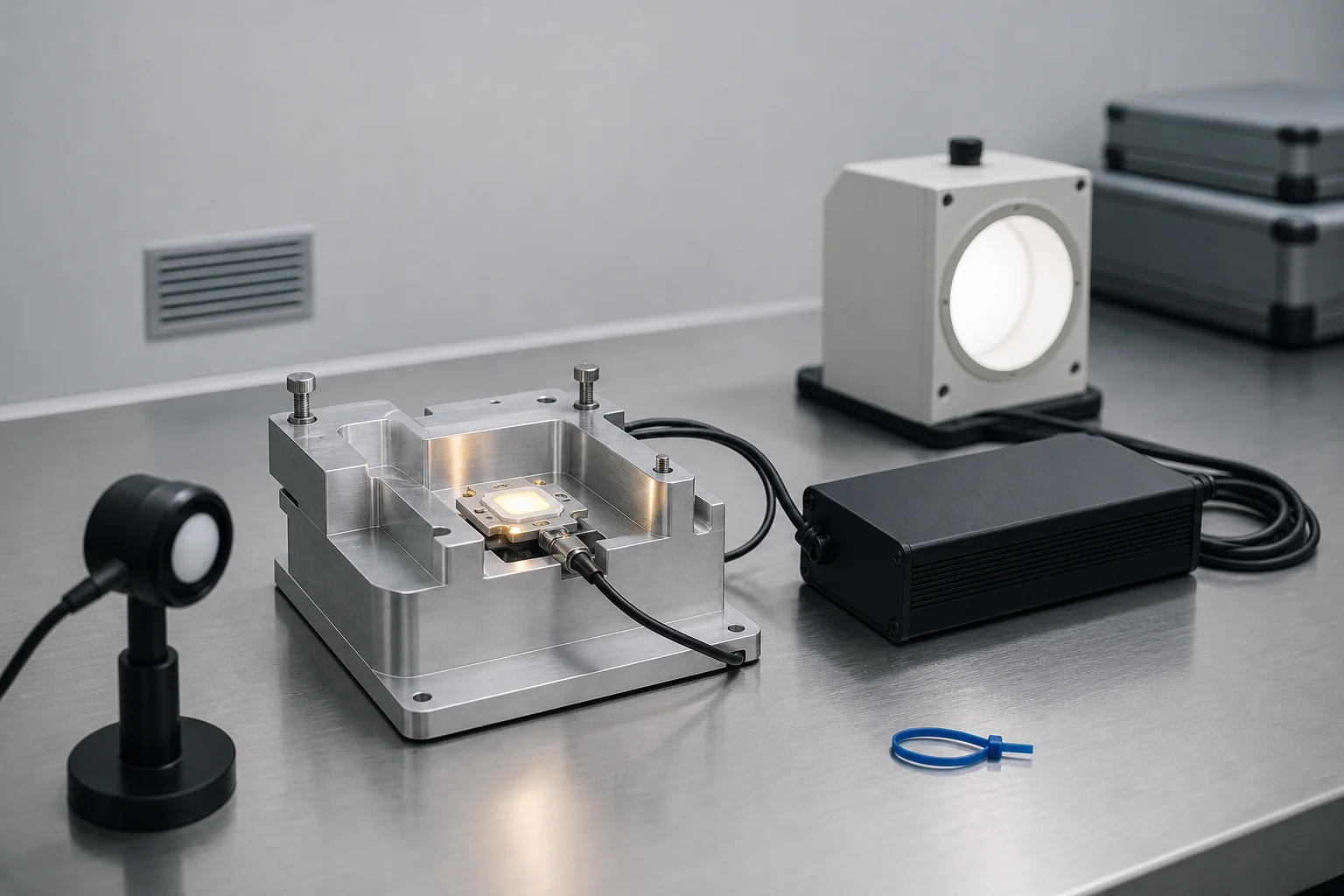 |
| Rated hours come from a short laboratory test of the light source, not from watching a finished fitting for years. |
A rated-hours figure is a projection, not a measurement
No manufacturer has watched a fitting for fifty thousand hours before selling it. A rated-hours figure comes from a short laboratory test of the light source, run at controlled drive currents and case temperatures, then projected mathematically out to the number on the datasheet. The test is real. The projection is an inference drawn from it.
Two consequences follow. The figure belongs to the light source and its test conditions, not to the finished fitting it is installed in. And the useful question is never what the number is, but what was measured, under what conditions, and how far past the measurement the projection ran.
L, B and C are three different things wearing one label
A lifetime claim is usually written as a compact code, and each element answers a different question.
L is lumen maintenance: the point at which light output has fallen to a stated percentage of its initial value, so L70 means seventy per cent, L80 eighty, L90 ninety. It describes fading, not failure. A fitting at L70 still lights the room; it simply emits less than it did.
B is abrupt failure, the percentage of a sample that has stopped working at that same point. C is catastrophic failure, where the loss is not a fade but a component giving out. An L figure alone says nothing about either, which is why a claim without a B or C figure is only half a statement.
How to read a claim line
Work down this table when a submittal arrives. The right-hand column is the part that turns a copied number into a checkable one.
| Element of the claim | What it states | What it does not state | Ask for |
|---|---|---|---|
| Rated hours, for example 50,000 h | A time point from a laboratory projection | Which conditions produced it, and whether your fitting matches | The test report behind the number |
| L70, L80 or L90 | The share of initial light output remaining | Whether any units also failed | The B and C figures from that projection |
| Test drive current | The current the sample was run at | The current your driver supplies | Measured current against your driver rating |
| Case temperature | The temperature the sample was held at | The temperature inside your enclosure | In-situ measurement, or a thermal test |
| Sample size | How many units were tested | Whether the spread was uniform | The spread, not only the average |
| Projection ratio | How far past the measured data the figure extends | How much is measured and how much inferred | The measured duration and the multiplier applied |
Where the projection stops being evidence
The projection method does not run indefinitely. Extrapolating from a few thousand measured hours out to tens of thousands multiplies the trend and the uncertainty together, so the method caps the projection at a stated multiple of the duration actually measured, and requires the test to have run long enough to be worth extrapolating at all. This is where two suppliers' identical numbers can mean different things, because a figure built on a shorter test with a larger multiplier is a weaker statement than the same digits built on a longer one. Ask for the measured duration and the multiplier separately; that pair tells you how much of the number is observation and how much is arithmetic.
Three mismatches that quietly void a claim
A claim travels with the conditions it was produced under. Move the fitting away from those conditions and the number no longer describes it.
- Drive current. A source tested at a gentle current and then driven harder in the finished fixture runs hotter and fades faster. The claim belongs to the tested current.
- Case temperature. This is the mismatch that hides best, because the sample is often held cool in a controlled jig while the installed fitting sits in a sealed decorative enclosure with no airflow. The same source run hotter will not follow the same curve.
- Optics, driver and assembly. Changing the driver, the diffuser material or the thermal path changes how hard the source works. The claim belongs to the tested assembly, not the family name.
None of this implies bad faith. A laboratory result reused on a product that is not the laboratory sample simply stops describing it.
Rated hours are not a warranty
The two terms sit next to each other in a submittal and mean different things. Rated hours are a technical projection about light output across a population; a warranty is a commercial undertaking about a specific unit failing within a stated period, and it carries an owner, a remedy and a route to claim.
Fading is not failure, so a fitting can sit inside its warranty while its light output has fallen well past the projected level. It can equally fail in year one, long before any rated figure, and still be a warranty matter rather than a broken projection. Read the exclusions before leaning on the figure.
A rated-hours figure answers one narrow question: how fast does this source fade under one set of laboratory conditions. It does not answer how long the fitting will work in your building, and it was never designed to.
What to write into the specification instead
The productive move is to specify the evidence rather than the number. Requiring a larger figure just gets you a larger figure; requiring a documented one gets you a submittal you can check.
- Require the light-source test data and the projection that follows from it, not a bare figure on a datasheet.
- Require the test to name its drive current and case temperature, and the fitting's own operating conditions to be declared beside them.
- Require the measured duration and the projection multiplier, so the ratio of observation to inference is visible.
- Require the housing and thermal design to stay fixed after sample approval, or require re-testing if it changes.
- Require the maintenance consequence to be stated, since the practical output of a projection is a replacement plan, not a guarantee.
Where a project depends on long service life, the honest answer is usually a maintenance and spares plan: know the fade rate you accepted, know where the drivers are, and hold stock of the parts that will actually need changing.
FAQ
Does L70 mean the fitting stops working?
No. It marks the point where light output has fallen to 70 per cent of the initial value. The fitting still operates; it simply produces less light.
Is a 50,000-hour rating the same as a warranty?
No. A rating is a technical projection about light output across a population. A warranty is a commercial undertaking about failure of a specific unit within a stated period. They are separate documents making separate promises.
Can I compare two suppliers' rated hours directly?
Only if the test conditions match. The same figure can rest on different drive currents, case temperatures and measured durations. Compare the test report, not the last line of the datasheet.
The fitting uses a different driver from the one tested. Does the claim still hold?
Not automatically. A driver change alters the current the source sees and the heat it produces, so the projection no longer describes the delivered fitting. Ask for the conditions to be re-declared, or the assembly re-tested.
What do B and C add to an L figure?
They describe failure rather than fading. B is the percentage of the sample that has stopped working at the same time point, and C describes catastrophic component loss. An L figure alone cannot say how many units failed.
The takeaway
Treat a rated-hours figure as a bounded projection and read it as evidence rather than a promise. Take the code apart, because L describes fading while B and C describe failure, and the three are not interchangeable. Ask for the measured duration, the drive current, the case temperature and the projection multiplier, then set those against how the fitting will actually run. Write the required evidence into the specification instead of demanding a bigger number, and keep the rated figure and the warranty in separate compartments, since only one arrives with a remedy.
Zerouno Lighting (ZeroUNO) manufactures hospitality decorative lighting in Zhongshan, China, including bespoke brass, glass, fabric and stone-bodied fixtures. Orders begin with a single-piece approval sample, and products carry a two-year warranty with a 48-hour response. Learn more at zerounolighting.com.
About the author
Sonny Yu is Sales Manager at Zerouno Lighting in Zhongshan, working with hotel owners, designers and procurement teams on bespoke decorative lighting from first drawing to final handover. He writes about the paperwork behind a lighting order, where the difference between a checkable claim and a copied number decides how a submittal is read.



没有评论:
发表评论