显示标签为“Selection & Procurement”的博文。显示所有博文

2026年10月14日星期三

Hotel Lighting Manufacturer vs Wholesaler: What Changes

Most hotel lighting packages are bought through a commercial chain rather than from the entity that builds the goods. The name on the quotation may be the factory that cuts and wires the metal, or a trading house that places the order elsewhere. Both arrangements are legitimate. What differs is where control sits, and that shows up in four places: the drawing, the approval sample, the change raised after the order, and the spare part the hotel re-orders years later.

This guide is for the people who settle those differences before the purchase order goes out: the designer issuing the specification, the procurement team comparing two quotations for the same fitting, and the owner's representative who signs the handover. It sets out what changes across the chain, and the questions worth asking while the answer can still change the order.
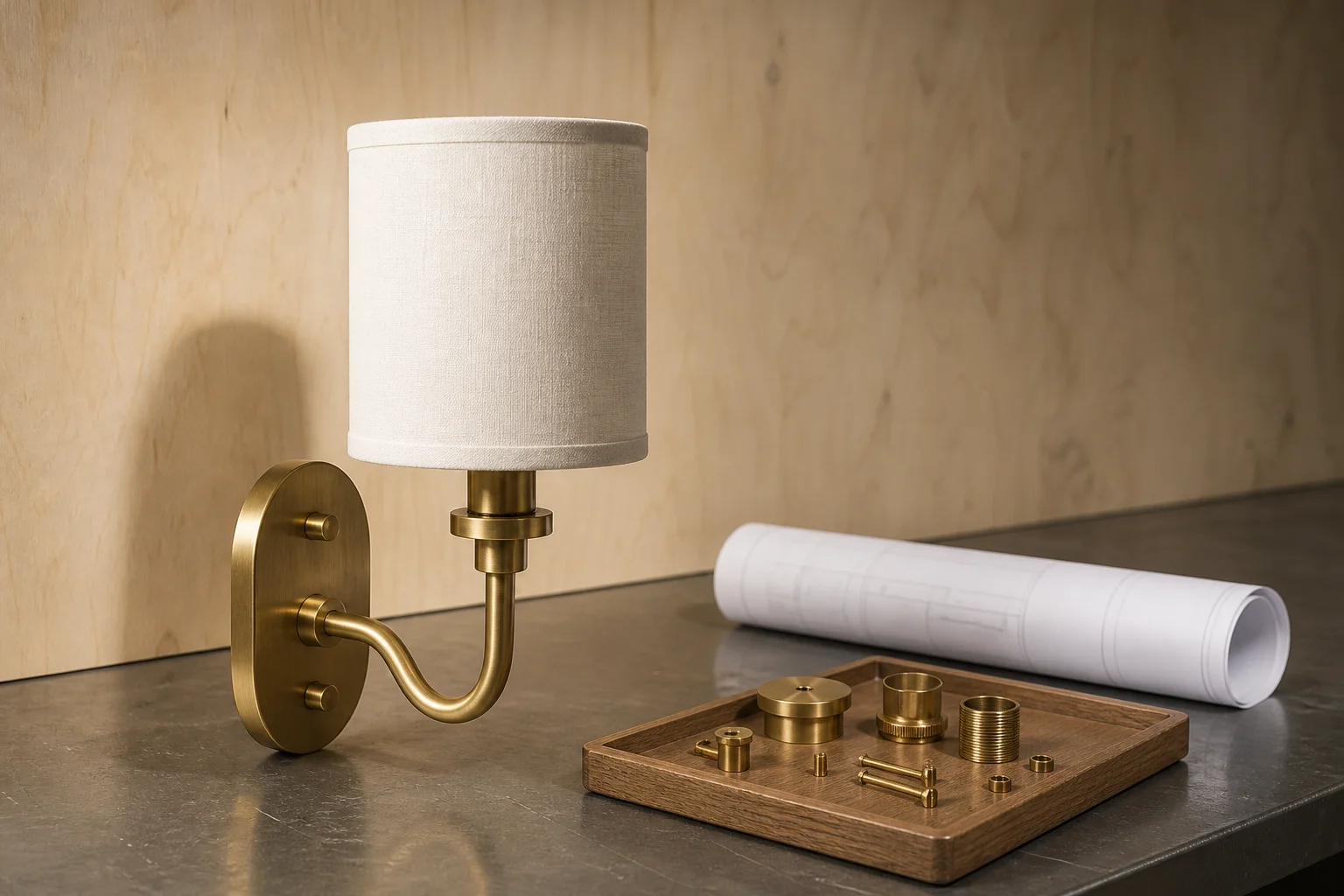
Brass hotel wall sconce in mid-assembly on a lighting workshop bench with a rolled drawing
The commercial chain decides how many hands a fixture passes through between the approved sample and the spare part the hotel re-orders.

Two businesses can sit behind one quotation

A maker owns the fixture engineering. The shop drawing, the holder type, the driver pocket, the backplate hole positions and the finish process sit inside one organisation that also runs the line. A reseller sells the same delivered object but does not hold that engineering; it holds a relationship with whoever does.

The distinction matters less at purchase than when something has to change. Specifications move, and where a question the drawing did not answer lands decides how long the answer takes. It also decides who is accountable.

Who owns the drawing

The shop drawing is the interface between design intent and metal. It fixes the mounting centre, the cable exit, dimmer compatibility and the tolerance on a custom dimension. Ask who will hold it and who will sign it.

With a maker, a revision is judged against tooling that already exists, and the answer reflects what the workshop can physically do. With a reseller, the revision is forwarded, and the answer depends on the queue at the other end. Neither route is wrong, but their response times diverge in the last three weeks before delivery, which is exactly when specifications move.

Two lines belong in the order: name the entity that holds the shop drawing, and state the route a technical query takes with the turnaround expected on it. That second line is what keeps a four-day question from becoming a week.

Who carries the approval sample

The approval sample is where the project is really decided, because it is what the design team signs against. A sample built on a prototype bench proves the design can exist; it does not prove the production line can repeat it.

With a maker, the sample normally comes off the line and tooling that will run the order, so its record is short: the drawing revision, the finish used and the approved photographs. With a reseller the sample is commissioned, so the questions change. Which line built it, and will that line run the order? If the second answer is uncertain, the sample has told you less than it appears to. Custom work in our own workshop begins with a single-piece approval sample for this reason: there is one object everyone has agreed on.

Keep the physical evidence either way: photographs, the finish reference and the drawing revision the sample was signed against are what settle an argument in month nine of a rollout.

What changes across the chain

The table below is a checklist of things to pin down rather than a ranking, because a reseller with a long-standing factory relationship can outperform a maker on one package, and the reverse is equally true.

AspectMakersResellersWhat to pin down in writing
Drawing ownershipHeld in houseForwarded to the building factoryName the entity that holds and signs it
Technical queriesAnswered where the fixture is builtRouted through an intermediaryState the query route and expected turnaround
Approval sampleBuilt on the production lineCommissioned from a factoryConfirm which line built it and will run the order
Mid-project changeFeasibility judged at the toolingJudged one hop awayFix who confirms a change, and by when
Service partsTo the original specificationDepend on the factory still supplyingRecord every replaceable part reference
Phased matchingMatched to an earlier phase on requestMatched only if the same factory is used againCarry the finish and colour reference on the order

Where a variation is absorbed

A variation raised after the order is not only a pricing event. It is a translation event, and each hop costs context as well as time: the reasoning behind the change thins as it travels, and a factory that receives a bare change note can implement it literally and still miss the point.

The control is a single written change note with one owner, stating what is changing, why, the date the answer is needed and the consequence of a refusal. The reply should carry three things: whether it is feasible, what it does to the delivery date, and what it does to anything already approved.

Spares continuity over a phased handover

Large projects rarely arrive in one drop. Floor-by-floor releases, separate towers and staged refurbishments all mean a later phase has to match an earlier one, and the matching problem worsens whenever the commercial chain changes between phases. A second phase awarded to a different reseller is the classic case: the fixtures can be specified identically and still arrive one shade away.

What protects a phased project is a reference list that travels with the order rather than with the company: holder and base type, finish and its process route, the colour appearance and rendering of the approved lamp, and a physical sample held on site. A colour is easier to match against an object than against a description.

The service question sits alongside it: a fixture may be serviceable by replacing a lamp, or sealed with the driver as its only replaceable part. Either way the hotel needs to know what it will re-buy and from whom, and that is easier to obtain while the order is open.

Questions that separate a maker from a reseller

Run these before the order is placed; a reseller can answer them well, and a weak link becomes visible early.

  • Which entity holds and signs the shop drawing, and who signs the revision the line works to?
  • Which line builds the approval sample, and is it the line that will run the order?
  • Who answers a technical query during production, and with what turnaround?
  • Who confirms feasibility, cost and schedule impact for a change raised after the order?
  • Which parts will the hotel re-order later, and against what reference?
  • Who signs the documents that travel with the goods, and where does inspection happen?
  • If a later phase must match this one, what finish and colour reference is kept, and where?
The quotation tells you what the fixture costs. The chain behind it tells you what a change will cost, and whether the tenth phase will still match the first.

FAQ

Is a reseller always more expensive?

Not predictably. The difference is rarely a simple markup, and a reseller may hold better factory terms than a small buyer can reach alone. What reliably differs is how many hops separate the question from the person who can answer it.

Can a reseller deliver exactly the same fixture?

Often yes, particularly when the same factory builds both routes. The exposure is traceability rather than capability: if the factory changes, the next batch can differ while the specification reads identically.

How do I find out who actually makes the fixture?

Ask in writing before the order: which entity holds the shop drawing, which line built the approval sample, and which line will run the order. Then check that the paperwork and the inspection point match those answers.

Does buying from a maker remove the risk?

No. Capacity, scheduling and communication decide the outcome, and a maker with a full order book can miss a date as easily as anyone else. What changes is the number of translations a technical question passes through, and who is accountable for it.

What is the single most useful line to add to an order?

Name the entity that holds the drawing and the spare-part reference, and state who answers a technical query. One sentence fixes the two things that cause the most trouble later.

The takeaway

Comparing a maker with a reseller is not a search for the honest option; it is a question about where control sits. Put drawing ownership, the sample's build line, the change route and the spare-part reference into the order document, and the chain stops being a hidden variable. Where a project is delivered in phases, treat the finish and colour reference as an asset of the project rather than of the supplier, and keep a physical sample on site.

Zerouno Lighting (ZeroUNO) manufactures hospitality decorative lighting in Zhongshan, China, including wall lights, bedside reading lights and alabaster-bodied pieces for hotel projects. Custom work starts from a single-piece approval sample, and every order carries a two-year warranty with a 48-hour response on service questions. Learn more at zerounolighting.com.

About the author

Sonny Yu is Sales Manager at Zerouno Lighting in Zhongshan, working with hotel owners, designers and procurement teams on bespoke decorative lighting. He writes about the commercial decisions that are cheap to settle on paper and expensive to settle on a delivered crate.


2026年10月5日星期一

Custom Lighting Sample Costs, Tooling and Payment Terms

On a stock order, the money moves after the unit exists. On a custom order it moves before: the drawing, the sample and the tooling are all paid for while nothing saleable has been built. That is the part of a hotel lighting package procurement teams find hardest to place on the quotation.

This guide is for the procurement leads and owners' representatives who set those orders up. It covers what is normally chargeable at each stage, what a paid sample buys, and how to sequence the milestones so the project does not pay twice.

A hand-built lighting sample on a workshop bench beside a finish reference tile
The approval sample is the artefact the order is measured against.

Why a custom order carries costs a stock order does not

A catalogue fixture has already been designed, tooled and sampled by the maker, at the maker's risk, before anybody buys it; all of that sits inside the unit price.

A custom order reverses it. The project needs a shape that is in nobody's range, so development is paid for by this order alone. Three things fall into that category, each a separate commercial event with its own approval and its own place in the cash flow: the drawing that turns a specification into something a workshop can build, the sample that proves the drawing, and the tooling that makes the approved shape repeatable.

None of those charges is unusual. Trouble starts when they are bundled into one figure, because a lump sum conceals that the sample is paid before the drawing is frozen, and the tooling before production is released.

What a paid sample is actually buying

An approval sample is not a preview and not a marketing photograph. It is one unit, built to the approved drawing in the approved finish, and it does three jobs.

  • It tests what a drawing cannot show. Arm geometry, how a shade behaves under real light, how a finish reads across a curved section and the reach of the switch are settled in the hand.
  • It becomes the reference. Once signed, it is what production is compared against and what a later phase is matched to.
  • It converts a discussion into a decision. A signed sample ends the argument about whether the fitting looks right, which would otherwise reappear at handover.

That is why a sample is normally chargeable: it consumes design time, materials and a production slot that would otherwise be building saleable units. On many projects the charge is credited back against the order, which is worth confirming in writing rather than assuming.

What is normally chargeable, stage by stage

Read the table as a cash-flow map rather than a price list. What matters at each stage is who is exposed, and whether the charge moves to the order or stays with the project.

StageWhat it coversNormally chargeable?What it protects
Shop drawingSpecification turned into a buildable drawing with tolerancesOften absorbed; separate when the design belongs to the projectThe dimension at the fixing
Approval sampleOne unit in the approved drawing and finishUsually charged; commonly credited against the orderFinish tone, geometry, shade behaviour
Second sample roundA rebuild after the drawing or finish changesCharged again; the first sample is supersededThat the revised drawing was built
ToolingMoulds, jigs and frames outside standard diametersSeparate, or amortised across the unitsThe profile that repeats the shape
ProductionUnits built to the retained sampleUnit priceThe delivered package
Packing and documentsLabelling, transit protection, export paperworkPer the agreed trade termArrival condition and paper trail

What makes a sample approvable the first time

Sample rounds are sequential: each is built after the previous one is reviewed, so every extra round pushes the production slot rather than running beside it. Most repeat rounds follow an approval that was never fully decided.

  • Freeze the drawing first. A sample built against an open drawing tests nothing.
  • Approve the finish physically. Judge it against a retained sample in the light of the room, not on a screen.
  • Check the interfaces. Switch reach, cable exit, mounting plate and driver access are what the room has to live with.
  • See it beside its neighbours. A fixture approved alone can still look like a different job beside the rest of the property.
  • Name one approver and a date. Approval by committee with no signatory is the commonest reason a sample sits unconfirmed while the schedule runs.
A sample is expensive next to the drawing it should have been checked against, and cheap next to the change order it prevents.

If the design also changes a control, a charging function or a mounting height, settle those before the sample is built: a change to a part means a new sample, a change to a drawing does not.

Tooling, seen from the payment schedule

Tooling in decorative lighting usually means cast or extruded parts, forming jigs, and frames outside standard diameters. It is a one-off cost attached to one configuration, invoiced at a fixed point in the schedule.

Two questions keep it predictable, and both are financial. Is the tool charged as its own line or spread across the unit price, and if it is spread, what does the unit price become once the tool has been paid for? And when is it invoiced? Tooling is normally payable before production is released, so the project funds the shape before it funds the units.

Where a second phase may order the same line, record which tools belong to this configuration and when their cost was covered. That note answers whether a repeat quotation is charging for the same tool twice.

Payment milestones in a custom order

A custom order carries more financial exposure for both sides than a stock order, and the milestone structure is how that exposure is shared. In outline it follows the risk: something when the order is placed and the production slot is committed, something before production is released to cover materials and tooling, and the balance as the goods are ready or shipped, against documents.

Three habits protect the buyer's position.

  • Tie each milestone to an event, not a date. On approval of the sample, on release to production and against shipping documents are checkable; a calendar date is not.
  • Name what the payment releases. A production milestone is the buyer's last point of control before materials are consumed.
  • Keep documents in the balance stage. If the final payment is released against a document set, the packing list, inspection record and agreed certificates arrive before the money does.

It also helps to know which stage a change lands in. A revision approved after production is released is not a revision; it is a change order, and it will be priced as one.

What to keep on file once the sample is approved

The commercial value of an approval is realised only if the evidence survives the people who made it. Three records belong with the order file.

  • The approved sample, or a photographic record with the drawing version it was built against. Without the version number, a finish dispute has no anchor.
  • The finish reference: a physical tile for every finish used across the property, dated and identified by line.
  • The commercial schedule: what was charged, what was credited, and which tools belong to this configuration.

It is the difference between a second phase that repeats cleanly and one that renegotiates the same development twice.

FAQ

Is a hotel lighting sample always charged for?

Not always, but it is normal on custom work. Development consumes design time, materials and a production slot, so a supplier who samples free is absorbing that cost elsewhere or pricing it into the units.

Is the sample charge refunded when the order follows?

Commonly it is credited against the production order rather than refunded, and the distinction matters: a credit reduces the balance, while a refund would leave the sample cost standing.

Should tooling be a separate line or amortised into the unit price?

Both are workable. A separate line keeps the unit price comparable across suppliers and makes a repeat order easier to price honestly.

How many sample rounds should a project allow for?

Budget for one and treat any further round as a schedule event. The number is driven by how many decisions are still open when the drawing is issued.

Can the sample stage be skipped to save time?

Only where the fixture is a catalogue item taken as it is. On a custom line, skipping the sample moves the same verification to the site, where a wrong finish costs far more to correct.

The takeaway

A custom lighting order pays for development before it pays for product, and the drawing, the sample and the tooling are three separate events rather than one lump. Treat the sample as a purchase that earns its cost back by ending the argument early. Then tie every milestone to an event rather than a date, record what was charged and what was credited, and keep the approved sample and finish references with the order file.

Zerouno Lighting (ZeroUNO) manufactures hospitality decorative lighting in Zhongshan, China, including bespoke fixtures built to project drawings and approved samples. Founded in 2013, the company supplies single piece samples for approval and works to a 25 to 35 day production window on custom pieces. Learn more at zerounolighting.com.

About the author

Sonny Yu is Sales Manager at Zerouno Lighting in Zhongshan. He works with hotel owners, designers and procurement teams through the commercial stages of a bespoke lighting package, from the first sample to the final payment documents.

2026年10月4日星期日

Stock vs Custom Hotel Lighting: When the Catalogue Wins

On most hotel lighting packages, stock versus custom is settled line by line rather than once for the building. The bedside pendant, the corridor sconce, the desk lamp, the bathroom mirror light: each is a separate decision, and the person who has to defend it later is usually the procurement lead, not the designer who drew it.

This guide is for that person, and for the owners and designers beside them. It covers where a catalogue fixture wins, what the buyer gives up by choosing one, the hybrid route most projects miss, and the questions that settle the line.

Two boundaries first. Whether a fixture suits a specific room, and whether it meets the compliance regime that applies there, is carried on its own submittal. Final light levels belong to the project lighting designer, working to the standards that apply where the building stands.

Three identical brass hotel table lamps with off-white shades beside one bespoke brass wall sconce on a workshop bench
Three identical catalogue lamps, one bespoke sconce: the whole argument is which column a line belongs in.

Why the whole schedule should not be written as custom

A guest room schedule is rarely short. Across room types, public areas and back of house, a mid-size property can carry several dozen line items, most of them ordinary: a sconce that lines up with a joinery detail, a table lamp with a fabric shade, a pendant over a bedside table. Writing every one as custom adds three problems that have nothing to do with design quality: each line waits for its own drawing, sample and production slot; a hand-built line is harder to repeat later; and its parts exist only for this order.

The workable split is to reserve custom for the lines where the drawing cannot be met any other way, and to let a catalogue fixture carry the rest. Not "catalogue where it is cheaper", but "catalogue where nothing in the brief requires a new drawing".

Where a catalogue fixture genuinely wins

Read the schedule against the table below, criterion by criterion. Neither column is better; they fail differently, and in different places.

What the project is buyingCatalogue fixtureCustom fixture
Fit to the drawingClosest of the maker's sizesDrawn to the schedule dimension
Time to first unitAgainst stock, in daysAfter drawings, a sample round and a production slot
Change after awardLimited to finish and configurationPossible while the project is still open
Finish controlThe maker's regime, repeated reliablyMatched to a project sample
Repeat phasesDepends on the item staying in the rangeReproducible from the drawing and finish
Spares in year threeStandard parts, tied to the catalogueMade for this order; ask about a spares run
Signature piecesRarely convincing as a lobby one-offThe reason the line exists

Two rows carry most of the weight. Finish control lets a catalogue item sit beside a bespoke one without looking like a different job; repeatability decides whether phase two can be ordered without a conversation.

What choosing catalogue asks you to give up

A catalogue fixture is built to the maker's dimensions, and what the project usually loses is the interface, not the look.

  • Dimensions that round. A stem, arm or projection that lands near the drawing rather than on it, which shows where a fixture meets joinery, mirror or headboard.
  • A fixed interface. Switch position, port type, cable exit and mounting plate are decided by the maker.
  • Shade and diffuser families. Proportions and material follow the range, so a room needing a softer or flatter glow may need a different line.
  • Availability over time. A catalogue item can leave the range, leaving a later phase without an identical replacement.
  • Presence in public areas. The lines a guest looks at closely are rarely the lines a range serves best.

None is fatal, and all are cheaper to accept at specification stage than to find on site. If a line meets joinery, or a guest touches it every night, move it to the custom column rather than hoping the rounding stays invisible.

The hybrid route most projects miss

The choice is not binary. A catalogue body with a project finish, a standard lamp with bespoke shade proportions, a catalogue sconce on a project backplate: each lets a line keep the maker's tooling while the project controls what is seen.

Hybrid works only when specified as such. Four things belong in writing before the order.

  • Which parts of the bill of materials the maker will move, and which stay fixed.
  • How the finished interface is drawn and approved, so the installed fixture matches the submittal.
  • Which finish reference the project holds, so a later phase can be matched.
  • How voltage, plug configuration and any control requirement are confirmed for that line.

A modification is neither a bespoke fixture with the protection of a catalogue version, nor a catalogue item with the flexibility of a bespoke one. Ask which side of that line the modified item sits on.

Five questions that settle each line

Five questions per line take less time than one change order later.

  • Would a rounded dimension be visible? If a fixture meets joinery, a mirror edge or a headboard, the drawing usually wins.
  • Does the line carry an interface the building must match? Switch, port, cable exit and mounting height are interface decisions, not aesthetic ones.
  • How many phases are planned, and how far apart? A line that must reappear in eighteen months argues for a route that repeats.
  • What happens if one unit is damaged in year three? Ask about spares before the order, not after the incident.
  • Is this a line the guest looks at, or one they merely use? Design attention belongs where the eye goes.

If a line fails only the phase and spares questions, a reserve of units may beat a custom run. If it fails the first two, custom is usually the honest answer.

Where custom is genuinely unavoidable

  • Rooms with non-standard proportions: an oversized headboard, a vanity beneath a specific mirror, a suite with a change of level.
  • Fixtures that must integrate charging or controls at a set height or position relative to the bed.
  • Feature pieces sized to one ceiling, where the point is that nothing else looks like them, and finishes that must match a joinery or stone sample across the property.
  • A repeat phase where the original line has left the catalogue and the drawing is the only reference.

Mixing both routes in one property

Most packages end up mixed, and the risk is not the mix. It is that two sources of finish and two sources of spares get managed as though they were one.

The mixed package fails quietly, at the finish, long after the schedule stopped being anyone's problem.

Five habits keep it coherent.

  • Hold one approved finish reference for the property and freeze shades and diffusers early, since they read as a family.
  • Take spares from the same production batch as the installed units.
  • Record in the O&M file which lines were catalogue, which were bespoke, and who made each.
  • Agree in advance how a mid-project substitution is reviewed, so a swapped part is a decision, not a discovery.

FAQ

Can a catalogue fixture be modified to fit our drawing?

Often, within limits. Finish and a limited dimension change are commonly moved; the housing, mounting interface and control gear usually stay. Ask before the order, since an undrawn modification is not protected.

Do we still need a mock-up room if we choose catalogue fixtures?

Yes, though the scope changes. A mock-up proves the interface rather than the piece: mounting height, switch reach, glare from the bed, and whether the item sits beside the bespoke lines in the room.

Will the same catalogue item be available for a later phase?

Not guaranteed. Ranges are revised, and today's line may not be identical in eighteen months. For a line that must reappear, ask its expected shelf life or hold a reserve.

Is custom always the more expensive route?

Not always. The comparison depends on quantity, tooling and finishing more than on the label. Price both routes against the same scope, not on a verbal comparison.

Who should make the call, the designer or procurement?

Both, on different grounds. The designer owns design intent and the interface; procurement owns phase planning, availability and spares. A line only one has signed off will be reopened later.

The takeaway

Catalogue and custom are not competing philosophies; they are two routes with different failure modes. A catalogue fixture buys speed and repeatable finish, and asks the project to accept the maker's dimensions and interface. A custom line buys fit and design control, and asks the project to carry drawings, samples and spares. Decide it line by line, keep custom where a rounded dimension or a fixed interface would be visible, and hold one finish reference across both routes. What keeps a package coherent is somebody writing down which line took which route, and why.

Zerouno Lighting (ZeroUNO) manufactures hospitality decorative lighting in Zhongshan, China. Founded in 2013, the company builds made-to-order wall, table and floor fixtures to project drawings, from a single-piece sample for approval through to production, and works with project teams on the lines a catalogue item cannot serve. Learn more at zerounolighting.com.

About the author

Sonny Yu is Sales Manager at Zerouno Lighting, working with hotel owners, designers and procurement teams on bespoke decorative lighting packages. He writes about specification decisions from the supplier side: which lines genuinely need to be made for a building, and how a package stays coherent when it draws on more than one source.

2026年10月2日星期五

How to Budget Hotel Renovation Lighting: Cost Drivers

A renovation lighting budget is rarely built from a specification. It is built from the last project's numbers, a per-key figure carried forward, or a supplier's indicative range, then defended line by line for two years. In a refurbishment the ground keeps moving: ceilings are opened, services are discovered, and fixture counts shift as rooms are re-measured.

This guide is for the people who must set that number before the specification exists: hotel owners, designers and project managers. It covers the cost drivers that move a decorative lighting allowance, the lines that belong inside the package, the allowances renovation teams leave out, and how to keep the figure defensible once tender starts.

Brass wall sconce on an oak panel wall in a stripped hotel room with an open ceiling void and material samples on a trestle
A renovation allowance is settled against what the opened-up room actually allows, not against the original drawing.

Why a renovation lighting budget is not a price list

A budget is an allowance for a scope that is not yet fixed. A price list describes a scope that is. Confusing the two means the lighting line is re-opened every time the drawings move.

Three differences matter in practice:

  • Purpose. A budget is built to be revised; a quotation to be held.
  • Input. A budget is assembled from cost drivers; a quotation from line items.
  • Timing and owner. A budget is set while rooms are still being measured; a quotation is issued against a frozen bill of quantities.

In a renovation the useful question is not what a wall light costs, but what it has to do in that room and what must change to deliver it. The second half carries the money.

The five cost drivers that move a decorative lighting allowance

Most of the variance between a low and a high allowance sits in five decisions, each easier to make early.

Cost driverWhat it coversWhy it moves a renovation figure
Fixture mixDistinct decorative types per room type, not the total countEvery added type carries its own drawing, sample and finish setup
Material and finish routeBase metal, finish family, shade material, diffuser typeA late substitution resets the sample, the batch and its evidence
Degree of customisationDimensions, silhouette and any functional contentA functional change after sampling invalidates the approved piece
Control and charging contentSwitch or dimmer, driver, charging modules, addressingThese parts have different owners, so answers arrive late
Release schedule and packagingDelivery drops, storage between phases, export packingOne sealed drop is cheaper, and rarely fits a live renovation

Mix, not count, is the driver teams underestimate. Two hundred identical corridor sconces across six floors behave like one type; six room types carrying four fixtures each behave like twenty-four, with more drawings, samples, finish batches and spares.

Choosing the frame: per key, per room type or per package

Every allowance is expressed in one of three frames, and the frame decides what the number can hide.

FrameWorks well whenWhat it tends to hide
Cost per keyFeasibility and scheme comparison, before rooms are measuredThat suites, corridors and public areas differ from a standard room
Cost per room typeRooms are re-measured individually, as in most refurbishmentsPublic areas, back of house, and the items shared between them
Cost per package or zoneThe fit-out is released in phases with separate completionsShared items such as mock-up, spares and control gear

Whichever frame is used, issue the allowance with its assumption list: fixture counts, material route, release drops. A number without assumptions cannot be checked, only renegotiated.

What belongs inside the lighting line and what sits outside it

Most budget arguments in a renovation are about boundaries, not amounts. Settle which of the following sit inside the lighting package, then write the answer next to the number.

  • Inside: the fixtures, and the drivers and control gear supplied with them.
  • Inside: integrated charging modules and any fixture-mounted interface.
  • Inside: spares, replacement units and project-specific labelling or packing.
  • Outside: freight, duty and customs handling, normally a logistics line.
  • Outside: mains wiring, containment and installation labour, which belong to the M&E package.
  • Outside on most projects: the mock-up room, often funded separately.

Two lines disappear between the boxes. The mock-up is assumed to be free because it is called a sample, when it is a room's worth of fitted luminaires. Spares are assumed to be included until somebody asks about year three.

The allowances renovation teams forget

A refurbishment carries risks a new build does not.

  • Spares at handover. One replacement per fragile or high-wear type, plus restarting a finish batch for a small re-run.
  • Breakage, damage and disposal. A modest allowance for units damaged in storage or during installation, plus removing the old fittings.
  • Punch-list replacements. Units meeting the specification but rejected on site for colour, grain or weave variation.
  • Re-access labour. Replacing a fitting after the ceiling is closed costs far more than replacing it before.
  • The documentation set. Material dossiers, spare-parts schedules and installation sheets: cheap to specify, expensive to reconstruct.

Individually none of these is large. Together they decide whether the budget closes or needs a second approval three months before handover.

Contingency: why a renovation carries more than a new build

Contingency is often copied as a percentage from a template. In a renovation it should be sized by unknowns, because the unknowns are physical: a ceiling void smaller than assumed, an existing wiring class the fittings are not built for, a fixing point that cannot take the weight, a finish that cannot be matched.

Three questions keep it honest. How many rooms have been opened up and measured? How much of the existing electrical installation has been surveyed? Which specification lines are still intentions?

A lighting budget is not judged by how low it starts. It is judged by whether its assumptions are still true on the day the last phase is released.

When an assumption changes, re-baseline at the point of evidence rather than the point of pressure. Sample approval is the natural gate: after it, material, finish and function are fixed.

Keeping the budget honest through tender

A budget survives tender only if the tender runs against the same frame that produced it.

  • Issue the assumption list with the budget, so returns can be tested against the same counts and materials.
  • Ask for a like-for-like return, and treat a materially lower figure as a question rather than a saving.
  • Fix the change-control clause before the order, so a revision has a defined route and cost consequence.
  • Keep the release schedule as its own line, so a phased programme is not compared with a single sealed drop.
  • Re-baseline at sample approval and at each phase release, rather than at delivery.

One boundary is worth stating. This is about how the allowance is built and defended, not the mechanics of a revision once production starts; change orders after the purchase order follow a different approval chain, and mixing the two is how a controlled budget becomes an uncontrolled one.

FAQ

How do you budget lighting for a renovation before the drawings are complete?

Build it from cost drivers rather than unit rates: fixture mix per room type, material and finish route, customisation content, control and charging, and the release schedule. Attach the assumption list so each driver can be revised as rooms are measured.

Should a lighting budget be priced per key or per fixture?

Per key suits feasibility and scheme comparison; per fixture becomes useful once room types are measured. Most renovations end up with both.

Does a bespoke fixture always cost more than a catalogue one?

Not always by much, but it carries a different cost structure. A bespoke fitting adds drawing, sampling and finish setup work; a catalogue item spreads that setup across many projects.

Who owns freight, duty and installation in the lighting line?

Usually nobody until it is written down. Freight and duty sit in a logistics line, mains wiring and installation labour in the M&E package, and the fixtures in the lighting package.

How much contingency belongs in a lighting budget?

Size it by unknowns rather than a copied percentage: how many rooms have been measured, how much of the electrical installation has been surveyed, and how many specification lines are still intentions.

The takeaway

A renovation lighting budget is an allowance for a scope that is still moving, so build it from cost drivers and issue it with its assumptions attached. The drivers that move the number most are fixture mix, material and finish route, customisation content, control and charging hardware, and the release schedule. Most of the pain sits in the lines nobody claimed: spares, mock-up, punch-list replacements and re-access labour.

Zerouno Lighting (ZeroUNO) manufactures hospitality decorative lighting in Zhongshan, China, and has built project and custom fixtures since 2013. Because a bespoke fitting's cost is decided at the sample stage, projects start from a one-piece sample that fixes material, finish and function before the order. Learn more at zerounolighting.com.

About the author

Sonny Yu is Sales Manager at Zerouno Lighting, working with hotel owners, designers and procurement teams on bespoke decorative lighting packages. He writes about the commercial mechanics of a lighting order that are cheap to settle while a project is still a drawing: how an allowance is built, what each line covers, and which assumptions to write down before tender.

2026年9月29日星期二

Hotel Lighting from China: What to Verify After You Order

Choosing a supplier is the decision everyone prepares for. The order that follows gets far less attention, and that is where most of the avoidable problems sit: a finish that drifted from the approved sample, a balance paid against a date instead of a milestone, a document set that arrives after the goods, or a delivery term loose enough to argue about.

This guide is for procurement leads and project managers who have chosen a supplier, likely in China, and are now writing the order. It sets out what to fix before the deposit leaves, how to attach payments to verifiable checkpoints, what the inspection right buys you, which documents travel with the goods, and where the risk changes hands.

A brass wall sconce on a foam pad beside its driver module and three loose screws on a workshop bench
A finished fixture staged with its driver and hardware: the release a payment milestone should be tied to.

Why the verification work starts after the supplier is chosen

Selection answers one question: can this factory make the fixture to the standard the project needs. It says nothing about whether this particular release will match what both sides agreed. Those are different risks, surfacing at different times.

  • Specification drift. A quotation is priced against a drawing revision. When the drawing moves and the order does not, the factory builds one version and the site expects another.
  • Terms left open. Who books freight, what the price covers, how long it holds, what happens if material costs move. Silence is not agreement; it is a dispute with a delay attached.
  • Document gaps. Files naming a product series rather than the ordered article, or predating a component change, are treated by the site team as missing.
  • Logistics assumptions. Both sides assume the other is arranging something, and the discovery happens once the container is at the port.

Every one of those is cheap to close while the order is a document and expensive once it is a shipment.

The commercial frame to settle before the deposit moves

Six items do most of the work. None is legal boilerplate; each closes a specific way an order goes wrong.

What to settleWhy it mattersWhat a clear version looks like
Revision referenceA quotation is valid only for the drawing it was priced againstThe order names the revision and its pricing date
Scope boundaryDrivers, hardware and spare parts are quoted in or out by habitAn explicit included and excluded list sits in the order
Delivery term and named placeA term without a place does not fix where responsibility changesTerm plus a named port, terminal or warehouse, and who books freight
Payment milestonesA schedule built on calendar dates pays for elapsed time, not progressEach instalment tied to an event you can verify
Price validity and variationMaterial and freight move; an open-ended price invites argumentA stated validity window and a named re-quote trigger
Tooling and sample ownershipTooling and samples are paid for once; ownership is not automaticThe order states what is chargeable and who holds tooling and sample

Tie each payment milestone to a physical checkpoint

The most common order failure is not a bad factory. It is a payment schedule that cannot fail, because nothing objective sits behind each instalment.

  • Sample approval: the single-piece sample signed against the drawing revision, with the sign-off recorded.
  • Production release: material issued and first articles checked against that sample before the run continues.
  • Pre-shipment pass: the inspection result recorded and shared before the balance falls due, not after.
  • Booking confirmation: freight booked against a stated sailing date, with the place named in the term.
  • Document set: the file that travels with the goods, complete and matching the order.

Where the balance is due before departure, the inspection should sit ahead of it. If it sits after, the payment rests on nothing you have seen.

An order is not verified at the port. It is verified the moment the drawing, the sample, the payment and the packing list describe the same thing, and the cheapest moment to check is before the deposit leaves.

The inspection right, and what it can settle

How to run a pre-shipment inspection is a subject of its own. At order stage the question is narrower: what the right to inspect buys you, and what it costs when used.

  • Who inspects. A third party, your own representative, or the factory's recorded checks. Decide before pricing, because a third-party visit adds days.
  • Notification window. How much notice the factory needs, so goods are packed but not yet sealed into a container.
  • What happens on a fail. Whether production is reworked, rechecked or paused, and who decides.
  • Who bears a second visit. A re-check costs money and days; say in advance who carries it.
  • The record. Photographs, measured dimensions, packing state and date, stored with the order file, not in a message thread.

An inspection right with no stated consequence is a preference. With a named remedy it is a term, and that term keeps a delivery date honest.

The document set that has to travel with the goods

How the goods are protected and labelled in transit is covered elsewhere. What matters here is the file: a fixture arriving without its paper is a fixture the site team cannot sign off.

DocumentWhat it should nameWho relies on it on site
Invoice and packing listThe article numbers and quantities on this orderCustoms and the receiving team
Approved drawing and revisionThe exact version the order was built fromThe installer and the site engineer
Sample recordThe sample reference and its approval dateWhoever checks first deliveries against the approved version
Submittal fileThe technical documents the specifier agreed toThe consultant's approval file
Installation instructionsMounting and connection guidance for this articleThe electrical contractor
Spare parts and warranty statementWhat is supplied, and what you agreed covers itFacility and maintenance teams

Two boundaries matter. Marking regimes and substance documentation form a separate compliance file, requested for the models actually shipped. A document naming a product family rather than the ordered article is treated as absent, even if it exists.

Shipping terms, and where the risk changes hands

The commercial term is the part of an order most often reduced to three letters. That is where the ambiguity concentrates.

  • The production plan and the sailing date. Made-to-order lighting runs on a production window, so booking freight before production ends moves the risk of a missed vessel onto you.
  • The named place. Without a named place the handover point is undefined. Write the port, terminal or warehouse into the order.
  • Clearance and insurance. Customs clearance and cargo insurance sit outside the transport itself. Name the party responsible for each.
  • Consolidation. Mixing this order with others reduces freight but complicates a damage claim, because responsibility is split.
  • Arrival checks. Agree how quickly goods are checked after arrival, and how long you have to report damage.

These lines decide whether a delay becomes a commercial event or a dispute. Writing them takes minutes; reconstructing them after a missed vessel takes weeks.

FAQ

Should the balance be paid before or after the inspection?

Inspection first is the cleaner sequence, because the payment then sits behind a verified result. Where the factory needs the balance before departure, move the inspection ahead of it.

What does a delivery term such as FOB or DDP actually decide?

It decides where responsibility for the goods changes hands and which costs sit with which party. It does not decide the price, or who clears customs and insures the cargo.

Do I need a third-party inspection on a decorative lighting order?

Not always. On a repeat order built to an approved sample, the factory's own records with a first-article check may be enough. What matters is that the right exists in the order.

Which documents should arrive before the goods?

At minimum the packing list, the invoice and the approved drawing revision, so the receiving team can match the delivery to the order. The submittal file and sample record are best settled before production is released.

What if the delivered finish does not match the approved sample?

That is why the sample record matters: the comparison is made against the signed sample and its revision, not a colour description in an email. Agree in advance how long the factory has to correct a deviation before the delivery date is at risk.

The takeaway

The order stage is where a good supplier choice is protected or wasted. Fix the six commercial items before the deposit, attach every payment to something verifiable rather than a date, and decide what the inspection right means when it fails. Then check that the document set names the article being shipped, and define the delivery term precisely enough that both sides agree where responsibility moves. None of it is complicated, and all of it is cheaper before the goods leave than after.

Zerouno Lighting (ZeroUNO) manufactures hospitality decorative lighting in Zhongshan, China, and has produced project and custom fixtures since 2013. Orders are built against a single-piece sample approved before the run is released, with made-to-order windows of 25 to 35 days and stock items ready in one to two days. Learn more at zerounolighting.com.

About the author

Sonny Yu is Sales Manager at Zerouno Lighting, working with hotel owners, designers and procurement teams on decorative lighting packages. He writes about the part of a project that happens after the design is agreed: how an order is written, verified and documented so what arrives matches what was approved.

2026年9月25日星期五

Hotel Lighting Suppliers for Multi-Property Rollouts

A hotel group approves one lighting family and then applies it to eight properties, in three countries, over eighteen months. The design intent is settled early. What stays open is who will supply it, and the shortlist is often built the way it was built the first time: three or four names, a price request, a sample, a decision.

That approach survives the first property and starts to cost money from the second. This guide is for the group procurement lead, design manager and project engineer shortlisting suppliers for a rollout rather than a single building. It covers how to group the work before approaching anyone, which decisions must stay identical, and the checks that only appear at programme scale.

A brass hotel wall sconce with an off-white linen shade beside its loose shade ring, backplate and linen swatch
A held finish reference: one approved sconce with the components it is checked against, phase after phase.

Why a rollout shortlist is not single-project selection repeated

On a single project the question is whether one supplier can make one package to the drawings, on time, to the agreed finish. On a rollout the question changes shape: the same answer has to hold several times, months apart, without the package drifting.

Three things appear at rollout scale that a single-property enquiry never tests. Repeatability, meaning the second and fifth properties arrive looking like the first. Spares continuity, meaning a part ordered in year three matches the part fitted in year one. And programme behaviour, meaning the supplier can hold a slot and stay reachable while several sites are live at once.

None of these can be judged from a photograph of a sample. They are decided by how a supplier works, which is why the shortlist must be built on capability rather than one returned price.

Group the properties before you group the suppliers

The shortlist becomes manageable once the estate is grouped. Suppliers are then measured against a handful of groups rather than eight separate projects.

Grouping axisWhat it separatesWhy it changes the shortlist
Room count and mixStandard rooms, suites, public areasDecides whether one family carries a property or needs sub-families
Brand tier or design intentFlagship against select-serviceSets the finish level and which suppliers can hold it consistently
Destination and electrical configurationVoltage, frequency, connection methodDecides whether one variant serves several properties
Opening or refurbishment dateSequence and phase releaseDecides whether a supplier must hold slots across a programme
Scope of the packageDecorative lighting, or lighting with loose furnitureDecides whether the supplier is coordinated or co-responsible
Existing installed baseRefurbishment against new buildDecides how closely new pieces must match what is already on the wall

Two or three groups are usually enough. A group containing one property is not a group; it is an exception, and exceptions belong in a written list rather than in the criteria.

Decide what must be identical and what may vary

Programmes fail when the wrong things are held rigid. Freezing everything produces impossible orders. Freezing nothing produces properties that no longer read as one brand.

ElementHeld identicalAllowed to vary
Finish and colour familyYes, against one agreed reference per materialNo
Shade material and shapeYes within a familyOnly where design intent differs by tier
Driver and control familyYes, where controls are sharedWhere a property's system differs
DimensionsNoYes, by ceiling height and wall zone
Cord set and connectionNoYes, by destination
Mounting and fixing detailPartiallyYes, where the substrate differs
Spare part referencesYesNo

This turns a vague instruction into a specification line. "Match the family" is not checkable. "Finish reference, shade shape and driver family are fixed; dimensions and cord set are per property" is.

Capability checks that only appear at rollout scale

The standard supplier checks still apply. What follows is the part a single-property enquiry does not surface, and where a shortlist should do its real work.

  • Can the supplier hold the agreed finish across phases produced months apart, and keep a reference sample from the first approved batch?
  • Will part references be recorded so that a spare ordered in year three matches what was fitted in year one?
  • Can units be packed and identified per property and per phase, so cartons arriving on three sites can be sorted without opening them?
  • Is there capacity to hold a production slot rather than fit the programme into whatever is left?
  • Who coordinates when two properties are live at once, and is that escalation path written down?
  • What happens to the spares allowance when a programme runs past its original end date?
  • How are packing lists issued, per phase, and to whom on site?

A supplier that answers these seven clearly earns a place on the shortlist even if another returns a lower price against the first property.

A scoring frame agreed before responses arrive

CriterionWhat it testsHow to test it at shortlist stage
Specification complianceWhether the supplier can meet the family without restating itAsk for a marked-up drawing set, not a brochure
Repeatability and finish controlWhether phase two matches phase oneAsk how a finish reference is held and re-checked
Quality documentationWhether a per-property record will existAsk to see the inspection record format
Spares and after-sales continuityWhether year three looks like year oneAsk how part references are stored and quoted later
Logistics and site reachWhether cartons arrive identifiable and on programmeAsk for a phase-by-phase packing and labelling plan
Programme managementWhether several live sites are coordinated or improvisedAsk who owns the schedule and how changes are notified
Commercial structureWhether the programme is priced and contracted defensiblyAsk for the basis of the offer, not only a total

Weight the criteria before responses arrive, not after. A frame written once the answers are in tends to justify the answer the team already preferred.

Run the first property as a pilot

The cheapest way to test a rollout supplier is to give them one property and treat it as evidence rather than as the start of the programme. That is worth writing into the commercial terms while alternatives are still live.

Pilot gates worth agreeing in advance are a first-article review against the approved sample, a finish comparison against the held reference, a packing and labelling check on the first release, and a written account of what went wrong.

Shortlist for the fifth property, not the first. Any supplier can look good once; a rollout asks the same supplier to look the same four more times, with different site teams watching.

Where multi-property shortlists go wrong

  • The shortlist for a single project, scaled up by repeating the order.
  • Finish matched by photograph and description rather than by a held reference.
  • No agreed variant schedule, so every destination becomes a new enquiry.
  • Spares bought per property with no programme-level record of part references.
  • Weighting decided after the responses were read.
  • The pilot treated as delivery rather than as evidence, with no gate that can fail.
  • Only one supplier genuinely able to carry the programme, but three names carried through to look competitive.

FAQ

How many suppliers should a rollout shortlist hold?

Three is usually enough to test the specification properly, and two is workable once the programme is defined. What matters is that each name can carry the whole programme, not just the first property. Padding the list with names that cannot scale adds process without reducing risk.

Should each property be tendered separately?

No. Tender the programme and price it per property, so the commercial structure is comparable and the variant schedule is negotiated once. Separate tenders tend to produce inconsistent finishes and duplicated spares.

How do we keep finishes consistent across phases?

Hold one approved reference per material, keep it with the supplier, and re-check every phase against it. Rely on photographs instead and the packages drift, especially with plated metal finishes and natural materials.

What if one property needs a different fixture?

Treat it as a documented exception with its own reference, not as a change to the family. Exceptions are normal in a rollout, but they must be visible so the rest of the programme is not adjusted around them.

Can one supplier serve several countries?

Often yes, but the connection method, driver variant and documentation usually change by destination. Ask how variants are coded and marked, and whether spares follow the variant rather than the project.

The takeaway

A rollout shortlist is a different exercise from choosing a supplier for one hotel. Group the properties first, decide what is fixed and what may vary, then score suppliers on repeatability, spares continuity and programme behaviour rather than on a single returned price. Agree the weighting before responses arrive, contract the first property as a pilot with gates that can genuinely fail, and write the exceptions down instead of quietly adapting the family to fit them.

Zerouno Lighting (ZeroUNO) manufactures hospitality decorative lighting in Zhongshan, China, and has produced project and custom fixtures since 2013. Multi-property programmes are discussed at specification stage, where the fixed elements, per-property variants and spare references are agreed together. Learn more at zerounolighting.com.

About the author

Sonny Yu is Sales Manager at Zerouno Lighting, working with hotel owners, designers and procurement teams on decorative lighting packages. He writes about the decisions that are cheap to settle at specification stage and expensive to unpick afterwards, including how a programme is specified once and delivered several times.

2026年9月17日星期四

Hotel Lighting OEM or ODM: Which Model Fits Your Project?

Every decorative lighting package begins with a decision that rarely reaches the drawing: is this fixture a design the supplier already makes, or a design made for this property? It is settled in the first commercial exchange, and it decides who owns the drawings, who pays for tooling, how long approval takes, and what happens when the property needs a replacement five years later.

This guide is for the people who live with that decision: owners' representatives, designers, procurement teams and the engineers who inherit the submittal. It sets out how stock, ODM and OEM supply differ, where cost and risk sit in each, and what to agree before a mould is cut.

Brass hospitality wall light sample with a fabric shade
An approval sample settles arm geometry, finish tone and shade behaviour before tooling is committed.

Three models, and what each one actually hands you

The three routes are not points on a quality scale. They are three answers to the question of who carries the design work, and each answer moves cost, time and ownership in a different direction.

ModelWhat the supplier bringsWhat you bringWhat you hold afterwardsWhere it fits
Stock or catalogueA design in productionA selection and finishNothing exclusive; easy to replaceBack of house, tight programmes
ODM with variantsAn existing body, adapted in finish or sizeThe variant specA configuration, not the designRefurbishments, fixed reopening date
Full ODMA design developed for the projectThe brief and approvalsThe design, if the contract says soA look not available on the market
OEMManufacturing to your designer's drawingsDrawings, tolerances, approvalsThe design and, usually, the toolingNew builds with a full FF&E drawing set

The table's real subject is not price but continuity: what can be reordered, and on what terms, when a fixture is damaged in year four.

What you actually buy when you choose ODM

With ODM you buy the supplier's development, not their design. The saving comes from tooling that already exists and a body already through production engineering, which is why most hotel lighting packages contain more ODM than OEM.

The trade-off is repetition. The same body can appear in another property nearby, and a guest who notices is not reading your specification. That is a consequence of the model, to be managed deliberately.

  • Settle whether the fixture is the supplier's catalogue design, and get that in writing rather than implied.
  • Ask what a finish or dimension variant changes: sometimes it is a genuine departure, sometimes the same body in another colour.
  • Decide whether the variant distinguishes the scheme enough, or whether the position needs a design of its own.
  • Confirm the replacement route for the exact configuration, not for the family it belongs to.

What changes on the submittal when you go OEM

OEM moves the source of truth. In an ODM order the catalogue page is the reference. In an OEM order the drawing is, and every dimension left undecided becomes a question the factory answers on your behalf.

That is the mechanism behind most OEM change orders. They rarely come from a supplier ignoring the drawing, but from a drawing that left a joint, a tolerance or a mounting detail open, and a factory that resolved it sensibly but differently from the designer's intent.

  • Dimensional drawings with tolerances, not just a nominal size.
  • Finish specified as substrate plus treatment, with a physical sample retained.
  • Lamp or LED module, driver location and the service route to reach it.
  • Mounting detail and the substrate it is fixed to.
  • Where the position demands protection, the sealed construction and its test evidence.
  • The documentation the project is obliged to hold, identified before the order rather than after.
The approval chain in an OEM order runs brief, drawing, sample, production. Every unanswered question at one step reappears as a change order at the next.

Tooling: who pays, who keeps, who can move it

Tooling is where the OEM discussion stops being about design and becomes commercial. In decorative lighting it usually means cast or extruded parts, forming jigs, and shade frames outside standard diameters: a one-off cost attached to a specific configuration.

Three questions decide the outcome, and all three belong in the contract rather than an email thread.

  • Charged or amortised. Tooling can be invoiced separately or spread across the unit price. If it is amortised, ask what happens to the unit price on a repeat order after the tooling is paid for.
  • Who holds it. Tooling that sits with the supplier is convenient and creates dependence. Tooling you own and store elsewhere has to be inspected and maintained by somebody.
  • Whether it travels. If a second source may be needed later, agree whether the tooling is transferable or a second set must be made, and who bears that cost.

A tooling schedule is worth more than a clause: list each tool, what it makes, when it was charged and where it is held. An hour of writing, and it answers the question that matters later: can this fixture be made again, by whom, and at what starting cost.

Exclusivity: what it is worth, and what it costs

Exclusivity is a commercial term, not a design condition, and it is worthless unless it defines its own boundaries. Four of them matter: what is protected, where, for how long, and against what volume commitment.

Protect the configuration, not the family. A body made exclusive in one finish and mounting is a far narrower commitment than an entire range, and usually enough to distinguish the scheme. Territory is rarely global; a city or a brand standard is more honest. A period should match the refurbishment cycle. Exclusivity offered without volume behind it tends to be quietly withdrawn the first time a larger project asks.

Where exclusivity is refused, the useful counterweight is not a discount but a documented spare and replacement commitment for the exact configuration, held for a defined period. That protects the operating property, which is what the request was really about.

Matching the model to the project type

The model should follow the stage of the project, not the team's preference:

  • New build with a complete FF&E drawing set: OEM for the positions that carry the design, ODM or stock for the rest.
  • Refurbishment with a fixed reopening date: ODM variants, because the schedule cannot absorb an open-ended development loop.
  • Multi-property rollout: develop once as OEM or adapted ODM, then freeze the configuration so later properties match the first.
  • A single feature fixture in a lobby: OEM, because the fixture carries the space and is worth the approval loop.
  • Back of house and service areas: stock, where the specification is about service access rather than appearance.

The failure mode in each case is the same: choosing the model late, after the drawing set is fixed or the programme has been compressed, which converts a development decision into a change order.

FAQ

Is OEM always more expensive than ODM?

Not automatically. OEM carries tooling and an approval loop, but it removes the cost of working around a catalogue body that almost fits. For many variants of an existing body, ODM usually costs less; for a specific geometry, OEM is often the cheaper way to get there.

Can an ODM fixture be made exclusive to one property?

Sometimes, and it depends on what is protected. One configuration, finish and mounting is a far narrower commitment for a supplier than a whole product family, and it is usually what the designer wants.

Who owns the drawings in an OEM order?

That is a contract term, not a default. Agree explicitly who owns the production drawings, who may reuse them, and whether the factory may offer the fixture elsewhere. Silence on this point is what lets an OEM design reappear later as somebody else's ODM.

How much time does OEM development add?

The added time sits in the approval loop, not the factory. Drawing review, finish sampling and a golden sample each need a decision from the design team, and that cycle usually sets the pace. Compressing it means taking those decisions early.

What should be agreed before tooling starts?

The drawing version being tooled, who pays for the tool, who holds it, whether it transfers, and the replacement route for the exact configuration. Once a mould exists, each of those answers costs more.

The takeaway

Stock, ODM and OEM are not quality tiers; they are three positions on who carries the design risk. ODM saves tooling and time and gives up some distinctiveness, which is manageable when chosen deliberately. OEM buys a project-specific design and brings an approval loop that must be resourced. Whichever route a project takes, write down what is protected, who owns the drawings and the tooling, and how the exact configuration gets replaced. Those records decide whether the package is still maintainable long after the opening photographs.

Zerouno Lighting (ZeroUNO) builds hospitality decorative lighting in Zhongshan, China, founded in 2013. The company works to project specifications and designer drawings, supplies single piece samples for approval before tooling is committed, and backs its fixtures with a two year warranty and a 48 hour service response. Learn more at zerounolighting.com.

About the author

Sonny Yu is Sales Manager at Zerouno Lighting, where he works with designers and procurement teams on the commercial and technical decisions behind a decorative lighting package. He writes about the choices that are cheapest on paper and most expensive later, from sourcing model and ownership through to spares and replacement.

2026年9月13日星期日

How to Compare Hotel Lighting Quotations: Beyond Unit Price

Three quotations for the same guest room lighting package land in the same week. One total sits visibly below the others. In hotel fit-outs that lower number is rarely a better offer; it is usually a different scope: a thinner wall section, a substituted diffuser, no mock-up, and freight quoted to the port instead of to site. Comparing the totals before comparing the scopes behind them is the most common way a lighting budget is lost between tender and delivery.

This guide is for the people who have to make that comparison stand up: procurement managers, owners' representatives and project designers holding the package. It sets out a line-by-line method for normalising hotel lighting quotations onto one scope, a weighted comparison table you can take into a tender review, and the commercial terms that decide whether the quoted number survives all the way to handover.

Brushed brass wall sconce beside blank quotation folders and material samples on a hotel lighting review desk
Comparing quotations starts with comparing what is in them: the fixture, the diffuser and the finish samples laid out together.

Why quotation totals are not comparable as received

A quotation is a commercial document built to win a package, not a neutral specification comparison. Two bidders can price the same drawing and produce totals that differ for reasons unrelated to manufacturing efficiency.

  • Different unit of pricing - per fixture, per room set, or a single project lump sum.
  • Different inclusions - drivers, lamps, mounting hardware and switch components are sometimes priced as extras.
  • Different delivery basis - ex-works, FOB, CIF and delivered-to-site carry very different freight and duty exposure.
  • Different packaging assumptions - bulk cartons for a warehouse versus room-labelled cartons for a live floor.
  • Different exclusions - mock-ups, spares, tooling and site support are frequently left outside the headline figure.

None of these differences is dishonest. They become a problem only when the comparison is made on the total instead of the scope behind it.

The eight line items that actually move a lighting quote

Once you know where divergence hides, a quotation can be read in about ten minutes. These eight lines explain most of the gap between the lowest and highest bid.

Line itemWhat to pin downWhat a low figure often hides
Body material and wall sectionAlloy, wall thickness, welded versus folded constructionA thinner section or lighter alloy that deforms on installation
Diffuser or shadeGlass, acrylic or fabric, thickness, and whether it is separately replaceableA glued or sealed diffuser that cannot be swapped when it cracks
Light engine and driverBrand tier, output consistency, and whether the driver is matched to the fittingAn unbranded driver with no replacement route two years later
Finish and coating routeSubstrate plus surface treatment, not only the colour nameThin plating, or a lacquer that fails in a bathroom environment
Tooling and non-standard sizesWhether tooling is included and who owns it afterwardsTooling billed later as a change order, or reused for another client
Sample and mock-up roomHow many units, in which finish, and who signs offNo physical approval step, so the first production fixture becomes the sample
Packaging and site readinessRoom-by-room labelling, protection grade, and pallet configurationBulk cartons that force the site team to re-sort and re-label
Freight, duties and sparesDelivery point, incoterm, duty responsibility and spare quantityPort-to-port pricing that leaves the last leg and the duties at your cost

Normalising quotes onto one scope before you score them

Normalisation is mechanical, and it is the step that makes every later decision defensible. Do it before any scoring, in writing.

  • Freeze the fixture schedule and the quantities, then issue the same version to every bidder.
  • State the delivery basis in one sentence, including the exact destination and who clears duty.
  • List the optional items explicitly: mock-up, spares, tooling and installation support, each marked in or out.
  • Ask every bidder to re-issue against the frozen baseline in one common template with the same line order.
  • Confirm the validity period and the currency, then convert to a single currency on one date and record the rate used.

If a bidder will not re-issue on the baseline, that refusal is itself information. It usually means the difference has to stay hidden for the bid to work.

A weighted comparison table you can defend to a board

Price is one criterion among several, and treating it as the only one is how projects end up buying replacements in year two. The weights below are a working starting point; adjust them to the project, then hold them fixed for all bidders.

CriterionWeightHow to score it
Scope completeness and specification compliance20Every schedule line answered, with no silent omissions
Materials and construction20Substrate, wall section and diffuser verified against the specification
Technical documentation and test evidence15Photometric and electrical documentation supplied, not promised
Delivery schedule and capacity15Production slot and shipping plan that match the fit-out sequence
Commercial terms15Validity, payment schedule, tooling ownership and escalation clauses
After-sales and spare parts10Response commitment, spare availability and replacement route
Tender communication5Quality and speed of the answers given during the bid process

Complete the scoring before opening the price envelope, or before discussing it. A bidder who scores well on the first six criteria and sits slightly higher on price is usually the safer award, and the table is what lets you explain that to a finance director.

Reading the commercial terms: validity, payment, tooling, MOQ

Commercial terms are where a quotation turns into a commitment, and the section most often skimmed during a busy tender round.

  • Validity - a quote valid for two weeks is not comparable with one valid for ninety days when metal prices move.
  • Payment schedule - deposit percentages, stage payments and the balance against shipping documents all change cash exposure.
  • Tooling ownership - if you paid for the tooling, the agreement should state that you own it and can move it.
  • Minimum order quantities - a low unit figure on a high MOQ can be worse than a higher unit figure on a smaller MOQ for a phased rollout.
  • Price escalation - for projects shipping months after award, confirm what happens if material or freight costs move.
  • Warranty scope - the term matters less than what it covers: LED module, driver, finish, and labour.
A quotation is a promise about scope. The terms are a promise about risk. Read the second one first.

Where quotations quietly diverge after award

The comparison you run at tender stage is not the last one you will make. Scope drift starts as soon as the purchase order is issued, in three predictable places.

  • Substitution after award - a driver, diffuser or finish is swapped for a comparable part. Name the items that cannot be substituted without written approval.
  • Samples that never become a standard - a mock-up is approved, then production is measured against the drawing. Record the approved unit as the reference and retain one on site.
  • Spares that arrive late - replacement modules and diffusers are cheapest when ordered with the main batch, and lose their colour match when sourced later.

Write those three points into the purchase order as clauses. It takes one paragraph and prevents the most expensive conversation of the project.

FAQ

How many quotations should we collect for a lighting package?

Three compliant bids is the usual working minimum: enough to reveal a scope outlier without spending more evaluation time than the package deserves. If two sit close together and the third is far below, it is more likely a scope problem than an efficiency gain.

Can we compare quotations built on different specification versions?

Only after normalising them. Ask each bidder to re-issue against one frozen schedule and one delivery basis, then compare. Until that happens you are comparing documents rather than offers.

Why do two suppliers quote such different freight?

Almost always an incoterm difference. Ex-works, FOB and delivered-to-site put the last leg, the insurance and the duties on different parties. Confirm the delivery basis and destination before reading any freight figure.

Should we always award to the lowest compliant bid?

No. Compliance filters out the unusable bids, and after that the real difference often sits in documentation, delivery capacity and spare parts rather than in the unit figure. A weighted score makes that judgement explicit instead of intuitive.

What if the winning quote changes after award?

Ask what changed, and why, in writing. If a component is substituted, request its specification and a sample in the agreed finish. If the change alters performance or appearance it is a variation, and should be priced and approved as one.

The takeaway

Hotel lighting quotations become comparable only once they describe the same scope. Build a frozen baseline, make every bidder answer it line by line, and separate the eight items that move cost. Then score on a weighted table that carries documentation, delivery and spares alongside price, and read the commercial terms before the unit figures. Do that, and the lowest bid stops driving the decision. The best-supported one does.

Zerouno Lighting (ZeroUNO) manufactures hospitality decorative lighting in Zhongshan, China, and works with hotel owners, designers and procurement teams from quotation review through to handover. Made-to-order packages typically run 25 to 35 days, with in-stock items shipping in 1 to 2 days. Learn more at zerounolighting.com.

About the author

Sonny Yu is Sales Manager at Zerouno Lighting, where he prepares and reviews decorative lighting quotations for hotel projects. He writes about the commercial and technical details that decide whether a package is delivered as quoted.

Modular Chandelier Assembly: Site-Proof Part Numbering

A modular chandelier rarely fails on site because the fixture is wrong. It fails because the crate, the drawing and the ceiling stop agreein...