A guest room fixture is judged by the guest. A facade fixture is judged by the weather, and the weather is not a polite critic. On an exterior specification the visible part of the brief, the shape and the finish and the way the light washes a wall, is settled on a drawing. What never appears on that drawing is what decides whether the fitting is still doing the job in year five: how water leaves the housing, how the finish behaves under ultraviolet light and salt, and whether anyone can service the fixture without hiring a platform.
This guide is for the owners' representatives, facade consultants and procurement teams who sign off exterior lighting on a hotel. It covers the loads an exterior fitting actually carries, which material and finish decisions move the durability needle, how mounting and access decide the maintenance bill, and what to record at handover so the second phase of a project matches the first.
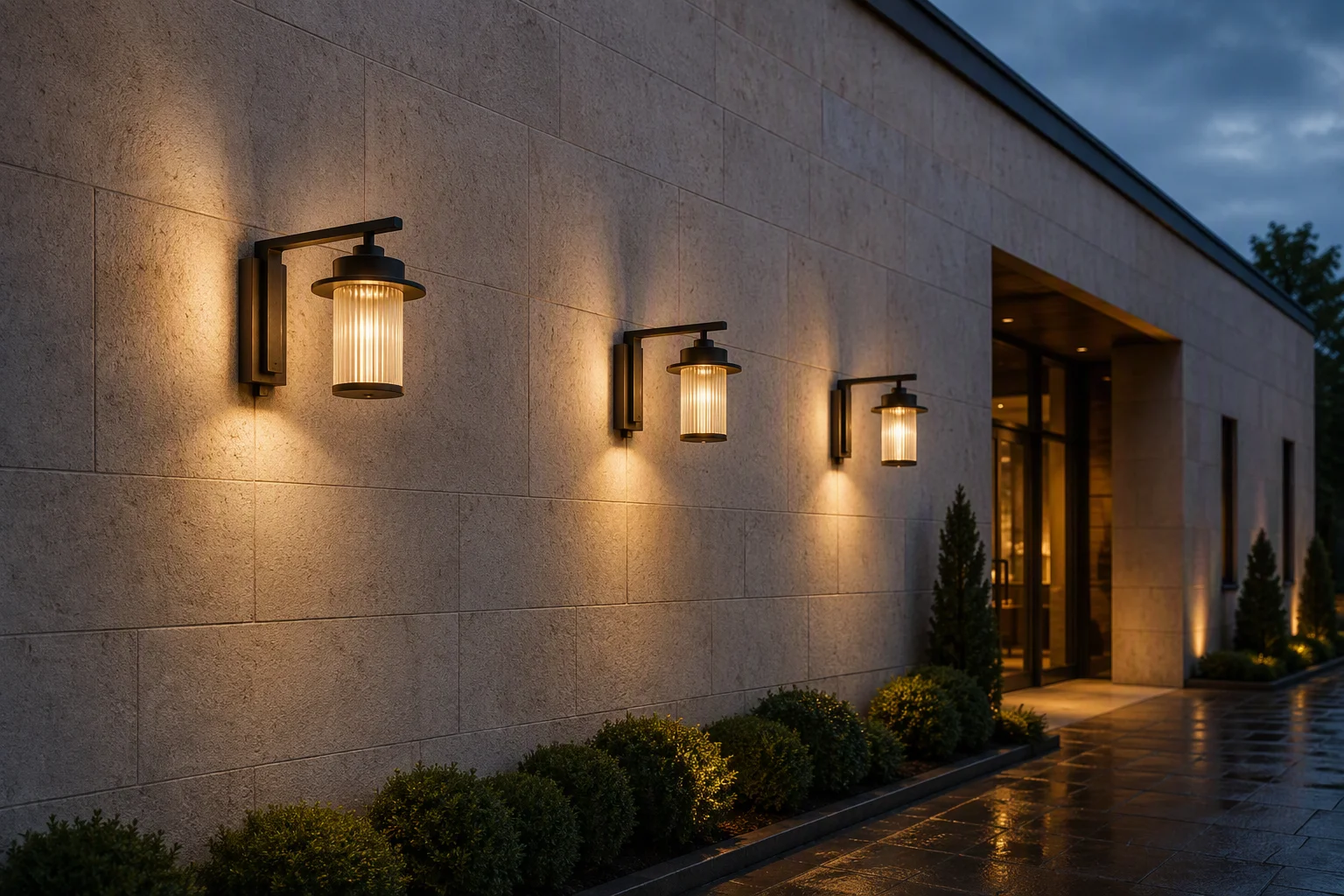 |
| A facade fitting is read at street distance, so a finish that chalks or streaks under ultraviolet light is visible to every passer-by. |
Why an exterior fixture fails long before an interior one does
Indoors, a decorative fixture lives in a controlled environment. The temperature is stable, rain never reaches it, ultraviolet light is filtered by glass, and cleaning is done by staff following a schedule. Outdoors all four protections disappear at once, and they fail in a predictable order.
Water arrives first, driven sideways by wind through joints and cable entries, and condenses inside the housing as the fitting heats and cools. Electronics fail before anything else does, because the driver sits behind the seal. Then the finish follows: coatings chalk, plated surfaces dull unevenly, and any plastic part that is not ultraviolet stabilised starts to yellow. Fixings go last and matter most, because a corroded bracket is a safety issue rather than an appearance one.
The visible result is worse outdoors than in. A tired finish inside a guest room is noticed by one guest at a time; the same finish on a facade is read from the street by everybody, and it reads as a maintenance failure rather than a design choice.
What durability actually means on a specification
Durability is not a single property and cannot be bought with a single number. An ingress protection rating describes dust and water entry under defined test conditions, and it is a sensible starting point, but it says nothing about how a coating survives three summers, how a fixing behaves in coastal air, or whether water can escape once it is inside. Treat the rating as an entry ticket, not as a warranty.
Four separate properties decide whether an exterior fitting lasts, and each one is askable at submittal stage.
| Property | What it protects | What to ask for |
|---|---|---|
| Ingress protection | Driver, wiring and connections | The rating plus the position of every entry point |
| Corrosion resistance | Housing, brackets and fasteners | The coating system and the grade of each fixing |
| Ultraviolet stability | Finish colour and plastic parts | The stabilised grade of any diffuser or gasket |
| Mechanical integrity | The fixture's attachment to the building | Design wind load and the anchor type per substrate |
Water, wind and thermal movement: the three loads that open a housing
An exterior housing is attacked from three directions, and a specification that answers only one of them will still fail.
Water enters through joints, cable entries and screw threads, and it also forms inside from condensation as the fitting cycles between warm and cold. A cavity that cannot drain will eventually hold water. Weep holes help only if they sit where wind does not push rain into them and remain clear after finishing.
Wind rarely breaks a fixture; it works it loose. The design case for a bracket is a gust rather than the weight of the fitting, and repeated movement loosens fasteners and fatigues the seal around them. The joint between fixture and facade is where this shows up first.
Thermal movement separates materials that expand at different rates. A dark housing in direct sun runs far hotter than the air around it, which shortens the working life of the driver inside, and the same heat cycling opens hairline gaps at the joints between the housing and its mounting plate.
Treat the seal as the last line of defence rather than the first. A housing that drains will outlast one that only tries to stay dry.
Materials and finishes that survive the exposure
Most exterior durability failures are one component failing ahead of the rest. Aim the specification at the weak link rather than at the whole fixture.
| Component | Where it fails | What to specify |
|---|---|---|
| Housing | Painted mild steel corrodes at cut edges and fixing points | A corrosion-resistant alloy with a documented coating system |
| Fasteners | Standard steel fixings rust and stain the cladding below | A marine-grade stainless fixing for every bracket and cover |
| Gaskets | Cheap rubber hardens and loses its seal within a season | A UV-stable elastomer, sized so it is compressed rather than squeezed |
| Diffusers | Untreated plastics yellow and go brittle in sunlight | A UV-stabilised grade, with the trade-off between impact and clarity stated |
| Plated finish | Plating dulls unevenly near salt and after harsh cleaning | A coating thickness, plus a written cleaning regime and a named cleaner to avoid |
Mounting and access decide the maintenance bill
A fixture that is never serviced will not last, however good its components are. The cost of reaching it is set at design stage, not at the first failure.
- Match the anchor to the substrate. Stone cladding, metal panel, render and timber take different fixings, and the wrong one either pulls out or cracks the facade.
- Watch what runs off the fixture. Water leaving a bracket carries dissolved metal with it, and the streak it leaves on pale cladding outlives the warranty.
- Put the driver where someone can reach it. A driver sealed inside a facade unit turns a five-minute replacement into a scaffold visit.
- Standardise the family. One fixture type per elevation keeps the spare parts list short and the second phase identical to the first.
- Point cable entries down and leave a drip loop. The seal at the entry matters more than the seal at the gland.
Handover: what to record so year five looks like year one
Durability is partly a documentation problem. The decisions that protect a facade are only useful if the people maintaining the building can find them.
- An as-built record of what was installed, elevation by elevation, with the fixing used in each substrate.
- A physical finish reference for every surface, dated, plus the cleaning products approved for it and the ones to avoid.
- A spares position covering what actually fails: the drivers, the gaskets and the diffusers, not the housings.
- A short inspection cadence that looks at brackets, gaskets and cable entries after the storm season.
FAQ
Is a high ingress protection rating enough for a hotel facade?
It covers water and dust entry, and it is the right place to start. It does not cover coating durability, fixing corrosion or ultraviolet ageing, so the rating should be one line in the specification rather than the whole argument.
Should exterior fixtures be aluminium, steel or brass?
All three can work. What decides the outcome is the coating or plating system and the grade of the fixings, together with how close the building sits to salt water. In a coastal environment the fixing grade matters more than the housing metal.
Why do exterior finishes fade unevenly?
Because they are not exposed to the same conditions. A surface washed by rain sheds salt and pollution; a sheltered face under an overhang keeps them. Cleaning that is uneven, or that uses an unsuitable product, widens the difference.
How do we keep facade fixtures serviceable without scaffolding?
Decide the access route during design. Mounting from inside the building, hinged or removable fronts, and keeping fixings within reach of a platform all remove the problem before it exists. Once the facade is closed, access is a cost.
Do exterior lighting circuits need surge protection?
Outdoor runs are more exposed than indoor ones, so protection is normally part of the electrical design. Confirm the arrangement with the project electrical engineer rather than assuming the fixture covers it.
The takeaway
An exterior lighting specification is decided by three things that never appear on the render: how water leaves the housing, how the finish and fixings behave under ultraviolet light and salt, and how far someone has to climb to change a driver. Specify the weak component rather than the whole fixture, keep the seal as a backstop and give the housing a drainage path, and settle the access route while the facade is still open. Then record the installed configuration, the approved finishes and the spares, so the property's second phase and its fifth year both look like its first.
Zerouno Lighting (ZeroUNO) manufactures hospitality decorative lighting in Zhongshan, China, including exterior and facade fixtures built to project drawings. The company has been producing since 2013, supplies single piece samples for approval, and supports its fittings with a two year warranty and a 48 hour response window. Learn more at zerounolighting.com.
About the author
Sonny Yu is Sales Manager at Zerouno Lighting in Zhongshan, where he works with hotel owners, facade consultants and procurement teams on the specification, sampling and delivery stages of bespoke exterior lighting packages.



没有评论:
发表评论