A hotel lighting package is usually maintained by the same person, with the same trolley, in the same fifteen minutes per room. That routine was built for bathrooms and floors; applied to the fittings themselves it becomes a slow chemical decision repeated hundreds of times a year. A fixture that arrived flawless can be dulled, clouded or streaked long before anything mechanical has failed.
This guide is for the people who own that outcome: housekeeping managers, chief engineers and the procurement teams who close out a lighting package. It sets out one routine per material family, the products that must never reach each surface, and the handover pack that stops the procedure drifting back to whatever is on the trolley.
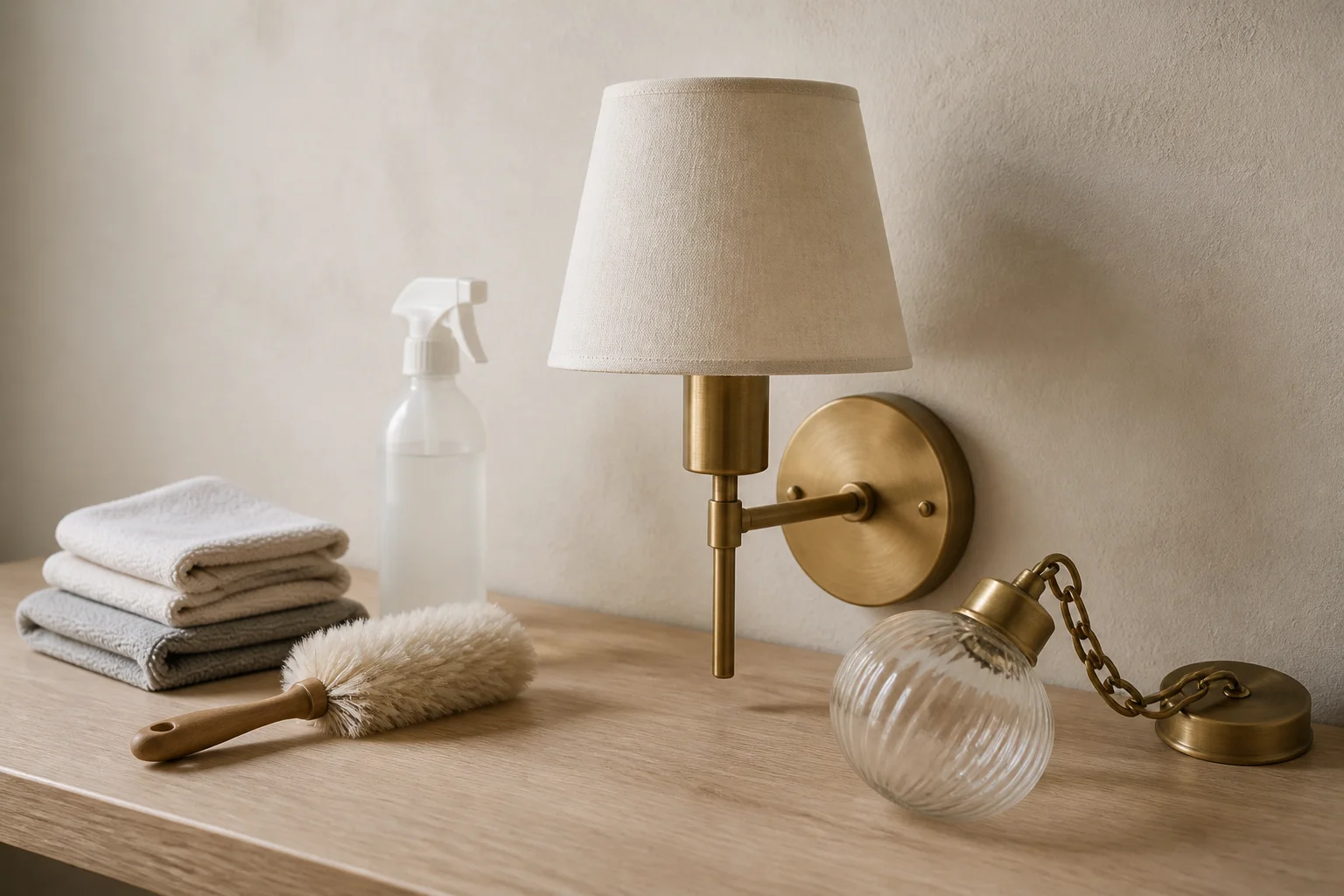 |
| One trolley, six surfaces: the cloth and the bottle have to change with the material, not with the room. |
Why a finish schedule and a cleaning trolley never agree
A cleaning trolley is standardised on purpose: one glass spray, one cream cleanser, one disinfectant, one pile of cloths, chosen for ceramics, glass, stainless steel and floors. A lighting package is the opposite. One guest room can hold lacquered brass, raw brass, powder-coated steel, a fabric shade, a glass diffuser and a stone panel, and those six surfaces tolerate six different things.
Nobody writes the join down. Procurement describes a finish by appearance, such as antique brass or matte black, and says nothing about what the surface can survive. Operations lists chemicals and cloths by area, not by material. Neither names the other, so the first person to push a trolley through the room makes a judgement the specification never gave them. The loss is almost always to chemistry or abrasion, and it is cumulative: one wipe proves nothing, while the same wipe daily for three years decides whether a finish still reads as the approved sample. Which chemistries attack which finishes belongs to a separate piece on finish durability; this article starts from the material and ends with the routine.
The cleaning routine by material family
Work down this table at handover and every time housekeeping is trained. The middle and right columns are the ones that matter on the trolley.
| Material | Routine | Approved method | Keep away |
|---|---|---|---|
| Glass shade or diffuser | Dust weekly, wipe monthly | Neutral soap, barely damp cloth, dried at once | Abrasives, scouring pads, direct spray |
| Crystal pendants | Dust weekly, soft brush | Diluted mild soap on the cloth, top down | Ammonia, soaking, alcohol on plated parts |
| Lacquered brass and bronze | Dust plus a damp wipe | Soft damp cloth, dried at once | Metal polish, abrasives |
| Raw or unlacquered brass | Dust, polish when needed | Mild polish, applied evenly, buffed one way | Abrasive pads, patchy spot polishing |
| Powder-coated steel | Damp wipe | Mild soap, rinsed and dried | Solvents, alcohol sprays, degreasers |
| Fabric shades and diffusers | Vacuum monthly, spot clean if needed | Brush attachment on low suction, foam blotted on | Soaking, rubbing, wet cloths from the bathroom |
| Opal acrylic diffusers | Dust, then a damp wipe | Mild soap and water, soft cloth | Alcohols, ammonia, dry rubbing |
| Stone, alabaster and marble | Dry dust only | Soft dry cloth, barely damp if needed, dried at once | Standing water, acidic cleaners, abrasives |
If the full table will not fit on a wall, cut it to one line per material and laminate that.
Glass and crystal are not the same job
Both are transparent and both show every mark, but the assembly around them differs. A glass shade takes a neutral soap and water wipe without complaint; crystal is much the same mineral family, yet pendants hang on wire, pins and plated links, and those fail first. The quickest way to shorten a chandelier's life is to spray a glass cleaner directly at it, because the product runs down through the crystal and onto the mounting, taking the lacquer or plating with it. Put the product on the cloth instead, steady the pendant with one hand, and work downwards from the top. Frosted, etched and printed glass takes a soft dry cloth only.
Metal: the lacquer line decides the product
The most common housekeeping error in a hotel corridor is brass polish on lacquered brass. Appearance gives no warning, because a lacquered and an unlacquered fitting can be specified in the same tone; behaviour does. Raw brass tarnishes and can be brightened with a mild polish. Lacquered brass does not tarnish, and each pass of polish removes a little of the film protecting it, in streaks that follow the cloth.
The test is safe and slow: watch the piece for a month. Still bright with dusting alone means it is coated, and needs only a damp wipe; a warm haze means it is raw, and can be polished evenly and infrequently with a mild product and a soft cloth, finishing in one direction. A darkened bronze that looks dull to a new cleaner is usually the approved colour, and polishing it back to brightness is a defect.
The question is not whether the fixture is dirty. It is whether the surface is coated. Polishing a lacquered fitting is not a stronger clean, it is a slower removal.
Fabric shades and diffusers: dry first, always
Textiles are the surfaces most often damaged by water, because a wet cloth from the bathroom is the closest thing to hand. Dust is the routine enemy and comes off with a vacuum brush attachment on low suction, worked from the top rim downwards; do that monthly in public areas and most shades need nothing else. Where a mark has to go, ask the supplier for a tested method and try it on the inner face first.
- Never immerse a shade or diffuser, even a removable one. The frame inside is usually steel and the weave loses its shape while it dries.
- Blot rather than rub, which works the mark into the weave.
- Spray onto the cloth, never onto the shade, so no liquid reaches the fitting below.
- Record which shades were spot cleaned, so a later patch is not read as a manufacturing fault.
Stone and translucent stone: water is the only real risk
Stone-bodied fixtures take a dry dusting as their whole routine. A soft dry cloth lifts dust without moving anything else, and a barely damp cloth is the limit when a mark has to go, because translucent stone is porous and stays in contact with water it cannot shed. Keep abrasives away as well: they dull the face, and a dulled face spreads light less evenly than the approved sample did. Standing water, acidic cleaners and soaking cloths are the three habits to write out of the procedure explicitly.
Writing the routine into the handover pack
A cleaning routine survives on paper or not at all. The person who washes a fixture in year three rarely attended the handover, and contractors who deep clean between seasons have no reason to know what the fitting is made of. Four items belong with the maintenance documents:
- A single page per material family, in the language the housekeeping team reads, with the approved method and the products to avoid.
- The approved product list with dilution, so a replacement can be checked against it rather than guessed.
- The cloth and tool list, because the wrong cloth does damage that looks like wear.
- A named contact for questions, so an unusual mark becomes a message rather than an experiment.
The routine breaks at three predictable moments: a new housekeeping starter, a change of contractor, and a seasonal deep clean.
FAQ
Can one spray cover glass, crystal and metal?
No. A product that is safe on a glass diffuser may strip lacquer from a brass base and dull a plated mounting. Use a neutral cleaner on glass and stone, and water with a soft cloth on metal.
Why did lacquered brass go patchy in one area?
Usually repeated polishing on the side that catches marks, such as the switch side of a backplate. Each pass removes a little of the clear film, and once it thins unevenly the surface reads as patchy under light.
Can a fabric shade be washed or dry cleaned?
Only by the supplier's tested method. Most shades are spot cleaned in place, because immersion softens the weave and attacks the steel frame inside. A badly marked shade is usually cheaper to replace than to restore.
Is a damp cloth safe on alabaster or marble?
Barely damp, and dried immediately. Dry dusting is the routine. Water left standing on translucent stone is the most common way a stone fixture loses its surface.
The takeaway
Decorative lighting is damaged by the routine more often than by the guests. Match one cleaning method to each material family, keep polish away from anything lacquered, keep water away from textiles and stone, and put the product limits where the trolley is loaded. Ask the supplier for the material list and the tested method at handover, laminate one page per material, and brief it again whenever the cleaning team changes. That page usually decides whether a finish still matches its sample or is replaced early.
Zerouno Lighting (ZeroUNO) manufactures hospitality decorative lighting in Zhongshan, China, including brass, glass, fabric and stone-bodied fixtures built to project schedules. Each order starts with a single-piece approval sample, and products carry a two-year warranty with a 48-hour response window. Learn more at zerounolighting.com.
About the author
Sonny Yu is Sales Manager at Zerouno Lighting in Zhongshan, working with hotel owners, designers and procurement teams on bespoke decorative lighting, from the material call through to the approval sample and the maintenance documents that follow it.



没有评论:
发表评论