A bar is the one room in a hotel where the guest faces the light. Everywhere else the lighting sits above or beside the viewer. At the counter the guest sits level with the back bar, looking straight into the source, the display and their own reflection in a polished top. A specification that reads well on a plan, with a tidy row of pendants over the counter, becomes a line of bright discs once somebody sits down.
This guide is for the teams who settle a bar package: owners, food and beverage operators, designers and procurement. It covers why the seated sightline decides everything, how the counter and back bar behave as mirrors, and how to split the room into layers that survive a full shift.
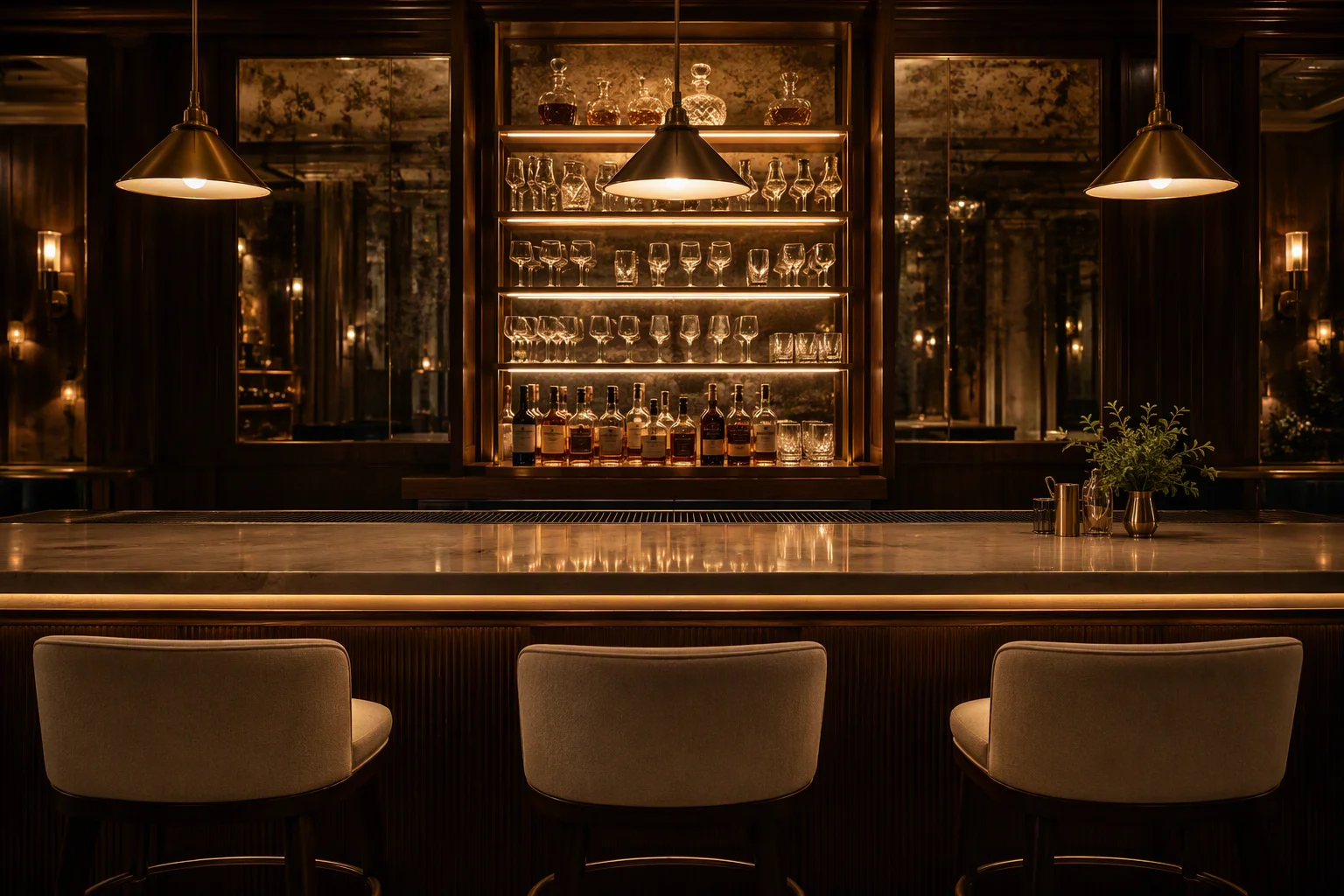 |
| A counter lit for the plan rather than for the stool reads as a row of bright discs. |
Why a bar is the hardest room in the hotel to light
Most hotel lighting assumes a viewer who is standing, walking or lying down, with light arriving from above or the side. A bar removes that assumption three times over.
First, the guest looks at the light: a seated patron faces the back bar, so anything behind the bartender sits in their field of view for the length of a drink. Second, the room holds two sightlines at once, because a guest on a stool sits near counter height while someone standing looks over it into the working well. Third, the room changes character inside one shift, from afternoon lounge to night venue, with the same staff and no time for a reset.
Light a bar for the person on the stool, not for the drawing. If a seated guest can point at the source, the layer is in the wrong place.
The counter and the back bar are mirrors, not surfaces
A bar is built from reflective surfaces. A polished counter mirrors whatever hangs above it, and a mirrored or glass-backed back bar doubles every source in the room. That is why a fixture which looks discreet in a showroom can read as a glare point once the room opens: the guest sees the source itself, plus its copy in the counter and its copies down the back bar.
The fix is rarely to dim everything. Move the layer, shield the source, or change the angle so the reflection falls outside the guest's view.
| Reflective element | What the seated guest sees | Where to fix it |
|---|---|---|
| Polished counter top | A copy of every pendant above | Set the source outside the counter's reflective angle |
| Mirrored or glass back bar | Each source repeated down the wall | Reduce visible sources; recess or shield the display light |
| Lit bottle display | A bright field behind the bartender's head | Light the shelf edge; keep the bright zone below eye line |
| Glossy counter front | Reflections of stools and floor light | Control the floor layer off the counter front |
| Hanging glassware rack | Sparkle scattered across the counter | Light it evenly as a feature, or leave it unlit |
Three layers, three jobs
Treat a bar as three separate systems rather than one lighting design. Each has a different job, a different level and a different owner in the conversation.
- Ambient layer: carries the room, warm and low, from open to close.
- Display layer: lights the back bar and bottle display. It is a merchandising decision as much as a lighting one, and the layer most likely to end up in the guest's eyes.
- Task layer: lights the bartender's working surface at the well and the bench, so measures are read accurately.
Settle the split on the drawing: a separate circuit per layer, a task light aimed at the working surface rather than into the room, a visible gap between ambient and display levels, and a shield on any source in a guest's line of sight. Because the room runs from afternoon lounge to late session, the same layers also need scene recall and a control the bartender can reach without walking around the counter.
The bartender's light is a task light, not a downlight
The instinct is to hang a downlight over the counter and let it do both jobs, and it does neither well. Aimed down it lands in the eyes of anyone seated opposite; aimed wide it lights the room instead of the work. Give the work its own light: a shielded source aimed at the well and the bench, with the guest's view left alone.
The working layer also has to render honestly: a bartender reads the colour of a spirit and the clarity of ice, so the light over the well has to show those things as they are. That is settled by the source chosen at specification, not by a later adjustment on site.
Wear: what a bar does to finishes and controls
A bar is a working surface with alcohol in it. Finishes and controls that look identical on a sample board age differently inside one.
- Spilled spirits and acidic mixers sit on plated trim around the well and are wiped, not rinsed.
- Ice wells and glass chillers put condensation under and around nearby fittings.
- Glass polish and sanitisers are chosen for the surface, not the material, and dull plating unevenly.
- Citrus and grease from the working area settle on any metal inside splash distance.
- Sticky residue collects on every control within reach of the counter.
Keep decorative finishes out of the splash zone, and route the room's controls where hands do not cross on the way to the well. Then record the approved cleaning products with the maintenance sheet, so nobody cleaning at two in the morning has to guess.
Commissioning the scene in one evening
Most bar lighting faults are visible within ten minutes of the room being used, so commission it that way.
- Sit on a stool at three points along the counter and note every source you can see.
- Stand at the bar and repeat, looking over the counter into the well.
- Walk the perimeter and check the counter for reflected points of light.
- Run each scene at the level it will be used at, not at full output.
- Drop to the lowest scene and check for flicker, a colour step, or a source that stays bright when everything else falls.
Anything you can point at from a stool should be changed before the room opens, because it cannot be fixed from a ladder afterwards.
FAQ
Does a hotel bar need downlights over the counter?
Not directly above the guest. A downlight over the counter sits in the view of anyone seated opposite it. Where a fixture is needed there, keep it out of the seated field of view or put it on the working circuit.
How do you stop reflections in a polished bar counter?
Move the layer rather than lower the level. Set the source outside the counter's reflective angle, shield it, or shift it to the perimeter, so the guest sees a lit surface rather than a copy of the fixture.
Should the back bar be lit from within?
Usually yes, because a lit back bar reads as the room's feature and helps the bartender work. The risk is the field of light behind the bartender's head, so light the shelf edge and keep the bright zone below the guest's eye level.
Can the bartender and the guest share one dimmer?
They can share the room but not one layer. Give the working light its own circuit and a control within reach, and leave the ambient and display on the guest scene. Otherwise the room runs at whatever the brightest task needs.
What colour temperature suits a hotel bar?
Warm, and held in a narrow range, with the final figure confirmed by the project lighting designer against the standards that apply to the property. What matters more than the figure is that the room does not turn colder as it dims.
The takeaway
A bar is lit for a guest who is sitting down and facing the light. Illuminate surfaces rather than delivering light to a point, keep the source and its reflections out of the seated sightline, and give the bartender a task light aimed at the work instead of a downlight over the counter. Separate the ambient, display and working layers so each can be set on its own, and check the reflective pairs in the counter and back bar before fittings are chosen. Then commission the room from a stool, because the faults that matter are visible from there and nowhere else.
Zerouno Lighting (ZeroUNO) manufactures hospitality decorative lighting in Zhongshan, China, including bespoke counter pendants and back-bar fixtures made to project specifications. Founded in 2013, the company supplies single-piece samples for approval and works to a 25 to 35 day production window on custom pieces. Bar packages are usually dimension-led, so the approved sample settles more than the drawing does. Learn more at zerounolighting.com.
About the author
Sonny Yu is Sales Manager at Zerouno Lighting in Zhongshan, working with hotel owners, designers and procurement teams on bespoke decorative lighting and its approval samples. He writes about the sequence of a real project, from a room's lighting layers to the finish and control decisions that are hardest to change later.



没有评论:
发表评论