Every decorative lighting package is judged twice: once on the drawing, and once in service, after the shade has been cleaned forty times and the lamp behind it replaced. Between those two moments sits a decision that rarely gets a line on the specification sheet, and that is the shade or diffuser itself. It decides whether a fixture gives a soft pool of light or a hot spot, whether the guest sees a lamp or a glow, and whether the fitting still looks deliberate after two years of housekeeping.
This guide is for the people who settle that question in writing: owners' representatives, designers, procurement teams and the engineers who inherit the result. It covers how shades and diffusers behave optically, how to match a material family to the position it serves, and what to record so the second floor matches the first.
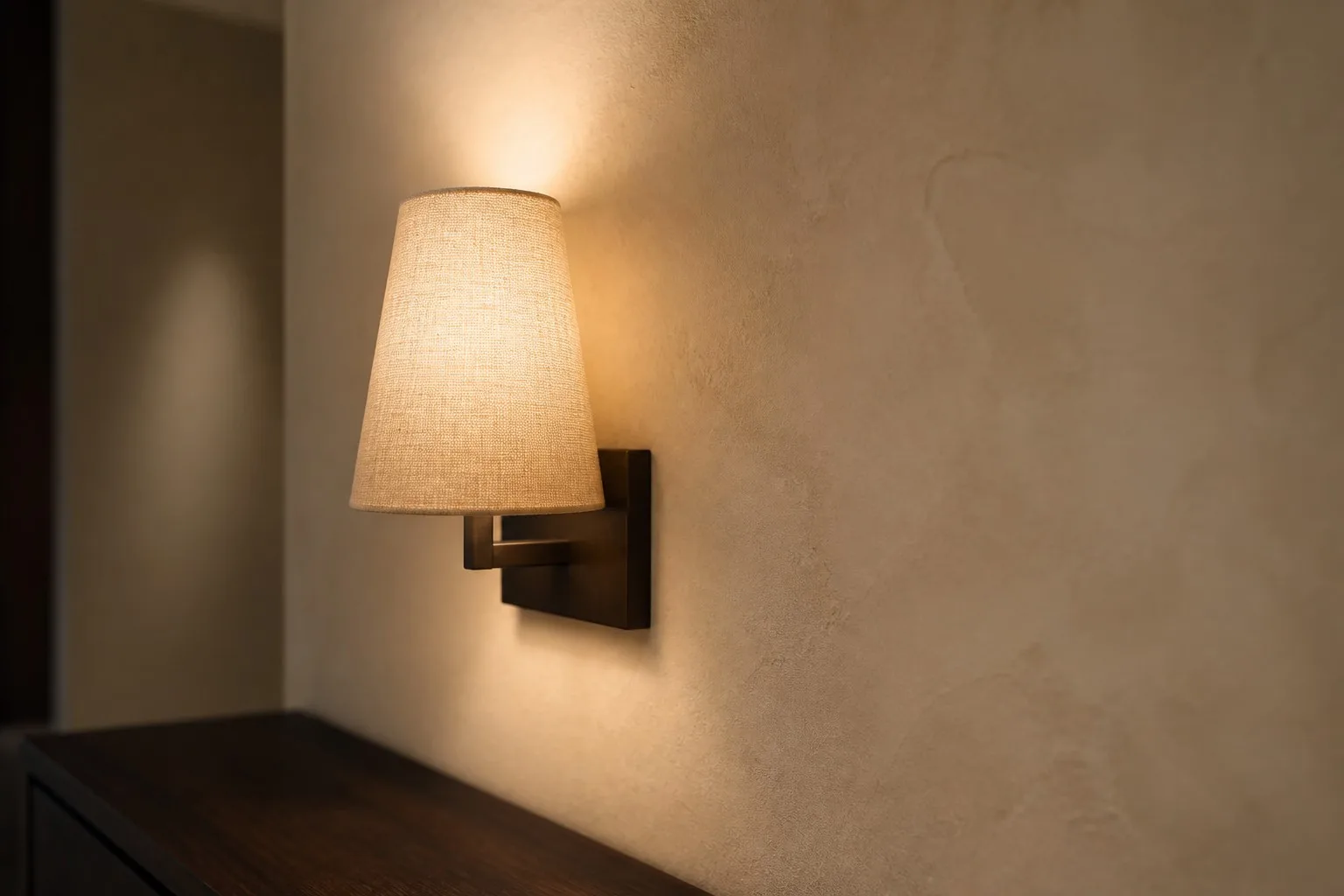 |
| Weave and diffuser decide whether the guest sees a soft glow or the lamp inside the shade. |
A shade is an optical component, not a finishing touch
A shade does three jobs at once. It distributes the light the source produces, it conceals the source and its hardware, and it contributes the surface the eye reads in the room. Treated as one decision, the result is usually a fitting that photographs well and disappoints at night.
The most common failure is a material chosen in a bright showroom with the fixture switched off. A shade is judged in the opposite condition, with the room dim and the guest two metres away.
- Distribution decides whether light leaves the shade upward, downward or evenly in every direction.
- Concealment decides whether the guest sees the LED board through the material at close range.
- Surface decides the tone the fitting contributes while switched off, which is most of the day.
Judge a shade in the condition the guest will meet it in: room dim, fitting on, viewer close enough to look straight at the material.
Material families at a glance
Most hospitality shades and diffusers fall into a handful of families, each behaving differently in light and carrying its own service risk.
| Family | Light behaviour | Suits | What to watch |
|---|---|---|---|
| Tightly woven fabric | Even diffusion, source masked up close | Bedside, vanity, guest rooms | Keep dry; brush clean only |
| Open weave fabric | Some transmission, strong texture | Pendants seen at distance | Source visible up close |
| Heavier cloth, drum or tapered | Softer edge, holds shape | Corridor, lobby, restaurant | Frame strength at large diameters |
| Opal acrylic | Full masking, even field | Corridors, volume production | Scratches and static |
| Clear glass or crystal | Source visible by design | Lobby features, chandeliers | Glare and hot spots |
| Natural fibre | Warm, directional texture | Resort and spa interiors | Humidity and coastal air |
Fabric shades: weave and weight first, colour second
Fabric shades are read largely by their weave. A tight weave diffuses light evenly, masks the source and stays visually quiet. An open weave lets more of the source through and tends to reveal the lamp and the shadow of the internal frame.
Weight is the second variable. A heavier cloth hangs straight on a drum or tapered shade and resists creasing in transit, while a light cloth can ripple along its seam, which reads as damage. Both are legitimate, but they behave differently at a 400 mm shade diameter.
Colour changes the delivered light, not only the appearance. An ivory weave reflects most of what reaches it; a deeply dyed shade absorbs it and tints the room. With a warm source already specified, a saturated shade pushes the visible light further than either decision intended.
- Use a tighter weave wherever guests view the fitting up close, such as bedside and vanity positions.
- Choose a heavier cloth for large drum and tapered shades.
- Keep the palette inside a narrow range across a property so replacement stock matches.
- Confirm the cloth tolerates whatever housekeeping actually uses on it.
Diffusers: masking the source matters more than the pattern
A diffuser sits between the source and the room, and it is chosen for transmission: how much light it passes, and how evenly. Opal acrylic and opal glass spread output across the whole surface and make the source indistinguishable. Clear glass and crystal do the opposite, turning the source into part of the design.
The practical question is whether the source will be visible from a normal viewing position. Where it will, the diffuser must mask it at the closest point a guest can stand. Where it will not, a clearer material can be used for its effect.
Matching the choice to the position
Exposure and viewing distance change with position, so the specification should change with them. The project lighting designer confirms the final figures against the standards that apply to the property.
| Position | How the guest meets it | What it must do | Check at submittal |
|---|---|---|---|
| Bedside table or wall | Close range, at seated eye level | Tight weave, low surface brightness | Source visibility in a dark room |
| Vanity, beside a mirror | Looked towards twice a day | Even diffusion, no hot spot on the face | Masking up close; reflection in glass |
| Corridor and lobby | Passed at distance from both sides | Even spread, no bright aperture | Distribution up and down; side glare |
| Restaurant and bar | Sitting beneath it for long periods | Warm, low brightness at eye height | Shade bottom against seated eye level |
| Spa and treatment | Reclined, looking upward | Full masking, no visible source | Source visibility when reclined |
| Back of house | Wiped down, rarely admired | Robust, replaceable, easy to clean | Cleaning compatibility and spares |
Fire performance and cleaning: the two service questions
Fire performance is a documented property of the material and its treatment, not something to assume from the look of the cloth. The requirement depends on the property's jurisdiction, insurer and fire strategy, so treat it as a submittal item: ask for the documentation covering the material actually being used, and have it reviewed by the party responsible for compliance. Substituting material late in an order is where this check usually gets lost.
Cleaning is the second question. Shades and diffusers are the parts housekeeping touches, and hotel cleaning agents are chosen for their effect on surfaces rather than on textiles. Vacuuming with a soft brush is harmless; wet wiping a fabric shade is not.
- Record which fire documentation the material holds, and its version, against the fixture schedule.
- Write the cleaning method onto the maintenance sheet: soft brush, dry, no wet wiping.
- Keep a service allowance for discolouration where a shade sits close to a hot source.
- Check the shade can be removed for lamp replacement without stressing its frame.
What to write on the specification sheet
Most disputes about shades and diffusers come from a schedule that names a look rather than a material.
- Shade material by family and weight, not just "fabric".
- Weave description or reference sample number, with a retained sample held by the supplier.
- Diffuser material and its opacity or transmission class, where specified.
- Fire documentation reference, including the standard cited.
- Cleaning instruction compatible with the property's regime.
- Spare allowance for shades and diffusers across the order.
- Replacement route: whether the material stays available through the refurbishment cycle.
A retained sample is the cheapest control on that list and the most often skipped. Two shades that look identical in a photograph can differ by a visible step side by side under the same source.
FAQ
Should a hotel use fabric shades or diffusers?
They solve different problems. Fabric shades control the surface the guest sees and how light is distributed; diffusers control how evenly the source is hidden. Many fixtures use both, with a diffuser behind the fabric.
How do I stop the light source being visible through the shade?
Combine a tighter weave with a diffuser between source and fabric, then check it in a dark room at the closest distance a guest will view it from.
Does shade colour change the light in the room?
Yes. A deeply dyed shade absorbs more of what reaches it and tints the light that leaves. Where the source colour is already specified, the shade colour belongs in the same review.
What documentation should I ask for on fire performance?
Ask for the documentation covering the material actually being used, and have it reviewed by the party responsible for compliance. Requirements vary by jurisdiction, insurer and fire strategy.
Can shades and diffusers be cleaned in place?
Diffusers usually can, with a soft cloth and a compatible agent. Fabric shades are better cleaned dry with a soft brush. Confirm what housekeeping actually uses before the regime is signed off.
The takeaway
Shades and diffusers are the parts of a package that guests see closest and touch most often, and usually the last to receive a material line on the schedule. Name the material family, the weave or opacity, the fire documentation and the cleaning method, and hold a retained sample. Those steps prevent the two failures that matter in service: a source the guest can see, and a second delivery that does not match the first.
Zerouno Lighting (ZeroUNO) manufactures hospitality decorative lighting in Zhongshan, China, founded in 2013. The company makes wall, table, floor and mirror fixtures to project specifications, supplies single piece samples for approval, and works to a two year warranty with a 48 hour response on service questions. Learn more at zerounolighting.com.
About the author
Sonny Yu is Sales Manager at Zerouno Lighting, where he prepares decorative lighting packages and their material submittals for hotel projects. He writes about the specification and service details that decide whether a lighting package still looks deliberate after the first refurbishment cycle.