A guest wakes at three in the morning and needs the bathroom. Switching on the room lights wakes the person beside them; crossing the room in the dark risks a fall. Night-path lighting exists to close that gap.
It is also the layer specified last and trimmed first, which is why it fails in ways nobody can quite name. This guide covers the three zones it has to serve, how control decides whether it works, and what to write into the RFQ.
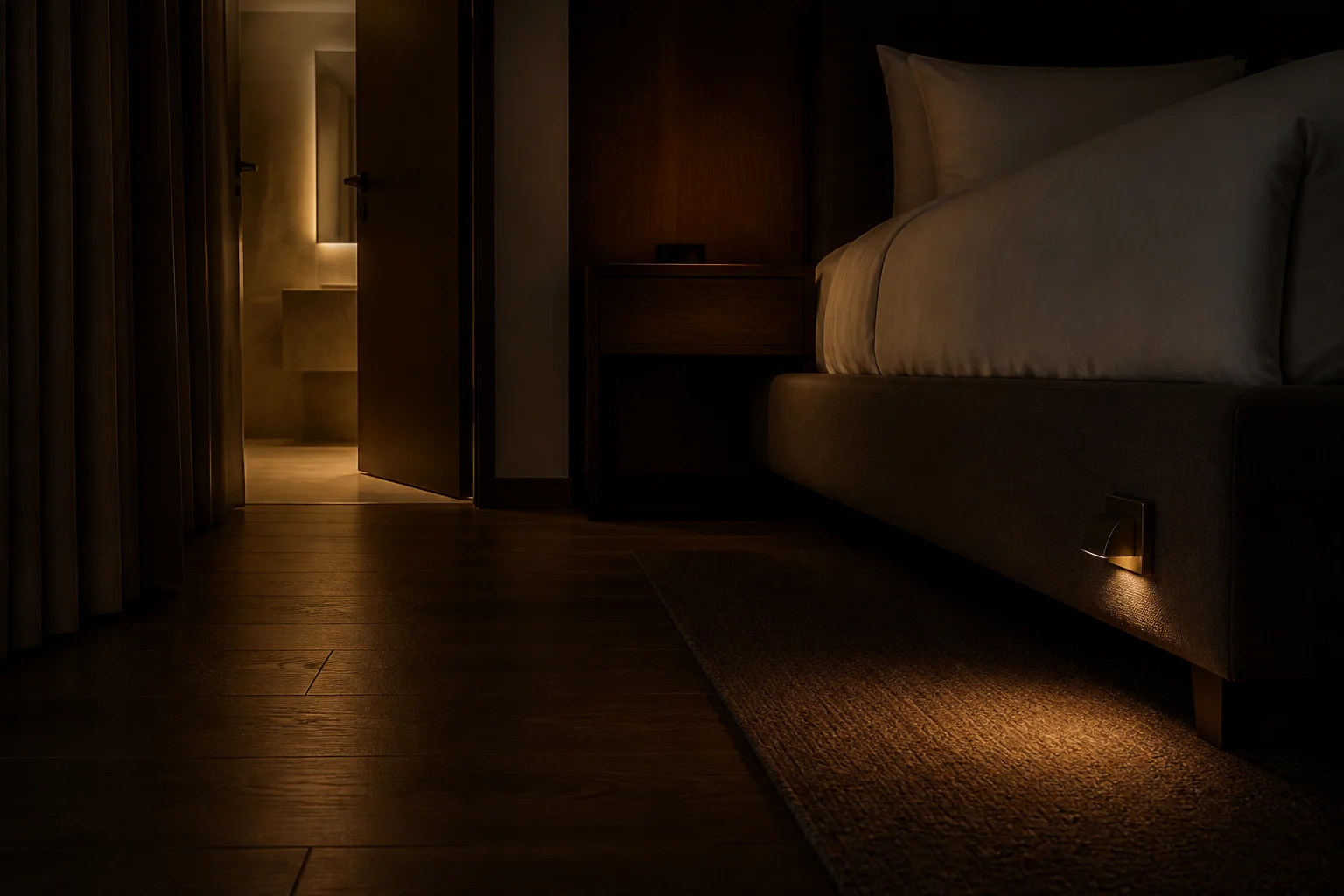 |
| A night path works when the guest never looks into the light: shielded at floor level and aimed at the route, not the room. |
What night-path lighting actually has to do
Night-path lighting carries two requirements that pull against each other. It has to give a guest enough visual guidance to cross a space they cannot fully see, and it has to stay dim enough that the person still asleep is not disturbed.
That is not a decorative problem. A layer that is too bright fails the second requirement; a layer with no shielding fails the first, because a source the guest looks into is glare rather than guidance. How much light the path needs is for the project's lighting designer, not a figure a supplier should invent on a specification sheet.
The three zones of a night path
Guests meet a night path not as one layer but as three separate moments, and a scheme usually fails in one of them rather than all three.
| Zone | What the guest needs | How it usually fails | Design response |
|---|---|---|---|
| Beside the bed | Light to find the floor and footwear without leaving the mattress | The only source is the reading light at working brightness | A shielded low-level source, or a dim-down switched separately from reading |
| The route to the door | A continuous guide along the walking line | A gap mid-route, or a fitting that comes on at full output | Even spacing along the walking line, starting low rather than rising to working level |
| Inside the bathroom | Task light at the mirror, with nothing spilling into the bedroom | Night and vanity lighting share one switch and one output | A separate low-level night circuit |
Two zones sit inside the room and one behind a door, which is why different people often specify them separately.
Why placement beats brightness
When a low-level night light feels uncomfortable, the instinctive fix is to lower its output again. The real problem is usually where it sits and what the guest sees of it.
A small source left open to the room becomes more visible, not less, when the guest sits up or swings their legs out of bed: it sits near eye level just as they look for it. Deep baffles, a recessed aperture, a down-facing slot or an opaque housing all solve that without reducing guidance. In decorative schemes a well-resolved shade does the same: closed on top, open only where the light is wanted.
Colour temperature belongs here too. A warm source reads as night to a guest who is half asleep; a cool source reads as daylight and signals alertness, so reserve warm light for the night layer.
Motion sensing: where it helps and where it fails
Sensing makes a night path feel responsive: the light appears where the guest is going. It also introduces failures unswitched designs do not have, most decided at commissioning.
- Field of view. A sensor that sees the whole bed triggers when a guest turns over; aim the detection zone at the floor beside the bed, not across the mattress.
- False triggers. A vent, a curtain shifting in a draught or warmth from next door will trip a badly aimed detector; guests notice a light that comes on for no reason.
- Hold time and fade. A long hold leaves the guest unable to switch off; an abrupt cut-off is startling. A slow fade makes the layer feel intentional.
- Starting level. A sensor that switches straight to working brightness defeats the layer; it should trigger at the low level the room uses at night.
- Where the logic lives. A sensor in the room control system can be reconfigured later; one embedded in a fixture cannot.
The test is a dark walk-through after commissioning, with the room set up as a guest will find it; a scheme signed off from a sheet alone will not survive a real night.
The bathroom night light is a separate layer
Bathroom lighting is normally specified as a task layer: light at the mirror for washing and dressing. Night lighting is a different job in the same room, and the two should not share a switch.
Where they do, a guest either wakes the room by switching on the vanity light or arrives to find the bathroom dark. A separate low-level source at floor or kick level keeps the night function on its own circuit and leaves the mirror layer free to work properly.
The detail that undoes it is spill back into the bedroom: a door swinging over a bright floor-level fitting, or a gap that throws a strip of light across the bed. Toilet and shower zones deserve the same pass, because retrofitting into a tiled zone later costs far more than specifying it now.
Retrofit constraints when you cannot pull new cable
Much of this layer is added to hotels already open, or in refurbishment, where walls are finished and ceilings are staying up. A night path is still achievable, but the solution is decided by what services already exist.
| What the room already has | What it allows | What to watch |
|---|---|---|
| A switch leg at the bedside | Independent night switching | Whether the wiring allows separate control |
| A socket behind joinery | A plug-in fixture with the cord concealed | Whether housekeeping can reach the plug |
| No wiring at all | A rechargeable fixture with an integral battery | Charging becomes a housekeeping task: name who does it |
| An existing controlled circuit | Night scenes added in software | The lowest level the fittings hold without flicker |
Whichever route is used, settle the maintenance model with the fixture: a rechargeable night light with no charging rota and no spare battery stops working in month three, and arrives as an operations complaint rather than a lighting one.
What to put in the RFQ
- The zones the scheme has to cover, and which fitting serves each one.
- Whether night switching is separate from the reading and vanity functions.
- Sensor logic: field of view, starting level, hold time and fade.
- The control interface, and the level the fitting must hold steady.
- Service access, plus the driver and battery references needed in year four.
- A mock-up requirement, because a night path is judged in a dark room.
The layer guests use most often is the one that gets value-engineered first, and it is the one they remember as a fall or a disturbed night.
FAQ
Does every guest room need a night path?
Not in the same form. A suite with an inner bathroom needs a longer, more considered route than a standard room, where a dim-down of the bedside fitting plus a shielded bathroom source often suffices.
Can the night light share a switch with the bedside reading lights?
It can share the fitting but not the switching. A reading light needs working brightness aimed at a book; a night light needs a low level aimed at the floor and the route.
Is passive infrared better than presence detection?
It depends on the layout rather than the technology. Infrared suits a tight zone beside a bed; presence detection covers more area but can see through a partition if aimed carelessly.
Can a night path be added without rewiring?
Usually yes, through an existing switch leg, a concealed plug-in fixture or a rechargeable one. The limit is the control logic: on a networked system a night scene may be a software change.
How do we stop bathroom light spilling into the bedroom?
Shield the source from the direction of the bed, keep the night fitting on its own circuit, and check the door in a dark mock-up rather than on a drawing. A fitting placed where it cannot be seen from the bed beats a dimmer one further away.
The takeaway
Night-path lighting is a safety layer that has to stay quiet. It fails predictably: too much visible source, switching tied to the wrong layer, sensors aimed at the bed, and maintenance nobody owns. Place the light so the guest never looks into it, keep the night circuit separate from the reading and vanity functions, and settle the sensor logic with a walk test in a dark room. Then write down how it will be maintained, because that decides whether it still works when the hotel is full. Done properly, guests never mention it, which is the point.
Zerouno Lighting (ZeroUNO) manufactures hospitality decorative lighting in Zhongshan, China, and has developed project and custom fixtures since 2013. Night-path and bathroom layers are usually resolved as part of a broader guest-room package, beginning with a one-piece sample so shielding, switching and finish can be checked before the room is closed up. Learn more at zerounolighting.com.
About the author
Sonny Yu is Sales Manager at Zerouno Lighting, working with hotel owners, designers and procurement teams on decorative lighting packages. He writes about the parts of an order that are easy to leave until late: how a layer is switched, where a fitting is fixed, and what must be written down before production starts.