2026年9月30日星期三

Hotel Suite Lighting vs Standard Rooms: Where to Spend More

Most hotel projects write one lighting schedule for the standard room and scale it up for the suite: more fixtures, a busier ceiling, the same layers on the same switches. The room grows, but the lighting still does what a single-room scheme does.

This guide is for the people who decide that schedule: owners setting the room mix, designers writing both types, and procurement teams turning the two into one order. It covers where extra spend on a suite is actually felt, where it disappears, and how to keep two room types in one fixture family.
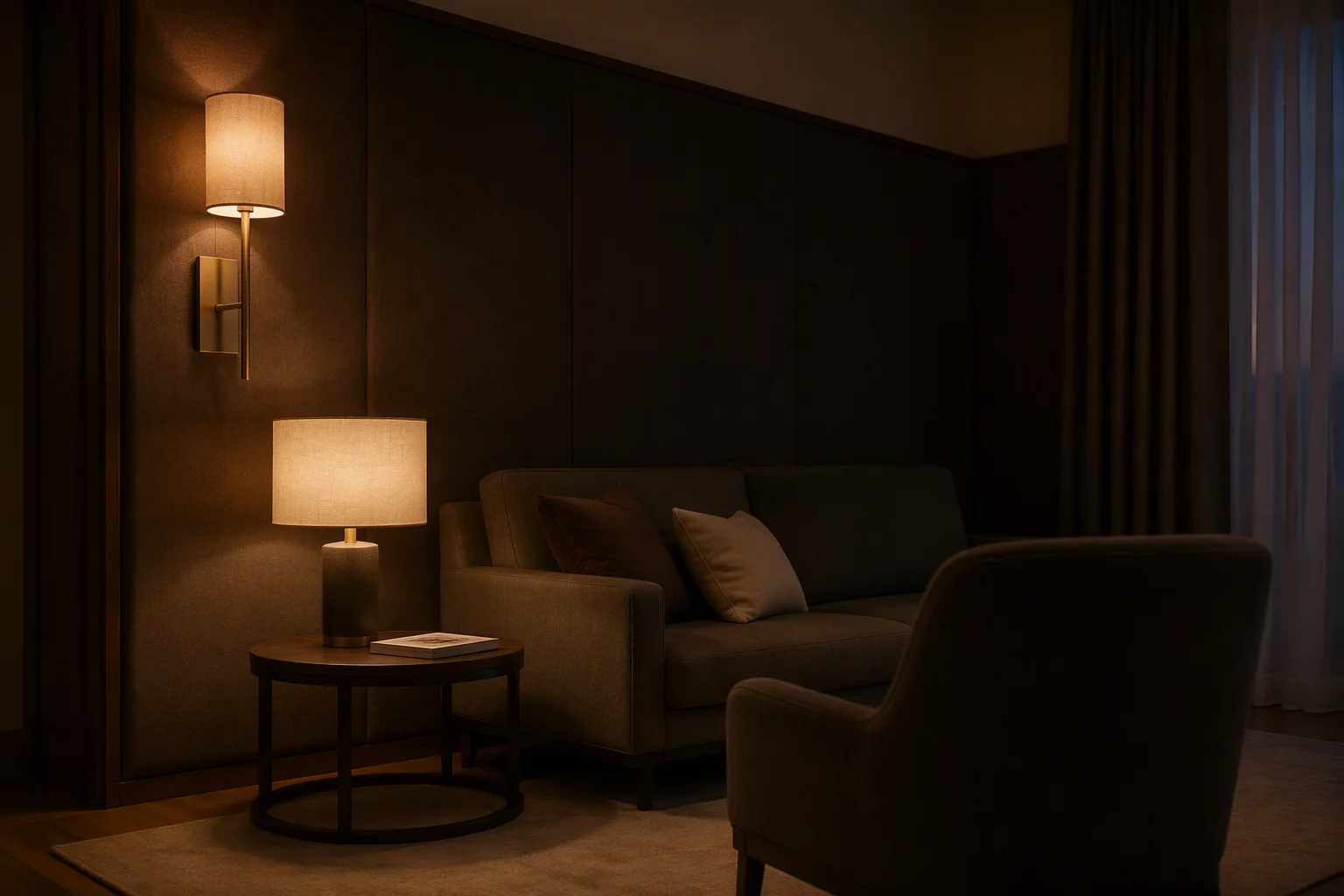
Hotel suite seating area lit by a separate decorative layer while the ambient layer stays low
In a suite the decorative layer has to drop low while the working layer stays up, which means two circuits rather than two fixtures.

A suite is not a bigger standard room

A standard room answers one sequence: arrive, unpack, sleep, leave. A suite is used in several modes during a stay, often by two people at once. That difference, not the floor area, is what its lighting has to answer.

  • Two people run on different schedules. Unless the reading and ambient layers switch apart, one guest decides for both.
  • Work and rest share the space. A laptop on the dining table in the evening is a task-light job sitting in the middle of an ambient scheme.
  • The room is used socially. A seating group has to hold a conversation or a room-service tray, a scene a standard room never supports.
  • The bathroom is a room, not a pit stop. Larger bathrooms and separate dressing areas are where the worst-lit corner usually sits.
  • The guest moves between zones. Living to sleeping to dressing means transitions a single-scene schedule does not resolve.

None of this is fixed by a higher fixture count. It is fixed by the number of independently controlled layers.

Where the extra spend is felt, and where it disappears

Suite lighting is judged in three moments: arriving after dark, working or reading while someone else sleeps, and using the bathroom and dressing area. Those are where additional spend earns its place.

The commonest misallocation is buying more of the same thing. A second identical decorative fitting on the same dimmer adds weight to the ceiling and nothing to the room. More output does not read as luxury; separation does.

The second sits in the control layer. A suite with twelve scenes nobody can name is worse than one with four the front desk can explain over the phone.

Which layers usually deserve the difference

Read the two room types side by side, layer by layer. The last column decides where the money goes, because it names the moment a guest would notice.

LayerWhat the standard room uses it forWhat the suite addsWhere the difference is felt
Entry and arrivalLight to enter and find the switchesA decorative piece on the arrival axis, on its own circuitThe first ten seconds through the door
Ambient and decorativeOne layer carrying the roomAmbient and decorative on separate dimmersReading while the decorative layer stays low
Work and diningAbsorbed into the general layerA directed layer on the table or deskLaptop work with no shadow on the keyboard
Bathroom and dressingTask light at the mirrorSeparated vanity, dressing and night levelsThe hour before dinner, and the 3 a.m. trip
Night pathDimming the bedside fittingA dedicated low-level routeA second occupant who is not woken
ControlA handful of states for one roomIndependent control of living and sleepingTwo guests using the suite differently at once

Three upgrades that consistently pay back

  • Bathroom and dressing as layers of their own. In a suite this is often the space guests describe afterwards. Separating vanity light from a night level and from the dressing area turns one difficult room into three workable ones.
  • Living and sleeping on independent control. This is what lets one person stay up without lighting the whole suite, and it is a wiring decision taken before any fixture is chosen.
  • One considered piece on the arrival axis. A single deliberate fitting carries more character than an extra row of matching fittings along the ceiling.

Where suites quietly waste money

  • Duplicated fittings on one dimmer. Two of the same fixture on one circuit is one impression, bought twice.
  • Brightness as a proxy for quality. Raising output flattens the room and loses the contrast that makes a scheme read as layered.
  • Scene lists longer than the staff can use. They age badly and make later changes harder to trace.
  • Upgrading guest-invisible surfaces. Ceiling fill rarely registers with the person paying for the room.
  • A second fixture family for the suite. Two design languages double the spares holding and the finish references kept for the hotel's operating life.

Keep both room types in one family

Differentiation should come from layers and placement, not from a second design language. Where both room types share a fixture family, a finish reference and a control protocol, the hotel keeps one set of spares, one approved sample and one set of drawings for the whole room mix.

  • Same family, different layer count. The suite carries more separately switched layers rather than different products.
  • One finish reference for both. Later replacements and later phases are matched against a single approved sample.
  • One driver and control protocol. Behaviour at low output stays consistent between the two room types.
  • Repeatable positions across suites. Identical layouts should place fittings in the same positions so maintenance is predictable.

Deciding before the schedule is issued

  • List the ways the suite is really used and name the layer that serves each one.
  • Mark which layers are suite-only and which are shared with the standard room.
  • Check that each suite-only layer sits on its own circuit and dimmer.
  • Walk the arrival sequence from the door and confirm which layers fade up first.
  • Confirm both room types still share one fixture family, one finish and one control protocol.
  • Agree the scene list and its names with the operator before handover, not after commissioning.

What to write into the specification

  • The layer list per room type, with the control grouping for each layer.
  • Which fittings are shared between room types and which are suite-only.
  • The dimensions and mounting interface that must repeat across identical suites.
  • The control protocol, including the lowest level a fitting must hold without flicker.
  • The service access route for every fitting; a suite ceiling is the least reachable in the building.
  • The approved finish sample and the reference later phases are matched against.
  • A mock-up covering one suite and one standard room, judged together.
The test of suite lighting is not whether it looks richer than the standard room. It is whether two guests can use the same room in different ways on the same evening without negotiating over the switches.

FAQ

Should a suite use different fixtures from the standard room?

Usually not. One fixture family protects the spare parts holding, the finish reference and the approved sample for the hotel's operating life. The suite should differ in how many layers it carries and where fittings sit, not in design language.

Where does the biggest difference between a suite and a standard room belong?

In the bathroom and dressing area, and in the separation of living from sleeping. Both are places where a suite is genuinely used differently, and both are decisions about circuits rather than more fittings.

How many lighting layers does a suite need?

Enough to cover the ways the room is actually used, each on its own control: ambient, decorative, work, bathroom, night, plus a grouping that splits living from sleeping.

Does a suite need more light than a standard room?

Not necessarily, and treating brightness as the difference is the commonest mistake. How much light each task needs is for the project's lighting designer to set against the applicable standard. What a suite needs is layers that switch independently.

What is the commonest suite lighting mistake in a hotel project?

Scaling the standard room schedule upwards: more fixtures, the same switch groups, a decorative layer tied to the working one. The result is a larger room two people still cannot use in two ways at once.

The takeaway

The difference between a suite and a standard room is not how much lighting is installed but how much can be controlled separately. Put the extra spend where a guest meets it: the bathroom and dressing area, the split between living and sleeping, and one deliberate piece at the arrival point. Leave the duplicated fittings, the higher output and the inflated scene list alone. Keep both room types in one fixture family, one finish and one control protocol, and the room mix stays serviceable for the life of the hotel.

Zerouno Lighting (ZeroUNO) manufactures hospitality decorative lighting in Zhongshan, China, and has built project and custom fixtures since 2013. Suite and guest room layers are usually resolved together, starting from a single sample piece so control grouping, mounting and finish can be checked before the schedule is frozen. Learn more at zerounolighting.com.

About the author

Sonny Yu is Sales Manager at Zerouno Lighting, working with hotel owners, designers and procurement teams on decorative lighting packages. He writes about the decisions that are cheap at drawing stage and expensive afterwards: how a room is layered, where each layer is switched, and what has to be written down before an order is released.

Hotel Ballroom and Meeting Room Lighting: Plan for Change

Ballrooms and meeting rooms are sold by the hour. One space hosts a gala dinner at eight, a product launch the next morning and a breakout after lunch, with no rigging crew in sight. That is where most ballroom specifications fail: the room is designed around one beautiful configuration, and every other programme is an exception.

This guide is for the people who make the space work across a year of events: hotel owners, project managers, M&E consultants and the engineers who inherit the controls. It covers why one perfect scene disappoints, how to read an event calendar as a lighting brief, and the layer stack and service access that decide whether the room still works in year five.

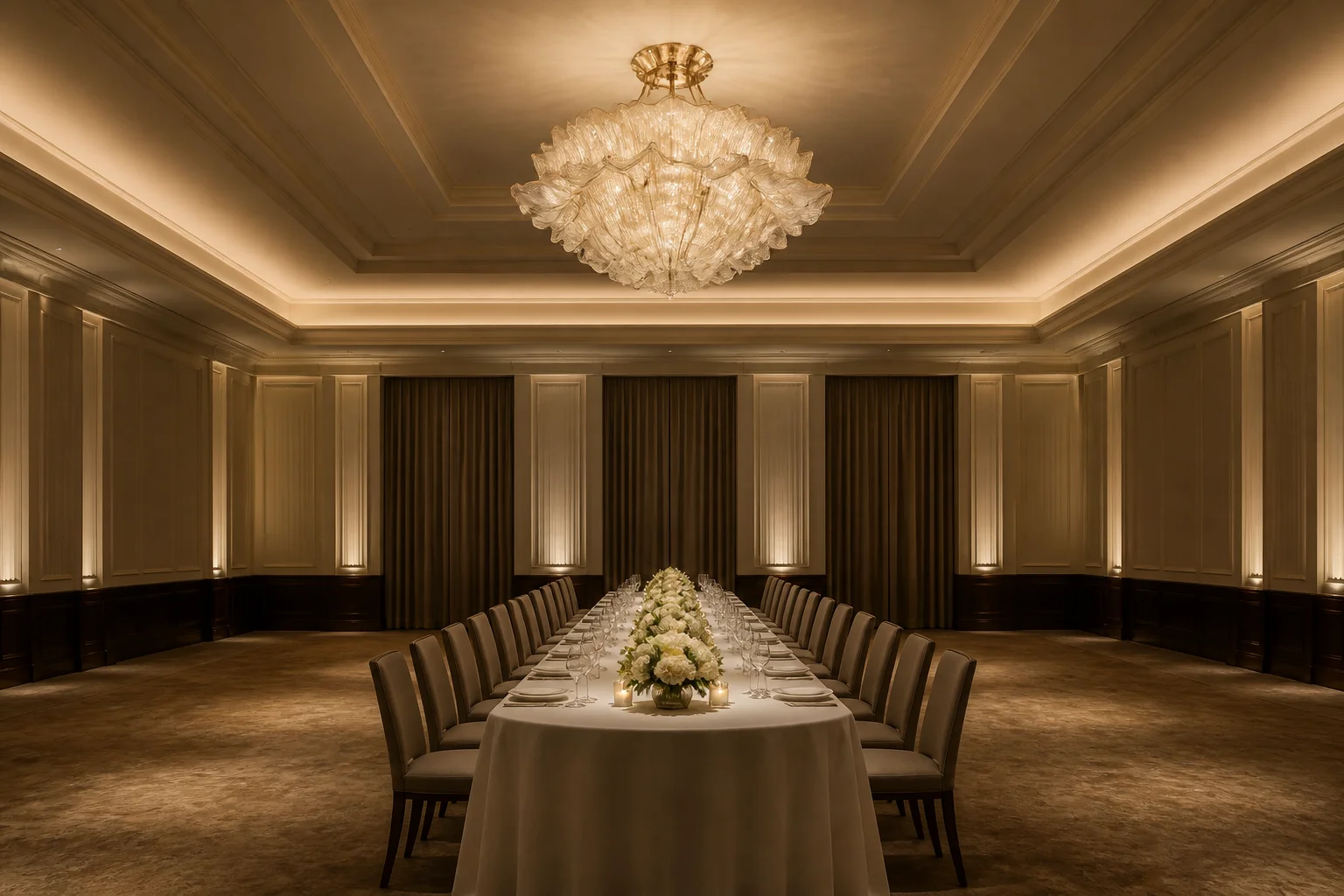
A hotel ballroom at night with one long banquet table beneath a large decorative ceiling centrepiece and a lit cove
An empty ballroom set for dinner: one decorative centrepiece, a lit perimeter cove and dimmed accent light doing three separate jobs.

Why one perfect scene is the wrong brief

A ballroom is usually designed from a render: tables set for dinner, a stage in the corner, the ceiling glowing. It is a beautiful picture and a poor brief: the room is re-set dozens of times a year.

  • The plan changes, the circuits do not. Tables move, the dance floor appears, the stage doubles in width. A circuit layout drawn around the original arrangement keeps lighting the old room.
  • Scene names age badly. Banquet and conference each cover a wide range of programmes, and neither tells an operator what to do when the room is half full.
  • The ceiling is the one thing nobody re-rigs. Everything above head height is permanent, so flexibility must be built into the layers and their controls, not improvised on the day.

Flexibility in a ballroom is not a fixture choice. It is a wiring and control decision taken before a product is selected.

Read the event calendar, not the render

The most useful document at concept stage is not the visualisation. It is a year of bookings, with seat counts and the configurations the sales team really sells.

  • The recurring configurations. Gala dinner, conference plenary, exhibition, wedding, awards night. Ask which half-dozen formats carry the revenue.
  • Where the screens go. Screen positions decide which fixtures drop out during a presentation, and which surfaces must stay matte.
  • Whether the room splits. If a partition can divide the space, each half needs its own lighting and control; shared circuits make that impossible later.
  • Which nights the ceiling matters. Gala nights depend on the decorative layer; conference mornings want the same ceiling dark.

Those four answers become the layer requirement. The render decides how it looks; the calendar decides what it does.

The layer stack that makes flexibility possible

Four layers, each on its own circuit and dimmer, cover almost everything a changing programme needs. The number of independent layers, not fixtures, measures how flexible the room will be.

LayerWhat the event asks of itWhat a fixed installation gets wrongWhat to specify
FunctionalWork light on tables, lecterns and circulationTied to the decorative layer, so it drops when the room dimsIts own circuit and dimmer
Perimeter and coveWashes walls and ceiling so the room reads at full sizeOne switch for the whole perimeter, so half the room cannot be lit aloneA split along the partition line and stage end
AccentPicks out tables, features and the stage edgeAimed once at the original layout and never re-aimedAiming access and a target schedule per group
DecorativeCarries the room's character on the big nightsShares a dimmer with functional light, so it cannot be reduced aloneA group that can fade to a low glow or drop out of a presentation

A shared dimmer between two layers removes both. The commonest mistake is putting the centrepiece on the working-light channel: the room then chooses between character and function all evening.

Beam angle, glare and the centrepiece that fights the screen

In a flat-floored ballroom, sightlines run in every direction: a fixture invisible from the back row at dinner can sit inside the projection path at a conference.

  • Keep the projection corridor clear. Treat the band between screens and back row as a zone no bright source may occupy, and mark it on the ceiling plan.
  • Manage reflections, not only glare. Glossy tables, tablets and printed agendas bounce a downlight back into the room. Matte surfaces and wider beams reduce it more than lower output.
  • Let the centrepiece be reduced without going dark. On its own dimmer it can drop to a low glow while the working layer stays up, which is what a lit-room presentation needs.
  • Re-aim after the first event. Accent positions are a starting point. Budget one aiming visit after the first event.

Meeting rooms: repeatability beats drama

The complaint from meeting rooms is rarely that the light is too dim. It is that the room behaves differently from the identical room next door, so nobody can prepare with confidence.

  • Identical rooms, identical schedules. The same fixture types, positions and scene numbers in every room of a given size.
  • Three buttons, not thirty. A presenter-facing panel with a few states beats a wall of scenes nobody remembers.
  • Light the faces, not the screen. For video calls the useful light falls on the people, not the screen behind them.
  • Coordinate with daylight and blinds. A dimming system that ignores the window fights the blinds all afternoon; agree who runs each.
  • Give the AV team an override. A local, reachable override stops the lighting becoming the reason a session starts late.

Who owns the scene list after handover

Scene programming is not finished when the levels look right on commissioning day. It is finished when the hotel's own team can rebuild an event without the installer.

  • Name every scene in the operator's language. Awards, tables removed tells a duty manager far more than Scene 4.
  • Cap the list. A short, well-named set of scenes gets used; a long one is abandoned within months.
  • Record the dimmer positions. The scene list belongs in the handover file, not only in the controller's memory.
  • Separate user and engineer access. Operators need the scenes; the layer structure should sit behind a different access level.
  • Rehearse one real event. Run the first gala with the AV team and the lighting together, then amend the scenes while everyone is still on site.
The test of a ballroom lighting scheme is not how it looks in the render. It is whether the room can be re-set for tomorrow's programme without a ladder or a phone call.

Service access and what keeps the room working in year five

The fixtures a hotel regrets are rarely the ones that failed to look right. They are the ones nobody can reach.

  • Plan a route to every fixture. Centrepieces, cove runs and high accents all need a cleaning and inspection route that avoids scaffolding in a sold ballroom.
  • Keep driver and control gear accessible. A driver behind a sealed ceiling turns a five-minute task into a closure.
  • Hold a finish reference. Late additions must match the batch installed at handover, so the approved sample belongs in the project file.
  • Leave headroom in the circuits. Adding fixtures later is simpler when no group sits at its limit and one control channel per layer is free.
  • Treat late additions as schedule events. Made-to-order fixtures run on a production window measured in weeks, so a late change of mind is a programme decision, not a shopping trip.

FAQ

How many lighting scenes should a ballroom have?

Enough to cover the configurations the hotel actually sells, and no more. Most ballrooms need a handful: one per recurring format, plus a cleaning state and a presentation state.

Should the decorative centrepiece share a control group with the functional lighting?

No. Its own dimmer lets the room drop the centrepiece to a low glow, or switch it out of a presentation scene, while the working light stays up.

Can a ballroom be split by a partition without a second lighting scheme?

It can, if the circuits already follow the partition line. Where both halves share a circuit, one half cannot be lit alone, and that cannot be fixed once the ceiling closes.

How should a hotel meeting room be lit for video calls?

The camera needs even light on the people, with the screen behind them kept under control. Coordinate with blinds and daylight, and give the AV team a local override.

What is the most common ballroom lighting complaint after handover?

Scenes that do not match the events the hotel sells, and fixtures nobody can reach for maintenance. Both are decided at design stage.

The takeaway

A ballroom does not need more fixtures; it needs more separately controlled ones. Read the event calendar before the render, build four independent layers instead of one beautiful arrangement, and keep the centrepiece on a group that can be reduced without taking the working light with it. Settle the partition split, the scene names and the maintenance route while the ceiling is still open.

Zerouno Lighting (ZeroUNO) manufactures hospitality decorative lighting in Zhongshan, China, and has made project and custom fixtures since 2013. Made-to-order packages run on a production window of roughly 25 to 35 days; stock items ship in one to two days. Learn more at zerounolighting.com.

About the author

Sonny Yu is Sales Manager at Zerouno Lighting, working with hotel owners, designers and project teams on decorative lighting packages. He writes about the rooms guests actually spend time in: how a scheme is layered, controlled and maintained once the hotel is open.

2026年9月29日星期二

Planning Phased Delivery for a Multi-Floor Hotel Fit-Out

A hotel lighting package is signed as one contract and installed as thirty separate rooms. The plan between those two facts is usually assumed rather than written, and that assumption turns a workable order into a run of urgent ones. When every floor is released at once, fixtures arrive faster than the site can receive them, protection gets stripped to save space, and the rooms that open first wait on the rooms that finish last.

This guide is for the people holding that plan: project managers, procurement leads and site teams on a new-build or renovation fit-out. It covers how to derive a delivery sequence from the installation sequence, what must stay identical across every phase, how to hold stock between drops, and the records that stop a phased delivery drifting into a re-order.

Wall sconces and table lamps staged in protective cradles along a hotel corridor awaiting phased installation
Fixtures staged in the corridor ahead of a phased release: the phase that opens first has to be identifiable at a glance.

Why one consolidated drop is the wrong default

A single shipment is the cheapest thing to arrange and often the most expensive thing to receive, because a hotel floor under construction has no spare room. Every carton staged for a floor still being framed stands in the way of the trades on the floor that is ready.

  • Site storage is the binding constraint. Ceilings, carpet and joinery all need the corridor before the lighting can go in.
  • Installation order is not order quantity. Rooms are finished in clusters, and a cluster spanning two floors pulls fixtures from both before either floor is complete.
  • Protection degrades on site. Cradles and foam inserts are designed for transport, not for months of stacking in a service corridor.
  • The later phases inherit the earlier mistakes. A mislabelled carton found on the last floor means returning to rooms already signed off.

Phasing is not an extra cost loaded onto the order. It is the schedule control that keeps one contract from becoming several urgent ones.

Derive the release sequence from the installation sequence

The delivery plan should follow the way the building is handed over, not the way the factory prefers to load a container.

  • Start at the opening date and work backwards. Establish which floors must be guest-ready on day one, which can be completed behind hoarding, and which are soft-opening rooms.
  • Group by room cluster rather than by floor. A room type spread across two floors needs its fixtures together, or neither floor can be signed off.
  • Name a physical trigger for each phase. A floor released by the wet trades, a ceiling grid closed, or a mock-up room signed off. A calendar date is not a trigger.
  • Test every trigger against the production window. Made-to-order lighting runs on a fixed window, so a trigger that slips two weeks moves every phase behind it.
  • Mark what cannot be split. Long-lead specials and shared driver batches may have to travel together even when the rooms are separate.

A sequence built this way becomes the document the factory plans against and the site team can be measured against. When a trigger moves, the effect on later phases is visible instead of discovered on site.

A phase matrix you can issue with the order

Most projects need three to five phases. The matrix below is a starting point; the last column is the one that matters, because a phase released without a fixed reference drifts in exactly the way the matrix exists to prevent.

PhaseWhat it coversRelease triggerWhat must be fixed before release
Phase 0Mock-up or pilot room setMock-up room signed offApproved sample, finish and installation detail
Phase 1Floors that open firstFloor released by wet trades, grid closedRoom-by-room quantity list and carton marking
Phase 2Mid-block floorsPrevious phase installed and checkedNote of any change agreed after phase 1
Phase 3Final guest floorsAccess and corridor protection in placeBatch and finish reference for the rest
Phase 4Spares and replacement stockHandover schedule agreed with operatorSpare list, storage location and named owner

Issue the matrix with the purchase order, not after production starts. A phase list circulated once goods are in build describes what happened rather than planning it.

What has to stay identical across every phase

Phasing splits deliveries, not the specification. The risk is that a package released in four drops drifts into four versions of the same fixture, and the difference only shows once the floors are lit together.

  • One approved sample governs every phase. Later batches are compared against the signed reference, not against a colour described in an email thread.
  • One finish reference and one grain direction. A different polishing run can read as a different tone under corridor lighting installed months earlier.
  • One driver and control specification. A substituted driver in the final phase can behave differently at low output on the same dimmer.
  • One labelling scheme. Room or cluster marking has to mean the same thing in phase 1 and phase 3, or the site team re-sorts every drop.
  • One revision record. The drawing revision each phase was built from belongs in the phase file, because it usually moves at least once during a fit-out.
The test of a phased delivery is not whether each drop arrived on time. It is whether a guest in a room from the last phase sees the same fixture as a guest in a room from the first.

Holding stock and protection between phases

The gap between two phases is where most damage happens, because nobody is watching the goods. Two decisions cover most of it: who holds them, and what happens to the packaging.

  • Who holds what. Stock kept at the factory, at a forwarder's warehouse or on site carries different handling risk and a different owner.
  • Protection stays fitted. Shade film and cradle inserts should come off at the point of installation, not when cartons are opened for counting.
  • Count on receipt, in writing. Each phase needs a signed count against the phase list, with shortages reported while the factory still has that batch.
  • Keep one reference unit reachable. An unopened sample from phase 1 settles any later comparison in seconds.

The controls that keep phases from drifting

Three habits do most of the work.

  • Phase file, phase sign-off. Each drop gets a short file: phase list, revision, count sheet and inspection result. The next phase is not released until the previous file is closed.
  • One contact, one channel. Sites lose weeks to instructions split across calls, chat messages and site diaries. Put delivery instructions in writing to one named contact on each side.
  • A weekly phase review. Fifteen minutes comparing planned triggers against site progress, so a phase moves while there is still production time to absorb it.

Where the phase plan is respected, the package can still be produced to one schedule. The production window applies to the order rather than to each drop: stock items ship in one to two days, made-to-order lighting runs on a window measured in weeks.

FAQ

How many phases should a hotel lighting delivery be split into?

Three to five covers most multi-floor projects: a pilot set, the floors that open first, one or two mid-blocks, and a final block with spares. More phases ease site storage but add handling and freight events, so split only where the sequence needs it.

Does phasing cost more than a single delivery?

It adds freight movements and administration, and can reduce total cost by cutting site storage, re-handling and rush replacements. Treat it as a schedule decision rather than a purchasing one, settled inside the delivery scope.

What if the installation sequence changes after the order is placed?

Re-issue the phase matrix and confirm which releases are already fixed in production. A phase not yet in production can usually be resequenced; one already built follows the original sequence unless the site can hold it.

Can spares ship with the first phase?

They can, and it is often the better call, because spares ordered with the main batch carry the same finish reference. The trade-off is site storage, so agree the location and owner with the phase list.

Who should hold the phase records?

The project team keeps the signed record on site and the supplier keeps the matching file against the article numbers ordered. Two copies of one phase file turn a shortage or a damage claim into a five-minute conversation.

The takeaway

A multi-floor fit-out is installed room by room, so the lighting should be released the same way. Derive the sequence from the installation sequence, put a physical trigger behind every phase, and issue the phase matrix with the order rather than after production starts. Hold one approved sample, one finish reference and one labelling scheme across every drop, and close each phase file before releasing the next. Phasing then stops being a complication and becomes the control that keeps one package from turning into a run of emergency orders.

Zerouno Lighting (ZeroUNO) manufactures hospitality decorative lighting in Zhongshan, China, and has produced project and custom fixtures since 2013. Made-to-order packages run on a production window of roughly 25 to 35 days, with stock items ready in one to two days. Learn more at zerounolighting.com.

About the author

Sonny Yu is Sales Manager at Zerouno Lighting, working with hotel owners, designers and site teams on decorative lighting packages. He writes about the delivery side of a project: how a package is sequenced, released and documented so that what arrives matches what was approved.

Hotel Lighting from China: What to Verify After You Order

Choosing a supplier is the decision everyone prepares for. The order that follows gets far less attention, and that is where most of the avoidable problems sit: a finish that drifted from the approved sample, a balance paid against a date instead of a milestone, a document set that arrives after the goods, or a delivery term loose enough to argue about.

This guide is for procurement leads and project managers who have chosen a supplier, likely in China, and are now writing the order. It sets out what to fix before the deposit leaves, how to attach payments to verifiable checkpoints, what the inspection right buys you, which documents travel with the goods, and where the risk changes hands.

A brass wall sconce on a foam pad beside its driver module and three loose screws on a workshop bench
A finished fixture staged with its driver and hardware: the release a payment milestone should be tied to.

Why the verification work starts after the supplier is chosen

Selection answers one question: can this factory make the fixture to the standard the project needs. It says nothing about whether this particular release will match what both sides agreed. Those are different risks, surfacing at different times.

  • Specification drift. A quotation is priced against a drawing revision. When the drawing moves and the order does not, the factory builds one version and the site expects another.
  • Terms left open. Who books freight, what the price covers, how long it holds, what happens if material costs move. Silence is not agreement; it is a dispute with a delay attached.
  • Document gaps. Files naming a product series rather than the ordered article, or predating a component change, are treated by the site team as missing.
  • Logistics assumptions. Both sides assume the other is arranging something, and the discovery happens once the container is at the port.

Every one of those is cheap to close while the order is a document and expensive once it is a shipment.

The commercial frame to settle before the deposit moves

Six items do most of the work. None is legal boilerplate; each closes a specific way an order goes wrong.

What to settleWhy it mattersWhat a clear version looks like
Revision referenceA quotation is valid only for the drawing it was priced againstThe order names the revision and its pricing date
Scope boundaryDrivers, hardware and spare parts are quoted in or out by habitAn explicit included and excluded list sits in the order
Delivery term and named placeA term without a place does not fix where responsibility changesTerm plus a named port, terminal or warehouse, and who books freight
Payment milestonesA schedule built on calendar dates pays for elapsed time, not progressEach instalment tied to an event you can verify
Price validity and variationMaterial and freight move; an open-ended price invites argumentA stated validity window and a named re-quote trigger
Tooling and sample ownershipTooling and samples are paid for once; ownership is not automaticThe order states what is chargeable and who holds tooling and sample

Tie each payment milestone to a physical checkpoint

The most common order failure is not a bad factory. It is a payment schedule that cannot fail, because nothing objective sits behind each instalment.

  • Sample approval: the single-piece sample signed against the drawing revision, with the sign-off recorded.
  • Production release: material issued and first articles checked against that sample before the run continues.
  • Pre-shipment pass: the inspection result recorded and shared before the balance falls due, not after.
  • Booking confirmation: freight booked against a stated sailing date, with the place named in the term.
  • Document set: the file that travels with the goods, complete and matching the order.

Where the balance is due before departure, the inspection should sit ahead of it. If it sits after, the payment rests on nothing you have seen.

An order is not verified at the port. It is verified the moment the drawing, the sample, the payment and the packing list describe the same thing, and the cheapest moment to check is before the deposit leaves.

The inspection right, and what it can settle

How to run a pre-shipment inspection is a subject of its own. At order stage the question is narrower: what the right to inspect buys you, and what it costs when used.

  • Who inspects. A third party, your own representative, or the factory's recorded checks. Decide before pricing, because a third-party visit adds days.
  • Notification window. How much notice the factory needs, so goods are packed but not yet sealed into a container.
  • What happens on a fail. Whether production is reworked, rechecked or paused, and who decides.
  • Who bears a second visit. A re-check costs money and days; say in advance who carries it.
  • The record. Photographs, measured dimensions, packing state and date, stored with the order file, not in a message thread.

An inspection right with no stated consequence is a preference. With a named remedy it is a term, and that term keeps a delivery date honest.

The document set that has to travel with the goods

How the goods are protected and labelled in transit is covered elsewhere. What matters here is the file: a fixture arriving without its paper is a fixture the site team cannot sign off.

DocumentWhat it should nameWho relies on it on site
Invoice and packing listThe article numbers and quantities on this orderCustoms and the receiving team
Approved drawing and revisionThe exact version the order was built fromThe installer and the site engineer
Sample recordThe sample reference and its approval dateWhoever checks first deliveries against the approved version
Submittal fileThe technical documents the specifier agreed toThe consultant's approval file
Installation instructionsMounting and connection guidance for this articleThe electrical contractor
Spare parts and warranty statementWhat is supplied, and what you agreed covers itFacility and maintenance teams

Two boundaries matter. Marking regimes and substance documentation form a separate compliance file, requested for the models actually shipped. A document naming a product family rather than the ordered article is treated as absent, even if it exists.

Shipping terms, and where the risk changes hands

The commercial term is the part of an order most often reduced to three letters. That is where the ambiguity concentrates.

  • The production plan and the sailing date. Made-to-order lighting runs on a production window, so booking freight before production ends moves the risk of a missed vessel onto you.
  • The named place. Without a named place the handover point is undefined. Write the port, terminal or warehouse into the order.
  • Clearance and insurance. Customs clearance and cargo insurance sit outside the transport itself. Name the party responsible for each.
  • Consolidation. Mixing this order with others reduces freight but complicates a damage claim, because responsibility is split.
  • Arrival checks. Agree how quickly goods are checked after arrival, and how long you have to report damage.

These lines decide whether a delay becomes a commercial event or a dispute. Writing them takes minutes; reconstructing them after a missed vessel takes weeks.

FAQ

Should the balance be paid before or after the inspection?

Inspection first is the cleaner sequence, because the payment then sits behind a verified result. Where the factory needs the balance before departure, move the inspection ahead of it.

What does a delivery term such as FOB or DDP actually decide?

It decides where responsibility for the goods changes hands and which costs sit with which party. It does not decide the price, or who clears customs and insures the cargo.

Do I need a third-party inspection on a decorative lighting order?

Not always. On a repeat order built to an approved sample, the factory's own records with a first-article check may be enough. What matters is that the right exists in the order.

Which documents should arrive before the goods?

At minimum the packing list, the invoice and the approved drawing revision, so the receiving team can match the delivery to the order. The submittal file and sample record are best settled before production is released.

What if the delivered finish does not match the approved sample?

That is why the sample record matters: the comparison is made against the signed sample and its revision, not a colour description in an email. Agree in advance how long the factory has to correct a deviation before the delivery date is at risk.

The takeaway

The order stage is where a good supplier choice is protected or wasted. Fix the six commercial items before the deposit, attach every payment to something verifiable rather than a date, and decide what the inspection right means when it fails. Then check that the document set names the article being shipped, and define the delivery term precisely enough that both sides agree where responsibility moves. None of it is complicated, and all of it is cheaper before the goods leave than after.

Zerouno Lighting (ZeroUNO) manufactures hospitality decorative lighting in Zhongshan, China, and has produced project and custom fixtures since 2013. Orders are built against a single-piece sample approved before the run is released, with made-to-order windows of 25 to 35 days and stock items ready in one to two days. Learn more at zerounolighting.com.

About the author

Sonny Yu is Sales Manager at Zerouno Lighting, working with hotel owners, designers and procurement teams on decorative lighting packages. He writes about the part of a project that happens after the design is agreed: how an order is written, verified and documented so what arrives matches what was approved.

2026年9月28日星期一

Hotel Lighting Metal Finishes: Brass, Steel or Aluminium

A lighting schedule can run to fifty pages and still leave one line almost empty. "Brushed brass" is not a specification: it does not say which brass, which process produced the surface, how the grain runs, or what the approved version looked like. The gap rarely shows up in a showroom. It shows up on site, when the wall lights in one wing read warmer than those in another, or when a replacement arrives in a tone that no longer matches the corridor.

This guide is for the specifiers and procurement leads closing that gap before an order is released: how to choose between the metal families decorative lighting uses, why substrate and finish route are separate decisions, and how to write and approve a line a factory can hold.

Brushed brass, satin steel, aluminium and polished chrome sample plates on a workshop bench
Four finish routes read side by side in the light the room will use: differences that vanish on a schedule are obvious on a bench.

Why the finish line is the least specific line on a lighting schedule

A finish is the one attribute everybody can see and almost nobody records precisely. It is agreed at a sample meeting, described in a word, then expected to travel unchanged through a quotation, a shop drawing, a production order and a replacement order years later.

  • Agreed by eye, recorded in words. A decision reached by holding two parts together becomes "soft brass" in the minutes, and the room for interpretation opens at that moment.
  • Issued before the finish is settled. The schedule is written to release the package, and "to be confirmed" is rarely confirmed later.
  • Vocabulary is not standardised. Satin, matte, brushed and antique mean different things to different suppliers, so one instruction can produce surfaces that do not sit together.

The fix is a line that describes a process and a reference rather than a mood.

The three metal families and where each one belongs

Most hotel decorative lighting settles into three metal families. They are not interchangeable, because each behaves differently under daily contact, humidity and cleaning. The family is the first decision; the finish route is the second.

Metal familyWhere it usually belongsWhat to watch in serviceWhat the factory needs
Brass and bronzeDry guest-facing fittings: bedside, corridor, lobby, restaurantColour shifts with handling and air; unlacquered surfaces patinateThe tone, the route, and whether the surface is sealed
Stainless steelHigh-contact positions: public areas, bar fronts, exterior doorsGrade matters more than finish; some environments spot soonerThe grade and the surface direction, stated not implied
AluminiumHidden structure and larger bodies where weight is a constraintSofter under impact; the coating route decides how it wearsThe alloy and coating route; a bare surface is rarely acceptable

Keep one family per visual line, and state the grade explicitly: one family name can cover materials that age quite differently.

Substrate and finish route are two separate decisions

A finish cannot be repeated when the specification named a colour and left the process open. Colour is the outcome; the route is how the surface is produced, and the route is what a factory has to hold.

Finish routeTypical lookRepair on siteBest suited to
Mechanical: brushed, satin, polishedMetal seen directly, with a visible grain or sheenLocal marks blend, but touch-ups show in raking lightSurfaces guests touch and inspect close up
Plated: chrome, nickel, gold toneBright, uniform, highly reflectiveDifficult; plating covers the whole partFormal interiors where uniformity is the point
Vacuum coated: PVD tonesHard-wearing coloured metal, including gold and blackDifficult once damaged; chosen for staying powerHigh-contact fittings in busy public areas
Painted or powder coatedOpaque colour that hides the metal beneathComparatively easy to touch up at handoverColoured bodies, service areas, concealed parts

Within mechanical finishes, one further variable decides whether two batches match: grain direction. Two parts brushed differently can read as two colours under the same lamp, so write the direction in rather than leaving it to habit.

Match the finish to the room, not to the showroom

A finish approved on a sample board under flat light is judged in the easiest conditions it will ever meet. The useful test is the room itself.

  • Dry guest-facing rooms. Bedside and corridor lighting is seen close up, so grain direction matters most here.
  • Wet rooms. Bathrooms expose metal to moisture and cleaning products, so the surface and its sealing decide how the fitting looks in year three.
  • Public touch points. Door pulls, bar fronts and lift surrounds are handled constantly, pushing the choice towards harder-wearing routes.
  • Exterior and coastal positions. Facade and terrace fittings face the harshest conditions, so grade and coating matter more than tone.
A finish is not approved on a sample board. It is approved in the room, at the distance the guest will see it, in the light that room will run every evening for the next ten years.

What actually drives the cost of a finish

Finish cost is rarely about the metal. It is about how often a part is handled and how much of it must be perfect, which is why a finish change is a quotation event rather than a colour choice.

  • The route itself: a mechanical finish and a vacuum-coated one are different operations with different equipment and rejection rates.
  • Part geometry: flat plates are straightforward; long arms, tight corners and deep recesses are not, because tool access limits consistency.
  • Coverage and split: a visible face only or every face the installer sees, and one batch or several runs weeks apart.
  • How many finishes sit in one order: each extra finish adds a setup, a batch check and a place for a mix-up at packing.
  • The reference sample and who holds it: a physical reference both sides keep is cheaper to reproduce than a photograph in an email thread.

A finish question answered late costs more than one answered at specification stage. Where a change arrives after the order is released, the useful reply is a decision rather than a preference: accepted, rejected, or accepted subject to a new sample.

Writing and approving a finish line a factory can hold

A finish line is complete when it removes the need for a conversation, and the approval step is where it stops being an opinion and becomes a record that still describes the same surface months later.

  • The family and the grade, named explicitly rather than described by tone.
  • The process route, for example brushed, satin, plated or coated, stated as a method and not only a colour.
  • The grain direction where a mechanical finish is used, and the sheen level as a comparison to the retained sample.
  • The reference and revision the finish is measured against, and which faces are finished.
  • The cleaning assumption, so the surface suits the products housekeeping will use.
  • View the sample in the room's own light and at the guest's own distance, not on a desk under a task lamp.
  • Sign the sample itself, not only the paperwork, and retain copies with the factory and the project under the same revision number.
  • Check the first production articles against that sample before the run continues.

At later phases, re-approve against the retained sample rather than the paperwork: a signed plate settles the question in seconds.

FAQ

Is brushed brass the same finish from every supplier?

No. The term covers a family of surfaces made by different abrasive routines and sealing choices, so two suppliers can both deliver brushed brass and still differ visibly. Specify the route.

Can a finish be touched up on site after handover?

It depends on the route. Painted and powder-coated surfaces are usually repairable, while plated and vacuum-coated ones generally are not, so those belong where handling damage is unlikely.

How do we keep a later phase matching an earlier one?

Retain the signed sample with its revision number, and re-order against the sample rather than the original colour description. On an occupied property, judge the match in place: the installed fittings have aged too.

What belongs in the finish section of the submittal?

The signed sample reference, the family and grade, the process route, the grain direction where relevant, the sheen comparison, and the approval date with the name of the signatory.

The takeaway

Metal finishes fail projects for documentary reasons more often than for manufacturing ones. Name the family and grade, choose the route deliberately, and write grain direction and sheen into the schedule instead of leaving them to habit. Place each finish by the room it lives in, so wet areas and exteriors are not judged by the standard set in a dry guest room. Then approve one signed sample, retain it with a revision number on both sides, and check the first production pieces against it. The finish line then becomes the line that settles arguments instead of starting them.

Zerouno Lighting (ZeroUNO) manufactures hospitality decorative lighting in Zhongshan, China, and has produced project and custom fixtures since 2013. Finish decisions are agreed on a single-piece sample before a run is released, and the approved sample is retained so a later batch can be checked against the version the project signed off. Learn more at zerounolighting.com.

About the author

Sonny Yu is Sales Manager at Zerouno Lighting, working with hotel owners, designers and procurement teams on decorative lighting packages. He writes about the decisions between a design intent and a delivered fixture: finishes, dimensions, and the documents that keep the two aligned.

Hotel Lighting Certificates: Which Marks a Project Needs

Decorative lighting is bought long before it is inspected. The specification is agreed, the order is placed, and the certificate question arrives months later, usually from a contractor who needs the file before the ceilings close. By then the drawings have moved on and the person who agreed the finish has left the project.

This guide is for the procurement leads, project managers and electrical consultants assembling that file. It maps which mark applies in which market, what each mark actually covers, who carries the obligation, and what to request for each fixture family. It deliberately stops at the marks themselves, because substance restrictions such as RoHS and REACH are a separate pack with their own logic.

Brass wall sconce with off-white fabric shade on a workshop bench beside its LED driver and a plain folder
A model-level document, not a brand-level statement, is what the approval file has to describe.

Why the certificate question arrives late in a lighting package

A luminaire is not one product with one certificate. It is a housing, a driver, an LED module, a switch or control, and sometimes a battery or a radio module. Each part can carry its own approval, and the marking on the finished fitting depends on how those parts are combined and on where the fitting is sold.

That is why the file gets assembled at the end rather than specified at the start. Three things push it late:

  • The destination is not final. A specification written for one market is often re-sold into a second one, which brings a second marking regime with it.
  • The product changes. A new finish is usually harmless, but a new driver, a wireless control or a rechargeable variant changes what the fitting needs.
  • The obligation sits with whoever places the goods on the market. That party may be the buyer, the importer or the local distributor rather than the factory.

None of those is a fault in the design. They are reasons to settle the marking question before sampling rather than after delivery.

Which mark applies in which market

The table is a starting map, not a substitute for advice on a specific project. Marking regimes change, and the transition arrangements between them are a subject of their own.

MarkMarketWhat it indicatesWhat it does not cover
CEEuropean UnionThe manufacturer declares the product meets the applicable EU directives, with a technical file behind that declarationPerformance, build quality, or that an outside body has examined the fitting
UKCAGreat BritainThe UK's own conformity marking, applied under UK rulesNorthern Ireland, or acceptance of a European file without checking the rules in force
UL listingUnited States and CanadaA third party has examined the product against a safety standard, at a named factoryAnything outside the listed product family, or a different manufacturing site
SAA / RCMAustralia and New ZealandElectrical safety approval inside the local framework, with RCM as the mark seen on the productOther markets, and fittings outside the approved scope

Two entries deserve caution. The UK regime has been through several transition arrangements, so a European file that was accepted two years ago should be re-checked rather than assumed. And "SAA" is trade shorthand: the regulatory requirement in Australia sits in the RCM framework, and an approval is held against a product and a responsible supplier rather than against a brand.

The mark, the listing and the factory

For a European market the manufacturer applies the mark itself and holds the technical file. That is a declaration route, and its strength rests on what is behind it: test reports, component approvals, a risk assessment, and a drawing that matches the version being shipped.

North America works differently because the approval is issued by a third party. A listing belongs to a construction and to a manufacturing location. Move production, change the driver, or add a variant that was not in the examined construction, and the listing may no longer describe what is on the pallet. Buyers who treat a listing as a brand-level attribute are the ones who discover this at inspection.

A certificate describes a product, a construction and a place of manufacture. When any one of those three changes, last year's paper may be describing a fitting nobody is buying any more.

What to collect for every fixture family

Ask for the file per family rather than per order, and keep it beside the approved drawing set instead of in a folder nobody opens.

  • The model reference, matched to the order. The document should name the article number or family on the purchase order, not a generic series name.
  • The construction it covers. Driver, control gear, and any battery or radio module forming part of the fitting.
  • The responsible party. Who declared it, who issued the approval, and who is placing it on the market in the destination country.
  • The date and revision. An undated file cannot be checked against the drawing revision the order was built from.
  • The format the site team can actually use. A file nobody on site can open or read is treated as a missing file.

Where the marking argument usually starts

Most of these disputes are not about whether a fitting is compliant. They are about whether the paper in the folder describes the fitting on site.

  • A brand-level statement is offered where a model-level document was requested.
  • The paper predates a driver change, so the construction inside it is no longer what is being built.
  • The mark is reproduced on a drawing or a brochure, which is not where conformity is evidenced.
  • The importer is not named, so nobody can point to the party carrying the obligation.
  • Radio and wireless controls are treated as an accessory, when they bring their own requirements with them.

Every one of those is settled by a single habit: keep the file attached to the model and the drawing revision, and re-issue it when either of them moves.

FAQ

Does CE marking mean a fitting has been tested by an outside body?

Not necessarily. For most luminaires the manufacturer declares conformity and keeps the technical file. Test reports may sit behind that declaration, but the mark itself is not evidence that a third party examined the product.

Can a North American listing be transferred to another factory?

No. A listing is issued to a specific construction at a specific manufacturing location. Moving production to another site is a change to be handled with the certification body, not assumed.

Is one certificate enough for a multi-country project?

Rarely. Marking regimes are national or regional, so a project spanning Europe, the UK, North America and Australia normally needs a file per destination, each matched to the models shipped there.

Who should hold the compliance file?

The party placing the goods on the market in that country, which is often the importer or the distributor rather than the factory. In practice, the procurement lead holds a copy matching the order and the site team holds the same revision.

What changes a luminaire's certification position?

The driver, the control gear, a wireless module, a battery, and the manufacturing site. Decorative detail usually does not. When any of the first group changes mid-project, ask for the file again rather than applying the previous one.

The takeaway

A compliance file is only useful if it describes the fitting actually being delivered. Decide the destination markets before sampling, map each one to the mark it needs, and collect the documents per fixture family rather than per brand. Name the party carrying the obligation, and re-issue the file whenever the driver, the control or the manufacturing site changes. Handled that way, the certificate question stops being a last-minute problem and becomes one of the package's ordinary submittals.

Zerouno Lighting (ZeroUNO) manufactures hospitality decorative lighting in Zhongshan, China, and has produced project and custom fixtures since 2013. Fixture families and their construction are fixed before a run is released, which is what keeps the model reference on an approval file matching the article on the order. Learn more at zerounolighting.com.

About the author

Sonny Yu is Sales Manager at Zerouno Lighting, working with hotel owners, designers and procurement teams on decorative lighting packages. He writes about the paperwork that travels with a custom fixture: how a model reference is kept intact between drawing, order and approval, and why a document describing last year's construction causes more trouble than no document at all.

2026年9月27日星期日

Hotel Lighting Specification Changes: What Designers Revise

A hotel lighting specification is rarely signed once. The version a factory builds from is usually not the first one. The fitting itself hardly changes. What changes is a finish, a fixing detail, the quantity per room type, or the way the light is switched on.

This guide is for the designers, project managers and procurement leads who absorb those revisions without losing the schedule or the price. It separates the changes that cost nothing from the ones that restart sampling, and shows how to record them so the drawing set, the quotation and the order still describe the same fitting.

Finish sample plates, a machined bracket and a wall light arm laid out on a workshop bench
Most revisions arrive as a substitution: the same fitting in a different finish, a different bracket, or a different diffuser.

Why a specification keeps moving after the first issue

The first issue of a lighting specification is a direction, not a construction document. It is written while other packages are still open, which is why it moves. The cost plan is reviewed and a package has to come down. A material turns out to be on a longer lead time than the programme allows. Ceiling services are coordinated and the fitting no longer has the space it was drawn into. Or the mock-up room is built, and something that looked right on paper does not in the room.

None of those drivers is a mistake. What turns them into a problem is treating each one as an instruction to change a drawing. A specification that moves without a record ends in a familiar position: the quotation describes one version, the workshop holds another, and nobody can say which was approved. The fix is not fewer changes but better ones.

The five changes that reach the factory on almost every project

Revisions are easier to manage once they are grouped by what they touch. Almost all of them fall into five classes, and each behaves differently once sampling has started.

ChangeWhat it looks like on the drawingsEffect on sampling and toolingWho signs it
Substitution of a finish or materialSame family, another tone, grain or plating route, or a shade from another millAbsorbed if the process route is unchanged; a new diffuser or shade means a new sampleDesigner, against the retained sample
Dimensional adaptation at the fixingBackplate, projection or cut-out adjusted to the substrate foundAbsorbed while the profile is reused; a new profile means new toolingDesigner with the site team
Quantity and room-type re-spreadCounts move between room types after the room list is finalisedNo effect on tooling, but labelling and packing lists change with itProcurement or FF&E lead
Control, switching or chargingA different dimming protocol, a moved switch, or a rechargeable variantAbsorbed during design; later it changes the driver or battery and the bracketProject manager with the electrical consultant
Tone or light qualityA warmer or cooler light family, or a softer diffuserDepends on what changed: a diffuser re-samples, a driver is checked against the control protocolDesigner, with the lighting designer

The table is a rule about time rather than cost. Sorting a revision into the right class before it is issued is what keeps the sample programme on its original dates.

What is absorbed inside a sampling cycle, and what restarts it

A change can be made to a drawing in an afternoon. Made to a part, it means a sample that has to be produced, shipped and looked at. That is the real cost of a late revision.

  • Restarts sampling: a new profile or a change to the forming tool; a different diffuser, shade or glass; a move between mains and battery power; a different plating process rather than another colour within it.
  • Does not restart sampling: a quantity change; a room-type re-spread; a relocated switch; a like-for-like substitution in the same finish family and process route.
  • Needs a decision rather than a sample: a tone change where the diffuser stays the same. Confirm it against the approved light family and record it.
  • Needs the site rather than the factory: the substrate, the fixing or the cable route. A fixture is buildable only once the wall behind it is known.
A revision is routine when it can be made to a drawing. It becomes a re-sample the moment it has to be made to a part, and no amount of urgency changes the order in which those two things happen.

The substitution that looks routine and usually is not

Finish substitutions arrive in the most innocent language: the same brass, a slightly softer sheen, a shade in a material that is easier to buy. They are also the change most likely to be approved by email and then forgotten by the drawing set.

Three checks catch almost all of them. Look at the new finish beside the retained sample, in the room where it will be seen at close range, not on a screen. Confirm the process route is the same: another colour within one process behaves predictably, the same colour produced another way does not. And tell everyone holding a copy of the finish schedule, since a finish used in bedrooms is usually used elsewhere in the property too.

Consistency between production batches is settled with the factory rather than on the drawing. What belongs here is simpler: a substitution is a specification event, and it should leave a trace in the document set, not only in an inbox.

A revision log that keeps drawing, quotation and order aligned

Most disputes on a decorative lighting package are a document problem rather than a manufacturing one. A quotation prepared on the second revision, a workshop building the fourth and a packing list written from the third delivers the wrong quantity in the wrong finish, without anyone making an obvious mistake.

A one-page revision log prevents it. Five fields are enough:

  • Revision number and the change, described as what it replaces, not only what it becomes.
  • Who requested it and the date agreed, with one named person per revision rather than a thread.
  • Which documents it touches: shop drawing, finish schedule, quotation line, packing list.
  • Whether it sits inside or outside the quoted scope, recorded at approval, not at invoicing.
  • The sample it is measured against, so the approved version is identifiable months later.

Keep the log with the drawings rather than beside them. A revision that cannot be found in the set a workshop is working from has not really been issued.

How to keep a revision from becoming a re-quote

A quotation is easier to live with when its structure anticipates revisions. A single lump sum reopens the whole number at every change. If the sample, the tooling and the units are quoted as separate lines, a revision can be aimed at the line it affects and the discussion stays there. Agree with the factory, before sampling starts, what counts as like-for-like and what counts as new work.

When a factory proposes a substitution, a decision is more useful than a preference: accepted, rejected, or accepted subject to a new sample. That reply takes a minute and removes the most common reason a fixture arrives in a finish nobody chose.

FAQ

How many revisions should a lighting specification go through?

There is no correct number, and a project claiming to have had none is usually one where changes were never recorded. What matters is that each revision is numbered, owned and reflected in the documents the workshop builds from.

Does a finish change always mean a new sample?

Not always. Within the same process route, a tone change can often be confirmed against the retained sample. A different process, material or sheen usually cannot, and belongs in a new sample before the order is released.

Can quantities be changed after the order is placed?

They can move, and the phase plan is where that is agreed. Shifting units between shipments is normally straightforward; adding them late is a production question.

Should the designer approve every revision?

Not every one, but one person should own the specification. The designer signs the appearance, the project manager the programme and procurement the money, and the log records all three so a change cannot be argued from memory.

What does a factory need to price a change quickly?

The revision number it supersedes, the line or part affected, and the date the answer is required. A change described against a drawing revision can be priced in the same conversation.

The takeaway

A specification that changes is normal. What separates a smooth package from a difficult one is whether each change was classified, recorded and approved by one owner. Sort every revision by the part it touches, treat anything needing a new part as a new sample, and log the five fields against the drawing set. The fixture on the wall will then be the version everybody agreed to.

Zerouno Lighting (ZeroUNO) manufactures hospitality decorative lighting in Zhongshan, China, and has produced project and custom fixtures since 2013. Single-piece sampling is available before a run is released, which is what makes a revision visible as a part rather than a line on a drawing. Learn more at zerounolighting.com.

About the author

Sonny Yu is Sales Manager at Zerouno Lighting, working with hotel owners, designers and procurement teams on decorative lighting packages. He writes about the stage where a specification is still open: substitutions that arrive by email, drawings that no longer match the quotation, and the document habits that decide whether a custom fixture is delivered as agreed.

Rechargeable and Plug-In Wall Lights for Hotel Retrofits

A guest room goes into refurbishment with a new headboard and a lighting plan that shows a slim wall light each side of the bed. Then the drawings come back: solid wall, no back box, a tiled bathroom on the far side, and a corridor that cannot be closed for chasing and inspection. Reopening that wall means dust control, electrical sign-off and rooms out of service for longer than the programme allows. So the conversation moves to rechargeable and plug-in wall lights.

This guide is for the hotel owner, project manager and procurement lead solving a lighting problem in a building that already exists. It covers the retrofit routes that avoid chasing the wall, what each commits the hotel to operationally, and how to sign the arrangement off before it is repeated across forty rooms.

A rechargeable hotel wall light with its head lifted off the wall bracket, above a charging dock on the bedside table
The head lifts off the bracket to charge, which is what removes the need for a circuit at the bed position.

Why a retrofit changes the lighting question

In a new build, the fixture is chosen first and the wiring follows the design. In a retrofit the order is reversed: the wall is fixed, the finishes are done, and the fixture has to live with conditions nobody designed it for. Three questions then move to the front of the specification.

  • Power becomes an operating decision, not a technical footnote. If the light is not on the mains, someone has to charge it and keep it lit.
  • The mounting detail decides whether the design is possible at all. Hollow plasterboard on steel studs, plaster over blockwork and a tiled wall are three different projects.
  • The guest-handling case matters as much as the light. A fixture a guest can unhook or take away will not survive a year of operation.

The four ways to put light on an existing wall

The table compares the routes that avoid opening the wall, what each one needs from the building, and the consequence that follows. It does not replace a lighting design; it narrows the options before a designer is asked to approve one.

RoutePower sourceWhat it needs from the wallOperational consequence
Rechargeable wall light with a removable headBattery in the head, charged off the fixtureOne fixing point; no cable, no back boxCharging location and spare rotation
Plug-in wall lightCord to an existing socketA socket within reachCord routing, socket sharing, appliance testing
Surface trunking to a wired fittingMains via surface containmentA containment run and an isolatorVisible containment accepted by the designer
Existing point re-aimed or repositionedThe circuit already thereNothing new on the wallWhether the result justifies no wall light
Light integrated into new joinery or a mirrorLocal supply in the new unitJoinery able to carry the fixtureJoinery lead time and maintenance access
The power source stops being a technical footnote the moment the wall cannot be opened. It decides who charges, who cleans, how the fixture is replaced, and whether housekeeping can keep it lit at all.

What each power option commits the hotel to

The specification is only half the decision. The other half is the routine the option creates, and that routine stays with housekeeping for the life of the room.

Battery fixtures with a removable head

These work when the routine is designed. Someone has to own the charging, and there has to be a charged spare so a room is not dark while a unit sits on the dock. Capacity also falls over the years, so the fixture is a service part as well as a fitting, and the replacement reference belongs in the handover pack.

Plug-in fixtures

A plug-in wall light is the simplest route where a socket already exists, and the least predictable in operation. The cord has to run somewhere, and a cord across a walk path or pinched behind a headboard is both a safety and a wear item. Sockets near beds are also the ones guests unplug to charge a phone, so the light is off when it is expected to work.

Wired fittings on surface containment

This option behaves most like a normal installation: no charging, no cords, no battery replacement. It is also the only one that leaves a permanent mark on the interior, so it needs the designer's agreement. Containment finish matters as much as fixture finish, because the two are seen together at close range.

Mounting and the wall you already have

Weight, substrate and hidden services decide whether a chosen fixture can actually be fitted, and they are checked in the room rather than on the plan.

  • Identify the substrate before ordering fixings. Plasterboard on studs, plaster over blockwork and solid brick need different fixings.
  • Assume services are in the wall until proved otherwise. Old conduit, water and drainage rarely appear reliably on refurbishment drawings, so confirm fixing positions with a detector before anyone drills.
  • Check the lever arm, not only the weight. A fixture that projects from the wall loads its fixing differently from one that sits flush.
  • Respect the compartment and the finish. Any penetration into a fire-rated or tiled surface belongs to the project team, not to an installer's judgement on the day.
  • Confirm the switching reach. A light a guest cannot reach from the bed will be left off, and the retrofit will have spent its budget on a fixture nobody uses.

Where retrofit wall lights go wrong

  • A cheap rechargeable unit is bought as a stop-gap for two rooms, then kept in service for years.
  • No charging point is designed, so units get charged at a desk, behind a curtain or in a back office nobody controls.
  • Battery fixtures are specified without a spare rotation, so a room stays dark for as long as a charge takes.
  • A cord is routed across a walk path or pinched behind a headboard, and fails the first housekeeping inspection.
  • No mock-up room is used, so the first forty rooms become the test.

A sign-off checklist for the first rooms

Run this in one completed room before the rollout, at night, with the person who will maintain the fixture.

  • Inspect the finished room at night, not from a drawing or a sample board.
  • Sit on the bed and confirm a guest can switch the light without getting up.
  • Time the charging routine with housekeeping, including the swap of a spare unit.
  • Walk the cord or containment route as a guest would, and check that nothing crosses a walk path.
  • Check the fixing on the real substrate, including a pull test on the bracket.
  • Record the spare part reference before the order is repeated.

FAQ

Does a rechargeable wall light need a mains connection at all?

No. A fixture with a self-contained battery and a removable head needs only a fixing point on the wall, which is what makes it usable where a circuit cannot be added. It still needs a charging location and a spare unit, agreed before the order.

How long does the battery last?

Runtime and service life depend on the fixture and on how the room is operated, so work from the figure stated for the specific model being quoted. Treat the battery as a service part with a replacement path rather than a permanent component.

Can a property mix plug-in and rechargeable lights in the same corridor?

Yes, and it often does, because rooms differ. Mixing types is fine while the finish and appearance stay consistent. What causes trouble is mixing them without telling the team which room has which.

Will a retrofit wall light look like a compromise?

Only when the power route is visible and unplanned. A removable head on a well-made bracket, or containment in a matching finish, reads as a deliberate detail. A cord taped along a skirting board never does.

The takeaway

In a retrofit the wall decides more than the fixture does. Where no circuit can be added, choose the power route first and the light second. Plan the charging location and the spare rotation with the fixture order, and confirm the substrate, fixing and cord route in a real room rather than on a drawing. Done in that order, a retrofit wall light is the version of the design the building could actually take.

Zerouno Lighting (ZeroUNO) manufactures hospitality decorative lighting in Zhongshan, China, and has produced project and custom fixtures since 2013, with a single-piece sampling stage so a retrofit fixture can be assessed in the room before a production run is released. Learn more at zerounolighting.com.

About the author

Sonny Yu is Sales Manager at Zerouno Lighting, working with hotel owners, designers and procurement teams on decorative lighting packages. He writes about the decisions that only surface once a building exists: power routes that cannot be chased, mounting conditions that are not on the drawing, and the housekeeping routines that decide whether a specification survives its first year.

2026年9月26日星期六

Hotel Bathroom Vanity Lighting: Why the Mirror Disappoints

A guest checks in, unpacks, walks into the bathroom and looks at the mirror. The lighting there tells them something the rest of the room did not: lines under the eyes sharpen, the mouth reads flatter, and a complexion that looked fine in the bedroom turns grey. Nothing has changed except the direction the light arrives from.

This guide is for the designer, project manager and procurement lead specifying vanity lighting for hotel bathrooms. It covers why the mirror is the hardest surface in the room to light, the geometry that decides whether a face reads well, how the fixture's tone relates to the rest of the guest room, and how to sign it off in a mock-up room before the order is released.

Two brass wall sconces with fabric shades flanking a hotel bathroom mirror above a stone vanity counter
Two matched fixtures at face height flank the mirror: the arrangement that fills shadows instead of creating them.

Why the mirror is the hardest lighting task in the room

Every other lighting decision in a guest room is about an object. The vanity mirror is the only place where the guest looks at a surface that reflects, and then at the thing being lit. A fixture that lights the counter beautifully can still be the reason a guest looks tired in the photograph they take before dinner.

Three properties of a bathroom make the task harder than it looks on plan. The room is small, so a fixture close to the mirror dominates the light the guest receives. The surfaces are reflective, so a bright counter or polished tap bounces light upward and reads as glare. And the guest stands close to the glass, which turns small errors in light direction into large ones on the face.

The geometry rule: light the face, not the counter

The decision that governs everything else is where the fixtures sit relative to the guest's face. Light arriving from directly above travels down the cheekbones, into the eye sockets and under the nose, producing the shadow pattern guests associate with bad hotel bathrooms. It also drops the guest's own hands into shadow while they are shaving or applying something.

Light arriving from the sides, at roughly face height, reaches the cheeks and jaw at a shallow angle and fills shadows instead of creating them. This is why two modest fixtures flanking the mirror consistently outperform one larger fixture above it, even when the larger fixture delivers more light into the room.

Judge a vanity layout by what it does to a face at standing distance, not by how bright the counter looks in a photograph. The counter is easy to light; the face is the part guests remember.

Fixture positions and what each one actually does

The table compares the arrangements that appear most often in hotel bathrooms. Tone and output still have to be confirmed against the project's lighting design, which is why it describes behaviour rather than fixed values.

ArrangementWhere the light landsEffect on the faceWhat to watch
Single fixture above the mirrorForehead and counterShadows in the eye sockets and under the nose; hands in shadowThe most common layout, and the one guests notice first
Two fixtures flanking the mirrorBoth sides of the faceEven, flattering, little distortion of featuresNeeds wall space either side of the glass
Vertical fixture on one side onlyHalf the faceStrong side shadow; the unlit side reads flatWorkable only where the mirror is small
Mirror-integrated lightThe face, from the glass planeDirect and even, sometimes clinicalLight reflected off the counter can double up and glare
Ceiling fixture near the mirrorFloor and counter edgePoor on the face; usually needs a second sourceTempting where the wall has no structure behind it

Two fixtures flanking the mirror are the default for a reason, but they only work if both are lit and matched. A pair where one fixture reads warmer, dimmer or slightly different in finish is the mistake guests notice most often, and it is a specification problem rather than an installation one.

Colour tone: matching the face to the rest of the room

A guest moves between bedroom, wardrobe area and bathroom within a minute. A face that reads warm in one space and grey in the next is a complaint waiting to be written, and it almost always comes from the vanity light being specified in isolation rather than as part of the room's light family.

The practical rule is to hold one tone family across bedroom and bathroom and avoid a sharp step between them. Where the bathroom is specified cooler for the mirror's sake, that should be a deliberate decision signed off in the mock-up room rather than inherited from a stock specification. The final value belongs to the project's lighting designer, who can weigh it against the local standard and the finish palette.

Damp zones, cleaning and what they change

A vanity fixture lives in one of the least forgiving positions in a hotel: close to water, wiped daily by housekeeping, and warm for most of the night. Three consequences follow for anyone specifying it.

  • Suitability for the location comes before style. A fixture intended for a wet or damp zone is built for that environment; one intended for a dry corridor is not. The zone decision is the project's to make against local requirements, and is best settled before finishes are fixed.
  • Smooth finishes clean better than textured ones. Where a fixture sits within reach of a basin, a wipeable surface and a shade material that tolerates regular handling age better than open weaves and unsealed timber.
  • Everything must be reachable. A lamp housekeeping cannot switch on, reach for or replace without a step ladder will be left off, and an unlit vanity fixture is worse than a smaller one.

A vanity lighting checklist for the mock-up room

The mock-up room is the cheapest place to find out that a layout does not work, and the only place where fixture, mirror, finish and a person appear together. Before sign-off, confirm each of the following.

  • Stand at the mirror and look at the light on your own face, not at the fixture.
  • Switch off every other light in the bathroom and repeat the check.
  • Compare the bathroom tone against the bedroom's from the doorway, at night.
  • Check that both fixtures are lit, matched and read identically at arm's length.
  • Look for glare in the mirror, on the tap and on a polished counter at standing height.
  • Reach for the switch and the shade the way housekeeping will, in shoes.
  • Photograph a face at standing distance and review the image away from the room.

Where vanity lighting fails in renovation projects

  • New fixtures are specified from a catalogue without checking what sits behind the existing wall.
  • The mirror is replaced but the old lighting position is kept because the electrics were already agreed.
  • A second, warmer fixture is added later, so the pair no longer matches and the mismatch becomes permanent.
  • The spares allowance is set by fixture count rather than by the parts that wear: shades, diffusers, connections.
  • The mock-up is treated as a visual sample rather than a working room, so nobody stands at the mirror.

FAQ

Are two small fixtures really better than one large one?

For lighting a face, yes. Two sources at the sides fill the shadows a single source above creates. The exception is a very narrow vanity with no wall space either side, where an integrated mirror light is the better compromise.

Should the vanity light match the bedroom lighting exactly?

The tone family should match; the fixture itself need not. Guests notice a step in tone between two rooms they walk between, not whether the two fittings share a design.

Which finish is easiest to live with?

A smooth, sealed finish that wipes clean without special products, in a tone that hides water marks better than mirror polish. That is usually settled by design intent and the housekeeping regime.

Can vanity lighting be added to an existing bathroom?

Sometimes. The limiting factor is what can be mounted and wired behind the mirror without disturbing the finish, so the position is best agreed before the tiling stage.

What should be checked before the order is released?

Fixture positions against the actual mirror size and standing height, the tone against the bedroom, damp-zone suitability, the spares that will be needed, and confirmation that both fixtures of each pair are identical in finish and output.

The takeaway

Vanity lighting fails for geometric reasons far more often than for output. Light the face from the sides, hold one tone family across bedroom and bathroom, choose a fixture suited to a damp and regularly cleaned position, and confirm it in a mock-up room with a person at the mirror. Two modest, well-matched fixtures will outperform a larger single source in exactly the place guests judge the room: their own reflection.

Zerouno Lighting (ZeroUNO) manufactures hospitality decorative lighting in Zhongshan, China, and has produced project and custom fixtures since 2013, with a single-piece sampling stage so a vanity fixture can be assessed on site before a production run is released. Learn more at zerounolighting.com.

About the author

Sonny Yu is Sales Manager at Zerouno Lighting, working with hotel owners, designers and procurement teams on decorative lighting packages. He writes about specification decisions that only become visible when a person stands in the finished room, and about how bathroom, corridor and guest room lighting are checked before production starts.

2026年9月25日星期五

Hotel Lighting Change Orders: Cost and Schedule Control

A hotel lighting package is approved, the order is placed, and then one line changes: a shade 40 mm wider, a different brass tone, a quantity cut because a corridor was re-planned. It arrives as an urgent email and lands on a factory that has already booked its slot and often already cut material.

This guide is for the project manager, procurement lead and design manager dealing with a change after the order rather than before it. It covers why timing drives the cost, the milestones that decide the answer, a routine for assessing and approving a change, and how to protect a delivery date when the change is genuinely necessary.

Decorative hotel lighting parts at different production stages on a workbench
The same change costs differently at every stage: what is already cut, formed or finished is what has to be repeated.

Why the same change costs more the later it arrives

A mid-production change is not expensive because suppliers are opportunistic. It is expensive because work already done has to be undone, repeated or written off, and every operation that follows narrows the options.

Three costs stack up once a change crosses a certain point. Material already committed: a sheet, profile, length of fabric or glass body cut to the approved dimension that cannot go back to stock. Capacity: the production slot has to be re-planned and the operations sequenced behind it may move. Re-approval: a changed drawing usually has to be signed off again before the item leaves the factory, and that signature sits outside the production schedule.

Which of the three applies is the whole point of assessing a change properly. A change raised before material is cut usually costs engineering time. The same change raised after a finish pass can cost the part.

The milestones that decide what a change really costs

Cost does not rise steadily; it steps up at specific points. The table maps the milestones that matter for decorative lighting and what a change raised after each one means.

MilestoneWhat is already committedWhat a change means from here
Drawing approvedNothing physical; the production slot is bookedRevised drawing issued; slot usually kept
Sample approvedJigs prepared; sample material usedA revised sample is normally required
Material cut or orderedProfiles, fabric, glass cut to sizeOff-cuts may be unusable; new purchasing can move the date
Metalwork formedForming set-up and labour already appliedRe-form or remake; finish may need rework
Finish appliedPlating, powder or lacquer pass and its curing timeThe part is stripped and re-run, or remade
Assembled and wiredComponents fitted, adhesive set, unit testedPartial teardown; some parts are single-use
Packed and labelledCarton, cradle and label dataRepack and relabel; possibly a new carton size

The table is not a reason to avoid changes. It is a reason to ask one question early: where is this order now, and what operation comes next? If material is being cut tomorrow, a decision today is cheap. If the frames were finished last week, the same decision is a remake.

A change-control routine that takes a day, not a week

Most of the damage comes from elapsed time rather than from the change itself. The routine below exists to produce a decision while the line can still wait.

  • Freeze the affected operations before the change is discussed. Letting the line run while the answer is being prepared is what turns a small change into a remake.
  • Put the change in writing under one reference, stating what changes and what does not. Half-specified changes generate a second change.
  • Ask for the delta, not a new price: material written off, operation repeated, effect on other items in the family, and the revised completion date.
  • Require the same answer format every time, so two options can be compared on schedule effect rather than on impression.
  • Decide rather than defer. Approve, postpone or drop it explicitly; a change left pending while production waits is the most expensive of the three.

What the approval should contain

As long as an approval says only "approved", the ambiguity stays in place. A workable one carries:

  • The revised specification line or drawing, with its revision reference.
  • A delta list: material written off, operation repeated, and the time effect rather than only the cost.
  • A revised completion date for the changed item, stated separately from the rest of the order.
  • Confirmation of which items are not affected, so work that is still correct is not stopped.
  • Any effect on the spare-parts allowance, part references, packing list or carton marking.
  • Confirmation that quality control will inspect against the revised document, not the superseded one.

Holding the delivery date when the change is necessary

Some changes cannot be refused, so the question becomes how to protect the date the rest of the project depends on. Four options are usually available.

  • Split the release. Ship the unaffected items on the original date and the changed item afterwards, if the installation sequence can absorb it.
  • Resequence on site. Move the changed item to a later floor, room type or phase while it is remade. That is a site decision, not a factory one.
  • Accept a single-item delay rather than a package delay. One late fixture is usually cheaper than a held phase.
  • Ask about an expedited path, with both a time effect and a cost effect stated in writing.
The expensive change is rarely the one that was approved. It is the one left pending while production continued, because by the time a decision arrives the cheapest version of it no longer exists.

Where change control breaks down

  • The change is agreed on a call and never restated in writing.
  • Production continues to the next operation while the change is being confirmed.
  • The delta is priced but its effect on the completion date is not, so the schedule is adjusted twice.
  • One item of a matched pair is changed and the other is not, so the pair no longer matches when installed.
  • Spare-part references and packing lists are not updated alongside the change.
  • The revised drawing never reaches quality control, so the item is inspected against the version it replaced.

Clauses worth settling before production starts

Change control is easier when the rules are agreed while nothing is urgent. None of the following needs a complicated contract.

  • One named approver per side, with a deputy, so a decision does not wait on one diary.
  • A definition of what counts as a change, so clarifications are not processed as rework.
  • The rule that every change is answered with a time effect and a cost effect, in the same format.
  • How revised documents are re-issued, and to whom, including quality control and packing.
  • How spare-part references and handover documentation stay aligned with the as-built item.

FAQ

Should a change ever be made after the finish has been applied?

It is possible, but the part is usually stripped and re-finished or remade, and both time and cost rise sharply. If the change is cosmetic and the finish family is unchanged, ask whether it can apply from a defined unit onward so part of the order is unaffected.

Does a mid-production change always move the delivery date?

Not always. If material is not yet committed and the slot still holds, the original date can often be kept. If new material or a repeated finish pass is needed, the date follows the new lead time.

What if the change affects only one item of a set?

Treat it as a documented variant rather than a change to the family. Give it its own reference, confirm the finish is still comparable to the other items, and keep the spare-parts list clear about which version is which.

Who should approve a change during production?

One named person per side, with a defined limit. Approvals that wait for a meeting turn a one-day decision into a one-week hold, and that hold usually damages the programme more than the change itself.

How long should an assessment take?

Ask for the assessment window rather than assuming one. Document and label changes can often be assessed within a working day; changes touching a form, a finish pass or a custom fabric must be checked against capacity and material availability.

The takeaway

A change during production is a scheduling event before it is a commercial one. The cost steps up at a handful of known milestones, and the cheapest decision is always the one taken before the next operation starts. Freeze the affected work, ask for the delta rather than a new price, insist that every answer states its schedule effect, and decide instead of deferring. Then update the drawing, the packing list and the spare-part references together, so the change ends where it was approved rather than at the loading dock.

Zerouno Lighting (ZeroUNO) manufactures hospitality decorative lighting in Zhongshan, China, and has produced project and custom fixtures since 2013, with single-piece sampling before a production run begins. Change handling is agreed at order stage, where the revision path, the document trail and the spare-part record are settled together. Learn more at zerounolighting.com.

About the author

Sonny Yu is Sales Manager at Zerouno Lighting, working with hotel owners, designers and procurement teams on decorative lighting packages. He writes about the decisions that are cheap to make before an order is placed and expensive to unpick afterwards, including how a change raised mid-production is assessed, approved and documented.

Modular Chandelier Assembly: Site-Proof Part Numbering

A modular chandelier rarely fails on site because the fixture is wrong. It fails because the crate, the drawing and the ceiling stop agreein...