A translucent stone shade is judged twice: in a sample room under a work light, and on a corridor wall at night. Between those moments sits a workshop process most specifications never mention, and it decides whether the shade glows evenly or reads as a grey slab.
This guide is for the people approving that process from a distance: the designer writing the stone specification, the procurement team comparing two suppliers quoting the same shape, and the owner's representative signing the sample off. It follows one alabaster body from block to lit inspection bench.
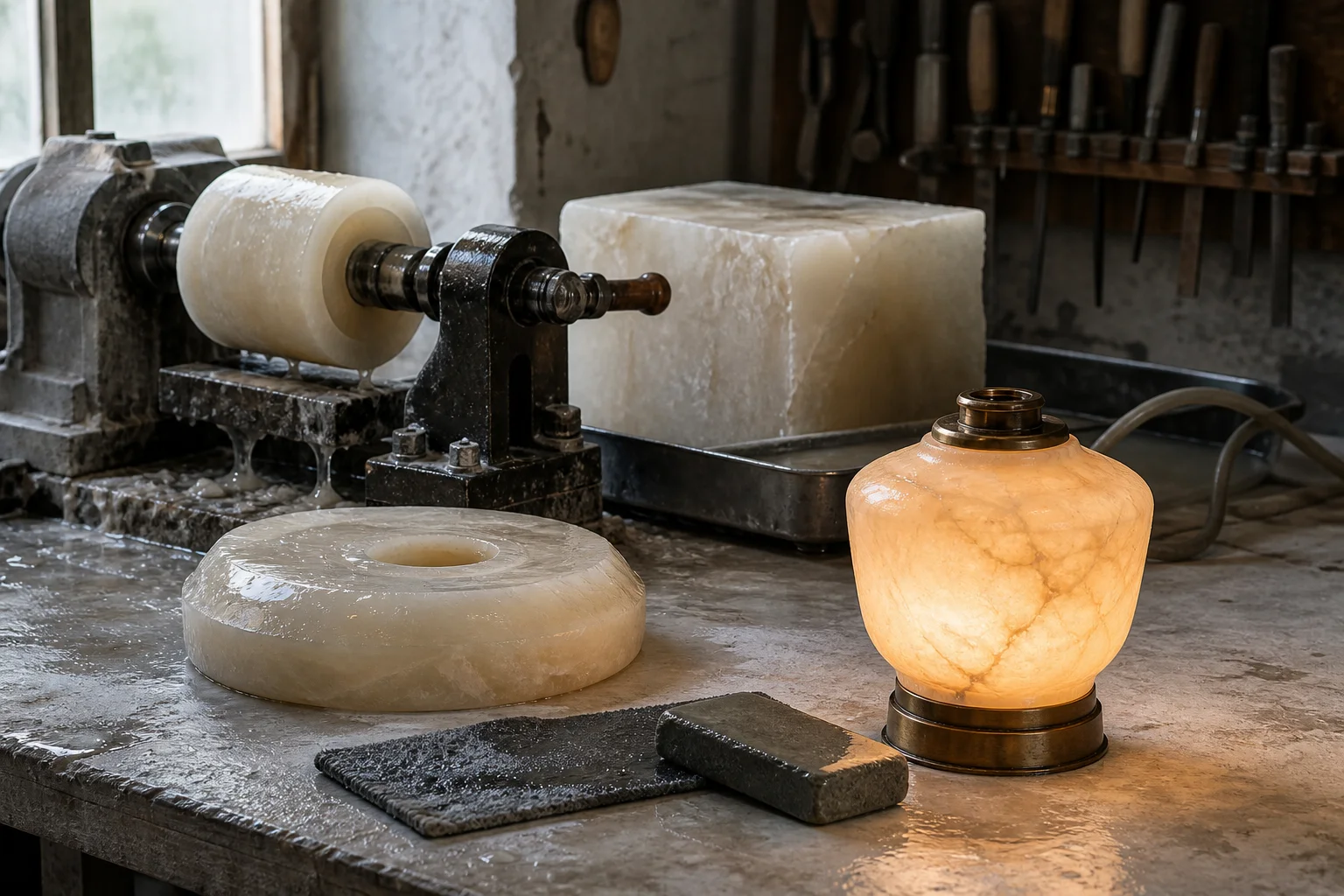 |
| Polishing removes the last fraction of the wall by hand, so two shades turned from one block can still disagree under a light. |
Why alabaster is worked wet, from the first cut to the last
Alabaster is a soft stone, and soft stone behaves badly worked dry. Dry cutting or sanding throws fine dust that is hard to contain, and generates heat at the tool edge; on a brittle translucent material that heat starts a hairline crack which stays invisible until the shade is switched on. So the whole sequence runs wet, and the same water darkens the stone and makes veining and density readable, which is why judgement calls on a block are made wet.
Reading the block face before anything is cut
Alabaster is worked block by block, so the first production decision is a reading of the stone rather than a machine setting. A face is cut across, wetted and examined for how evenly light will pass, whether veins will show as dark lines under backlight, and where density shifts.
That reading settles two things: the orientation of the body inside the block, because a shade ground perpendicular to the banding behaves differently from one ground across it, and whether the whole run comes from this block. A single block is the most effective consistency tool available, and asking for one costs nothing at this point.
Cutting oversize, then turning a body in passes
The blank leaves the block oversize. Water-jet cutting takes that first pass because it removes material without the heat and shock of a saw. Everything after this stage removes material, so the oversize allowance is the last real room the workshop has.
Turning then runs in many light passes rather than a few deep ones. Each pass takes a small layer, is checked, and is followed by another; deep cuts on a soft layered stone are how a body ends out of round, or how a thin section fails later at a load point.
Passes also let the workshop respond to what the block contains: a hidden hairline or a harder inclusion shows up mid-turn, and the usual answer is to reduce the remaining wall and move the piece to a smaller body rather than patch the surface. Ask how a workshop handles that, because the answer shows whether the stone or the schedule is driving the order.
| Production stage | What it protects | What it means for the buyer |
|---|---|---|
| Reading the wet block face | Orientation and evenness of glow | Ask which block supplies the run |
| Oversize water-jet blank | Stock removed without heat or shock | Later stages only remove material |
| Turning in light passes | Wall integrity and fixing margin | Ask what happens when a flaw appears mid-turn |
| Hand wet polishing | Even surface and final wall | The stage most responsible for batch tone |
| Metal seating | Every structural load path | Load should always travel through metal |
| Lit inspection per piece | Faults the dry surface hides | The only check that sees the finished glow |
Hand wet-polishing is where the glow is decided
Polishing decides how the finished shade looks, and it is the stage with the least machinery in it. Each piece is worked by hand under running water through a descending series of grits, turning a scratched surface into a soft even face. Two things are managed at once: the surface, because scratches scatter light unevenly and appear as dull patches once the fitting is switched on; and the wall, because polishing removes material, and a face worked slightly thinner reads lighter under backlight.
That second point is the one buyers rarely see coming. Two shades can share a profile, be cut from the same block and turned on the same lathe, and still disagree under a work light, because the last fraction of wall came off each piece by hand. It cannot be polished back on. Ask a workshop how it manages batch tone: an honest answer describes a check on the light bench, not a promise about the lathe.
The metal carries the load, never the stone
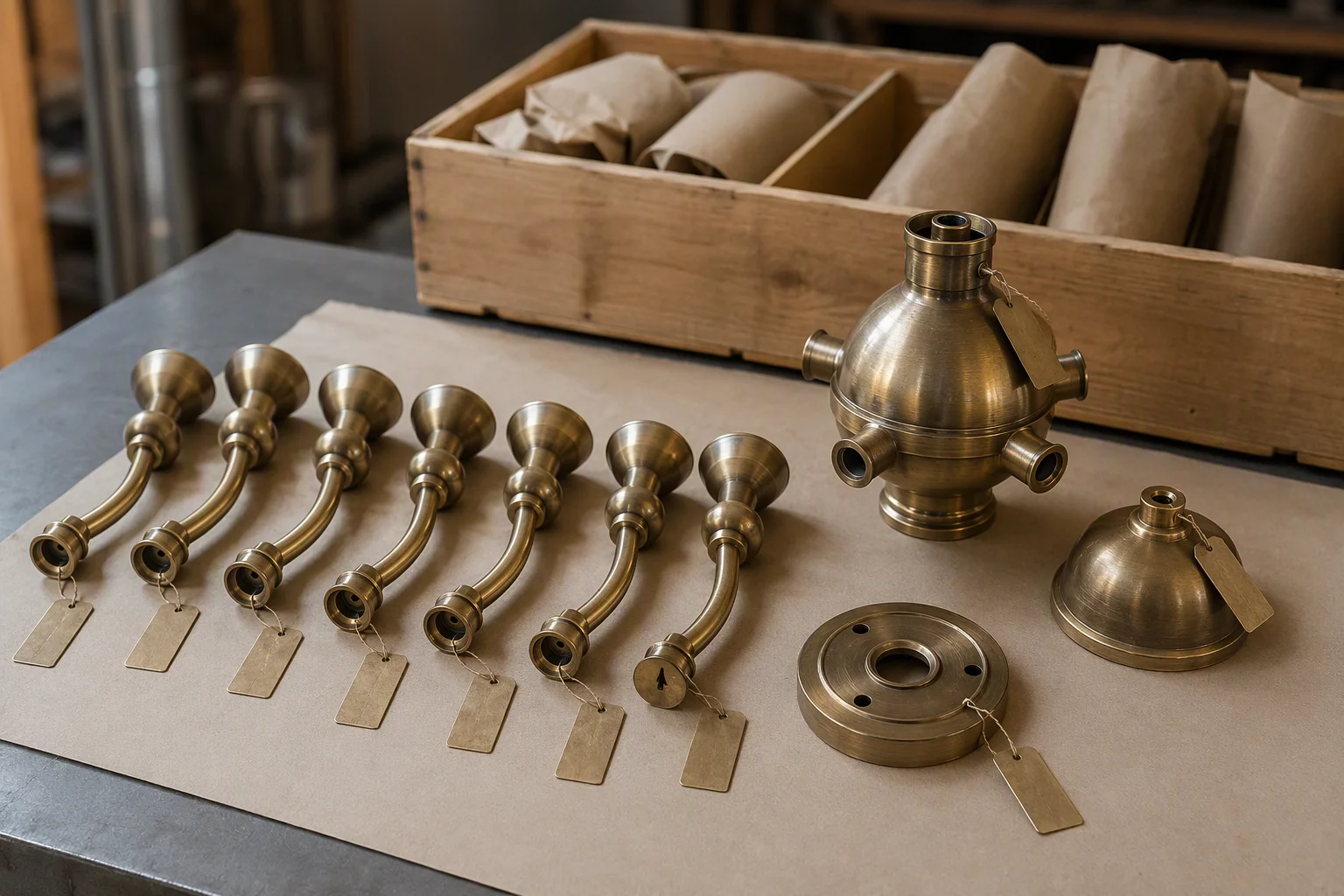
Alabaster does not hold a thread, so no part of a stone body carries its own weight or the weight of the fitting. The metal frame takes the load and the stone sits inside it: a collar at the neck, discreet pins or a pressed seat at the base, and a bracket at the wall or canopy.
The production consequence is that turning does not finish at a profile but at a mating surface. The collar has to meet the turned body along a line that neither rocks nor pinches, which is why the two parts are fitted together on the bench rather than finished separately and assembled later. Ask where the load is carried and what is left at the mounting edge, and the answer should describe a metal part in every load path.
Wall thickness is the trade-off you have to rank
There is no single correct wall thickness, because the figure that makes a shade glow evenly is rarely the figure that makes its fixing margin safe. A workshop can grind towards one or the other, or towards a middle it can hold across a batch, but not all three at once.
The trade-off therefore has to be settled before the first cut. Thickness is removed in stages, so the decision is unrecoverable: the same blank becomes a brighter thinner-bodied shade or a quieter heavier one, and the choice is made once. Turning leaves the wall thicker than the finished piece needs, and the last of it goes at the polishing bench.
Thickness is the one decision this process cannot reverse. Choose the end of the range before the first cut, not after the first shade is lit.
What to inspect in the lit sample, and what a repeat order changes
The sample bench is where all of this becomes evidence. Switch the fitting on, then check:
- Light the piece rather than judging it switched off: veins and uneven patches show under transmission that the surface conceals.
- Look at the fixing margin at the top edge, where the wall is thicker and the metal takes the load.
- Check the wall at the rim and near the base, since a piece that thins towards a load point has been polished past its margin.
- Compare tone against the approved master in the same room, at the brightest and dimmest setting.
- Ask which block supplied the sample, and have the answer written into the order.
On a repeat order only two variables move: the block, and the hand at the bench. Profile, metal, seat and load path are fixed by the drawings and the approved sample. The useful question is therefore not whether a second delivery matches the photographs, but whether it sits inside the agreed tolerance band and matches the tone of the phase beside it.
FAQ
Why is alabaster cut and polished wet rather than dry?
Wet working holds the dust down, keeps the tool edge and the stone cool on a brittle material, and darkens the face so veining and density can be read.
Does an alabaster shade need a metal frame?
Yes. Alabaster will not hold a thread, so the frame takes the load and the stone sits inside it. Every load path should be metal.
Why do two shades from one order look slightly different when lit?
Block variation and the hand at the polishing bench. Manage both with a single-block request and a tolerance band, not one master sample.
Can the wall thickness be changed after the sample is approved?
Only downwards. Material is removed stage by stage, so a body can be ground thinner but not returned to thicker; a change to the target wall means a new body.
How long does a custom alabaster lighting order take?
Custom work begins with a single-piece approval sample, and a production run typically takes 25 to 35 days from the approved drawing. Lead time is confirmed on the quotation, since block selection and inspection come first.
The takeaway
An alabaster shade is made by removal, so every stage narrows the options rather than adding to them. Read the block wet, cut oversized, turn in light passes and polish by hand, knowing the polishing bench decides the tone of the batch. Let metal carry every load, settle the wall trade-off before the first cut, and inspect the sample lit rather than switched off. Buyers who ask which block is running, and which end of the thickness range is held, get a batch that keeps its tone.
Zerouno Lighting (ZeroUNO) manufactures hospitality decorative lighting in Zhongshan, China, including alabaster-bodied pendants, wall lights and table lamps. Custom pieces start from a single-piece approval sample. Learn more at zerounolighting.com.
About the author
Sonny Yu is Sales Manager at Zerouno Lighting in Zhongshan, working with hotel owners, designers and procurement teams on bespoke decorative lighting. He writes about how a fixture is actually produced, because the workshop decisions behind a stone body are the ones that show up on the wall.



没有评论:
发表评论