A lighting package is usually the last trade finished and the first to be walked. By the time the fixtures are up, the corridors are painted and the opening date has stopped moving, the review that decides whether the lighting is accepted happens in rooms that already look complete. That is the worst moment to find that the list has no structure.
This guide is for the people who run that walk and then have to close it: the project manager running the review, the owner's representative who signs acceptance, and the supplier answering every line. It covers how to classify an item before arguing about it, which items should stop acceptance, and how to write a line that can actually be closed.
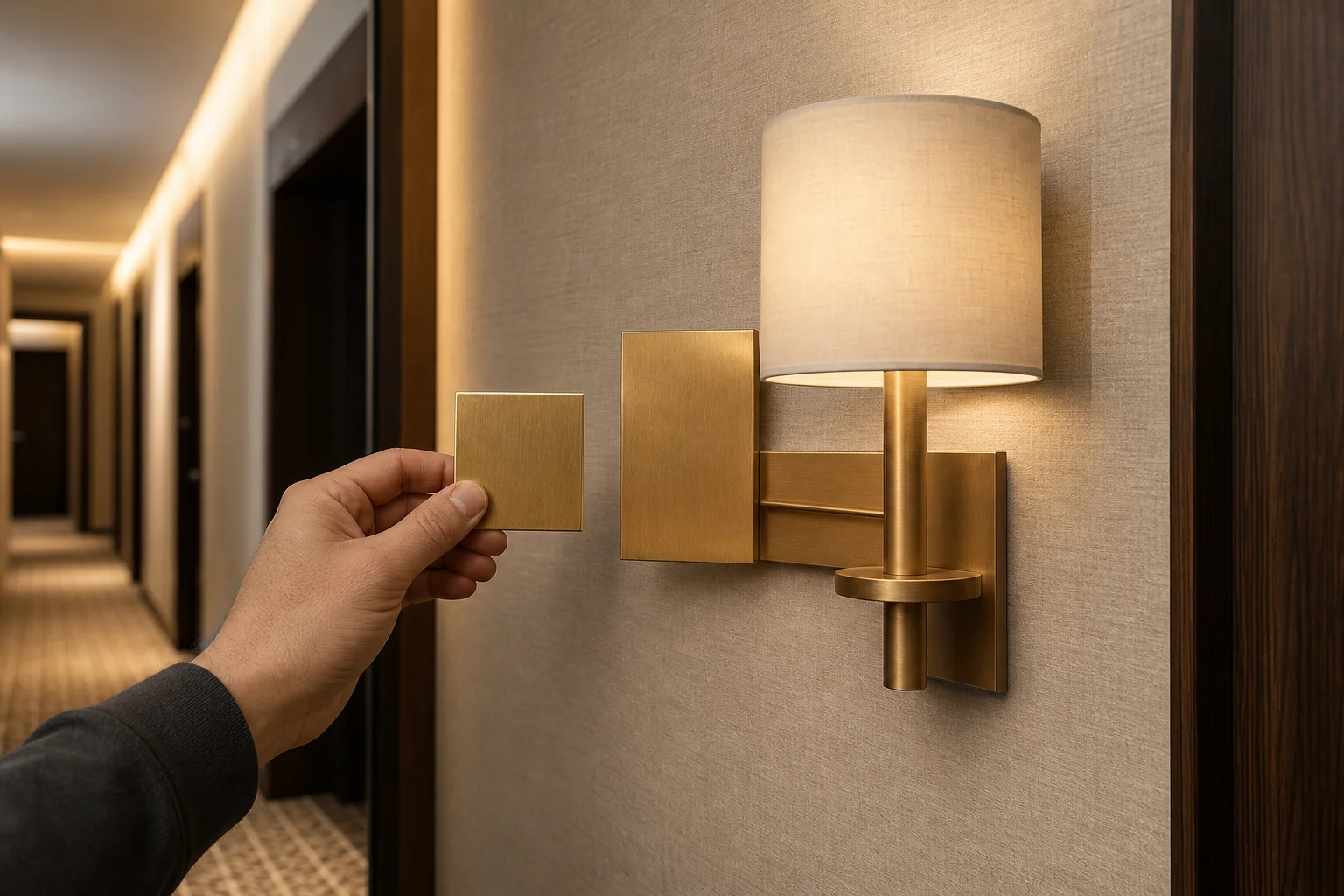 |
| The approved sample is the reference the walk is judged against, not a memory of it. |
A punch list is a triage document, not a complaints form
By the time the walk happens everyone is tired and the instinct is to work down one queue in the order things were noticed. That order records the walk, not the work. A scuff on a lobby panel and a ballroom scene that will not hold on the control panel are both lighting items, yet they have different owners, different evidence and a different cost of delay.
Sort every line into one of five families first. The family decides who can close it and whether the room can stay in use meanwhile.
| Family | Typical items | Closed by | Closed with |
|---|---|---|---|
| Visual and alignment | Shade out of level, visible seam, glare from a seat | Installer and designer | Photograph against the approved sample |
| Electrical and control | Scene will not recall, flicker at the low end, driver hum | Electrical contractor and supplier | Every scene tested in the hotel's own conditions |
| Finish and product evidence | Tone drift against master, transit bruise, missing part | Supplier | Replacement or written acceptance |
| Access and maintainability | No route to the driver, canopy that will not open | Contractor and designer | A demonstrated service route, recorded |
| Documentation and handover | Missing as-built, no spares list, unrecorded driver locations | Supplier and contractor | The issued document set |
Two rules follow. An item cannot be closed by a party who does not own it. And the evidence in the last column closes the line, not the opinion of whoever is standing closest to it.
Sort the disposition before you argue the severity
Within its family, every line also needs a disposition, better written during the walk than decided later by email.
- Blocking. Safety, operation, installation integrity or a room that cannot be used as intended.
- Repair. A real defect, contained and not affecting use.
- Documentation gap. The hardware is right and the paper is missing.
- Preference change. The work matches the approved sample and the requirement has moved.
- Deferred. Agreed for a later phase, with a date and an owner.
These are not degrees of severity. A documentation gap is not a defect, a repair is not a reason to hold a floor, and a preference change is not part of the contract at all.
Which items stop acceptance, and the order to work the list
A blocking item is not the ugliest item on the list. It is the item that stops the room doing its job: a night or emergency route that cannot be controlled, an unverified fixing, a missing part that prevents a group being commissioned, or work that contradicts the approved drawings.
Each blocking item needs an owner, a date, the evidence that will show it fixed and how it will be re-tested. Without the last, the line returns on the next walk. Work the list in order: blockers first, then anything touching water, power or a load path before a finished ceiling is re-opened, then control behaviour scene by scene while the controls contractor is still on site, then visual items at the guest's eye level, and documentation and preferences last.
A preference is not a defect
The most corrosive line on a punch list reads like a defect but is a change of mind. The fixture was made to the approved sample and hung where the drawing shows it, and now the owner wants it lower. Left unclassified, it is argued as a quality failure, and every other item loses credibility with it.
Handle it as a change request instead: priced, scheduled and approved separately, with the original installation closed as compliant. The same discipline applies to finish opinions, where the useful question is whether a piece deviates from the approved master sample or simply reads differently in this room. Only the first is the supplier's to answer.
A punch list is a record of what was agreed, not a negotiation reopened at handover. A line that cannot name the approved reference it fails is a preference, and preferences have their own route.
How to write a line so it can be closed
Most items that stay open for months are badly written rather than difficult. A line reading corridor lights flicker cannot be closed, because nobody can tell when it is fixed. A complete statement carries five fields.
- Location. Room, wall, level or fixture tag, precise enough to find without a guide.
- Symptom. What is observed, in plain language, without guessing at the cause.
- Condition. Which scene, dimming level or time of day, since many faults appear at one end of the range.
- Reference. The drawing, sample or approved document the work is measured against.
- Closure test. What will be seen when it is right, so the item can be signed off without discussion.
Where a fault could sit at more than one layer, say so. A symptom can come from the fixture, the driver, the wiring, the control system or the scene programming, and naming the layer to check first stops two trades pointing at each other.
Access and maintainability are defects too
A fixture that nobody can service is not finished, however good it looks on the day. If the driver sits behind a sealed panel, if the canopy cannot be opened without dismantling the shade, or if the access equipment will not reach the fitting once the furniture is in, the item is open regardless of its appearance. Confirm the route in, the position of every consumable part and the cleaning method housekeeping will actually use; all three are cheap to settle while the site is open.
The close-out file that survives staff turnover
The people who close the last items are rarely the people who will maintain the lighting. A close-out is finished only when the file behind it can be read by someone who was not on the walk.
- As-built drawings and the room schedule, marked with what was installed.
- A scene list in plain language, mapped to the control groups that deliver it.
- Driver and lamp positions, so a replacement does not begin with a search.
- Approved sample and finish codes, so a later order can be matched.
- The spares list with quantities and storage location.
- The cleaning method per material, and the warranty boundaries that give a failure an owner.
Then attach an owner, a date, a photograph, a severity and a closure rule to every item still open. Final acceptance is a controlled record, and the moment it becomes a set of memories the argument restarts at the first staff change.
FAQ
What is a punch list in a lighting package?
The structured record of everything to be corrected, confirmed or documented before the lighting is accepted. Each line carries an owner, a date, evidence and a closing test.
Which items should block final acceptance?
Those that stop the room working as designed: night routes that cannot be controlled, unverified fixings, missing parts and work that contradicts the approved drawings. Cosmetic and documentation items are tracked to closure instead.
Who should attend the lighting walk?
The owner's representative, the designer, the main contractor, the electrical contractor and the supplier. Each sees a different risk: operability, design intent, installation sequence and what can be corrected at the factory.
Why do punch-list items stay open for months?
Usually because the line was written as a complaint rather than a record. Without a location, a condition, an approved reference and a closure test, nobody can demonstrate the item is finished.
What happens to items found after handover?
They follow the warranty route rather than the punch list. Keep the approved sample codes, driver positions and spares list from handover, because those let a fault be diagnosed and a replacement matched.
The takeaway
Treat the lighting walk as triage: sort every line into its family and disposition before anyone argues about severity, and let only genuine blockers stop acceptance. Write each item with a location, a condition, an approved reference and a test that closes it, and route preferences to a change request rather than a defect list. The fixtures are the easy part; the record decides whether the list ever closes.
Zerouno Lighting (ZeroUNO) manufactures hospitality decorative lighting in Zhongshan, China, including bespoke brass, glass, fabric and stone-bodied fixtures. Each order begins with a single-piece approval sample, the reference a punch list is measured against, and products carry a two-year warranty with a 48-hour response. Learn more at zerounolighting.com.
About the author
Sonny Yu is Sales Manager at Zerouno Lighting in Zhongshan, working with hotel owners, designers and procurement teams on bespoke decorative lighting from the first drawing to final handover. He writes about the closing stages of a lighting order, where the difference between a defect and a change of mind decides how quickly a project is signed off.



没有评论:
发表评论