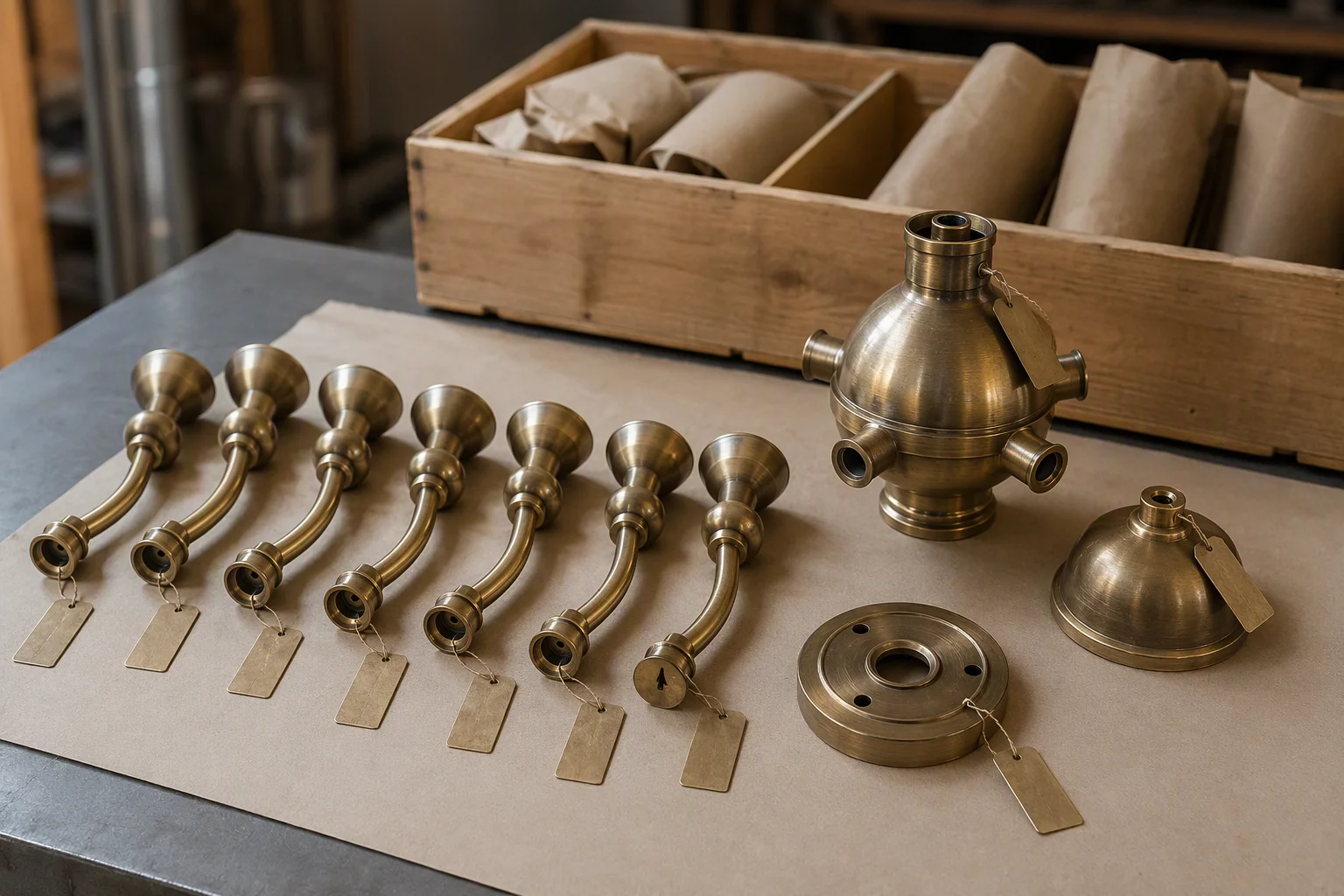
A lighting schedule can run to fifty pages and still leave one line almost empty. "Brushed brass" is not a specification: it does not say which brass, which process produced the surface, how the grain runs, or what the approved version looked like. The gap rarely shows up in a showroom. It shows up on site, when the wall lights in one wing read warmer than those in another, or when a replacement arrives in a tone that no longer matches the corridor.
This guide is for the specifiers and procurement leads closing that gap before an order is released: how to choose between the metal families decorative lighting uses, why substrate and finish route are separate decisions, and how to write and approve a line a factory can hold.
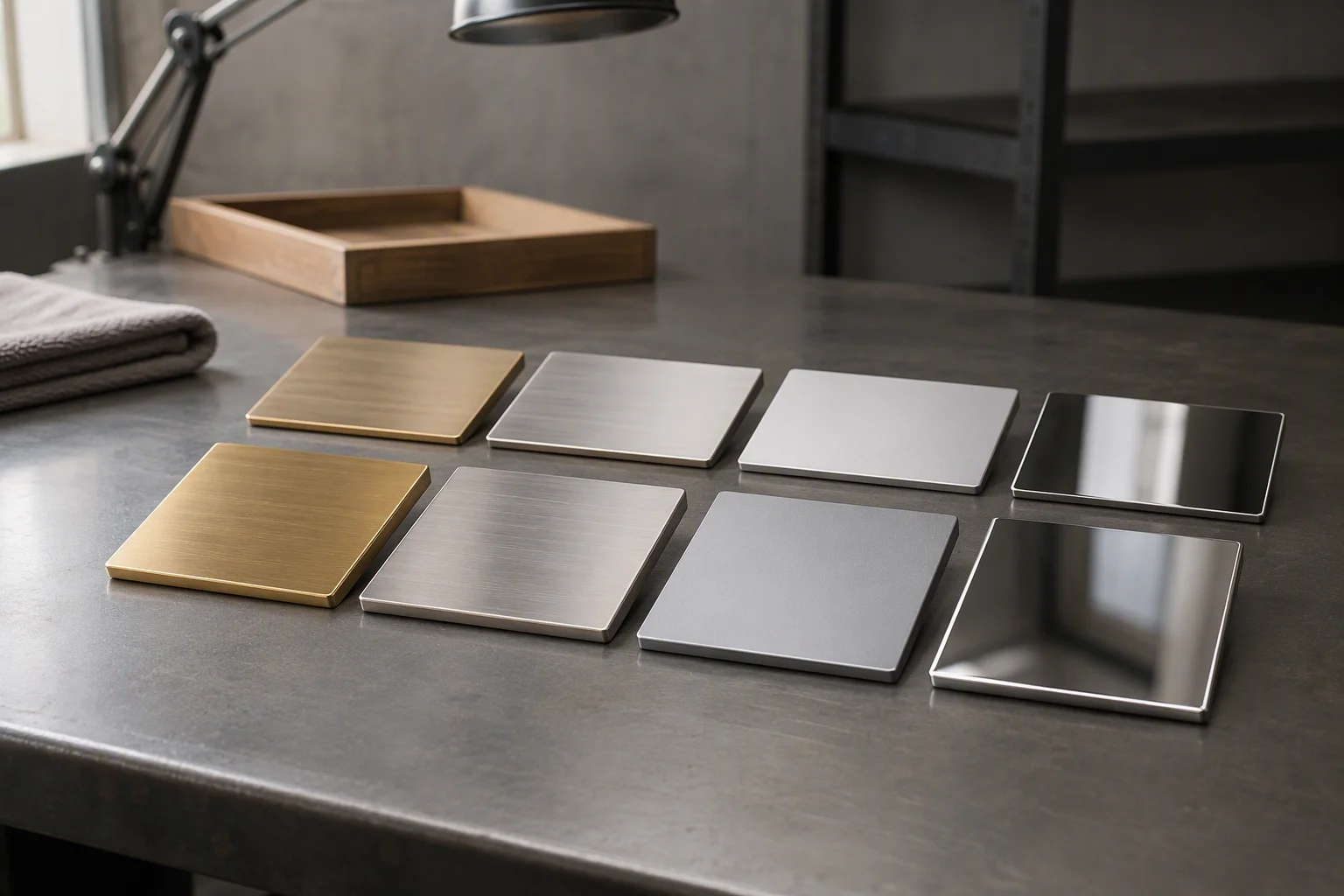 |
| Four finish routes read side by side in the light the room will use: differences that vanish on a schedule are obvious on a bench. |
Why the finish line is the least specific line on a lighting schedule
A finish is the one attribute everybody can see and almost nobody records precisely. It is agreed at a sample meeting, described in a word, then expected to travel unchanged through a quotation, a shop drawing, a production order and a replacement order years later.
- Agreed by eye, recorded in words. A decision reached by holding two parts together becomes "soft brass" in the minutes, and the room for interpretation opens at that moment.
- Issued before the finish is settled. The schedule is written to release the package, and "to be confirmed" is rarely confirmed later.
- Vocabulary is not standardised. Satin, matte, brushed and antique mean different things to different suppliers, so one instruction can produce surfaces that do not sit together.
The fix is a line that describes a process and a reference rather than a mood.
The three metal families and where each one belongs
Most hotel decorative lighting settles into three metal families. They are not interchangeable, because each behaves differently under daily contact, humidity and cleaning. The family is the first decision; the finish route is the second.
| Metal family | Where it usually belongs | What to watch in service | What the factory needs |
|---|---|---|---|
| Brass and bronze | Dry guest-facing fittings: bedside, corridor, lobby, restaurant | Colour shifts with handling and air; unlacquered surfaces patinate | The tone, the route, and whether the surface is sealed |
| Stainless steel | High-contact positions: public areas, bar fronts, exterior doors | Grade matters more than finish; some environments spot sooner | The grade and the surface direction, stated not implied |
| Aluminium | Hidden structure and larger bodies where weight is a constraint | Softer under impact; the coating route decides how it wears | The alloy and coating route; a bare surface is rarely acceptable |
Keep one family per visual line, and state the grade explicitly: one family name can cover materials that age quite differently.
Substrate and finish route are two separate decisions
A finish cannot be repeated when the specification named a colour and left the process open. Colour is the outcome; the route is how the surface is produced, and the route is what a factory has to hold.
| Finish route | Typical look | Repair on site | Best suited to |
|---|---|---|---|
| Mechanical: brushed, satin, polished | Metal seen directly, with a visible grain or sheen | Local marks blend, but touch-ups show in raking light | Surfaces guests touch and inspect close up |
| Plated: chrome, nickel, gold tone | Bright, uniform, highly reflective | Difficult; plating covers the whole part | Formal interiors where uniformity is the point |
| Vacuum coated: PVD tones | Hard-wearing coloured metal, including gold and black | Difficult once damaged; chosen for staying power | High-contact fittings in busy public areas |
| Painted or powder coated | Opaque colour that hides the metal beneath | Comparatively easy to touch up at handover | Coloured bodies, service areas, concealed parts |
Within mechanical finishes, one further variable decides whether two batches match: grain direction. Two parts brushed differently can read as two colours under the same lamp, so write the direction in rather than leaving it to habit.
Match the finish to the room, not to the showroom
A finish approved on a sample board under flat light is judged in the easiest conditions it will ever meet. The useful test is the room itself.
- Dry guest-facing rooms. Bedside and corridor lighting is seen close up, so grain direction matters most here.
- Wet rooms. Bathrooms expose metal to moisture and cleaning products, so the surface and its sealing decide how the fitting looks in year three.
- Public touch points. Door pulls, bar fronts and lift surrounds are handled constantly, pushing the choice towards harder-wearing routes.
- Exterior and coastal positions. Facade and terrace fittings face the harshest conditions, so grade and coating matter more than tone.
A finish is not approved on a sample board. It is approved in the room, at the distance the guest will see it, in the light that room will run every evening for the next ten years.
What actually drives the cost of a finish
Finish cost is rarely about the metal. It is about how often a part is handled and how much of it must be perfect, which is why a finish change is a quotation event rather than a colour choice.
- The route itself: a mechanical finish and a vacuum-coated one are different operations with different equipment and rejection rates.
- Part geometry: flat plates are straightforward; long arms, tight corners and deep recesses are not, because tool access limits consistency.
- Coverage and split: a visible face only or every face the installer sees, and one batch or several runs weeks apart.
- How many finishes sit in one order: each extra finish adds a setup, a batch check and a place for a mix-up at packing.
- The reference sample and who holds it: a physical reference both sides keep is cheaper to reproduce than a photograph in an email thread.
A finish question answered late costs more than one answered at specification stage. Where a change arrives after the order is released, the useful reply is a decision rather than a preference: accepted, rejected, or accepted subject to a new sample.
Writing and approving a finish line a factory can hold
A finish line is complete when it removes the need for a conversation, and the approval step is where it stops being an opinion and becomes a record that still describes the same surface months later.
- The family and the grade, named explicitly rather than described by tone.
- The process route, for example brushed, satin, plated or coated, stated as a method and not only a colour.
- The grain direction where a mechanical finish is used, and the sheen level as a comparison to the retained sample.
- The reference and revision the finish is measured against, and which faces are finished.
- The cleaning assumption, so the surface suits the products housekeeping will use.
- View the sample in the room's own light and at the guest's own distance, not on a desk under a task lamp.
- Sign the sample itself, not only the paperwork, and retain copies with the factory and the project under the same revision number.
- Check the first production articles against that sample before the run continues.
At later phases, re-approve against the retained sample rather than the paperwork: a signed plate settles the question in seconds.
FAQ
Is brushed brass the same finish from every supplier?
No. The term covers a family of surfaces made by different abrasive routines and sealing choices, so two suppliers can both deliver brushed brass and still differ visibly. Specify the route.
Can a finish be touched up on site after handover?
It depends on the route. Painted and powder-coated surfaces are usually repairable, while plated and vacuum-coated ones generally are not, so those belong where handling damage is unlikely.
How do we keep a later phase matching an earlier one?
Retain the signed sample with its revision number, and re-order against the sample rather than the original colour description. On an occupied property, judge the match in place: the installed fittings have aged too.
What belongs in the finish section of the submittal?
The signed sample reference, the family and grade, the process route, the grain direction where relevant, the sheen comparison, and the approval date with the name of the signatory.
The takeaway
Metal finishes fail projects for documentary reasons more often than for manufacturing ones. Name the family and grade, choose the route deliberately, and write grain direction and sheen into the schedule instead of leaving them to habit. Place each finish by the room it lives in, so wet areas and exteriors are not judged by the standard set in a dry guest room. Then approve one signed sample, retain it with a revision number on both sides, and check the first production pieces against it. The finish line then becomes the line that settles arguments instead of starting them.
Zerouno Lighting (ZeroUNO) manufactures hospitality decorative lighting in Zhongshan, China, and has produced project and custom fixtures since 2013. Finish decisions are agreed on a single-piece sample before a run is released, and the approved sample is retained so a later batch can be checked against the version the project signed off. Learn more at zerounolighting.com.
About the author
Sonny Yu is Sales Manager at Zerouno Lighting, working with hotel owners, designers and procurement teams on decorative lighting packages. He writes about the decisions between a design intent and a delivered fixture: finishes, dimensions, and the documents that keep the two aligned.