Every decorative lighting package begins with a decision that rarely reaches the drawing: is this fixture a design the supplier already makes, or a design made for this property? It is settled in the first commercial exchange, and it decides who owns the drawings, who pays for tooling, how long approval takes, and what happens when the property needs a replacement five years later.
This guide is for the people who live with that decision: owners' representatives, designers, procurement teams and the engineers who inherit the submittal. It sets out how stock, ODM and OEM supply differ, where cost and risk sit in each, and what to agree before a mould is cut.
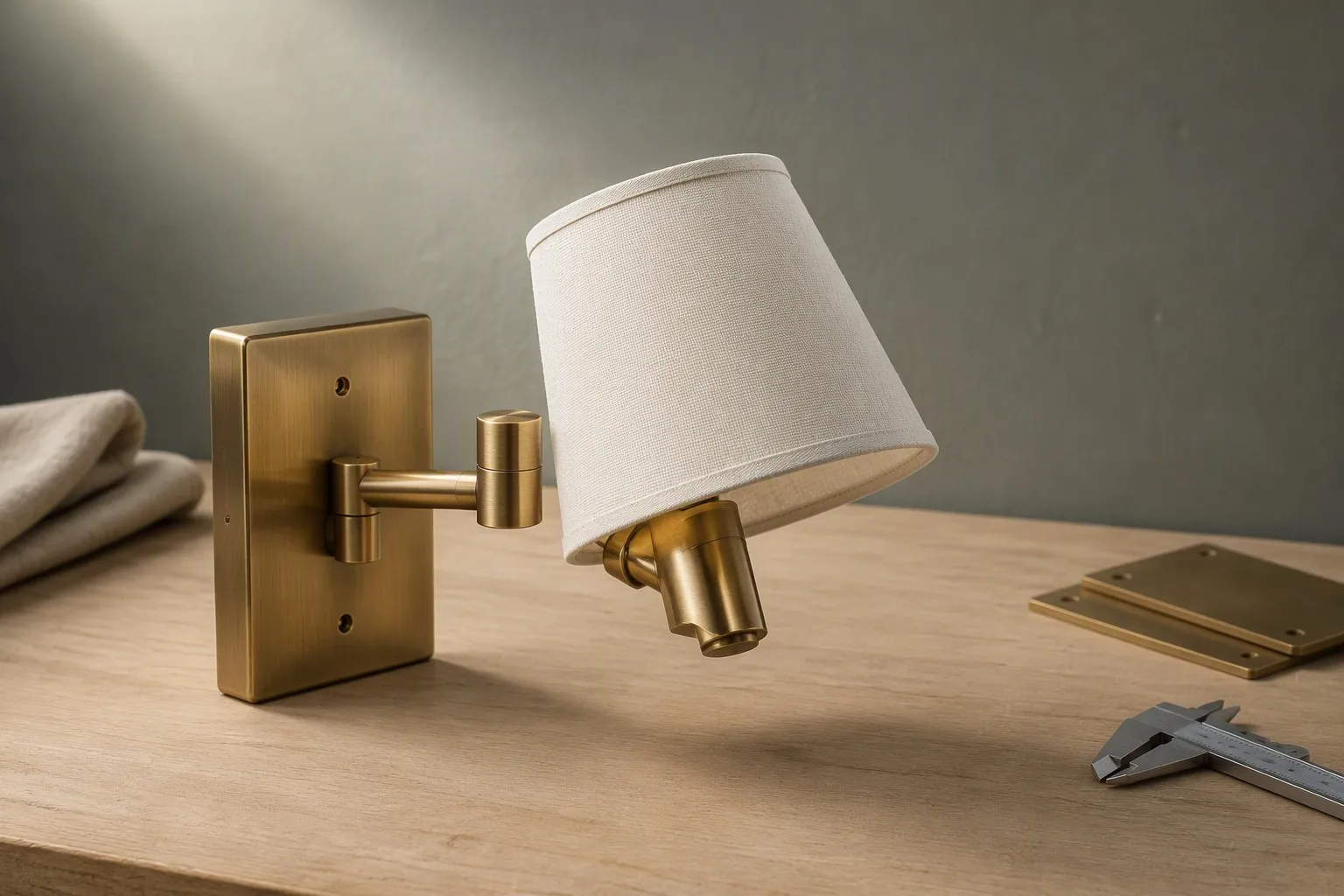 |
| An approval sample settles arm geometry, finish tone and shade behaviour before tooling is committed. |
Three models, and what each one actually hands you
The three routes are not points on a quality scale. They are three answers to the question of who carries the design work, and each answer moves cost, time and ownership in a different direction.
| Model | What the supplier brings | What you bring | What you hold afterwards | Where it fits |
|---|---|---|---|---|
| Stock or catalogue | A design in production | A selection and finish | Nothing exclusive; easy to replace | Back of house, tight programmes |
| ODM with variants | An existing body, adapted in finish or size | The variant spec | A configuration, not the design | Refurbishments, fixed reopening date |
| Full ODM | A design developed for the project | The brief and approvals | The design, if the contract says so | A look not available on the market |
| OEM | Manufacturing to your designer's drawings | Drawings, tolerances, approvals | The design and, usually, the tooling | New builds with a full FF&E drawing set |
The table's real subject is not price but continuity: what can be reordered, and on what terms, when a fixture is damaged in year four.
What you actually buy when you choose ODM
With ODM you buy the supplier's development, not their design. The saving comes from tooling that already exists and a body already through production engineering, which is why most hotel lighting packages contain more ODM than OEM.
The trade-off is repetition. The same body can appear in another property nearby, and a guest who notices is not reading your specification. That is a consequence of the model, to be managed deliberately.
- Settle whether the fixture is the supplier's catalogue design, and get that in writing rather than implied.
- Ask what a finish or dimension variant changes: sometimes it is a genuine departure, sometimes the same body in another colour.
- Decide whether the variant distinguishes the scheme enough, or whether the position needs a design of its own.
- Confirm the replacement route for the exact configuration, not for the family it belongs to.
What changes on the submittal when you go OEM
OEM moves the source of truth. In an ODM order the catalogue page is the reference. In an OEM order the drawing is, and every dimension left undecided becomes a question the factory answers on your behalf.
That is the mechanism behind most OEM change orders. They rarely come from a supplier ignoring the drawing, but from a drawing that left a joint, a tolerance or a mounting detail open, and a factory that resolved it sensibly but differently from the designer's intent.
- Dimensional drawings with tolerances, not just a nominal size.
- Finish specified as substrate plus treatment, with a physical sample retained.
- Lamp or LED module, driver location and the service route to reach it.
- Mounting detail and the substrate it is fixed to.
- Where the position demands protection, the sealed construction and its test evidence.
- The documentation the project is obliged to hold, identified before the order rather than after.
The approval chain in an OEM order runs brief, drawing, sample, production. Every unanswered question at one step reappears as a change order at the next.
Tooling: who pays, who keeps, who can move it
Tooling is where the OEM discussion stops being about design and becomes commercial. In decorative lighting it usually means cast or extruded parts, forming jigs, and shade frames outside standard diameters: a one-off cost attached to a specific configuration.
Three questions decide the outcome, and all three belong in the contract rather than an email thread.
- Charged or amortised. Tooling can be invoiced separately or spread across the unit price. If it is amortised, ask what happens to the unit price on a repeat order after the tooling is paid for.
- Who holds it. Tooling that sits with the supplier is convenient and creates dependence. Tooling you own and store elsewhere has to be inspected and maintained by somebody.
- Whether it travels. If a second source may be needed later, agree whether the tooling is transferable or a second set must be made, and who bears that cost.
A tooling schedule is worth more than a clause: list each tool, what it makes, when it was charged and where it is held. An hour of writing, and it answers the question that matters later: can this fixture be made again, by whom, and at what starting cost.
Exclusivity: what it is worth, and what it costs
Exclusivity is a commercial term, not a design condition, and it is worthless unless it defines its own boundaries. Four of them matter: what is protected, where, for how long, and against what volume commitment.
Protect the configuration, not the family. A body made exclusive in one finish and mounting is a far narrower commitment than an entire range, and usually enough to distinguish the scheme. Territory is rarely global; a city or a brand standard is more honest. A period should match the refurbishment cycle. Exclusivity offered without volume behind it tends to be quietly withdrawn the first time a larger project asks.
Where exclusivity is refused, the useful counterweight is not a discount but a documented spare and replacement commitment for the exact configuration, held for a defined period. That protects the operating property, which is what the request was really about.
Matching the model to the project type
The model should follow the stage of the project, not the team's preference:
- New build with a complete FF&E drawing set: OEM for the positions that carry the design, ODM or stock for the rest.
- Refurbishment with a fixed reopening date: ODM variants, because the schedule cannot absorb an open-ended development loop.
- Multi-property rollout: develop once as OEM or adapted ODM, then freeze the configuration so later properties match the first.
- A single feature fixture in a lobby: OEM, because the fixture carries the space and is worth the approval loop.
- Back of house and service areas: stock, where the specification is about service access rather than appearance.
The failure mode in each case is the same: choosing the model late, after the drawing set is fixed or the programme has been compressed, which converts a development decision into a change order.
FAQ
Is OEM always more expensive than ODM?
Not automatically. OEM carries tooling and an approval loop, but it removes the cost of working around a catalogue body that almost fits. For many variants of an existing body, ODM usually costs less; for a specific geometry, OEM is often the cheaper way to get there.
Can an ODM fixture be made exclusive to one property?
Sometimes, and it depends on what is protected. One configuration, finish and mounting is a far narrower commitment for a supplier than a whole product family, and it is usually what the designer wants.
Who owns the drawings in an OEM order?
That is a contract term, not a default. Agree explicitly who owns the production drawings, who may reuse them, and whether the factory may offer the fixture elsewhere. Silence on this point is what lets an OEM design reappear later as somebody else's ODM.
How much time does OEM development add?
The added time sits in the approval loop, not the factory. Drawing review, finish sampling and a golden sample each need a decision from the design team, and that cycle usually sets the pace. Compressing it means taking those decisions early.
What should be agreed before tooling starts?
The drawing version being tooled, who pays for the tool, who holds it, whether it transfers, and the replacement route for the exact configuration. Once a mould exists, each of those answers costs more.
The takeaway
Stock, ODM and OEM are not quality tiers; they are three positions on who carries the design risk. ODM saves tooling and time and gives up some distinctiveness, which is manageable when chosen deliberately. OEM buys a project-specific design and brings an approval loop that must be resourced. Whichever route a project takes, write down what is protected, who owns the drawings and the tooling, and how the exact configuration gets replaced. Those records decide whether the package is still maintainable long after the opening photographs.
Zerouno Lighting (ZeroUNO) builds hospitality decorative lighting in Zhongshan, China, founded in 2013. The company works to project specifications and designer drawings, supplies single piece samples for approval before tooling is committed, and backs its fixtures with a two year warranty and a 48 hour service response. Learn more at zerounolighting.com.
About the author
Sonny Yu is Sales Manager at Zerouno Lighting, where he works with designers and procurement teams on the commercial and technical decisions behind a decorative lighting package. He writes about the choices that are cheapest on paper and most expensive later, from sourcing model and ownership through to spares and replacement.



没有评论:
发表评论