Most hotel lighting packages are bought through a commercial chain rather than from the entity that builds the goods. The name on the quotation may be the factory that cuts and wires the metal, or a trading house that places the order elsewhere. Both arrangements are legitimate. What differs is where control sits, and that shows up in four places: the drawing, the approval sample, the change raised after the order, and the spare part the hotel re-orders years later.
This guide is for the people who settle those differences before the purchase order goes out: the designer issuing the specification, the procurement team comparing two quotations for the same fitting, and the owner's representative who signs the handover. It sets out what changes across the chain, and the questions worth asking while the answer can still change the order.
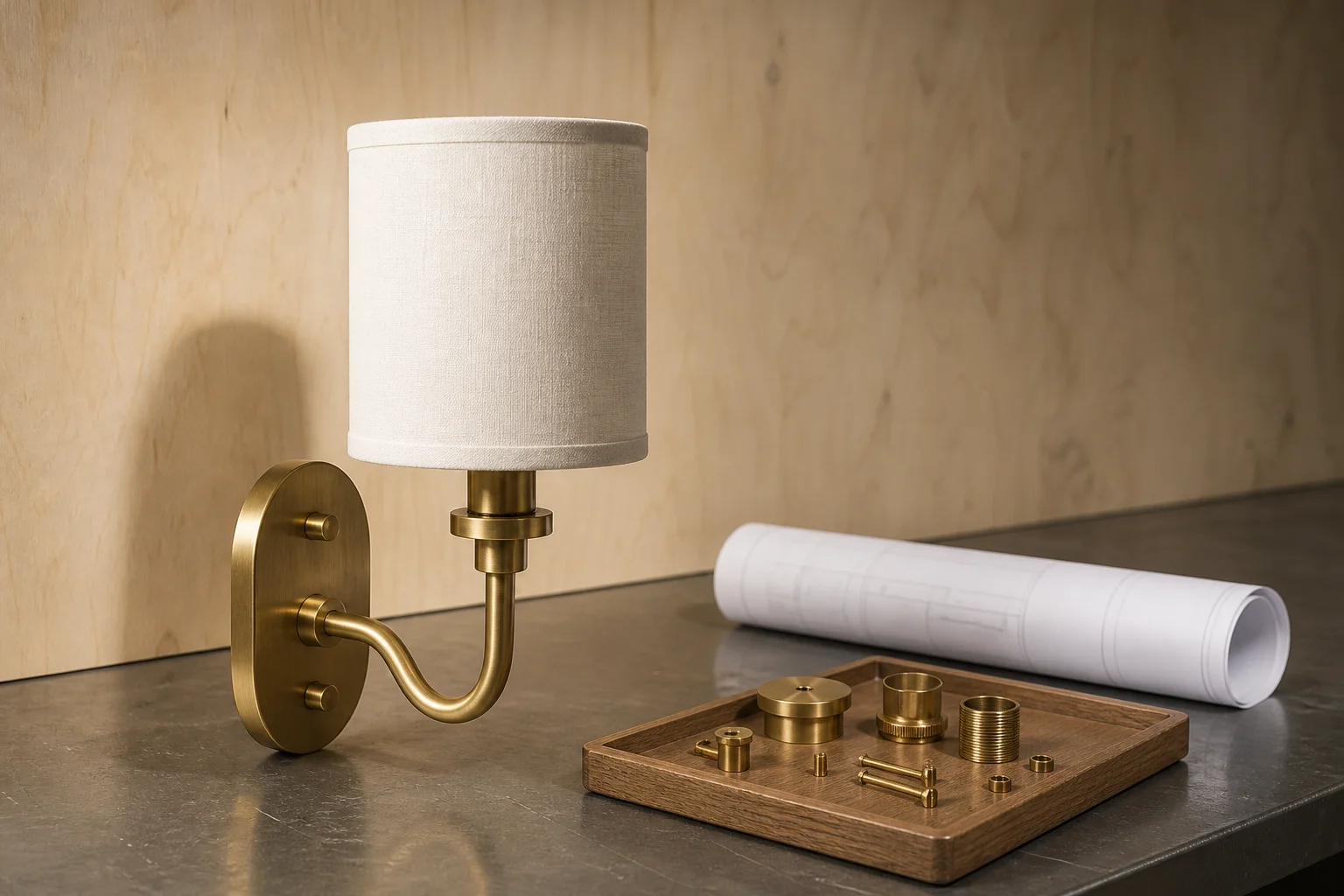 |
| The commercial chain decides how many hands a fixture passes through between the approved sample and the spare part the hotel re-orders. |
Two businesses can sit behind one quotation
A maker owns the fixture engineering. The shop drawing, the holder type, the driver pocket, the backplate hole positions and the finish process sit inside one organisation that also runs the line. A reseller sells the same delivered object but does not hold that engineering; it holds a relationship with whoever does.
The distinction matters less at purchase than when something has to change. Specifications move, and where a question the drawing did not answer lands decides how long the answer takes. It also decides who is accountable.
Who owns the drawing
The shop drawing is the interface between design intent and metal. It fixes the mounting centre, the cable exit, dimmer compatibility and the tolerance on a custom dimension. Ask who will hold it and who will sign it.
With a maker, a revision is judged against tooling that already exists, and the answer reflects what the workshop can physically do. With a reseller, the revision is forwarded, and the answer depends on the queue at the other end. Neither route is wrong, but their response times diverge in the last three weeks before delivery, which is exactly when specifications move.
Two lines belong in the order: name the entity that holds the shop drawing, and state the route a technical query takes with the turnaround expected on it. That second line is what keeps a four-day question from becoming a week.
Who carries the approval sample
The approval sample is where the project is really decided, because it is what the design team signs against. A sample built on a prototype bench proves the design can exist; it does not prove the production line can repeat it.
With a maker, the sample normally comes off the line and tooling that will run the order, so its record is short: the drawing revision, the finish used and the approved photographs. With a reseller the sample is commissioned, so the questions change. Which line built it, and will that line run the order? If the second answer is uncertain, the sample has told you less than it appears to. Custom work in our own workshop begins with a single-piece approval sample for this reason: there is one object everyone has agreed on.
Keep the physical evidence either way: photographs, the finish reference and the drawing revision the sample was signed against are what settle an argument in month nine of a rollout.
What changes across the chain
The table below is a checklist of things to pin down rather than a ranking, because a reseller with a long-standing factory relationship can outperform a maker on one package, and the reverse is equally true.
| Aspect | Makers | Resellers | What to pin down in writing |
|---|---|---|---|
| Drawing ownership | Held in house | Forwarded to the building factory | Name the entity that holds and signs it |
| Technical queries | Answered where the fixture is built | Routed through an intermediary | State the query route and expected turnaround |
| Approval sample | Built on the production line | Commissioned from a factory | Confirm which line built it and will run the order |
| Mid-project change | Feasibility judged at the tooling | Judged one hop away | Fix who confirms a change, and by when |
| Service parts | To the original specification | Depend on the factory still supplying | Record every replaceable part reference |
| Phased matching | Matched to an earlier phase on request | Matched only if the same factory is used again | Carry the finish and colour reference on the order |
Where a variation is absorbed
A variation raised after the order is not only a pricing event. It is a translation event, and each hop costs context as well as time: the reasoning behind the change thins as it travels, and a factory that receives a bare change note can implement it literally and still miss the point.
The control is a single written change note with one owner, stating what is changing, why, the date the answer is needed and the consequence of a refusal. The reply should carry three things: whether it is feasible, what it does to the delivery date, and what it does to anything already approved.
Spares continuity over a phased handover
Large projects rarely arrive in one drop. Floor-by-floor releases, separate towers and staged refurbishments all mean a later phase has to match an earlier one, and the matching problem worsens whenever the commercial chain changes between phases. A second phase awarded to a different reseller is the classic case: the fixtures can be specified identically and still arrive one shade away.
What protects a phased project is a reference list that travels with the order rather than with the company: holder and base type, finish and its process route, the colour appearance and rendering of the approved lamp, and a physical sample held on site. A colour is easier to match against an object than against a description.
The service question sits alongside it: a fixture may be serviceable by replacing a lamp, or sealed with the driver as its only replaceable part. Either way the hotel needs to know what it will re-buy and from whom, and that is easier to obtain while the order is open.
Questions that separate a maker from a reseller
Run these before the order is placed; a reseller can answer them well, and a weak link becomes visible early.
- Which entity holds and signs the shop drawing, and who signs the revision the line works to?
- Which line builds the approval sample, and is it the line that will run the order?
- Who answers a technical query during production, and with what turnaround?
- Who confirms feasibility, cost and schedule impact for a change raised after the order?
- Which parts will the hotel re-order later, and against what reference?
- Who signs the documents that travel with the goods, and where does inspection happen?
- If a later phase must match this one, what finish and colour reference is kept, and where?
The quotation tells you what the fixture costs. The chain behind it tells you what a change will cost, and whether the tenth phase will still match the first.
FAQ
Is a reseller always more expensive?
Not predictably. The difference is rarely a simple markup, and a reseller may hold better factory terms than a small buyer can reach alone. What reliably differs is how many hops separate the question from the person who can answer it.
Can a reseller deliver exactly the same fixture?
Often yes, particularly when the same factory builds both routes. The exposure is traceability rather than capability: if the factory changes, the next batch can differ while the specification reads identically.
How do I find out who actually makes the fixture?
Ask in writing before the order: which entity holds the shop drawing, which line built the approval sample, and which line will run the order. Then check that the paperwork and the inspection point match those answers.
Does buying from a maker remove the risk?
No. Capacity, scheduling and communication decide the outcome, and a maker with a full order book can miss a date as easily as anyone else. What changes is the number of translations a technical question passes through, and who is accountable for it.
What is the single most useful line to add to an order?
Name the entity that holds the drawing and the spare-part reference, and state who answers a technical query. One sentence fixes the two things that cause the most trouble later.
The takeaway
Comparing a maker with a reseller is not a search for the honest option; it is a question about where control sits. Put drawing ownership, the sample's build line, the change route and the spare-part reference into the order document, and the chain stops being a hidden variable. Where a project is delivered in phases, treat the finish and colour reference as an asset of the project rather than of the supplier, and keep a physical sample on site.
Zerouno Lighting (ZeroUNO) manufactures hospitality decorative lighting in Zhongshan, China, including wall lights, bedside reading lights and alabaster-bodied pieces for hotel projects. Custom work starts from a single-piece approval sample, and every order carries a two-year warranty with a 48-hour response on service questions. Learn more at zerounolighting.com.
About the author
Sonny Yu is Sales Manager at Zerouno Lighting in Zhongshan, working with hotel owners, designers and procurement teams on bespoke decorative lighting. He writes about the commercial decisions that are cheap to settle on paper and expensive to settle on a delivered crate.



没有评论:
发表评论