A hotel opens, the lighting is commissioned, the contractor demobilises, and three months later a housekeeper reports a flickering bedside reading light. Someone opens the project folder looking for the fixture schedule and finds an issued-for-construction PDF that no longer matches anything on the wall. That gap between what was specified and what was installed is why handover documentation exists.
This article is about the lighting O&M pack: what a maintenance team needs inside it, what is just weight, and how to build it before the last fixtures leave site. It is written for hotel owners and project teams who receive the pack rather than produce it, and it stays separate from the punch list, since closing defects and documenting a system are different jobs.
Write the pack while the site is still open
Documentation written after handover is reconstruction, not record. The installers have moved on, the room numbers have changed twice, and the person who knew where the remote drivers went has left the subcontractor. The working window is the final weeks of installation, while ceilings are still accessible. Use it to capture what cannot be recovered later:
- Photograph every fixture type in position, including the ceiling interface and any access hatch.
- Record as-built circuits and control zoning against the room numbers on the doors.
- Note each remote driver's location and photograph the route a technician would take to reach it.
- Keep the finish sample from the last batch, labelled with reference and approval date.
- Log the exact carton and fixture label wording, because that is what a storeman searches for.
- Name the site contact who can still confirm a part number after handover.
A handover pack is not judged by how thick it is. It is judged by whether a technician who has never seen the building can find the driver behind a given fixture in under ten minutes.
The six sections a lighting O&M pack actually needs
Most packs fail in two directions: a marketing folder with a drawing stapled to it, or a five-hundred-page dump of every submittal ever issued. Neither helps a duty engineer at eleven at night.
| Section | Question it answers | Who uses it |
|---|---|---|
| Fixture register | What is installed, where, and what is inside it | Maintenance, purchasing |
| As-built drawings and control zoning | What is really on the ceiling and which switch controls it | Engineering, electrical contractor |
| Driver and access map | Where the gear is hidden and how to reach it | Duty technicians, MEP team |
| Spare parts and finish record | What we hold, and what the approved finish looks like | Stores, purchasing, housekeeping |
| Service statement | What is covered, for how long, and who to call | Owner, operator, procurement |
| Care instructions by material | How to clean it without destroying it | Housekeeping supervisors |
Six sections also define what to leave out: the catalogue and quotation, because pricing belongs in the contract file; undated drawings, since a superseded sheet in a live folder is worse than a missing one; and duplicate statutory paperwork. If a technician cannot act on a page, it belongs elsewhere.
The fixture register is the spine of the whole pack
If only one section survives, it should be the register. One line per fixture type: the tag that appears on the fixture, room types and quantities, finish reference, light source and driver reference, and the supplier's item reference. Drawing callouts, spare parts, warranty claims and replacement orders all hang off those tags.
Two failures are common. A register that lists quantities supplied rather than installed cannot be reconciled against a walk-through, and quietly hides site losses and attic stock. A register whose tags exist only in the spreadsheet leaves the technician at the fixture unable to connect the object to the line. Reconciling has to be done on foot: take the register into three sample rooms of different types, find every line, and mark what cannot be found.
As-built drawings are not the issued drawings
Issued drawings describe intent; as-built drawings describe the building. Between the two sit a beam that moved for a sprinkler drop, a ceiling that came down by a hundred millimetres, and a room numbering scheme changed after the signage was printed. All of it makes the issued set useless for maintenance.
An as-built set need not be redrawn in CAD, but it needs three properties. It must be dated. It must be marked with what changed rather than reissued under a fresh title block. And it must carry control zoning as actually wired, panel by panel, because the question at a front desk is never which fixture is which but which switch turns the cove off without killing the reading lights. Aiming records stay with the design intent file, referenced rather than absorbed.
Drivers, access and the ten-minute rule
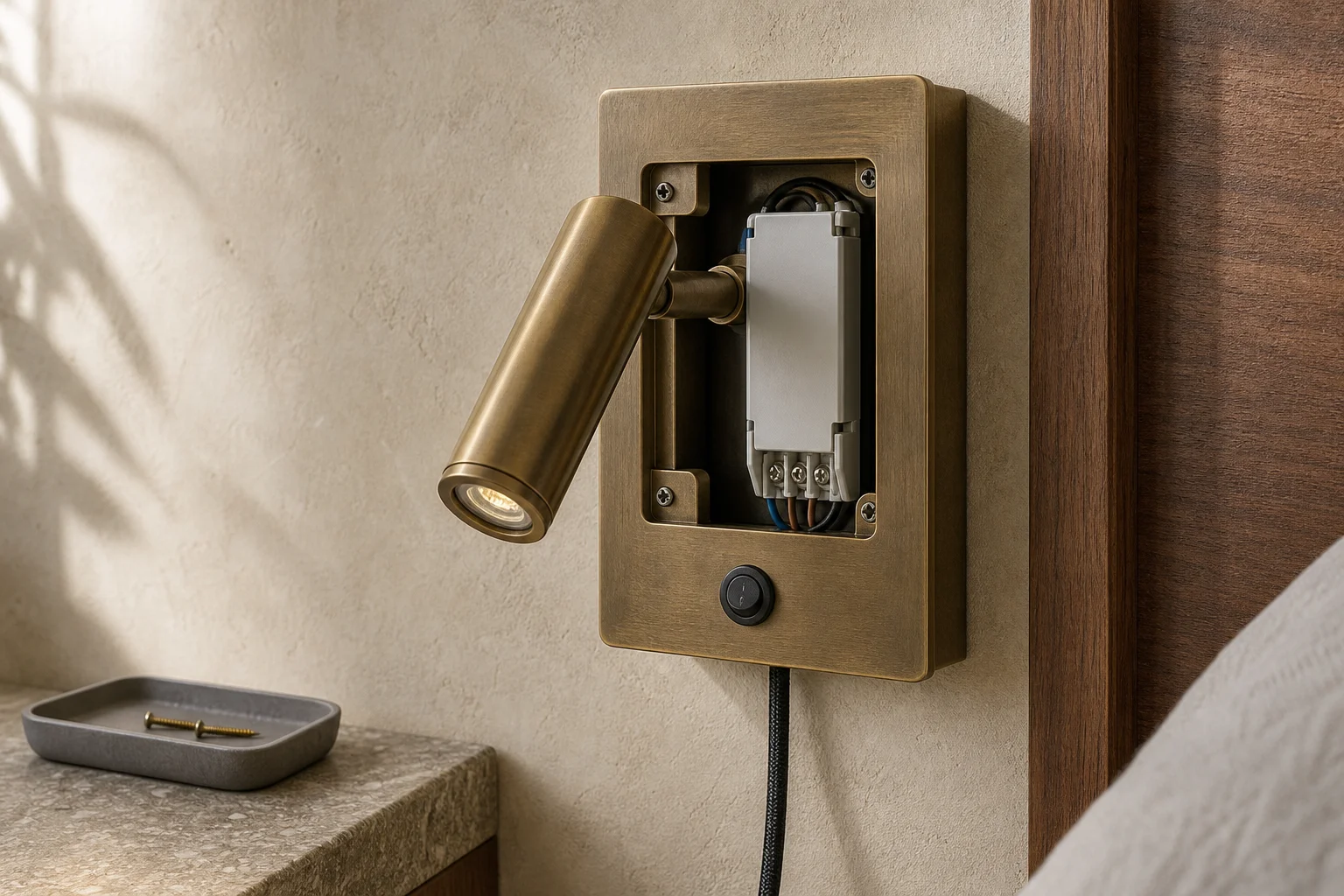 |
| A driver is only serviceable if the pack records how to reach it, not just where it was drawn. |
Decorative fixtures increasingly carry their electronics remotely, which is good for heat and bad for maintenance if nobody recorded where the gear went. A driver above a fixed plaster ceiling with no hatch turns a five-minute swap into a ceiling opening, a redecoration, and a conversation about who pays.
The access map is the section technicians use most in year two and it is almost always the thinnest. For each fixture family, state where the driver sits, whether access is a hatch, removable panel or lift, and which isolator is locked off first. Where the route passes through another trade's riser, say so, because that is where the work order stops. If a driver cannot be reached without destructive work, write that down too: an operator needs it to hold a retention or negotiate a hatch.
Spares, finishes and the colour record
The spare parts list is a commercial decision expressed as a technical document. What matters is what was handed over, where it is stored, and what it fits. A spare that exists but cannot be located is not a spare.
Finish is where documentation earns its keep years later. The same finish name across two purchase orders is not proof of a match: plating baths drift, powder batches vary, and patina develops at different rates with handling. The only arbitration tool that survives is a retained physical sample, labelled with reference, batch and approval date, and kept with the spares. For natural materials it records an approved range, not an exact match, and the pack should say so. Stone and alabaster vary between blocks; a replacement shade will not be a twin, and a document that pretends otherwise turns a material property into a complaint.
Sign-off, and what the signature actually covers
Handover signatures cause disputes because two confirmations get conflated. Signing for documentation confirms that the listed sections were received, that the revision is identified, and that the register reconciled against the sample rooms on the stated date. It does not confirm that the installation is free of defects, and it does not transfer the defects liability period. Those sit with the punch list and the contract.
A short acceptance walk makes the signature meaningful. Take the register into one room of each principal type, confirm three fixture lines end to end (tag, part reference, access route), check zoning against the panel, and confirm the spares are in the store. Record the date, pack revision, and two named contacts, one commercial and one technical.
FAQ
Who should own the lighting O&M pack after handover?
The operator's engineering department should hold the controlled copy, with the owner's project team keeping the contractual set. Ownership matters less than control: one nominated person should know which revision is current and where the finish sample is stored.
How long should the pack be kept?
For the life of the installation, and well beyond the warranty period. The register is often the only surviving record of a discontinued item.
Can a digital folder replace a printed pack?
For drawings and registers, yes, provided the folder is reachable from the plant room and the file names match the site tags. The finish sample cannot be digitised, and a photograph carries no material reference.
What if the as-built drawings were never produced?
Commission a measured survey of fixture locations and zoning rather than reissuing the original set. It is a smaller job than it sounds, and a dated survey is more honest.
Does the pack need to state spare parts quantities?
It should state what was handed over, unit by unit, even where the agreed holding is zero. Recording a deliberate zero prevents the same conversation at every future failure.
The takeaway
Handover documentation is the operating manual for a system that outlives everyone who built it. Assemble it while the site is open, keep it to six working sections, and make the register reconcile on foot. Record the driver access route as carefully as the finish, retain a physical sample with its batch, and state plainly what the signature does not confirm. That pack beats a folder that only satisfies a checklist.
Zerouno Lighting (ZeroUNO) manufactures hospitality decorative lighting in Zhongshan, China, and supports hotel projects from sampling through to handover documentation. Custom orders typically run 25 to 35 days, and our warranty statement covers two years with a 48-hour response commitment. Learn more at zerounolighting.com.
About the author
Sonny Yu is Sales Manager at Zerouno Lighting, working with hotel owners, designers and procurement teams on decorative lighting for guest rooms, corridors and public areas. He writes about the practical side of delivering hospitality fixtures, from sampling and finish approval to the paperwork that keeps a building serviceable after opening.



没有评论:
发表评论