A hotel can re-carpet a corridor, re-hang its art and replace every headboard without touching the electrical installation. Change the lamp base and the property's whole spare-lamp routine changes with it. The base is the small metal interface at the foot of the lamp, and it quietly decides which bulb the hotel can buy locally for the next decade.
This guide is for the people who settle that detail on paper: the designer writing the fixture schedule, the procurement team comparing two quotations for the same fitting, and the owner's representative signing off a rollout that spans more than one country. It covers what E27, E26 and B22 actually mean, where the differences bite, and how to lock the choice before the metalwork is cut.
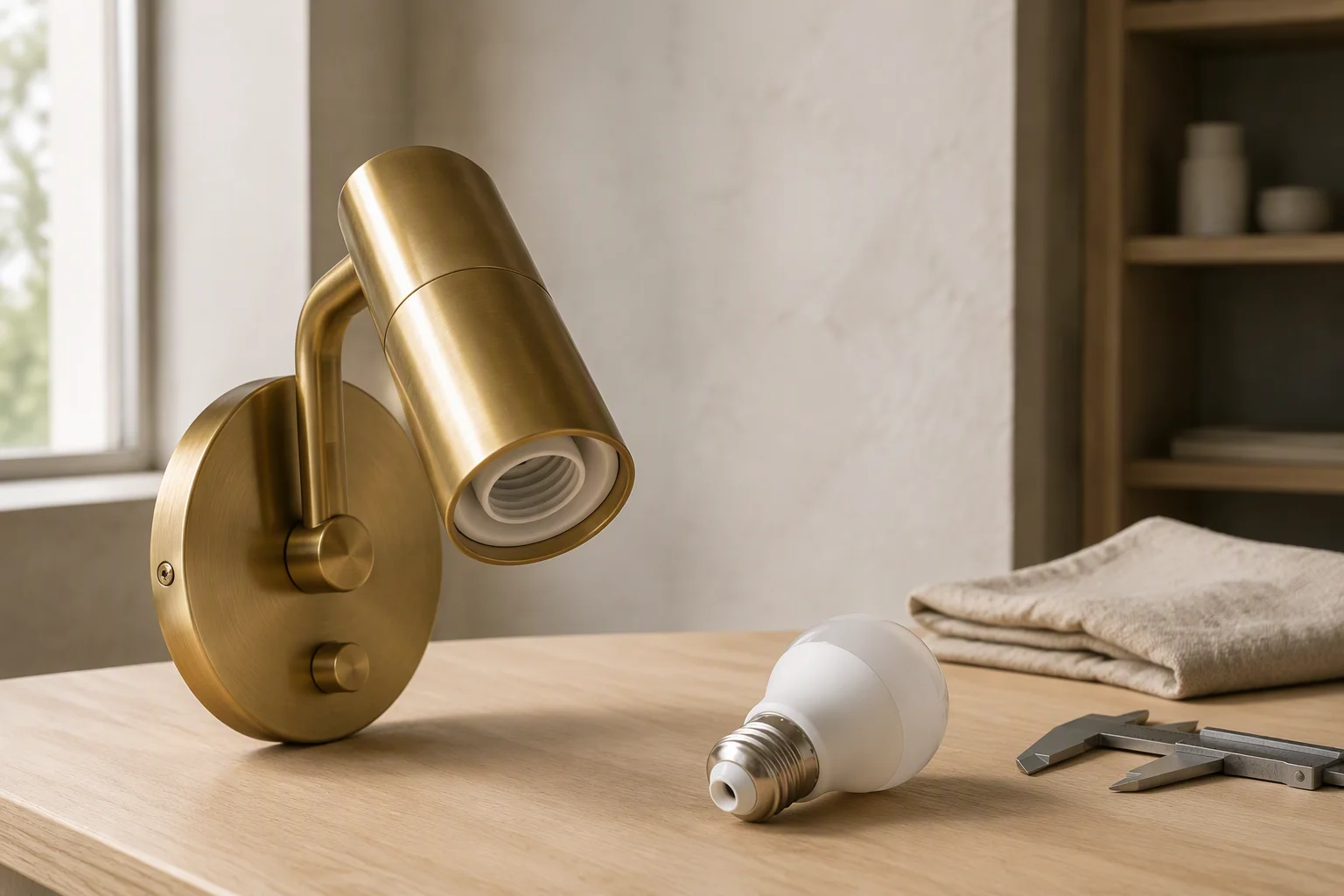 |
| The holder is built once and the lamp is replaced many times, so the base must suit the market that will buy the spare. |
The lamp base is a purchasing decision, not a design detail
Most fixture schedules describe the base in three careless words: standard screw. That phrase hides a regional decision with a long tail, because a hotel does not buy its replacement lamps from the supplier that built the fitting. It buys them from whichever local wholesaler stocks the lamps that market uses, usually years later, by someone reading a label in a maintenance cupboard.
The base therefore belongs to the market where the property stands, not to the mood board the room was designed from. Where the two disagree, every routine lamp change becomes a special order. The holder is also a mechanical part fixed while the fitting is built, so once the metalwork is committed a change of base is not an amendment to a drawing but a new component and a new approval sample.
What the base code tells you at a glance
The naming convention carries more information than it looks. E marks an Edison screw cap and B marks a bayonet cap; the number beside it is the nominal diameter in millimetres. An E27 lamp screws into a 27 mm holder, an E26 into a 26 mm holder, and a B22 pushes and twists into a 22 mm bayonet.
The code is mechanical rather than electrical, so two lamps that fit the same holder can still be quite different products, and one millimetre matters more than it sounds once both families sit side by side.
| Base | Cap type | Nominal size | Market convention | What it means for spares |
|---|---|---|---|---|
| E27 | Edison screw | 27 mm | Widely used across Europe and Asia | Broadest choice of local LED lamps |
| E26 | Edison screw | 26 mm | Standard in North America | Spares tie to one regional supply chain |
| E14 | Small Edison screw | 14 mm | Decorative and small table lamps | Fewer output choices; fix the reference |
| B22 | Bayonet | 22 mm | Traditional in the UK and several other markets | No cross-compatibility with screw caps |
| B15 | Small bayonet | 15 mm | Small decorative fittings | Narrower local stock; keep a sample |
Why E26 and E27 are not interchangeable in practice
An E26 lamp and an E27 lamp look like the same object. The difference is a single millimetre of thread diameter, and that millimetre is enough to make two caps that should not be treated as one.
In a sample room the mismatch is easy to miss, because a lamp can often be persuaded into the wrong holder far enough to light. In service it appears as intermittent contact or a cap cross-threaded by a housekeeper, neither of which looks like a specification error. The practical rule is a single one: one base convention per property, written down and carried through the schedule, the approved lamp and the spare-lamp stock.
Bayonet markets change the whole spare-lamp story
A bayonet cap is not a screw cap with a different measurement. It is a different mechanical system: two pins, a push and a quarter turn. Nothing about it is compatible with an Edison screw, so a bayonet property and a screw-cap property cannot share a spare-lamp cupboard however similar the fittings look.
For a multi-property rollout this is a commercial fact rather than a technical footnote. Two markets on different caps mean two holder variants on the order, two approved lamp references for the maintenance manual and two lines in the quotation. Raised while the drawings are open it costs a line item; raised after delivery it costs a rework programme.
Integrated LED removes the base and moves the risk
Not every decorative fixture in a hotel has a user-replaceable lamp. A growing share of wall lights, linear details and small downlights are integrated LED, sealed at the factory with no cap at all. That removes the base question, and it also removes the lamp as the thing that fails first.
The trade-off is worth stating plainly. An integrated fitting cannot be repaired by swapping a lamp, so the service part becomes the fitting itself or its driver, and both depend on the supplier still being able to provide a match. The questions to settle are the ones a hotel can act on years later: is the driver reachable from the room side, is there a documented replacement path, and does the warranty cover the complete assembly rather than the light source alone.
Spare-lamp discipline across a multi-country portfolio
Once the base is fixed, the next failure is usually a colour mismatch. Two lamps can share a base, a shape and a nominal rating and still look different at low output, because colour appearance and colour rendering vary between products and between production runs. A replacement that satisfies the electrical description but not the appearance of its neighbours will be noticed by guests long before it is noticed in a maintenance log.
The fix is record-keeping rather than hardware. The spare-lamp record for each property should carry the base, the colour appearance and the colour rendering of the approved lamp, plus a physical sample kept on site, because colours are easier to match against an object than against a description.
Fix the base on the drawing, then write it into the specification
The base is settled when the holder is chosen, well before the mock-up room, and everything afterwards is more expensive. The specification is where the decision has to be visible.
- State the base in the fixture schedule for every item, in code form, and delete the phrase standard screw.
- Record the market each base was chosen for, so a later reader sees the reasoning rather than guessing.
- Name an approved lamp reference covering the base, colour appearance and colour rendering.
- Confirm the holder takes the exact lamp the property intends to buy locally, not a near equivalent.
- Keep one base convention per property, and split the schedule where a portfolio crosses screw and bayonet markets.
- Ask the supplier to show the holder type on the submittal drawing, not only the fitting's family name.
The base is the one part of a hotel fixture the hotel will re-buy without you. Specify it for the market that has to maintain it, not for the market that happened to supply it.
FAQ
Is E26 the same as E27?
No. Both are Edison screw caps, but the nominal diameters differ by one millimetre. They are separate standards, and a lamp built to one should not be relied on in a holder built to the other.
Can a hotel run E27 lamps in an E26 holder?
It can appear to work in a sample room and then behave badly in service. Intermittent contact and cross-threaded caps are the usual outcomes.
Which base should a UK property use?
Bayonet caps are the traditional domestic convention in the UK and several other markets, though screw caps are also widely stocked. What matters is choosing once per property and carrying it through to the spare-lamp list.
Does the base decide which lamp a fixture can use?
Only the mechanical fit. The lamp also has to suit the installation electrically and the fixture optically, so the base is the first filter rather than the whole answer.
Can the base be changed after the sample is approved?
It becomes a new holder, a new approval sample and a fresh block of production time. Change it while the drawings are open, not after the mock-up is signed.
The takeaway
Treat the lamp base as part of the commercial specification rather than a footnote on the drawing. Fix one convention per property, write the base into the fixture schedule in code form, and name the exact lamp the hotel can buy locally ten years from now. Where a portfolio crosses bayonet and screw markets, expect two holder variants and two spare-lamp lines, and put that in the quotation while it is still cheap to change.
Zerouno Lighting (ZeroUNO) builds hospitality decorative lighting in Zhongshan, China, from bedside reading lights and wall-mounted pieces to alabaster-bodied fittings for hotel projects. Holder type and approved lamp reference are settled before production starts, with custom work beginning at a single-piece approval sample and a bespoke order typically running 25 to 35 days. Learn more at zerounolighting.com.
About the author
Sonny Yu is Sales Manager at Zerouno Lighting in Zhongshan, working with hotel owners, designers and procurement teams on bespoke decorative lighting. His writing follows a specification from the schedule through to the maintenance cupboard, on the principle that small mechanical decisions decide how a project behaves in service.



没有评论:
发表评论