Most bespoke lighting conversations begin with the part of the fitting you can see: the silhouette, the finish, the shade. The parts a guest actually touches, the switch, the charging port and the dimmer, are usually settled last, often after the design has been approved and the first quotation issued.
This guide is for the people who sign off custom fixtures: hotel owners, interior designers and procurement teams placing a bespoke order. It covers what changes when the customisation is functional rather than visual, and what has to be frozen before production rather than argued about afterwards.
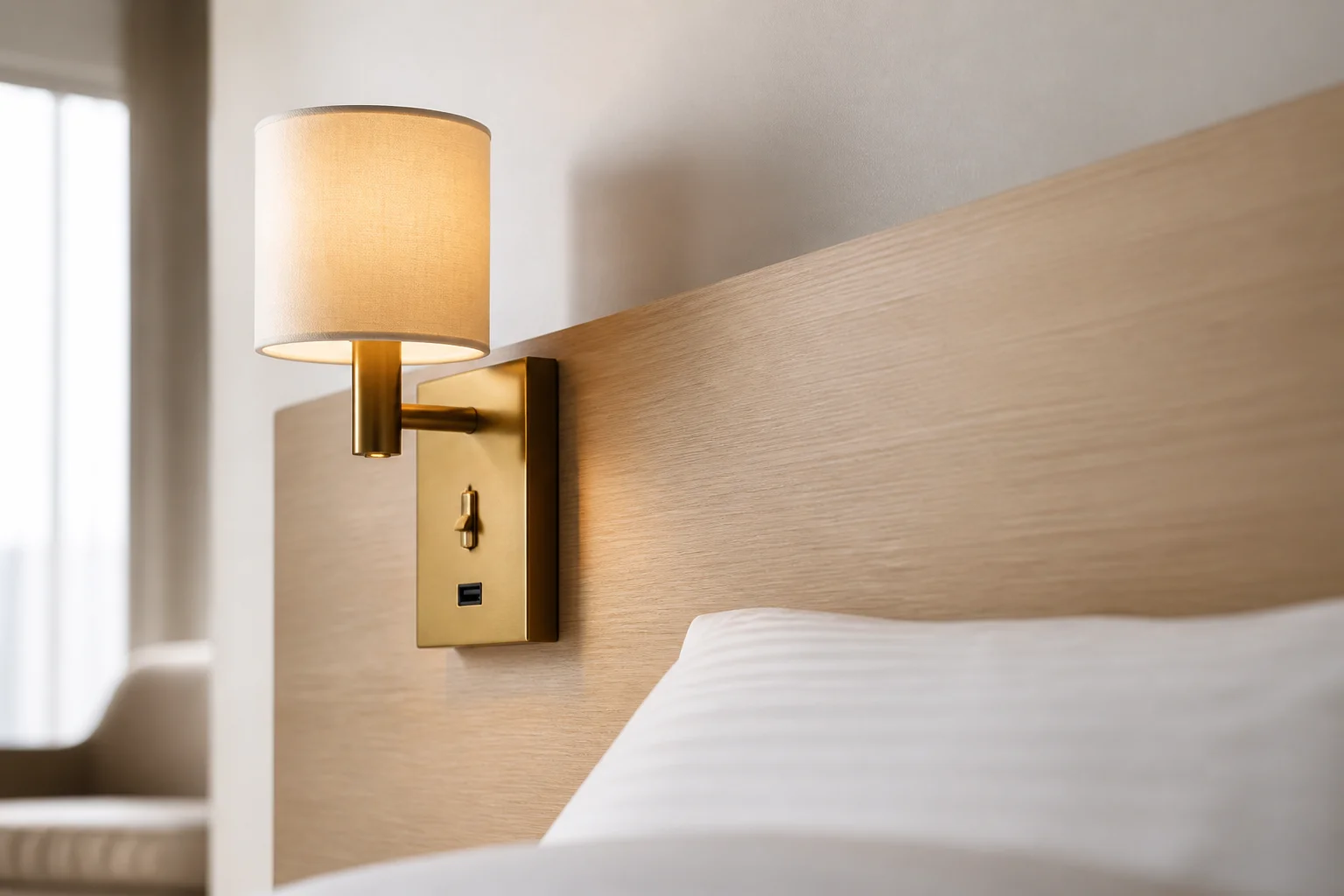 |
| The parts a guest touches: one switch and one charging port set into the backplate of a custom bedside fitting. |
Why the functional brief arrives last
A visual decision can be agreed in one meeting: everyone reacts to a drawing and the argument ends. A functional decision depends on answers that arrive from elsewhere: which control method the building uses, whether the operator wants charging at the bedside, how the room is cleaned and reset. Those answers land weeks after the concept, so the functional brief drifts in behind the visual one.
That sequence causes most customisation rework. A fitting that gains a switch, a charging module or a different driver late is no longer the fitting that was sampled and priced. The fix is not complicated, but it has to happen early: list the functional lines with the finishes and dimensions, and require an answer before the design is released for sampling.
What functional customisation actually changes
Visual customisation changes the drawing. Functional customisation changes the bill of materials, the wiring and the sample. Four lines move most often after approval.
- Control interface. The switch or dimmer the guest touches, and where it sits on the fitting.
- Charging. Whether a module is built in, which port standard it carries and where the cable leaves the body.
- Dimming behaviour. Not the control method, but what the fitting does at its lowest usable level and in a mixed load.
- Service access. How each of the above is reached and replaced without removing the fixture.
Each line looks small alone; together they decide whether the delivered fixture behaves like the sample, and each carries a different owner on the project side.
The control interface is a design decision, not a detail
The interface is the only part of a custom fixture the guest operates by hand, so it deserves the same attention as the shade. Four options cover most projects, and the choice follows the room's use rather than the product range.
| Interface option | Where it suits | What to freeze before sampling |
|---|---|---|
| Switch integrated in the fixture | Bedside and reading fittings reached by hand | Position on the body, travel and feel, material, replaceability |
| Wall switch or wall dimmer | General room layers controlled from the entry | Plate range, gang count, wiring class the fitting is built for |
| Dimmer built into the fixture | A single decorative piece on its own circuit | Dimming range, lowest stable level, the driver that achieves it |
| Addressable or bus control | Layered schemes with scenes and a panel | Control method, addressing plan, operator handover |
One interface should not do two jobs. A fitting carrying both the guest switch and the scene control makes every later fault ambiguous, and a switch hidden behind the shade is a complaint waiting to be logged.
Charging modules: integrate early, not as an add-on
Charging is the fastest-moving line in the brief. Port standards change, guests arrive with more devices, and a module fitted as an afterthought is usually the first part to fail. It is also the line most often left to whoever supplies the furniture, which is how a room ends up with charging points none of the drawings show.
- Port standard and count. How many ports, which connector type, whether fast charging is expected; confirm with the project's electrical consultant.
- Placement. A port reached while lying down differs from one on a desk, and the cable route changes with the position.
- Cable management. Strain relief at the entry and a route clear of the shade, so the fitting is not pulled out of alignment.
- Shared capacity. Where two ports share a module, what happens when both are in use belongs in the specification.
- Serviceability. The module and connector should be replaced without dismantling the fixture, and clean without taking the finish with them.
Where a hotel has already standardised a charging arrangement elsewhere, match it rather than inventing a second standard. The subject here is what an integrated module does to a bespoke fixture's design and order.
Dimming behaviour is where guests form an opinion
Control methods are compared elsewhere, so keep this section on behaviour. Guests do not notice which system a room runs on, but they notice flicker, a jump at the bottom of the range, and a fitting that sits brighter or dimmer than its neighbour on the same setting.
- The lowest stable level. Agree the level the fitting holds without flicker or drop-out, and test it on the sample, not on paper.
- Driver matching. The driver has to suit the project's control method, and a bespoke fixture is the wrong place to find a mismatch.
- Channel count. Whether the fitting dims as one piece or in separately controlled sections changes the wiring and the submittal.
- Mixed loads. Two fittings that behave well alone can behave badly on a shared dimmer; check them together.
- Colour at low output. If the fitting should warm or hold its colour as it dims, that is a specification decision, not a default.
What a functional change does to the sample and the submittal
A sample proves what it contains. If the switch, the charging module or the driver changes after approval, the sample no longer describes the delivered fitting.
Two habits keep this honest. Sample the function as well as the form, so the approved piece carries the specified interface, module and driver. Then keep a functional revision log beside the drawing set, one line per change with its date and approver, so order, drawing and quotation stay in step before release.
On a bespoke fixture the look is what the project argues about and the function is what it lives with. The switch a guest presses every night outlasts every opinion about the shade.
The functional lines to freeze before production
Before production starts the factory needs a short, fixed list. If any line is still open, it is a change order waiting to be raised.
- Supply voltage and frequency, and the wiring class the fitting is built for.
- Control method, addressing plan and the number of separately controlled channels.
- Interface type and its exact position on the body.
- Charging ports, connector standard and placement.
- Driver type and location, with the access route for replacement.
- The spare and replacement parts the operator will need later.
None of these lines is unusual, and none is expensive to answer early. The cost arrives when the answer is given late, as a second sample, a re-quote or a re-wired batch.
FAQ
Can controls and charging be added after the fixture design is approved?
They can, but the fitting becomes a new specification rather than the approved one, usually meaning a fresh sample and a revised quotation. Bringing the functional lines into the first brief is cheaper.
Should the charging module be supplied by the lighting manufacturer or a third party?
Either works if one party owns the interface with the fixture. The module, its connector and its cable route should be specified together, so no gap is left between the fitting and the electrical work on site.
Does custom dimming behaviour add to the schedule?
It can, because a driver matched to the project's control method has to be tested rather than assumed. Settle the behaviour before sampling and the check folds into the sample cycle.
Who decides the control interface: the designer, the operator or maintenance?
All three have a line. The designer owns how it looks and feels, the operator owns what the guest is asked to do, and maintenance owns whether it can be replaced.
What is the commonest functional customisation mistake?
Freezing the appearance and leaving the function open. The finish is locked and the drawing signed while the switch, the module and the driver are still undecided.
The takeaway
Customisation is usually discussed as a question of looks, but the lines that decide whether a bespoke fixture works sit behind the shade: the control interface, the charging module and the dimming behaviour. Bring those into the specification with the finishes and the dimensions, give each one an owner, and freeze them before production. Sample the function as well as the form, and the fixture a guest touches every night will match the drawing the project signed.
Zerouno Lighting (ZeroUNO) manufactures hospitality decorative lighting in Zhongshan, China, and has built project and custom fixtures since 2013. Functional customisation is usually resolved at the one-piece sample stage, where the control interface, the charging module and the driver can be checked together before the specification is frozen. Learn more at zerounolighting.com.
About the author
Sonny Yu is Sales Manager at Zerouno Lighting, working with hotel owners, designers and procurement teams on bespoke decorative lighting packages. He writes about the decisions that are cheap while a project is still a drawing and expensive once an order is released: what a custom fixture is asked to do, who decides it, and what has to be written down before production begins.



没有评论:
发表评论