A decorative lighting package is usually audited on two things: whether the electrical assembly carries the marks the destination market expects, and whether the photometric schedule was honoured. The material set rarely gets the same attention, yet it is the part that stops a container at the port or fails a fire officer's inspection.
This guide is for hotel owners, designers and procurement teams placing the order. It covers which parts of a decorative fixture carry a fire or material requirement, what the evidence has to show, where documentation chains break, and what belongs in the specification.
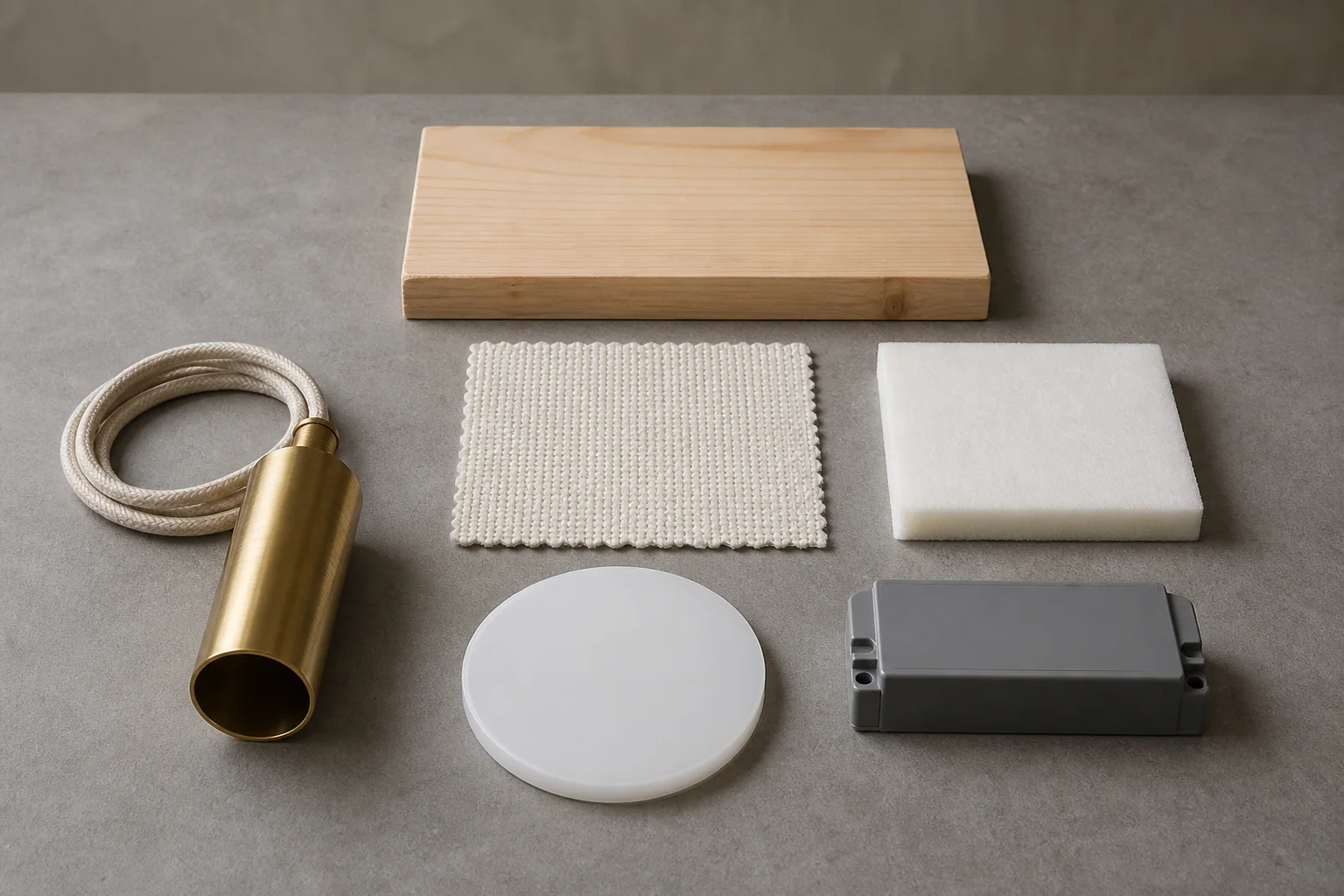 |
| The material set behind a decorative fixture: fabric, foam, timber, brass, diffuser and driver each carry their own document. |
Where fire and material compliance actually lands
A decorative fixture is not one material. It is an assembly of at least six, and the electrical mark usually speaks to one of them.
- The shade. Woven fabric, laminated textile or paper, and the largest exposed surface on most hospitality fittings.
- The padding. Foam or wadding behind a padded backplate or a wrapped panel.
- The substrate. Timber, MDF or plywood used as a backplate, a base or a decorative panel.
- The plastics. Diffusers, trims, end caps and cable grommets.
- The cable and insulation. The flexible cord and its sheath, crossing from the fixture into the building's wiring.
- The adhesives and coatings. The bond between a fabric and its backing, and the lacquer on a timber surface.
Which of these carries a requirement depends on the market and on the room: a shade in a corridor and a shade in a guest bathroom can be judged against different criteria. The widest-reaching requirement is usually attached to the furnishing material rather than to the electrical product.
The material families that carry the risk
Two questions decide how much attention each family deserves: how much of it is exposed, and whether it can be changed unnoticed. Fabric and foam are exposed and easily substituted; cable and drivers are hidden but fully specified.
- Textiles and foam. Chosen for appearance but judged on ignition behaviour; a mill's substitution of a backing or treatment is invisible in a render.
- Timber and panel products. Judged on flame spread, and sensitive to whether the same species or board was used in production as at sampling.
- Plastics and diffusers. Usually the easiest to evidence, because the grade carries the report, provided the grade supplied matches the one reported.
- Cable and insulation. Typically covered by the cable's own document, held in the fixture's file only if somebody asks.
The practical rule is that the material a project can see is the material it forgets to document, and the fabric on the shade is the commonest cause of a compliance argument at delivery.
On a decorative fixture the electrical mark answers the inspector and the material file answers the fire officer. A fitting can satisfy one and fail the other.
Reading the requirement of the destination market
There is no single international fire requirement for a decorative luminaire's materials. Markets differ in whether the material is regulated as a product in its own right, folded into building or hotel regulation, or left to the operator's insurer. The buyer's job is not to memorise the regimes but to name the applicable one in the specification and ask for evidence against it.
| Element | What the requirement usually governs | What to request before the order is placed |
|---|---|---|
| Fabric shade or textile panel | Ignition and flame-spread behaviour of the material itself | A report naming the exact fabric, its backing and any treatment |
| Foam and wadding | Ignition behaviour of the fill where it is exposed or thinly covered | A report naming the foam grade and density, not a generic class |
| Timber, MDF and plywood | Surface flame spread, and in some markets substrate treatment | Species or board type, any treatment applied, and the panel construction tested |
| Plastic diffusers and trims | Contribution to fire growth where the market requires it for the assembly | The polymer grade and the report issued for that grade |
| Cable and insulation | Performance of the flexible cord and its sheath | The cable reference and its own certificate, matched to what is fitted |
| The assembled fixture | Overall behaviour, where the market asks for the finished item | A report for the complete assembly as supplied, not a representative part |
Two cautions belong beside that table. Regimes change, so a document correct at specification can be superseded by the time the goods ship. Where the project's consultant has issued a fire strategy, that document outranks any general reading.
What a test report has to show before you accept it
A report is not a certificate. It records what was tested, how, and with what result, and its value depends on how closely the tested item matches the item supplied.
- Who issued it. The laboratory, its accreditation and the issue date, so the document can be verified rather than filed.
- What was tested. The material, its construction and its finish, not a family name covering several products.
- How it was tested. The method and its edition, because results are not portable between editions.
- What the result means. The outcome stated against the criterion the market applies, not only a pass or fail label.
- Whether it is the supplied item. The tested material has to trace to the material on the purchase order.
- Whether it is still current. Issue date, any expiry the market sets, and whether a material change invalidates it.
Where the documentation chain breaks
Most material compliance failures are not forgeries but gaps nobody owned. Five recur often enough to be treated as a checklist.
- The tested sample is not the production item. A fabric is swapped for a visual match, or a foam grade changed for availability, after the report was issued.
- The report belongs to a component supplier. It covers the fabric or driver as sold by that supplier, and says nothing about the finished fixture.
- A material is reported, an assembly is supplied. A fabric report does not describe the laminated shade, nor a board report the lacquered panel.
- The requirement is argued by equivalence. A declaration that a similar material met the criterion elsewhere is not evidence here.
- The file is dated before the last change. Documents stay in the folder while the specification, and with it the material, move on.
What to write into the specification
Compliance is cheaper to write than to argue. Six lines in the specification remove most of the exposure.
- Name the material, not the colour: fibre, weave, backing, foam grade, timber species, polymer grade.
- Name the fire criterion the destination market applies, and the market it applies in.
- Require the evidence before production release, not before shipment: a report arriving late cannot change a batch already made.
- Name who may approve a material substitution, and require it to be re-evidenced rather than re-declared.
- Keep one material dossier per project, travelling with the approved sample.
- Repeat the requirement in the change-control clause, so a revision cannot quietly change a documented material.
FAQ
Does an electrical certificate cover the fire performance of a shade?
Generally no. An electrical mark addresses the electrical assembly, while the fire behaviour of a furnishing material is a separate requirement with separate evidence. A fixture can hold a valid electrical document and still fail a material check.
Is a fabric's fire report enough for the finished fixture?
Only where the market asks for the material alone. A fabric report describes the fabric as tested, not the laminated or tensioned shade as supplied, so the construction, backing and adhesive also need to be traceable.
Who carries the risk if a material is substituted during production?
Whoever approved the substitution, which is why the specification should name that person and require re-evidence. An unapproved substitution moves the risk to the supplier, a loosely approved one back to the project.
Is the requirement the same in every market?
No, and it is not always a product requirement. Some markets regulate the furnishing material directly, others reach it through building or hotel regulation, and others leave it to the operator or its insurer.
What if a project states no fire requirement at all?
Ask in writing and record the answer. Where the operator or its insurer holds the requirement, an email naming it is enough to build the order around; silence is what creates the argument.
The takeaway
Fire and material compliance on a decorative lighting package is decided long before anything reaches a fire officer, in the specification that either names the materials and the criterion or leaves both open. Fabric, foam, substrate and cable each need an owner, a document and a rule about substitution. Electrical compliance is handled because it has a form to fill in; the material set has no form, which is why it surprises projects at delivery.
Zerouno Lighting (ZeroUNO) manufactures hospitality decorative lighting in Zhongshan, China, and has built project and custom fixtures since 2013. Material and finish decisions are usually settled at the one-piece sample stage, where fabric, substrate and finish can be checked against the specification. Learn more at zerounolighting.com.
About the author
Sonny Yu is Sales Manager at Zerouno Lighting, working with hotel owners, designers and procurement teams on bespoke decorative lighting packages. He writes about the parts of a lighting order that are cheap to settle while a project is still a drawing and expensive once production starts: which materials are specified, who owns each one, and what has to be written down before release.



没有评论:
发表评论