A mock-up room is the last point in a hotel project where a lighting decision is still cheap to change. Everything after it is expensive to move: the production order, the finish run, the delivery sequence, the installation on floors already decorated. That is the argument for building one, and the reason a room waved through in twenty minutes is worse than no mock-up at all. It turns an open question into a signature.
This guide is for owners, designers, project managers and procurement teams who have to run that room and put a name to the result: what the mock-up must contain, the order to walk it in, how to light it, and the records that keep a sign-off intact.
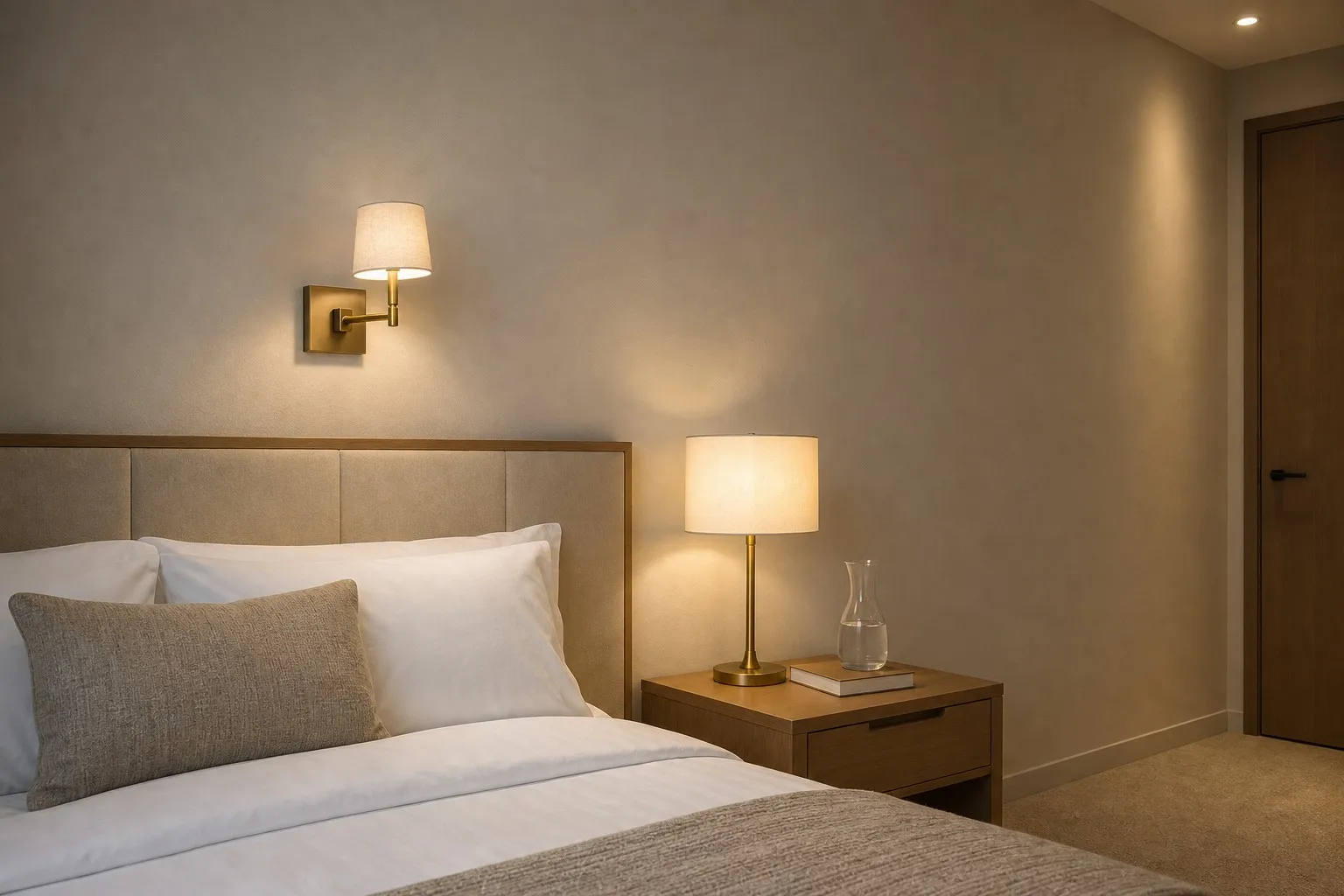 |
| A mock-up is signed off on what the guest actually sees: fitting height against the mattress, glare from a lying position, and how the shades read against the headboard and linen. |
A mock-up room is a decision venue, not a sample order
The word "sample" causes most of the trouble. A sample is something you look at; a mock-up is a decision you make, installed and switched on in the room it was designed for, and judged from the positions a guest will occupy rather than from a doorway. That changes what the review needs: not only the fixtures, but the furniture they interact with, the finishes they sit against, the controls they run on, and the people who maintain them.
What the room has to contain before the walk-through is worth doing
Most disappointing mock-ups are incomplete rather than wrong. The fixtures are correct, but the room cannot demonstrate the problem they were meant to solve.
- The full decorative family, not the hero fitting. Wall light, table lamp, standard lamp and ceiling layer, each in at least one position, so the way they read together is visible.
- The specified furniture. The actual nightstand, headboard and mattress height. A reading light judged against a borrowed table is judged against the wrong datum.
- The adjoining finishes. Door hardware, joinery and the wall finish the fixtures sit against. Brass that reads warm on a board can turn cold beside the wrong joinery.
- The control system. The real dimming protocol and scene controller, not a temporary switch on a bench.
- The guest's own positions. A clear route to lie on the bed, sit at the desk and walk in from the corridor.
- The people who will live with the decision. Housekeeping and engineering should see the room before it is signed; their objections are cheaper now than at handover.
The sign-off areas, and what each one is really testing
A mock-up is usually walked once, by a group, and discussed afterwards. A table keeps everyone on the same question.
| Sign-off area | What you are really testing | What "signed" should mean |
|---|---|---|
| Fixture family and completeness | Whether the layers were designed as a set or assembled from a catalogue | Every family present in at least one position, code recorded |
| Mounting heights and positions | Whether the reading light and switch are reachable from a lying position | Agreed heights written down, not remembered |
| Finish and colour consistency | How the brass behaves under room light and against the joinery | One finish code fixed for the whole run |
| Behaviour from the guest position | Glare when lying down, shade brightness, spill through the door gap | Levels agreed at the bed, not at the threshold |
| Scenes and controls | What a guest can reach, what housekeeping can override, what the night scene does | A scene schedule reproducible floor by floor |
| Service and driver access | Whether a driver can be replaced without dismantling the headboard | A service route agreed with engineering |
| Cable and switch set-out | Whether the first-fix drawing survives contact with real furniture | The set-out drawing marked up and returned |
Walk it in this order
Sequence matters, because the first impression biases everything after it. Daytime first, then night, then the mechanics.
- Walk in as a guest would, from the corridor with the door closing behind you. The first read of the room is judged here.
- Then lie on the bed. Reading position, glare and shade brightness are decided here, and nothing else reproduces it.
- Then run the scenes. Day, evening and night, with the transitions, not only the end states.
- Then dim everything and check the door gap, the mirror and the reflection in the television screen.
- Then talk to housekeeping and engineering with the lights still on, while the room is standing.
A mock-up room does not need to be beautiful to be useful, but it does need to be uncomfortable. If nobody in the room changes their mind about anything, the review was probably too short.
Light the mock-up the way the hotel will operate it
The most common failure at mock-up stage is reviewing the room at one flattering setting. The room has to work at eleven at night and at seven in the morning, and that window is where it should be judged.
Three things are worth insisting on. Review the night scene as the default and treat the bright setting as the exception. Ask what the fittings look like switched off, because that is how they read for most of the day. And confirm that decorative and escape route lighting stay on separate circuits, which constrains where the control gear can sit.
Brightness itself should not be argued about in the room. Task illuminance belongs to the project lighting designer, confirmed against the standards that apply to the property. What the mock-up settles is everything the numbers cannot: glare, shade glow, the colour of light against the finishes, and how the fittings behave overnight.
What the signature should record
A sign-off is only as strong as what it names. "Mock-up approved" on a drawing is close to worthless six months later, when nobody remembers which finish was in the room.
- The fixture code and finish code for every item, matched to the schedule.
- Agreed mounting heights and set-out dimensions, marked on a drawing.
- The scene schedule, with the settings that were demonstrated.
- Open items, separated from closed ones, each with an owner and a date.
- Photographs of each position in the agreed settings, taken the same evening.
Two entries are habitually forgotten and matter most. The photographs, because they end arguments about what was shown. And the open items, because a room signed with unresolved questions will be changed later at production cost.
Why signed mock-ups still fail at rollout
A mock-up proves that a design can work. It does not prove that the package will match it, and that gap is where complaints live.
Three causes recur. The finish drifts between production batches, so the fittings on floor nine sit a shade away from the approved room. The set-out drifts on site, so a reading light approved at one height is installed at another and the glare the mock-up eliminated comes back. Or the scene schedule is never written down, so each floor is commissioned by a different electrician.
All three are controlled the same way: fix the finish code for the whole run, freeze the set-out drawing once the mock-up is signed, and issue the scene schedule as a document rather than a demonstration.
FAQ
How long should a mock-up room be reviewed for?
Long enough to cover daytime, evening and night scenes, and for the room to be lie-in tested by more than one person.
Should the mock-up use production fixtures or a one-off sample?
Production-representative is what matters. The mock-up is only useful if the fittings can be made again to the same standard, so the finish and construction shown must be what the order will use.
Does the mock-up have to be built on site?
On site is strongest, because real room dimensions and first-fix positions are part of what is being checked. Where that is not possible, a factory-built room works provided the furniture, finishes and controls match.
Who should sign the mock-up?
Whichever party owns the design decision and will carry the cost of changing it later, usually alongside the project manager. Engineering and housekeeping should attend even if they do not sign; their findings are the cheapest changes available.
What happens to an open item after sign-off?
It should be listed with an owner and a date rather than left as an understanding. A finish question is best resolved by agreeing a new sample deadline and holding affected production until it closes.
The takeaway
A mock-up room is an approval instrument, so make it complete, walk it in a deliberate order, and light it the way the hotel will run it. Judge the night scene first, check the room from a lying position, and bring housekeeping and engineering in while the lights are still on. Then record what was agreed: fixture and finish codes, mounting heights, the scene schedule, open items with owners, and photographs as shown. Signed properly, it is the cheapest place in a project to change your mind.
Zerouno Lighting (ZeroUNO) manufactures hospitality decorative lighting in Zhongshan, China, founded in 2013 with a team of 120. One-piece sampling for project approval is a normal part of how the company works with designers, and made-to-order packages are quoted with a 25 to 35 day production window. Learn more at zerounolighting.com.
About the author
Sonny Yu is Sales Manager at Zerouno Lighting, working with hotel owners, interior designers and procurement teams on decorative lighting packages for hospitality projects. He writes about the practical decisions behind specifying hotel lighting, from mock-up approval and finish control through to lead times, inspection and after-sales.



没有评论:
发表评论