Guests never read your lighting specification, and almost nobody reads a warranty until something fails. When a decorative luminaire is rejected at handover because a finish has dulled, or a wall light stops working two years into operation, the conversation moves quickly from "is it faulty" to "is it covered". Those are different questions, and the document that answers the second one is the exclusion list, not the headline warranty term.
This guide is for owners, procurement teams, facility managers and designers who have to make that distinction hold up in a claim. It sets out what decorative lighting warranties cover, the exclusions that cause most disputes, and the records that decide whether a claim survives.
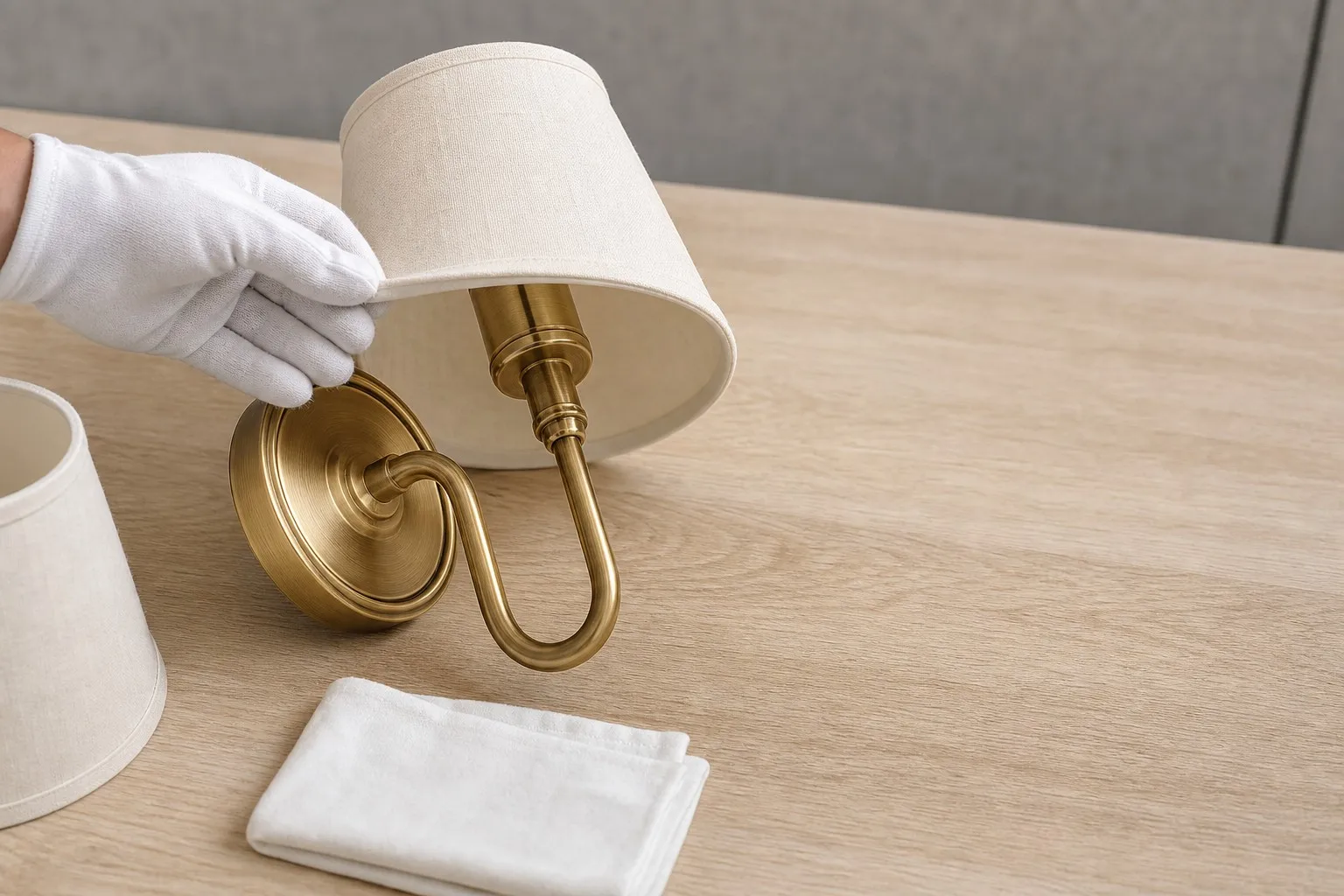 |
| Checking shade, finish and mounting detail at the bench turns a warranty claim into a defects conversation. |
The warranty term is the least informative line in the document
A warranty certificate leads with a duration, and that number is the easiest to compare and the least useful on its own. Four commitments share the same page, and a claim is only as strong as the weakest of them.
- Term. How long coverage runs, and from which date: delivery, installation or handover. A project completed in stages can burn months of coverage before the first guest arrives.
- Scope. Which components are included. Body and finish, light engine, driver and diffuser are separate items commercially, and are often covered for different periods.
- Conditions. The exclusion list: environment, installation, cleaning, modification, supply voltage.
- Service commitment. The response route and timing when a claim is made, which is what the property actually experiences.
A generous term with a thin scope is worth less than a shorter term that names the light engine, the driver and the finish.
The exclusions that cause most lighting disputes
Most rejected claims do not fail because the product was outside warranty. They fail because the failure happened through an excluded route. The table sets out the exclusions that come up most often, and the action that keeps a claim alive.
| Exclusion | How it usually reads | What it means on site | What protects the claim |
|---|---|---|---|
| Installation and handling | Damage from incorrect installation or handling is excluded | A fitting mounted without the supplied bracket or gasket | Keep installation instructions on site and photograph the install |
| Site environment | Products in unregulated humidity or aggressive air are excluded | Pool decks, spa areas, coastal facades, back-of-house laundries | Declare the space at specification stage and agree finish and ingress protection |
| Cleaning agents | Damage from abrasive or solvent-based cleaning is excluded | A finish dulls unevenly after housekeeping switches product | Agree a cleaning schedule with named products and issue it to housekeeping |
| Third-party work | Alteration, rewiring or repair by others voids coverage | A local electrician swaps a driver to avoid a call-out | Agree one route for spares and repairs before opening |
| Consumables and wear | Lamps, batteries, diffusers and textiles are consumables | A cracked diffuser is classified as damage, not defect | Order spares with the main batch so replacements match |
| Supply conditions | Damage from incorrect voltage or an unstable supply is excluded | Multi-country projects with mismatched voltage or control gear | Confirm supply voltage, dimming protocol and driver at order stage |
| Events outside control | Fire, flood and similar events are excluded | Water ingress after a building leak | Treat it as an insurance matter, not a warranty claim |
None of these clauses is unreasonable. Each exists because the failure happened somewhere before, and a supplier who has seen it happen will name it. The problem is discovering the clause after the loss rather than before the order.
Installation and handling: where coverage quietly ends
Decorative lighting is finished goods by the time it reaches site, which makes installation a common boundary in the claim conversation. A fitting can leave the factory perfect and arrive marked or dulled because it was stacked against a wet wall or left in an unconditioned store.
- Keep fittings in their packaging until the room is ready, and keep the packaging in case anything has to travel back.
- Mount on the supplied bracket and gasket. A substitution stays invisible until water or vibration finds the gap.
- Have the electrician work to the supplied wiring diagram, and record the supply conditions at commissioning.
- Photograph each fitting at installation and again at handover. Two photographs close most arguments.
An exclusion list is written by the party who knows which failures actually happen. If a clause reads oddly specific, it is specific because it has been argued about before.
Environment and cleaning: the exclusions nobody reads
Two clauses cause a disproportionate share of disputes in operating hotels: the environment the fitting was specified for, and the product used to clean it.
On environment, the ask is precise. A fitting designed for a dry guest room is a different product from one expected to survive a spa, a pool deck or a coastal facade. If the specification does not declare the space, the supplier will reasonably assume the gentler one. The fix is a written declaration at specification stage, recorded against the fixture schedule.
On cleaning, the difficulty is that the person who damages the finish rarely signed the warranty. Housekeeping uses what is available and what works, and a universal bathroom cleaner can dull a plated surface over repeated contact. The control is a short cleaning schedule naming the products approved for each finish family, issued to housekeeping and kept with the maintenance file.
What a claim actually needs
A claim is an evidence exercise as much as a technical one. A supplier cannot assess a failure it cannot see, and a request backed by images, dates and part references is resolved quickly.
- The order reference, the fixture code, and the room or floor it was installed on.
- The installation date and the date the fault appeared.
- Clear photographs of the failed unit, the mounting detail and the surrounding environment.
- Whether the fault is isolated or affects other units from the same batch.
- The finish code and batch reference for the run, so any replacement matches.
- A note of what has already been changed on site, including any third-party part.
Two items are worth holding deliberately. Keeping spares and the exact finish code for the whole run means a replacement arrives matching the property rather than reading as a repair. Planning the after-sales route alongside the order, rather than after opening, is what allows coverage to be applied instead of argued about.
Writing the exclusions into the purchase order
Exclusions are easier to live with when they were agreed before production. Three clauses cover most of the exposure.
First, record the environment: state where each fixture family will be installed and confirm the specified finish and ingress protection suit it. Second, name the non-substitutable items: light engine, driver, diffuser specification and finish code, with any change requiring written approval. Third, agree the spare strategy: how many units are held, where stored and who owns them.
Add the service route on the same page. A warranty states the conditions of coverage; the after-sales commitment states how a claim is handled and how fast. A named contact with a stated response window turns a dispute into a process.
FAQ
How long should a decorative lighting warranty be?
Length matters less than scope. A statement covering the body, the finish and the light engine for a defined period is worth more than a longer term that leaves the electronics outside. Our own standard term is a two-year warranty with a 48 hour response commitment.
Is a finish or coating covered by the warranty?
Usually yes, but with the most conditions attached. Finish coverage normally links to the declared environment and to cleaning practice, so it depends on what the fitting was specified for and what has been used on it. Recording both is what makes a finish claim possible.
What if only one unit fails from a batch?
Single failures are handled as units, and matching usually matters more than coverage. A replacement produced later can differ slightly from the original run, so hold spares from the same batch.
Does the warranty cover freight on a replacement part?
Coverage for the part and responsibility for the journey are separate questions, and the second is often left unspoken. Agree the delivery basis and duty responsibility at order stage so a replacement is not delayed.
What voids a lighting warranty most often?
In practice, three things: cleaning products that were never agreed, third-party modification on site, and installation outside the supplied method. All three are avoidable with a short documented process.
The takeaway
A hotel lighting warranty is a short list of promises wrapped around a longer list of conditions. Read the term, the scope, the exclusions and the service commitment together, because a claim depends on all four. Declare the environment at specification stage, agree the cleaning products and the non-substitutable items, and hold spares and finish codes for the whole run. Then write the agreed exclusions into the purchase order, so the argument happens before production, not after handover.
Zerouno Lighting (ZeroUNO) manufactures hospitality decorative lighting in Zhongshan, China, founded in 2013 with a team of 120. Its standard commercial terms include a two-year warranty and a defined route for spares and finish continuity across a project. Learn more at zerounolighting.com.
About the author
Sonny Yu is Sales Manager at Zerouno Lighting, working with hotel owners, interior designers and procurement teams on decorative lighting packages for hospitality projects. He writes about the commercial and practical side of specifying hotel lighting, from warranty and after-sales terms through to custom finishes, spares planning and delivery.



没有评论:
发表评论