Of all the fittings in a hotel guest room, the bedside reading light is the one that fails most quietly. Nothing burns out, nothing falls off the wall, and the room still photographs correctly. It fails because the guest ends up tilting a book to find the beam, or because one person reading at eleven o'clock throws light across the whole bed.
This guide is for owners, designers, procurement teams and engineering staff who specify, order or sign off bedside lighting. It covers mounting height, beam angle, glare control, control placement and mechanism choice, and what to test in a mock-up room before the specification is frozen.
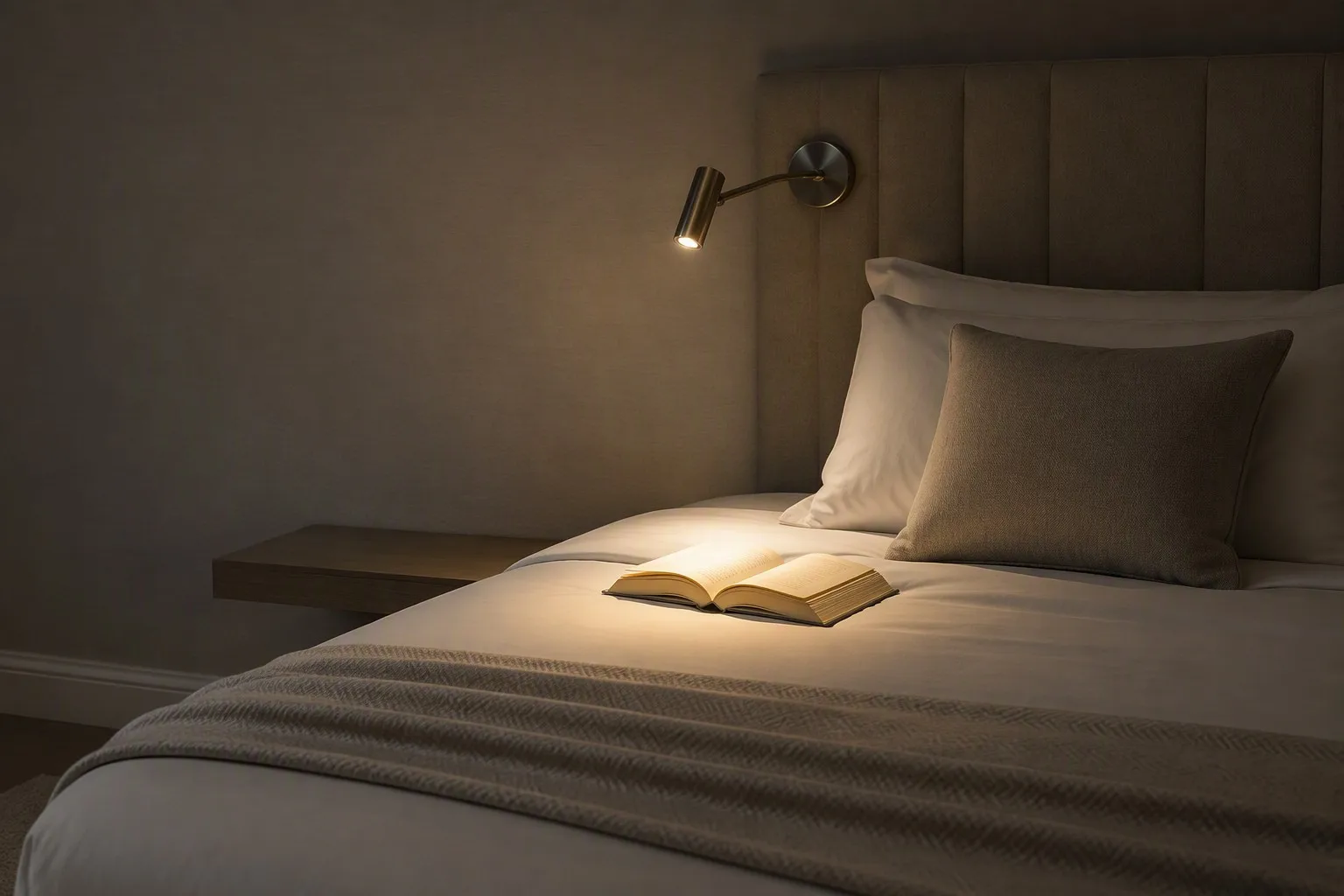 |
| A bedside reading light should put its beam on the page, not on the room. |
A reading light is a geometry problem before it is a brightness problem
Reading in bed is a task with an awkward geometry. The reader is lying down, so the head sits low and close to the surface the light has to land on, the book is held at an angle that shifts as the reader moves, and there is usually a second person in the bed who did not ask for any light at all.
That combination means a fitting chosen on appearance alone will often disappoint. What matters is where the source sits relative to the reader's head, and how far the beam spreads from there. Brightness is a consequence of those two decisions, not a substitute for them.
A bedside fitting has to do five things at once:
- Land useful light on the page rather than on the pillow or the reader's face.
- Keep the source out of the reader's direct line of sight when the head is on the pillow.
- Keep the beam off the neighbouring pillow.
- Be reachable without the guest sitting up.
- Dim low enough that the other occupant is not disturbed.
A fitting that satisfies all five is rarely the smallest one in the range.
Set the mounting height from the mattress, not the floor
The most common specification error is a mounting height taken from the floor. Mattress height varies between brands, and it changes again when a property replaces toppers or swaps a bed frame. A fixture set at what looked correct on a drawing can sit well below the reader's shoulder two years later.
Measure from the top of the mattress instead, and set the source above the mattress plane and forward of the pillow, near shoulder level when the guest is lying down. The project lighting designer validates the final dimension against the actual bed specification and the local standard.
| Where the source sits | What the reader gets | What goes wrong |
|---|---|---|
| Above the mattress, forward of the pillow | The beam lands on the page | Aim drifts high and the book falls out of it |
| Level with the mattress top | Light across the pillow | The pillow becomes the brightest surface |
| Behind the reader's shoulder | Grazing light across the page | The reader's own head casts a shadow |
| Two headboard fittings set wide apart | Coverage for a double bed | Light collects between the two readers |
| Ceiling or cove only | Even general light | No task layer at all |
Beam angle: why a narrow optic usually beats a broader one
A beam angle describes how far a fitting's light spreads. A narrow optic concentrates output into a small pool; a wide optic spreads the same output over a larger area. For reading the target is small, because a paperback is not a large object.
- A narrow optic puts usable light on the page with less spill towards the other occupant.
- A wide optic lights the wall evenly and suits a decorative wall light, but rarely works as a task light.
- A narrow beam aimed badly is worse than a wide beam aimed well.
- Where one fitting must serve both roles, an asymmetric distribution is the usual compromise.
The test is not how the fitting looks switched on in a showroom. It is whether a guest lying on the pillow can read without moving the book, and without the other side of the bed noticing the light.
Glare: solve for two people, not one
Glare in a guest room is rarely about the fitting being too bright. It is about the source being visible. When the light source can be seen directly from either pillow, the fitting will be judged harsh regardless of its output.
- Recess or shield the source so it cannot be seen from either pillow position.
- Prefer a deep or baffled shade over an open one.
- Check reflections in the mirror, the television screen and any polished surface at eye level. A reflection reads as glare even when the fixture is out of view.
- Check the finish: a polished interior near the source returns a hot spot, a matte one does not.
This is where the second occupant enters the brief: the person not reading experiences the fitting as a problem, and their tolerance limits how much light can leave the page.
Controls: reachable lying down, and able to go low
A reading light that has to be switched off by getting up will be reported. The switch should be reachable from the lying position.
- Provide local dimming, not only local switching.
- Keep the reading circuit separate from the general room circuit, so turning the room off does not force the bedside light off with it.
- Avoid a single master switch at the entrance that silently cuts the bedside supply.
- In controlled rooms, confirm the reading light is separately addressable rather than a group member that moves with the scene.
Mechanism: match the fitting to how guests will use it
The mechanism decides whether the fitting still works after five years of adjustment. Four families cover most hotel rooms.
| Mechanism | Best for | What to watch |
|---|---|---|
| Fixed directional head | Standard rooms with a known bed position | No adjustment, so the initial aim must be recorded |
| Swing arm | Rooms where guests move the light to suit themselves | Joints that loosen; specify a friction joint, not a detent |
| Flexible gooseneck | Shallow headboards and close reading positions | Re-aiming fatigue; keep the driver in the base, not the head |
| Headboard integrated | Clean lines and a fixed bed layout | Reflector geometry drives glare; test with the mattress in place |
On any adjustable fitting, the moving part is also the part that wears. Ask what the joint is made of, and hold spare units so a replacement matches.
What to test in the mock-up room
A mock-up room is the only place where mounting height, aim, mattress height and the actual headboard can be judged together. Four checks cover most of the risk.
- Lie on the bed with the real mattress and topper fitted, and read at each bedside.
- Check the fitting from the opposite pillow with everything else switched off.
- Check the lowest dimming level in a dark room and judge whether it still disturbs the other occupant.
- Photograph the aim and record the exact mounting dimension.
Write those dimensions onto the fixture schedule. A mounting height agreed in the room and never written down leaves every later floor to be aimed by eye.
FAQ
How high should a hotel bedside reading light be mounted?
Measure from the top of the mattress rather than the floor, and set the source above the mattress plane and forward of the pillow, near shoulder level when lying down. The project lighting designer sets the final dimension.
What beam angle works best for bedside reading?
A narrow optic aimed carefully is usually more comfortable than a wide one, because it puts light on the page and less on the neighbouring pillow. Aim matters more than angle.
Should the reading light be on its own circuit?
Yes. A separate dimmable circuit lets one guest keep reading while the rest of the room goes dark, and stops a master switch by the door from cutting the bedside light.
Are integrated USB ports at the bedside worth adding?
They are commonly requested and rarely regretted, but they change the electrical layout. Confirm the port rating, where the transformer sits, and whether the port stays live when the light is off.
Can existing bedside lights be upgraded to read better?
Often yes, without new wiring. Re-aiming the fitting, swapping a wide optic for a narrow one or an open shade for a baffled one, and confirming local dimming will solve a large share of complaints.
The takeaway
A bedside reading light is judged on geometry, not output. Set the mounting height from the mattress top, choose a narrow optic, and aim it at the page rather than the room. Shield the source, give the guest local dimming on a separate circuit, and match the mechanism to how the fitting will be moved. Then test the arrangement in a mock-up room with the real mattress in place, and write the final dimensions onto the fixture schedule.
Zerouno Lighting (ZeroUNO) manufactures hospitality decorative lighting in Zhongshan, China, founded in 2013 with a team of 120. The company produces bedside and headboard integrated reading lights to project specifications, and supplies single piece samples for mock-up sign-off. Learn more at zerounolighting.com.
About the author
Sonny Yu is Sales Manager at Zerouno Lighting, working with hotel owners, interior designers and procurement teams on decorative lighting packages for hospitality projects. He writes about the practical side of specifying hotel lighting, from bedside reading comfort through to finish continuity, lead times and after-sales terms.




没有评论:
发表评论