Water is what ends a decorative fixture. Not the LED module, not the finish on the day it is installed, but the slow ingress of moisture into a housing that was never sealed for the place it ended up. The fittings most exposed are rarely the ones studied at specification stage: the wall light beside the shower, the vanity sconce under a mirror that is wiped down twice a day, the fixture on a coastal facade that takes salt spray for a decade.
This guide is for the people who settle that question in writing: owners' representatives, designers, procurement teams and the engineering staff who inherit the result. It covers how an IP code is structured, how to match a rating to the zone it serves, where the argument between designer and supplier starts, and what to confirm on the submittal before the order is placed.
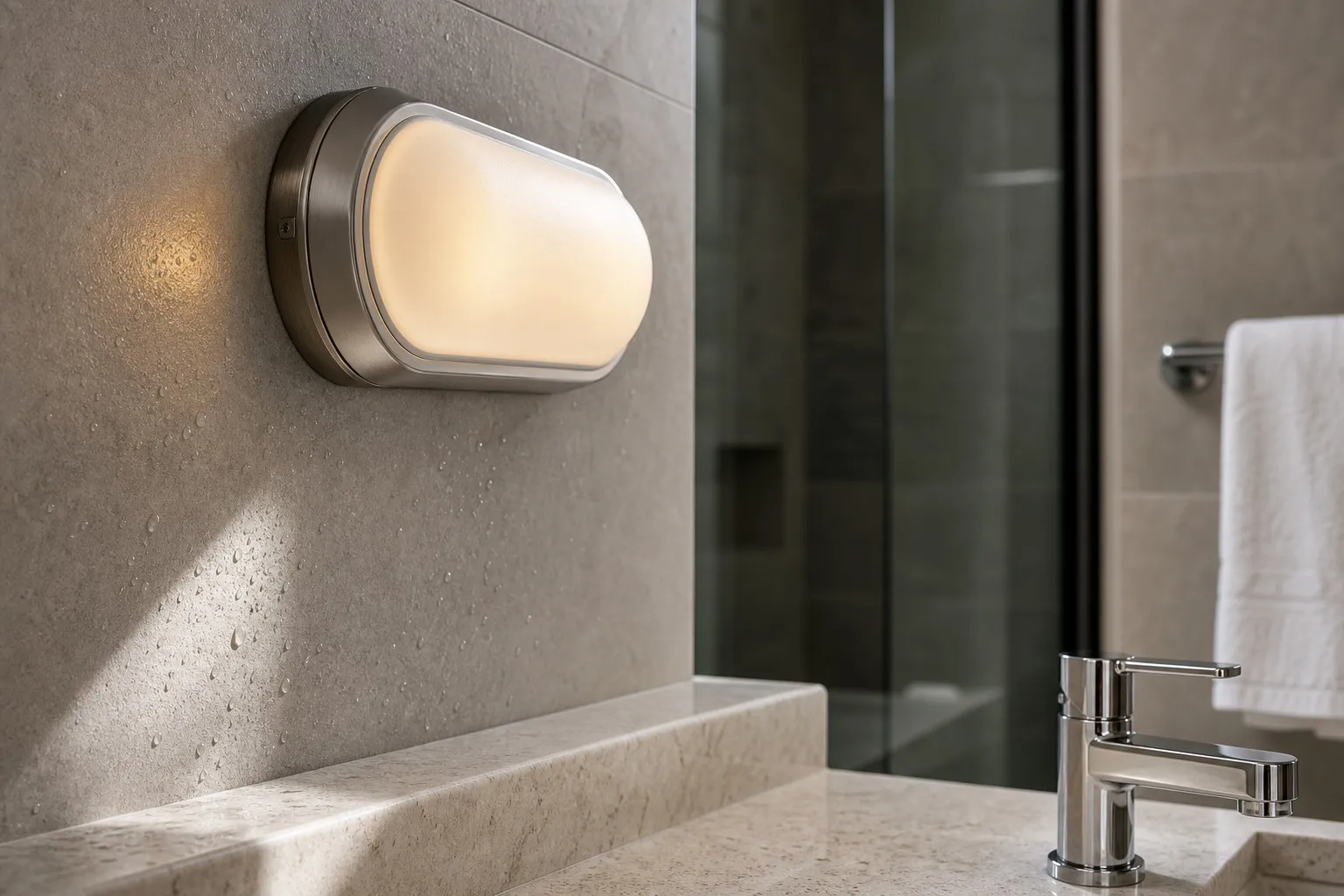 |
| A wet-zone wall light is judged on its seal rather than its shape: the gasket, the fixing and the drainage decide whether the protection survives housekeeping. |
An IP rating is a maintenance decision, not a bathroom detail
It is tempting to treat ingress protection as a line on a datasheet that the supplier fills in at the end. It reads better the other way round: as a decision about how often somebody has to climb a ladder.
A fitting with adequate protection for its position is cleaned, inspected and left alone. One without it fogs internally, corrodes at the fixing points and starts to draw attention from the maintenance team. That cost arrives years later, in occupied rooms that cannot easily be closed.
- Wet rooms are a continuous exposure, not an occasional one.
- Cleaning agents attack finishes and seals in ways that water alone does not.
- Open windows and doors let wind-driven rain reach places the drawing never anticipated.
- Service access matters as much as sealing: a housing that cannot be opened cannot be maintained.
How to read an IP code
An IP code is two numbers answering separate questions. The first covers protection against solid objects, including dust. The second covers water. A letter X in either position means the fitting was not declared or tested for that class, which is not the same as being protected against it.
- First digit runs from no protection against contact up to dust-tight. The lower steps cover tools and small objects long before they cover dust.
- Second digit runs from vertical drips through to continuous immersion. The steps are not even in effort: splash to jet changes the gasket design, not only its thickness.
- The X reads as not declared. Where it sits in the position that matters for the location, ask for that position to be declared.
- Both digits together describe a test outcome, not a construction. Two fittings can share a pair of numbers and behave differently in service.
What the code does not tell you is the gasket material, how many sealing surfaces there are, or whether the housing drains. Those decide whether the rating is still doing its job after five years of housekeeping.
Ask what happens when the seal ages, not only what it achieved on the day it was tested.
Matching the rating to the zone
Exposure changes with position, so the requirement should too. The table below maps what usually drives each location; the project lighting designer confirms the final figure against the standards that apply to the property.
| Zone | Typical exposure | What drives the requirement | What to check on the submittal |
|---|---|---|---|
| Bathroom vanity wall | Splashes and steam, wiped daily | The cleaning routine more than the water | Gasket material, diffuser sealing, fixing corrosion resistance |
| Bathroom, at or beside the shower | Direct spray, regularly | Distance from the outlet and spray direction | Compressed or bonded seal, and where the driver sits |
| Bedroom, corridor, public areas | Dry, dust only | Nothing beyond basic dust protection | That over-specification has not blocked service access |
| Covered terrace and porte-cochere | Driving rain, humidity, temperature swing | Drainage and condensation, not rainfall alone | Whether the housing drains and breathes without admitting water |
| Coastal facade | Salt spray, UV, thermal cycling | Finish system and metal choice as much as sealing | Fastener material, coating spec, dissimilar metal contact |
| Poolside and spa | Chlorinated water, frequent washing | Chemical exposure layered on water | Seal compatibility with the cleaning regime |
| Back-of-house and plant rooms | Wash-down cleaning | Hose direction and pressure | That the fitting is rated for jets, not only splashes |
Bathroom zones: where the argument usually starts
Two fittings in the same bathroom live in different conditions. One a short distance from the shower rose takes direct spray; one above the far end of the vanity takes steam and a cloth. Treating the room as a single zone causes most cases of over-specification, and most later claims.
- Mark the boundary on the section drawing, and issue it with the schedule.
- Separate the fitting that will be sprayed from the one that will only be splashed.
- Keep the driver outside the spray zone wherever the design allows it.
- Confirm what housekeeping will use on the surface, then check the seal against it.
Exterior and facade: water is only half the problem
Outdoors, moisture arrives with company. UV breaks down plastics that would have lasted indoors, thermal cycling works on the seal and the fixings daily, and salt spray attacks any point where two different metals meet.
- Drainage - a housing that fills has to empty. Ask where the water goes before accepting a rating.
- Seal geometry - a compressed gasket behaves differently from a bonded bead once the housing expands in the sun.
- Fasteners - stainless steel against aluminium is a corrosion cell, not a fixing.
- Coating - outside, the finish specification matters more than the body material.
Where IP ratings get misread
- Assuming a higher number is always safer. A heavily sealed housing can hold condensation as effectively as it keeps water out, and it cannot be opened for service.
- Reading the fitting's rating as the installation's rating. A correctly rated fixture on a poorly detailed back box still fails.
- Treating the rating as permanent. Gaskets take a set, coatings wear, fasteners corrode. The code describes the unit as tested, not the unit in year six.
What to confirm on the submittal
The submittal is the last place where an ingress protection decision is cheap to change.
- The declared IP code with both positions stated, and where on the fixture it applies.
- Seal type and material, and whether the diffuser can be removed for service without destroying the gasket.
- The finish system as substrate plus treatment, with a corrosion class where the location calls for one.
- Fastener materials, and confirmation that the fixing does not create a galvanic pair.
- Driver location relative to the wet zone, and the route for replacing it later.
- The cleaning agents the finish and seal are compatible with, written down for housekeeping.
FAQ
What IP rating does a hotel bathroom light need?
No single number fits every position, because a bathroom contains several different exposures. Settle the requirement per position against the project specification and the applicable standards, and confirm it with the lighting designer before the schedule is issued.
Is a higher IP rating always the safer specification?
Not automatically. A higher rating usually means a more heavily sealed housing, which is harder to service and can hold condensation if it does not drain or breathe. Match the rating to the exposure and confirm the maintenance route at the same time.
Can an IP rating be maintained over the life of the fixture?
It depends on the gasket and the fixing. Compressed seals take a set, coatings wear and fasteners corrode, so the rating describes the unit as tested. Spares and a service route are what preserve protection in practice.
Does an IP rating cover chemical cleaning?
No. The code covers solids and water only. Cleaning chemistry is a separate compatibility question, and it is worth settling before housekeeping standardises on a product.
What does an X in the IP code mean?
It means that position was not declared or tested. If it sits in the position that matters for the location, ask for it to be declared rather than assuming protection that has not been demonstrated.
The takeaway
Ingress protection is a decision about exposure, not a number copied from the last project. Read the code as two separate answers, match each position to what will actually reach it, and check the things the code does not describe: seal type, drainage, fasteners and finish system. Then write the cleaning and maintenance assumptions onto the submittal, so the protection specified is still there at handover and after.
Zerouno Lighting (ZeroUNO) manufactures hospitality decorative lighting in Zhongshan, China, founded in 2013 with a team of 120. The company produces made-to-order wall, mirror and exterior fixtures to project specifications, supplies single piece samples for approval, and works to a 25 to 35 day production lead time on custom orders. Learn more at zerounolighting.com.
About the author
Sonny Yu is Sales Manager at Zerouno Lighting, preparing decorative lighting packages and their technical submittals for hotel projects. He writes about the specification details that decide whether a package performs as drawn in wet, coastal and high-traffic hotel environments.




没有评论:
发表评论