A hotel lighting package is signed as one contract and installed as thirty separate rooms. The plan between those two facts is usually assumed rather than written, and that assumption turns a workable order into a run of urgent ones. When every floor is released at once, fixtures arrive faster than the site can receive them, protection gets stripped to save space, and the rooms that open first wait on the rooms that finish last.
This guide is for the people holding that plan: project managers, procurement leads and site teams on a new-build or renovation fit-out. It covers how to derive a delivery sequence from the installation sequence, what must stay identical across every phase, how to hold stock between drops, and the records that stop a phased delivery drifting into a re-order.
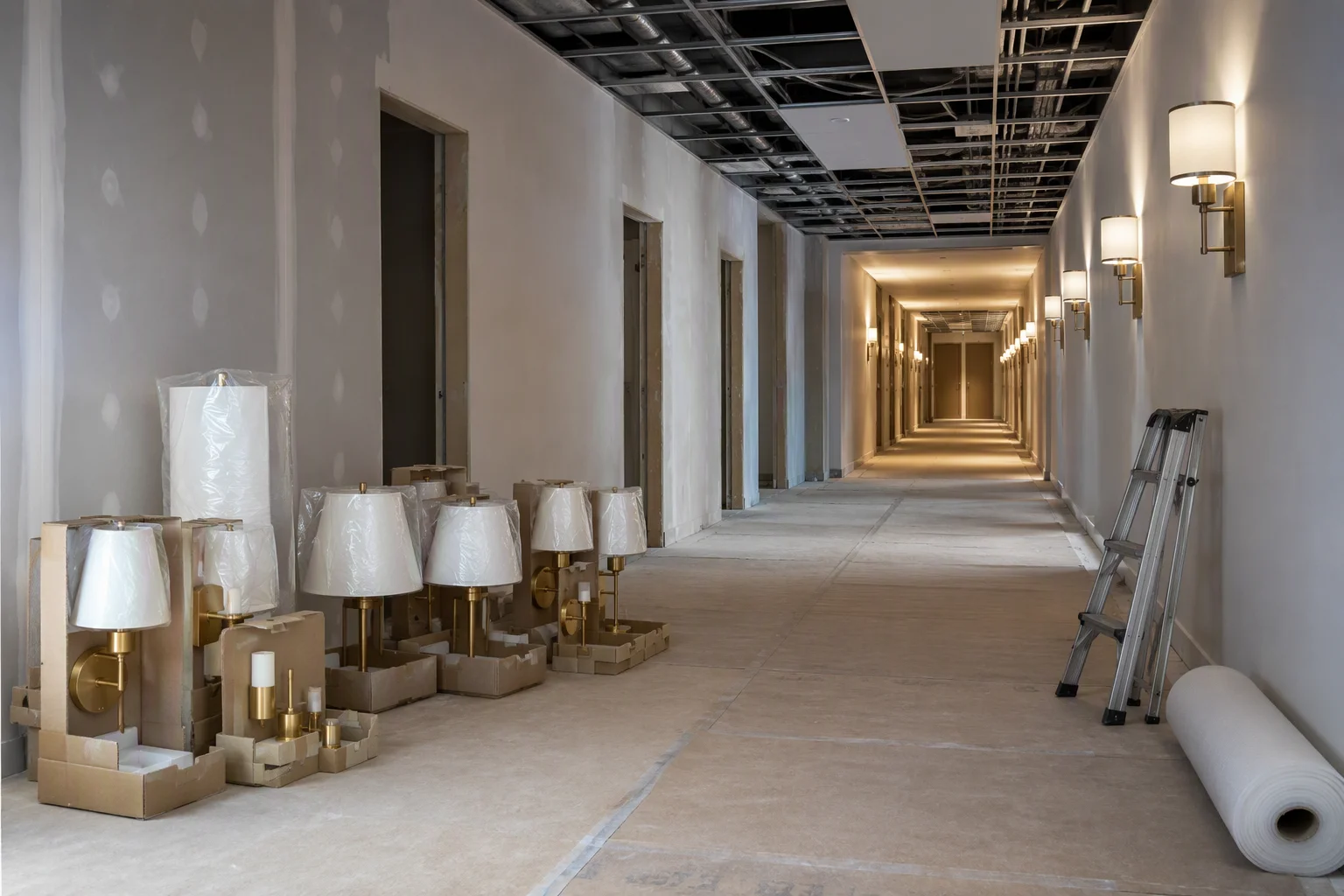 |
| Fixtures staged in the corridor ahead of a phased release: the phase that opens first has to be identifiable at a glance. |
Why one consolidated drop is the wrong default
A single shipment is the cheapest thing to arrange and often the most expensive thing to receive, because a hotel floor under construction has no spare room. Every carton staged for a floor still being framed stands in the way of the trades on the floor that is ready.
- Site storage is the binding constraint. Ceilings, carpet and joinery all need the corridor before the lighting can go in.
- Installation order is not order quantity. Rooms are finished in clusters, and a cluster spanning two floors pulls fixtures from both before either floor is complete.
- Protection degrades on site. Cradles and foam inserts are designed for transport, not for months of stacking in a service corridor.
- The later phases inherit the earlier mistakes. A mislabelled carton found on the last floor means returning to rooms already signed off.
Phasing is not an extra cost loaded onto the order. It is the schedule control that keeps one contract from becoming several urgent ones.
Derive the release sequence from the installation sequence
The delivery plan should follow the way the building is handed over, not the way the factory prefers to load a container.
- Start at the opening date and work backwards. Establish which floors must be guest-ready on day one, which can be completed behind hoarding, and which are soft-opening rooms.
- Group by room cluster rather than by floor. A room type spread across two floors needs its fixtures together, or neither floor can be signed off.
- Name a physical trigger for each phase. A floor released by the wet trades, a ceiling grid closed, or a mock-up room signed off. A calendar date is not a trigger.
- Test every trigger against the production window. Made-to-order lighting runs on a fixed window, so a trigger that slips two weeks moves every phase behind it.
- Mark what cannot be split. Long-lead specials and shared driver batches may have to travel together even when the rooms are separate.
A sequence built this way becomes the document the factory plans against and the site team can be measured against. When a trigger moves, the effect on later phases is visible instead of discovered on site.
A phase matrix you can issue with the order
Most projects need three to five phases. The matrix below is a starting point; the last column is the one that matters, because a phase released without a fixed reference drifts in exactly the way the matrix exists to prevent.
| Phase | What it covers | Release trigger | What must be fixed before release |
|---|---|---|---|
| Phase 0 | Mock-up or pilot room set | Mock-up room signed off | Approved sample, finish and installation detail |
| Phase 1 | Floors that open first | Floor released by wet trades, grid closed | Room-by-room quantity list and carton marking |
| Phase 2 | Mid-block floors | Previous phase installed and checked | Note of any change agreed after phase 1 |
| Phase 3 | Final guest floors | Access and corridor protection in place | Batch and finish reference for the rest |
| Phase 4 | Spares and replacement stock | Handover schedule agreed with operator | Spare list, storage location and named owner |
Issue the matrix with the purchase order, not after production starts. A phase list circulated once goods are in build describes what happened rather than planning it.
What has to stay identical across every phase
Phasing splits deliveries, not the specification. The risk is that a package released in four drops drifts into four versions of the same fixture, and the difference only shows once the floors are lit together.
- One approved sample governs every phase. Later batches are compared against the signed reference, not against a colour described in an email thread.
- One finish reference and one grain direction. A different polishing run can read as a different tone under corridor lighting installed months earlier.
- One driver and control specification. A substituted driver in the final phase can behave differently at low output on the same dimmer.
- One labelling scheme. Room or cluster marking has to mean the same thing in phase 1 and phase 3, or the site team re-sorts every drop.
- One revision record. The drawing revision each phase was built from belongs in the phase file, because it usually moves at least once during a fit-out.
The test of a phased delivery is not whether each drop arrived on time. It is whether a guest in a room from the last phase sees the same fixture as a guest in a room from the first.
Holding stock and protection between phases
The gap between two phases is where most damage happens, because nobody is watching the goods. Two decisions cover most of it: who holds them, and what happens to the packaging.
- Who holds what. Stock kept at the factory, at a forwarder's warehouse or on site carries different handling risk and a different owner.
- Protection stays fitted. Shade film and cradle inserts should come off at the point of installation, not when cartons are opened for counting.
- Count on receipt, in writing. Each phase needs a signed count against the phase list, with shortages reported while the factory still has that batch.
- Keep one reference unit reachable. An unopened sample from phase 1 settles any later comparison in seconds.
The controls that keep phases from drifting
Three habits do most of the work.
- Phase file, phase sign-off. Each drop gets a short file: phase list, revision, count sheet and inspection result. The next phase is not released until the previous file is closed.
- One contact, one channel. Sites lose weeks to instructions split across calls, chat messages and site diaries. Put delivery instructions in writing to one named contact on each side.
- A weekly phase review. Fifteen minutes comparing planned triggers against site progress, so a phase moves while there is still production time to absorb it.
Where the phase plan is respected, the package can still be produced to one schedule. The production window applies to the order rather than to each drop: stock items ship in one to two days, made-to-order lighting runs on a window measured in weeks.
FAQ
How many phases should a hotel lighting delivery be split into?
Three to five covers most multi-floor projects: a pilot set, the floors that open first, one or two mid-blocks, and a final block with spares. More phases ease site storage but add handling and freight events, so split only where the sequence needs it.
Does phasing cost more than a single delivery?
It adds freight movements and administration, and can reduce total cost by cutting site storage, re-handling and rush replacements. Treat it as a schedule decision rather than a purchasing one, settled inside the delivery scope.
What if the installation sequence changes after the order is placed?
Re-issue the phase matrix and confirm which releases are already fixed in production. A phase not yet in production can usually be resequenced; one already built follows the original sequence unless the site can hold it.
Can spares ship with the first phase?
They can, and it is often the better call, because spares ordered with the main batch carry the same finish reference. The trade-off is site storage, so agree the location and owner with the phase list.
Who should hold the phase records?
The project team keeps the signed record on site and the supplier keeps the matching file against the article numbers ordered. Two copies of one phase file turn a shortage or a damage claim into a five-minute conversation.
The takeaway
A multi-floor fit-out is installed room by room, so the lighting should be released the same way. Derive the sequence from the installation sequence, put a physical trigger behind every phase, and issue the phase matrix with the order rather than after production starts. Hold one approved sample, one finish reference and one labelling scheme across every drop, and close each phase file before releasing the next. Phasing then stops being a complication and becomes the control that keeps one package from turning into a run of emergency orders.
Zerouno Lighting (ZeroUNO) manufactures hospitality decorative lighting in Zhongshan, China, and has produced project and custom fixtures since 2013. Made-to-order packages run on a production window of roughly 25 to 35 days, with stock items ready in one to two days. Learn more at zerounolighting.com.
About the author
Sonny Yu is Sales Manager at Zerouno Lighting, working with hotel owners, designers and site teams on decorative lighting packages. He writes about the delivery side of a project: how a package is sequenced, released and documented so that what arrives matches what was approved.



没有评论:
发表评论