A spa treatment room is the one room in a hotel where the guest spends an hour with their eyes closed, then opens them. Everything decided at specification stage is judged in that second: whether the light is soft and warm, or a bright disc they turn away from. Most of what makes the room work is built into the ceiling detail, where no change of lamp can rescue it later.
This guide is for the people who settle a spa package: owners, spa operators, designers and procurement teams buying to a schedule. It covers why a reclined guest is the hardest viewer in the building, why indirect light beats fixtures, how to light the therapist's work without lighting the guest's eyes, and what a humid room does to a fixture over five years.
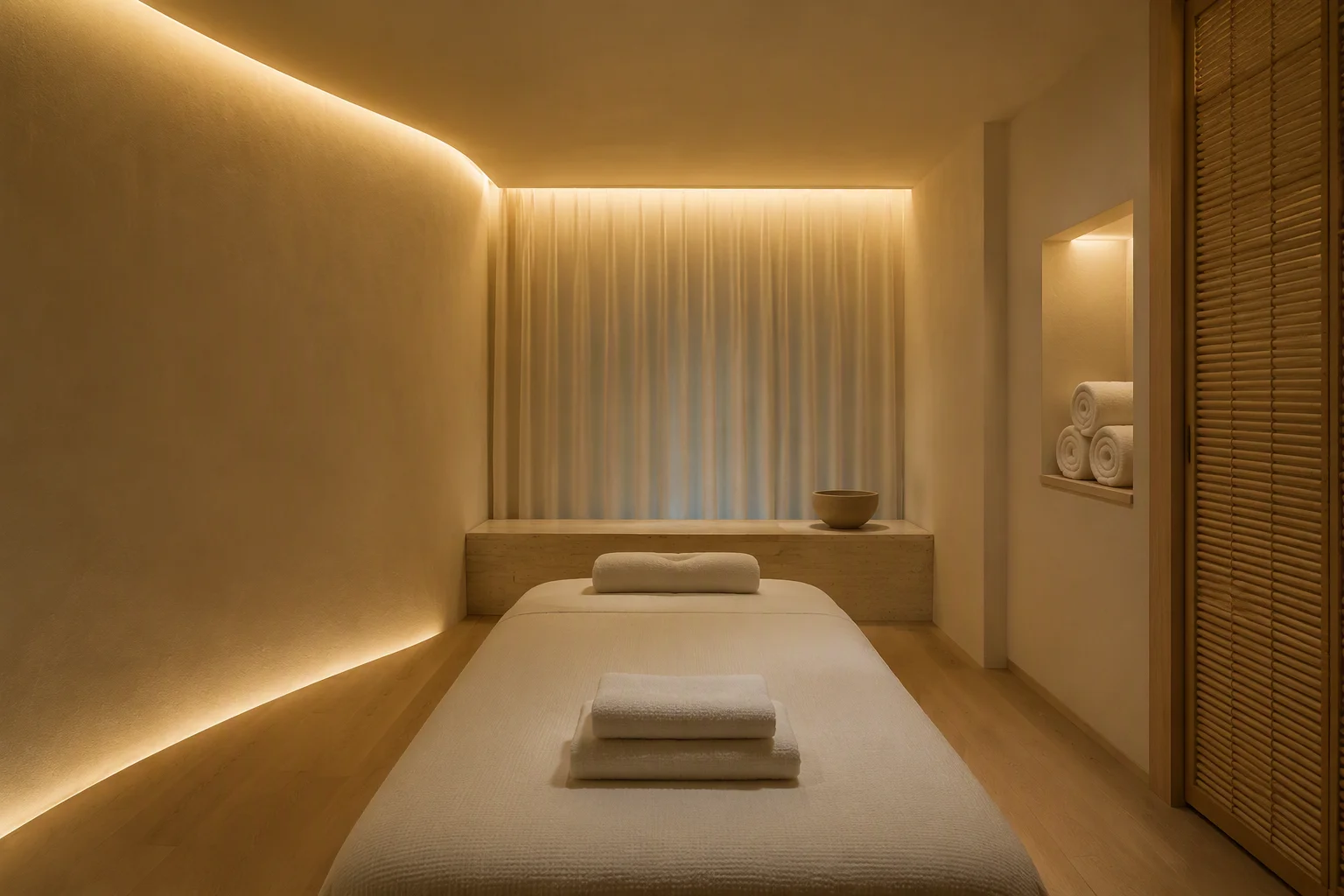 |
| A treatment room is judged from the bed, not the doorway: the lit surface should be visible, never its source. |
Why a spa room breaks the usual lighting logic
Most hotel lighting assumes someone standing or sitting upright, with light from above and the side. A treatment room inverts those assumptions. The guest lies down, so their field of view becomes a low horizontal plane meeting the ceiling at a shallow angle, and anything recessed overhead sits squarely inside it. The room is often internal, with no window to dilute the effect, and the door is closed throughout.
Two consequences follow. The ceiling stops being a convenient place to hide the light and becomes the surface the guest studies. And the room must do two jobs at once, because a therapist is working in it with their eyes open. That is why a spa package is usually specified late and is expensive to change: the lighting sits inside the ceiling and wall construction, not in loose fittings.
Light the room, not the eye: indirect light as the default
The rule is to illuminate surfaces rather than deliver light to a point. A cove, a recessed slot or a shielded uplight behind a headboard throws light onto a surface first, so the guest sees a lit surface, not its source. Where a fixture must be visible, it should present a glowing body rather than an exposed lamp.
| Where the light is aimed | What the guest sees | What to change |
|---|---|---|
| Recessed downlight above the bed | A bright disc inside the view | Move the layer to the perimeter |
| Bare lamp at eye height | Glare level with the face | Shield, reduce, or reflect it |
| Visible cove or slot edge | A bright line across the ceiling | Set the source back until hidden |
| Uplight behind a recliner | Hotspot on the ceiling above | Diffuse it, or move to the perimeter |
| Backlit panel at the foot | Vertical glare at the wrong end | Lower it, keep it below the sightline |
| Vanity light in the shower | A bright reflected surface | Separate circuit, on only in use |
Light a surface, not a face. If the guest can point at the source from the bed, the ceiling detail is unfinished.
The detail matters more than the fixture. A cove deep enough to hide its source is invisible from the bed; the same cove with the strip at the lip reads as a line of dots. That is why a mock-up of the ceiling detail pays for itself: the fault is geometric.
Two jobs in one room: the guest's rest and the therapist's sight
Running the room on one lighting layer forces a compromise nobody wins: bright enough for the therapist, too bright for the guest to settle. Split it into two systems. The guest's layer is indirect, warm and low, and stays on. The therapist's layer is a task light aimed at the working area, outside the resting sightline: a tight beam or a shielded light at bench height, not another downlight.
Settle the split on the drawing:
- Separate circuits for the ambient layer, the task layer and wet-area light.
- A task light aimed at the working surface, not the room.
- A control the therapist can reach without walking around the bed.
- A visible difference in level, not only on the schedule.
- No functional light sharing a switch with the guest scene.
- A shield on any source inside the therapist's line of work.
Two boundaries belong here. Whether showers, steam rooms and pool-adjacent areas need a particular ingress protection is a compliance question, carried on the fixture's rating and submittal rather than in the layout. And final light levels are set by the project lighting designer against the standards that apply to the property.
Warm tones, and dimming that stays warm
A treatment room is one of the few spaces where a guest notices a colour shift. Enclosed, quiet and viewed for an hour, a room that turns colder as it dims reads as clinical; the same room that warms as it comes down reads as calm. That belongs to the light engine and its driver, decided at specification, not at commissioning.
Three things are worth settling in writing:
- The warm range the room should sit in, confirmed by the project lighting designer.
- Whether the engine warms as it dims or holds a constant colour, which is often wrong here.
- The lowest level at which the room still reads as lit, without flicker or a colour step.
Skin and fabric are read under this light, so colour rendering belongs in the decision: where a therapist has to judge skin or a product, the source has to show it honestly.
What a spa does to a fixture over five years
A spa is a warm, humid and lightly oiled environment, and finishes that look identical on a sample board age differently inside it.
- Warm humid air and massage oil settle on surfaces and are wiped repeatedly, to a routine rather than a plan.
- Chlorinated or salt-laden air in pool-adjacent rooms works on platings and fasteners untouched elsewhere.
- Textile shades hold moisture and odour, so a crisp sample reads tired after two years.
- Radiated heat from a concealed source discolours a shade mounted close to it.
- Cleaning products chosen for the surface, not the material, dull a plated finish unevenly.
Two controls keep this manageable. Keep decorative content above the splash zone and clear of the oil tray. Then match the finish family to the room's regime and record the approved cleaning products on the maintenance sheet, so nobody has to guess.
FAQ
Should a spa treatment room have any downlights at all?
Not directly above the bed. Where a fixture is needed, keep it out of the guest's upward field of view or put it on the therapist's circuit. Most of the room's light is better carried by surfaces.
How do you keep the source invisible when the guest is lying down?
Design the detail first: a deep cove, a set-back slot or a shielded uplight, then check it from the bed in a mock-up rather than from the doorway. Geometry decides this, not the fitting.
What colour temperature is right for a spa?
Warm, and held in a narrow range, with the final figure confirmed by the project lighting designer against the standards that apply to the property. What matters more than the figure is that the room does not turn colder as it dims.
Can the guest and the therapist share one dimmer?
They can share the room, but not one layer. Give the therapist's task light its own circuit and a control within reach, and leave the ambient on the guest scene. Otherwise the room is as bright as the brightest task.
Do spa fixtures need different finishes?
They need finishes matched to the room: warm humid air, massage oil, repeated wiping and, in pool-adjacent areas, chlorinated or saline air. Choose the family for those conditions and record which cleaning products are safe on it.
The takeaway
A spa is lit for a guest lying down with their eyes closed, so light placed where it suits the drawing fails. Illuminate surfaces rather than delivering light to a point, keep the source out of the upward field of view, and separate the therapist's working light from the guest's rest. Warm the room as it dims, and choose finishes for humid air rather than for the sample board. Settle the ceiling detail in a mock-up, because no change of fitting rescues it later.
Zerouno Lighting (ZeroUNO) manufactures hospitality decorative lighting in Zhongshan, China. Founded in 2013, the company produces made-to-order wall, table and floor fixtures to project specifications and supplies single-piece samples for approval. Spa fixtures are usually bespoke in dimension and finish, so the approved sample matters more here than in a repeatable room type. Learn more at zerounolighting.com.
About the author
Sonny Yu is Sales Manager at Zerouno Lighting, preparing bespoke decorative lighting packages and their samples for hotel projects. He writes about the decisions fixed before anything is manufactured: how a room is lit, how a finish is chosen, and how a sample becomes a signed-off order.



没有评论:
发表评论