A decorative lighting package is the most fragile line in a hotel fit-out and rarely the most expensive. A chandelier crate cannot be re-made from a builders' merchant, a fabric shade cannot be re-ordered in the same dye lot, and the installation window it was planned around will not move.
This guide is for the people who own the goods from the factory gate to the store: procurement managers, project managers and the site team receiving the container. It covers where breakage happens, how to choose a transport mode for fragile work, what to settle before the doors close, the damage that breaks nothing, and the handover record that decides who pays.
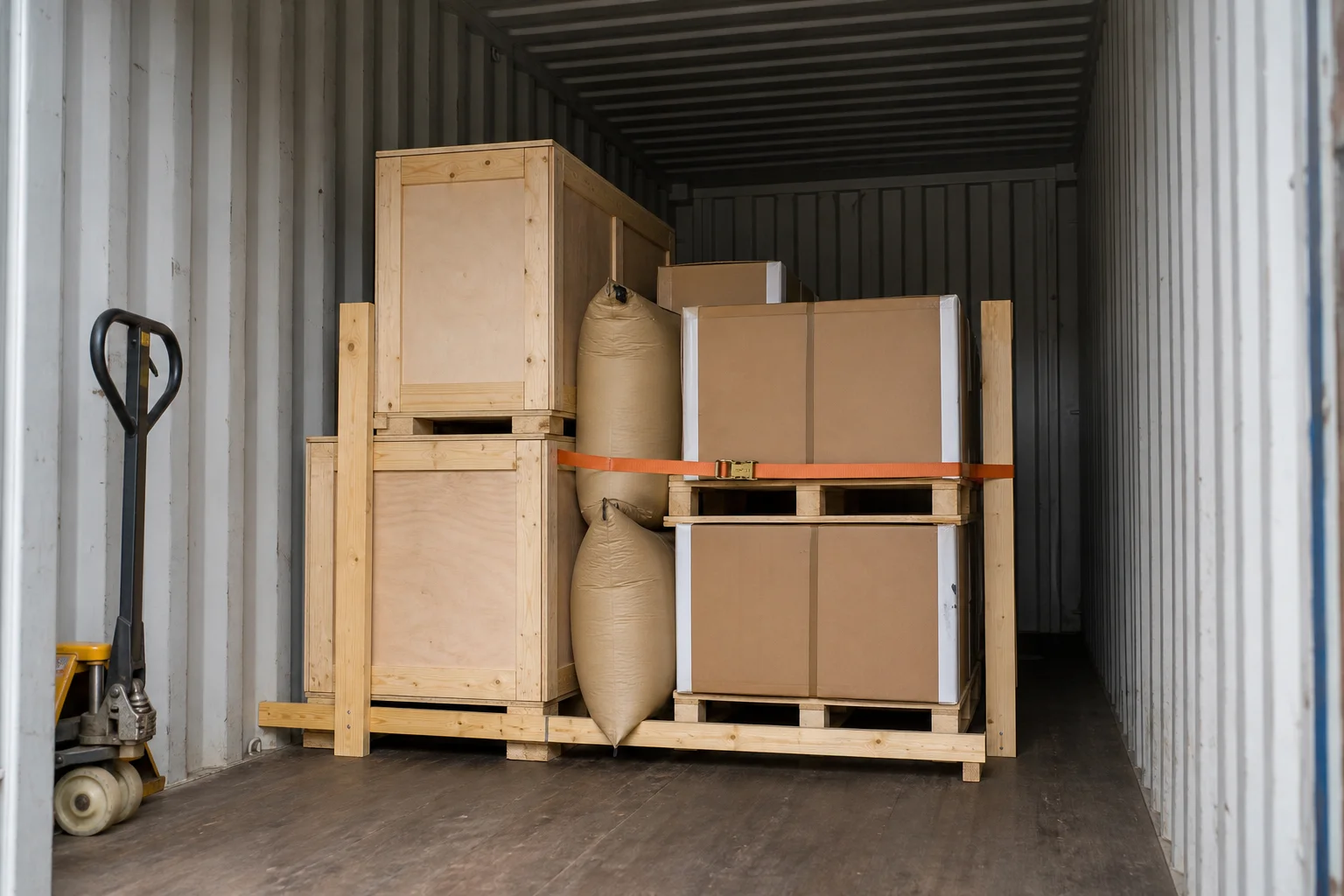 |
| Most transit loss happens where the load is handled, not where it is carried. |
Where breakage actually happens on the way to site
Transit damage is imagined as a rough sea crossing. The sea leg is the calmest part of the journey: the container is sealed, the goods do not move, and nobody opens the doors for three weeks. Loss happens at the points where the load is handled, and each point has a different owner.
| Stage | What typically goes wrong | Who controls it there |
|---|---|---|
| Loading at the factory | Cartons stacked by weight, not fragility | Supplier and collection carrier |
| Inland leg to the port | Road vibration and repeated transloading | The forwarder's haulier |
| Terminal and vessel stowage | Impact from neighbouring cargo; the box shifted | Terminal operator and the line |
| Transshipment | Discharge and reload; doors reopened for inspection | Transshipment port authority |
| Customs and final delivery | Unpacked for examination, repacked to a lower standard | Customs broker and final carrier |
A container stowed once and delivered direct carries fewer exposures than the same goods consolidated through three terminals.
Choosing the mode: fewer handlings beats faster
The instinct is to buy speed. Speed matters, but exposure matters more, because a fixture that arrives early and broken has arrived late. The real decision is how many times the goods will be touched.
| Mode | Typical handlings | Where it fits | Main exposure |
|---|---|---|---|
| Full container, direct | Loading, terminal, discharge, delivery | A single release phase, or a package that fills a box | Terminal handling; the box shifted |
| Groupage or part-load | Adds consolidation and de-consolidation | Small or phased packages that cannot fill a container | Repeated hand-balling of mixed cargo |
| Air freight | Loading, terminal, discharge, delivery | Samples, mock-up units and urgent replacements | Cost, and pieces still crated for air pallets |
Ask what the goods will be touched by, not only how long the journey takes. On fragile decorative work, one fewer handling is worth more than one week saved.
If a package can be re-phased to fill a container, take the reduction in exposure. If it must travel as a part-load, the crate design matters more, not less.
What to settle before the container is sealed
Once the doors close, the only party who can still act is the carrier, and the carrier is not looking at your shades. Settle these before loading, and record the answers.
- One container, one manifest. Know which fixture types sit in which box, and where the fragile types are.
- Fragile types off the floor and off the top. Heavy metal and stone bases low, shades and glass cradled on pallets.
- Nothing loose above a hard edge. A carton resting on one corner of a metal frame concentrates the stack load onto a single line of a shade.
- Securing, not just loading. Dunnage or airbags between pallet faces, so a gap cannot become a running start on a rough road.
- Humidity control for the sea leg. Desiccant and a container liner where the route crosses climate zones.
- Seal number and loading photographs. Photograph the seal and the loaded interior before the driver leaves.
None of this is unusual to a forwarder who moves furniture and decorative joinery. Where a lighting package is treated as general cargo, these points are often not raised at all.
The damage that does not break anything
Breakage is visible, which is why it gets the attention. The expensive losses are often silent, and they surface weeks after delivery.
- Condensation inside a sealed container. Warm humid air trapped at loading condenses as the box crosses cooler latitudes; unprotected metal develops bloom and early corrosion.
- Finish bloom and water spotting. A lacquered or plated surface exposed to sustained condensation can develop a film that cleaning cannot polish out.
- Damp textile. Fabric closed up wet can grow mildew that is only found when the shade is unpacked on site.
- Heat build-up. A container standing on a terminal apron reaches temperatures that soften some adhesives and can distort a thin diffuser under stack load.
- Long storage at site. Goods held in a damp basement for months carry more risk than the voyage itself.
These losses rarely look like a transit claim, because nothing is cracked. They appear as a finish that has to be re-polished and a punch-list item nobody budgeted for, which is why desiccant, liners and raised, ventilated storage belong in the same conversation as stowage.
The handover record, and where risk passes
Risk in transit is not a moral question, it is a documentary one. Whoever can show the condition of the goods at each handover is the party whose version survives.
- Photograph the seal and container number at each change of custody. A seal number that does not match the transport document becomes impossible to prove a week later.
- Never sign a clean delivery receipt before counting. A signature without a written exception usually closes the carrier's exposure on the spot.
- Record exceptions on the delivery note itself. "Cartons 14 and 15 dented, contents not inspected" beats a photograph taken after the vehicle has left.
- Segregate damaged goods. Keep the unit, the carton and the internal packing together, untouched, until the survey is done.
Two distinctions are worth holding. The delivery basis fixes the point at which the goods become your risk; insurance decides whether you are reimbursed after they do. And carrier liability is normally capped by weight or by package, well below the value of a bespoke order. A settlement can repay an invoice, but not six weeks of production or the dye lot. Notice periods usually run from delivery rather than from discovery, so build the file in the first week.
The receiving routine: the first hour after the container lands
Most projects get one chance to establish the condition of a shipment, and it is the hour after the vehicle arrives.
- Check the seal number against the transport document before the doors are opened.
- Photograph the container, the seal and the load as it is revealed.
- Count cartons against the packing list and mark exceptions on the delivery note.
- Open two or three cartons of each fragile type in front of the driver.
- Note the weather and delivery condition: a wet load and a dry load are different claims.
- Move the goods to raised, dry, ventilated storage and log the location.
One boundary is worth stating: this is about the journey and the handover, not about how the factory packs and labels, nor the pre-shipment inspection that should already have happened at the works.
FAQ
Should decorative lighting ship in a full container or as a part-load?
A full container whenever the package can fill or nearly fill one, because it removes the consolidation and de-consolidation handlings a part-load adds. Where volumes are small or phased, a part-load is workable if the crate design is specified for repeated hand-balling.
Who is responsible for damage that happens in transit?
It depends on the agreed delivery basis, which fixes the moment the goods become your risk. In practice the party who can evidence the condition at each handover decides the argument.
How many spare units should be ordered for fragile types?
Enough to cover realistic transit and handling loss on the fragile families, plus a later replacement. A re-run of a small batch normally costs far more than the original units.
Can we claim from the carrier for a broken fixture?
Usually yes, but within limits. Carrier liability is capped by weight or by package and rarely covers the full value of a bespoke order, so cargo insurance closes the gap.
Does the supplier's packaging guarantee the goods arrive intact?
No packing can guarantee a journey it does not control. Good export packing removes avoidable loss, but the terminal, the depot and the final delivery are outside the supplier's hands.
The takeaway
Decorative lighting is lost at the handling points, not in the sea passage, so plan the journey around how many times the goods will be touched. Take a full container where the volume allows, secure and humidity-control the load before the doors close, and treat the handover record as part of the purchase. Then cover the whole route, because a liability cap and an insurance payout are not the same as getting the right fixture back on the right wall in time.
Zerouno Lighting (ZeroUNO) manufactures hospitality decorative lighting in Zhongshan, China, and has built project and custom fixtures since 2013. Because bespoke work rarely survives a re-order in the same finish or dye lot, export packing and loading plans are settled with the sample, not after the order. Learn more at zerounolighting.com.
About the author
Sonny Yu is Sales Manager at Zerouno Lighting, working with hotel owners, designers and procurement teams on bespoke decorative lighting packages. He writes about the parts of a lighting order decided before anything is manufactured: how a package is planned, protected and handed over.




没有评论:
发表评论