A hotel room is designed in daylight and judged in the dark. Sample boards are reviewed beside a window at two in the afternoon; the room guests remember is the one they meet at three in the morning, half asleep, trying not to wake the person beside them.
This follows one night in a guest room and sets out what has to be decided, tested and handed over. It is written for the operator signing off a mock-up, the designer writing the control intent, and the buyer wondering why phase three differs from phase one.
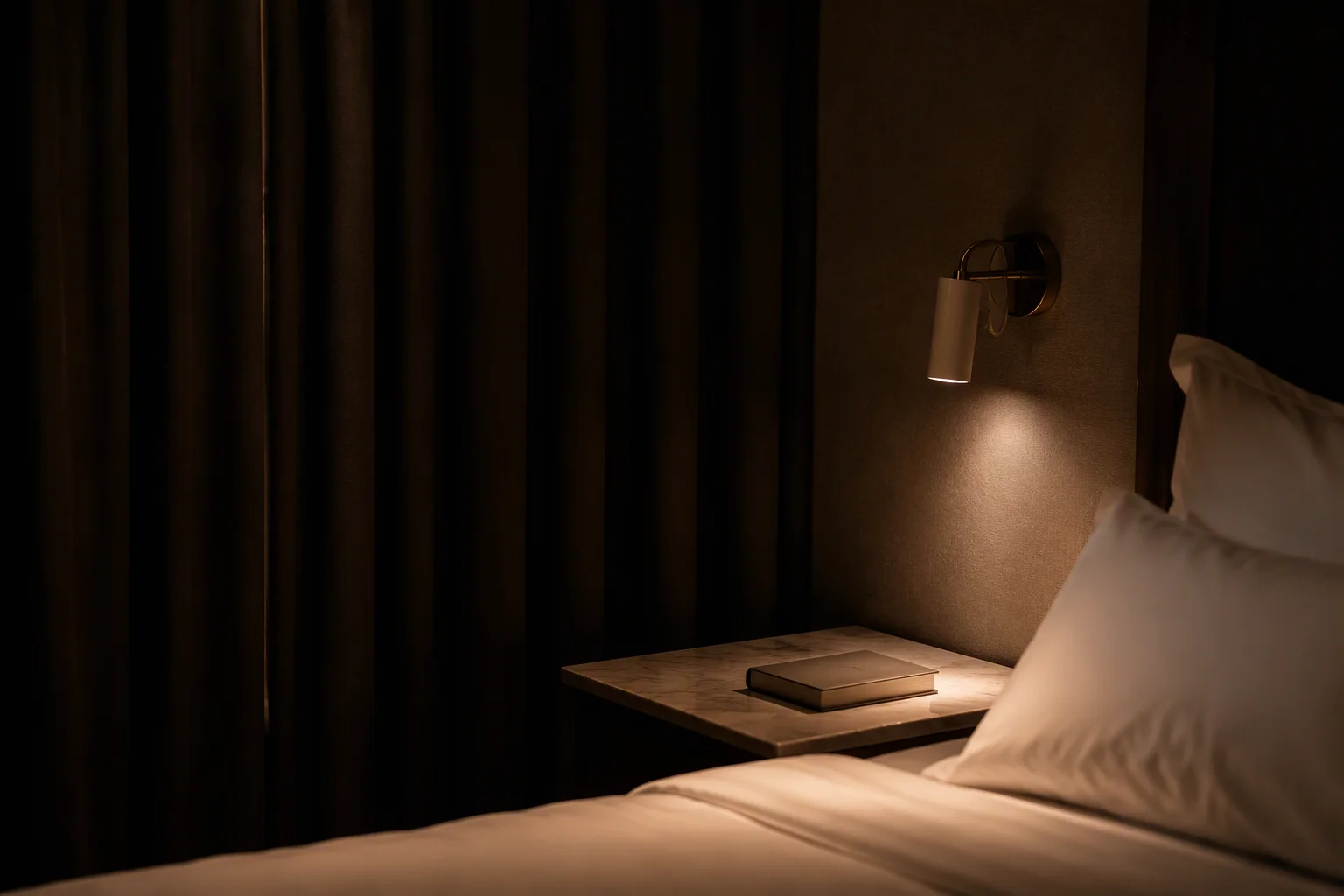 |
| The level a guest lives with is whatever the fixture does at the bottom of the dimmer. |
A room is judged at 3 a.m., not at check-in
Guests form a first impression in daylight, but the verdict comes in the dark. The complaints that reach an operator are rarely about maximum output. They are about the bottom of the range: what happens between off and a little, whether a control can be found without switching on the ceiling, and whether the room stays dark once the curtain is closed.
That is hard to demonstrate. A full-output photograph proves nothing; two products with identical headline figures can differ in the last ten per cent of travel. The honest test is a fade in the finished room, after dark, on the control the guest will touch.
One night, three moments
The guest room is not one lighting condition. It is at least four, and they are not served by the same settings.
| Moment | What the guest is doing | What the lighting has to do | What actually decides it |
|---|---|---|---|
| Evening, before sleep | Unpacking, reading, settling in | A low pool at the bed that does not reach the other pillow | The bottom of the bedside circuit, not its maximum |
| Lights out | Last page, phone down, settling | Reduce light to almost nothing without a step, click or blackout | Dimming floor and the shape of the curve |
| 3 a.m. | Water, bathroom, back to bed | Enough light to cross the room, not enough to wake the body | Night provision and where its control sits |
| First light | Still asleep, curtains closed | Darkness where the guest believes darkness is | Curtain overlap and the gap at the centre |
Notice the missing column: colour temperature. Whether a room reads warm or neutral is settled early, with the concept. What decides sleep is how the room behaves at low output.
Where dimming actually fails: the bottom of the travel
Most specification conversation concerns output at full. Almost none concerns the last ten per cent of the rotation, where the guest spends the evening. Three failures account for most complaints, none visible on a summary datasheet.
A dead band. Nothing happens for the first part of the travel, then the light arrives in one jump. The guest expects a small change and gets a large one.
A visible step. The light dims in discernible increments, which is not comfortable on a fixture a metre from a pillow.
A cut-out at the bottom. Below some threshold the driver stops, so the last part of the rotation does nothing and the light snaps off.
A fourth behaviour is worth understanding rather than judging. Some sources shift warmer as they dim; others hold colour and read colder. Neither is wrong, but half and half in one room looks inconsistent, usually because the bedside and the ceiling came from different families.
A dimmer that reaches one per cent on a datasheet and jumps at fifteen per cent in the room has not dimmed. The guest experiences the jump, not the number.
The test is cheap: a full fade in the room, after dark, on the intended control and lamp. Record the lowest level still useful for reading and the level at which the light cuts out. Both belong in the handover pack.
The switch a guest has to find without looking
At three in the morning nobody reads a label. The hand goes where it went at eleven.
A flat panel with no tactile reference is invisible to a hand; a rocker with a physical edge is findable without a glance. It is decided at specification stage and rarely discussed there, yet it decides whether a guest must sit up and switch on a general light to turn off a bedside light.
The standby indicator deserves the same scrutiny. A small blue LED on a touch panel is convenient in daylight and can be the brightest object in the room at night. Facing the pillow, it is no longer an indicator but a light source with no dimmer. Television standby lights behave the same way.
Then there is the conflict nobody owns. A door-card or master switch that kills the whole room, night provision included, means a guest returning in the dark crosses the room to find the card slot. Whether the night light sits on the master circuit is one line in the drawings.
When blackout and the night light work against each other
Blackout is a promise about darkness; a night light is a promise about not walking into furniture. They are usually specified by different people, installed by different trades, and first tested together the night the room is photographed.
The curtain line matters more than the fixture. A night light above the hem of a full-drop blackout curtain washes the ceiling, where a guest lying on their back will see it. Below the hem, the same light spills under the curtain onto the floor.
Reflection is the second trap. A night light aimed across a glossy television panel or a mirror doubles itself, and the reflected patch can land at eye level from the pillow.
The third is the curtain. A gap at the centre overlap, or a track that stops short of the wall, puts a stripe of corridor light across the bed at dawn. It is found in the mock-up or not at all: lie on the bed at night, curtains closed, and look for light that should not be there.
A night walk-through, and what to record
Commissioning is usually a daytime activity with a clipboard and a torch. One evening visit per room type changes what gets handed over.
- Enter from the corridor with the room dark and note the first thing you can see.
- Fade each bedside circuit slowly and record where it steps, flickers or cuts out.
- Lie on the pillow and look at every indicator, sensor and standby LED.
- Cross to the bathroom and back without touching a general light.
- Close the blackout curtains and check the centre overlap and both edges.
- Test the master switch and door card, and confirm which circuits stay live.
- Write the minimum usable level and the cut-out level into the handover pack.
Bring the operator's representative, the commissioning engineer, and someone from housekeeping. Housekeeping sets the evening state, and a room that is perfect when the technician leaves can be reset to full brightness by a turndown routine nobody documented.
On a phased rollout the handover pack is also the specification for the next phase. A second batch is ordered months later, and the only record of how the first behaved at low level is what was written down.
FAQ
Does warm dimming help guests sleep?
It changes how the room looks at low level, which is why designers use it. It does not replace a low enough minimum, a findable control and a room that stays dark.
What is a sensible minimum level for a bedside light?
It depends on the shade, the source and the room. The workable definition is functional: the lowest level at which a guest can still read without the light reaching the other pillow.
Should the night light be on the master switch?
Usually not, since the point is that it works when everything else is off. Whatever the arrangement, test it with the door card removed and the master switch off.
Can any of this be corrected after opening?
Some of it. Drivers can be replaced, controls swapped and scenes reprogrammed. Wiring routes, switch heights and curtain tracks generally cannot, so settle those before the mock-up is signed off.
The takeaway
Guests do not evaluate a room by its maximum output. They evaluate it at the bottom of the dimmer, in the dark, with one hand: where the dimming floor sits, whether the control can be found by touch, whether the standby light is brighter than the night light, and whether the curtain and the fixture were ever tested together.
None of it is expensive at drawing stage. All of it is awkward once the room is finished. One evening walk-through per room type, with the results written down, is the cheapest insurance on a hotel lighting package.
Zerouno Lighting (ZeroUNO) manufactures hospitality decorative lighting in Zhongshan, China, including wall lights, bedside reading lights and bespoke ceiling fittings, with custom work since 2013. Because the low end only shows itself in the finished room, custom orders begin with a single-piece approval sample and a 25 to 35 day production window. Learn more at zerounolighting.com.
About the author
Sonny Yu is Sales Manager at Zerouno Lighting in Zhongshan, working with hotel owners, designers and procurement teams. He writes about the details that decide how a property lives with a fixture: dimming behaviour, serviceability, and the documents that outlast the opening date.




没有评论:
发表评论