Hotel lighting is specified in metal, glass and fabric by default. Timber arrives later, usually because someone wants the scheme to belong to its location rather than a catalogue. Wood is one of the few materials that reads as regional, and it softens a space that would otherwise be chrome and plasterboard.
Timber also behaves nothing like the materials around it. This guide is for the people who make it last in a working hotel: designers writing the specification, procurement teams turning it into an order, and the team fitting it to a wall that was never built for it.
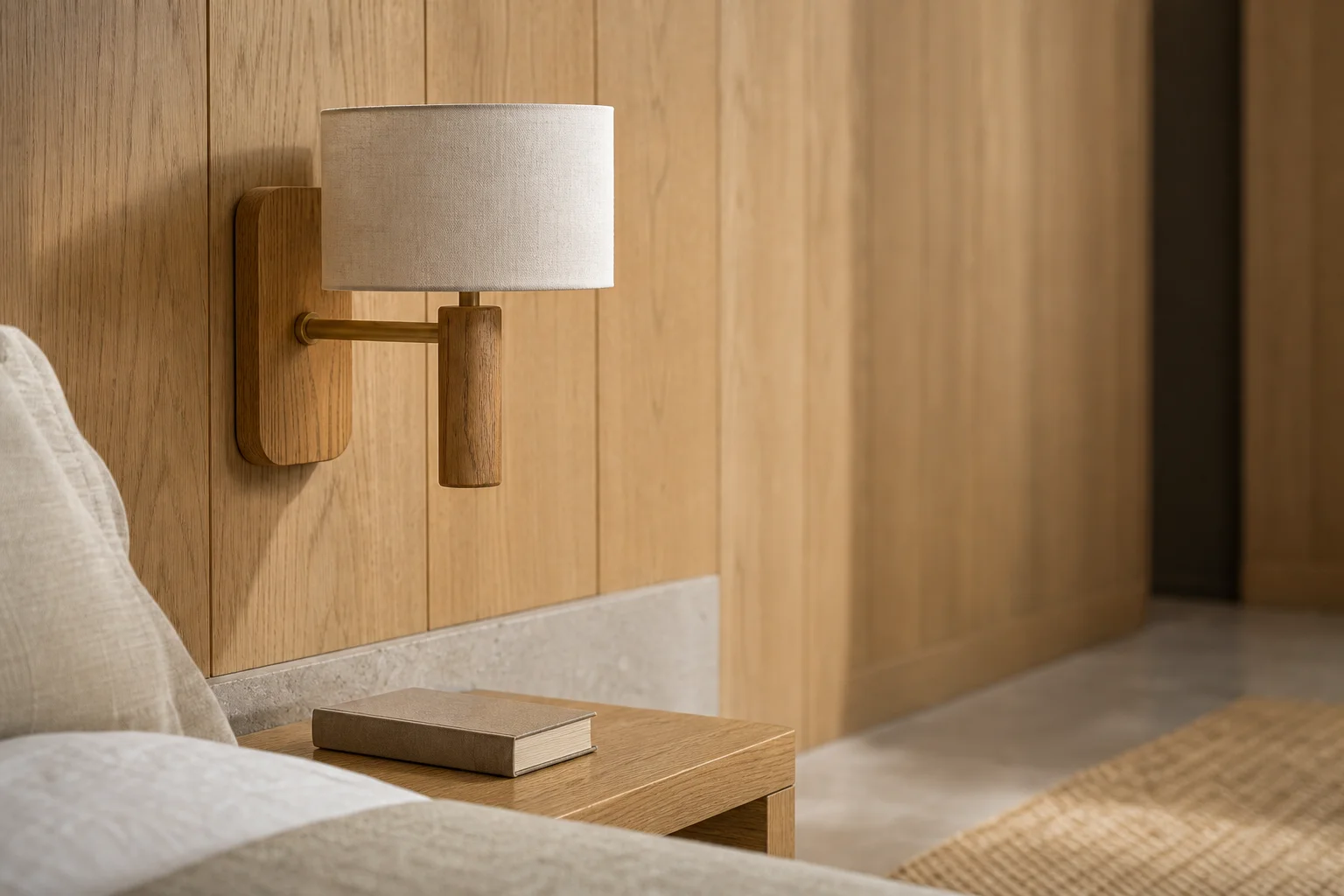 |
| Timber reads as joinery rather than hardware, which is exactly why the joint and the finish have to be specified. |
Why timber behaves differently from metal or glass
A metal backplate and a wooden one look similar on a drawing and behave nothing alike. Four differences decide most outcomes.
- Timber moves. It takes on and gives off moisture with the air around it, so a panel that fits a wall box in a dry workshop may not fit a humid corridor.
- Timber burns, and can be eaten. Fire and insect treatment are separate questions from whether the finish looks right.
- Timber is soft. Housekeeping carts, luggage and ladders mark it in ways a powder-coated steel backplate shrugs off.
- Timber has direction. An arm turned across the grain and a backplate veneered along it are different decisions.
None of this rules wood out. It means the specification has to answer questions a metal fixture never raises.
Where wood earns its place, and where it works against you
The dividing line is the cleaning regime and the moisture the fixture lives in, not the style of the interior. Where a damp wipe is the whole maintenance story, timber suits. Where surfaces are hosed, steamed or scrubbed weekly, it does not.
| Position | How timber performs | What to settle first |
|---|---|---|
| Guest room headboard wall | Strong. Reads as joinery, not hardware | Grain direction and fixing tolerance |
| Suite dressing area | Strong. Light grazing timber is memorable | Driver heat, usually in the same carcass |
| Lobby and reception panelling | Good at scale | Batch colour across a long run of panels |
| Restaurant and bar joinery | Good, with a hard-wearing finish | Cleaning agents on the front-of-house schedule |
| Bathroom, in or near a wet zone | Conditional. Needs a zone-rated assembly | Zone classification, before a material is chosen |
A timber fixture rarely fails because the species was wrong. It fails at a joint with no room to move, or a finish that met a cleaning agent it was never specified for.
Solid timber, veneer and the alternatives
Most arguments about finish quality are really arguments about construction. Four options cover nearly every specification, and each fails in a different place.
| Construction | What it is | Suits | Where it fails |
|---|---|---|---|
| Solid timber | Milled from one piece | Small backplates, turned arms, handled edges | Movement across a large flat face |
| Veneer on a stable core | A thin face bonded to a stable substrate | Large backplates where stability beats thickness | Edges, which take impact first |
| Veneer with a solid edge | Veneered face, solid lipping on exposed edges | Panels handled at install and cleaned in service | Nothing specific. The durable middle ground |
| Wood-effect film on metal | A printed surface over a metal body | Retrofits and wet zones wanting the look | It does not age like wood, and close inspection shows it |
State the construction on the schedule, not only the species. A supplier can meet a species requirement with any of the four, and the choice decides how the fixture survives its fifth year.
Moisture, heat and the two failures that actually happen
The joint, not the wood. Timber takes on moisture and swells. Fixed rigidly between metal parts, or trapped in a frame with no allowance, that movement goes somewhere: a split, a lifted veneer edge, or a fixing pulled out of the wall. Ask how the assembly accommodates movement, and expect a specific answer rather than a reassurance.
The finish, cooked or chemistry. Driver heat inside a closed timber carcass is the most common cause of a finish that dulls or cracks; the second is a cleaning agent the finish was never specified to resist. Both are avoidable at the drawing stage: keep the driver out of the timber box, or give the box a route to shed heat.
Where a fixture is proposed in or near a bathroom, the zone question belongs to the project lighting designer and the local standard that applies. What the supplier contributes is construction detail: how the assembly is sealed, where the electronics sit, and how it is serviced without cutting the wall.
Finishes: specify by exposure, not by appearance
A finish sample photographed under studio light tells you very little. What the finish must survive is a list of events, and the specification is easier to write once they are named.
- Housekeeping chemistry. The products actually on the trolley, including the ones used on a bad day.
- Handling during installation. Trolleys, ladders, and the last person to touch the fixture before handover.
- Daylight and UV. A lobby panel that sees sun will move in colour, and an oiled surface moves faster than a sealed one.
- Abrasion at the reachable zone. The part a guest or a cleaner actually touches.
- Water at the base. Anything meeting a floor or counter needs its bottom edge detailed for it.
Oiled, waxed, lacquered and sealed finishes each answer part of that list. The requirement worth writing down is behaviour: a finish hotel maintenance can spot-repair on site beats a perfect factory finish that needs a returns process to restore.
What to write into the specification
- Species, or "species or approved equivalent" where substitution is allowed.
- Construction: solid, veneer, veneer with a solid edge, or wood-effect over metal.
- Grain direction, and how the pieces in one visible run are matched.
- The fire and insect treatment requirement, as confirmed by the project team for that location.
- The finish system, plus the cleaning agents it is expected to resist.
- How the assembly accommodates movement at its fixings.
- A physical finish sample panel, approved against the joinery rather than a photograph.
Two of those lines do most of the work: grain matching and movement. They are also the two most often left out, because both feel like factory details rather than specification.
What to check on the sample
A single sample is the right instrument for a timber fixture: it tests material, joint and finish together without committing a run.
- The grain and colour against the approved panel, in the light the fixture will live in.
- The edge detail, especially on a veneered panel, since edges take impact first.
- The joint, by asking how far the panel can move and where that movement goes.
- The finish, at an angle where sheen shows rather than straight on.
- The heat, once the backplate has had time to settle at working temperature.
Then leave the sample in a room for a few days, in the season the hotel actually experiences. Timber is the one material where a week of real conditions answers more than an hour of inspection.
FAQ
Can timber be used in a hotel bathroom?
It can, where the assembly suits the zone and the project designer has confirmed the classification for that position. The supplier's job is to show how the electronics are protected and how the unit is serviced.
Does a wood fixture need a fire treatment?
That depends on the location and the authority having jurisdiction, and the project team confirms it. The supplier must state the treatment used and keep that documentation with the order.
Will timber colours match across project phases?
Not automatically. Wood is a natural material and a batch is the smallest reliable unit of colour, so keep an approved reference panel and match later phases against it rather than a photograph.
How does wood cope with a humid climate?
With a construction, a finish and a movement allowance designed for it. The failure signal is a lifted edge or a crack at a fixing, which is a design issue rather than a material one.
Should the driver sit inside the timber?
Only when the design gives it a route to shed heat, or when volume lets the temperature settle. A driver sealed inside a small timber box is the most common cause of a finish problem found later.
The takeaway
Wood is worth specifying for the reason people reach for it: it makes a scheme specific to a place. But it asks more of the paperwork than metal does. Name the construction and not just the species, state the grain and how it is matched along a visible run, specify the finish by what it must survive, and design the fixings so the panel can move. Then approve a sample that has sat in the room for a few days.
Zerouno Lighting (ZeroUNO) manufactures hospitality decorative lighting in Zhongshan, China, and has built project and custom fixtures since 2013. Timber and mixed-material pieces here are proved on one sample before a run is released, and made-to-order work typically runs 25 to 35 days. Learn more at zerounolighting.com.
About the author
Sonny Yu is Sales Manager at Zerouno Lighting, working with designers and procurement teams on hospitality lighting packages. Much of his week goes on reconciling what a drawing asks for with what a material will actually do once it reaches a hotel.



没有评论:
发表评论