Ask a project team what went wrong with a hotel restaurant and the answer rarely mentions the number of light fittings. It mentions a room that felt too bright at seven and too dim by nine, food that looked better on the chef's own photographs than on the table, and a guest holding a phone over the menu. None of those complaints are about how much light there is. They are about what the light does.
This guide is for the people who specify and buy the decorative lighting in a hotel dining room. It explains why colour rendering matters more than output, where rendering quietly fails, and what to settle with a supplier before a sample is approved.
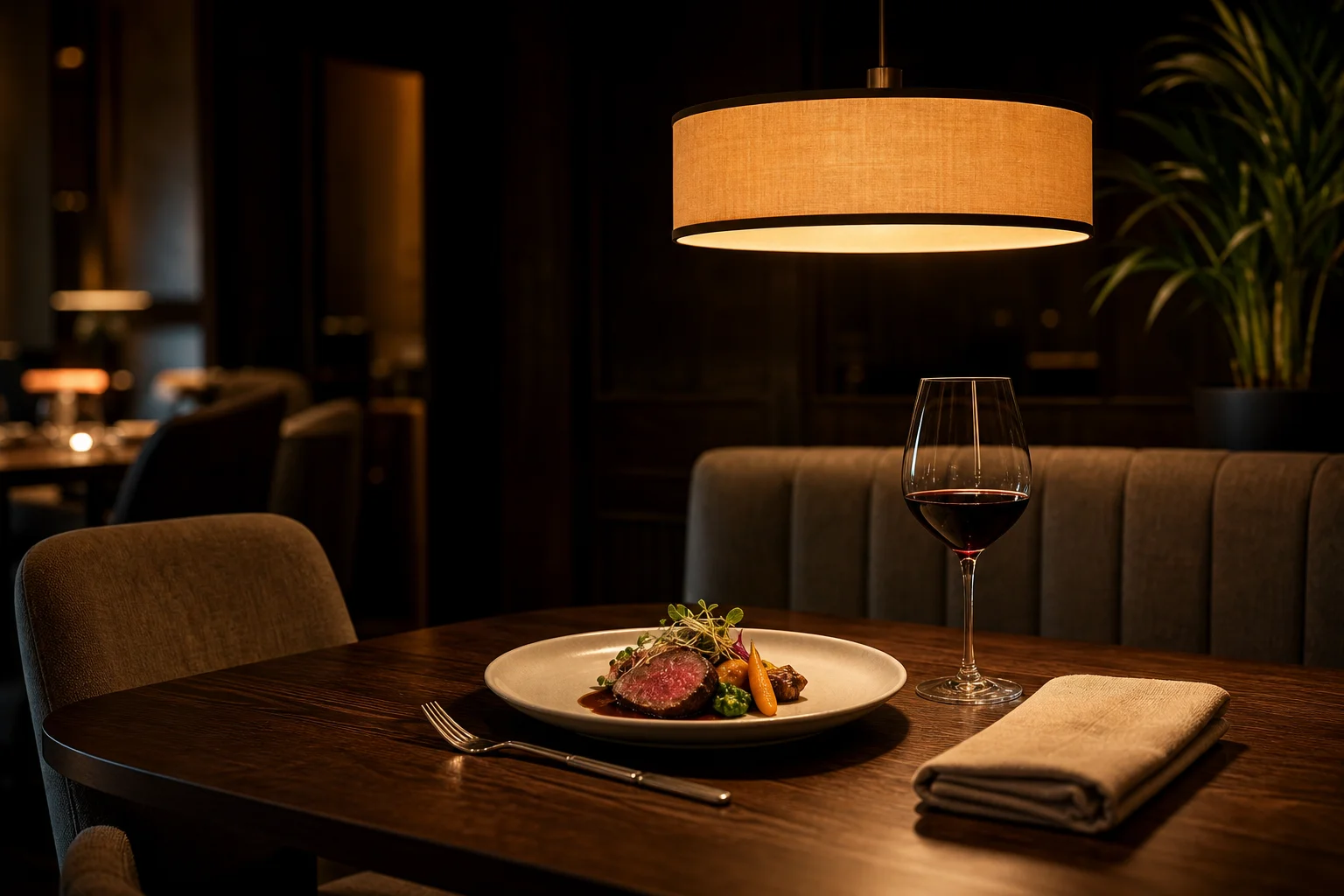 |
| What reaches the plate is decided by the source and the diffuser together, not by output alone. |
Why a brighter restaurant is not a better-looking one
The instinctive fix for a dining room that feels flat is more light. It is also the fastest way to lose the room. Raising output lifts the walls and the ceiling as well as the table, and once everything is evenly bright the space loses the contrast that made it feel deliberate.
Brightness is a quantity. Rendering is a quality. A dining room with modest output and a source that shows colours honestly reads as warm and considered. The same room with twice the light and a source that flattens reds reads as a canteen. Guests will not name the difference, but it shapes where they book next.
What a rendering figure measures, and the sample it leaves out
Colour rendering describes how faithfully a source shows the colours of what it lights. The familiar index compares a source against a reference of the same colour temperature, on a scale reaching 100, where the two are indistinguishable.
The useful detail is what that average is made of. The classic general index averages a set of muted test colours. The saturated red is one of the samples but is effectively left out of the average, so two sources carrying the same headline figure can treat a steak, a tomato or a glass of red wine very differently. A rendering claim is the start of a conversation, not the end of one.
| What the claim says | What it does not tell you |
|---|---|
| A high general rendering figure | Nothing about deep reds, so nothing about meat, tomatoes or wine |
| A figure quoted at full output | How the source behaves at the low level the room actually runs at |
| A colour temperature in kelvin | Whether the tint stays neutral or drifts green or pink as it dims |
| A source reference on the schedule | Whether the diffuser in front of it changes what reaches the plate |
The dining table is a colour-critical task
A restaurant table is not a task surface in the way an office desk is. The task is visual judgement of things that carry a price and get photographed: the plate, the garnish, the finish on a sauce. Guests compare the plate against what they expected, and the lighting is the only variable they can blame.
The complication is the fixture itself. In a hotel restaurant the lamp is usually decorative, with a fabric shade, an opal diffuser, tinted glass or an amber one, and each of those materials filters the spectrum before the light reaches the table. A source chosen for its rendering can be undone by the shade chosen for its looks. That is not an argument against shades. It is an argument for approving the two together.
Rendering reaches a guest in three places:
- The plate. Deep reds decide whether protein reads as appetising or tired.
- The glass. Wine is judged by colour before it is tasted, and a red under a poor source turns brown.
- Faces. Skin is the hardest thing to render well, and a green or grey cast across a table of guests is noticed at once.
Dimming is where good rendering quietly falls apart
Most hotel restaurants spend dinner service at a fraction of the output the fitting can deliver. That is exactly where a specification written at full output stops describing the room. As a source is dimmed its colour behaviour can drift: the tint may warm, which is often wanted, or it may move toward green or pink, which is not. Near the bottom of the range some source and driver combinations become unpredictable or cut out early, leaving a gap between the lowest setting the control system offers and the lowest the fitting will hold.
Flicker belongs in the same conversation. A dining room is now routinely on camera, and a fitting that flickers invisibly to the eye can band on a phone screen. Rendering and flicker are settled by the same two components: the source and the driver.
What the guest judges, and where each decision is made
Restaurant lighting goes sideways for a simple reason: the decisions sit across four documents and nobody owns all of them. The table maps what a guest notices to what decides it.
| What the guest judges | What decides it | Where it is fixed |
|---|---|---|
| Whether the food looks appetising | How deep reds render at the dimmed level used at service | Source and driver, agreed at sample approval |
| How the room feels at eight | Lowest stable output and the dimming curve | Control interface stated in the order |
| Whether a menu can be read | Vertical light and glare off the fitting | Fixture height, shielding and diffuser |
| Whether the wine looks right | What source and glassware do together | Source reference on the schedule |
| Whether the room looks intentional | Contrast between lit tables and circulation | Pendant spacing and beam control |
| Whether a replacement in year four matches | Whether source, driver and diffuser were recorded | Handover documentation |
Running a sample that answers the question
A sample reviewed in a workshop answers the wrong question. The only useful test puts the fitting where it will hang, on a table with real plates, real glassware and a real bottle, at the output level the room will run at during service. Four things are worth settling then, because all four are awkward to change later:
- Read the plate and the wine under the proposed fitting, against the fitting already in the room.
- Drop the dimmer to the service level and look again. A colour shift here is a source or driver decision, not a trim adjustment.
- Look at the fitting from a seated guest's position, not standing. A lamp that reads as elegant across the room can be a bare glare source from a chair.
- Record the combination approved: source reference, driver reference, diffuser material and finish. Replacements years later match a record, not a photograph.
A restaurant does not fail on output. It fails on a plate that looks tired and a guest holding a phone over the menu.
FAQ
Is colour rendering the only figure that matters in a restaurant?
No, but it is the one most often taken on trust. Output, glare control, dimming behaviour and the diffuser all matter. Rendering is singled out because it is the hardest to correct once the fixtures are on site.
Can a shade or diffuser change the colour of the light?
Yes. Fabric, tinted or amber glass and opal materials each filter the spectrum differently. The source and the diffuser together are what the guest sees, so they should be approved as a pair.
Why does the food look worse later in the evening?
Because the room is usually dimmed as service progresses, and a source that behaves well at full output does not always behave the same way near the bottom of its range. That is why a sample has to be judged at the level the room runs at.
Who should choose the light source, the designer or the supplier?
The project's lighting designer sets the performance the room needs. The supplier's job is to meet it, and to say plainly when a chosen diffuser, shade or driver makes that impossible.
We are keeping existing fittings in a refurbishment. What should we check?
Whether the original source is still available, and whether anything offered as a replacement behaves the same way at low output. Changing only the source can change the look of the whole room, which is usually what the project was trying to avoid.
The takeaway
Restaurant lighting in a hotel is decided less by brightness than by how honestly the light shows what is on the table. Agree the rendering target with the project lighting designer, treat the diffuser and the source as one decision, judge the sample at the dimmed level the room will really run at, and keep the approved combination on the handover record. The fixture is the part the guest sees. The rendering is the part the guest experiences.
Zerouno Lighting (ZeroUNO) manufactures hospitality decorative lighting in Zhongshan, China, and has built project and custom fixtures since 2013. Restaurant and bar packages normally begin with a one-piece sample against the drawing, with made-to-order work typically running 25 to 35 days once the sample is approved. Learn more at zerounolighting.com.
About the author
Sonny Yu is Sales Manager at Zerouno Lighting, working with designers, contractors and procurement teams on hospitality lighting packages. Much of his time goes on the questions that surface after a sample is reviewed: how a diffuser changes the light, how a driver behaves near the bottom of its range, and what has to be written down so a later phase still matches.



没有评论:
发表评论