Every custom lighting order begins with a drawing that everybody likes, and a question nobody has answered yet: can this actually be made, and made the same way every time? A concept drawing settles what a fixture should look like. It says nothing about the wall it will be fixed to, the driver hidden behind it, or the batch produced six weeks after the sample was approved.
This guide is for the project team, the procurement lead and the consultant who have chosen a custom design and now have to get it built. It sets out the five gates between a sketch and a delivered fixture, what each should produce, and which decisions are yours rather than the factory's.
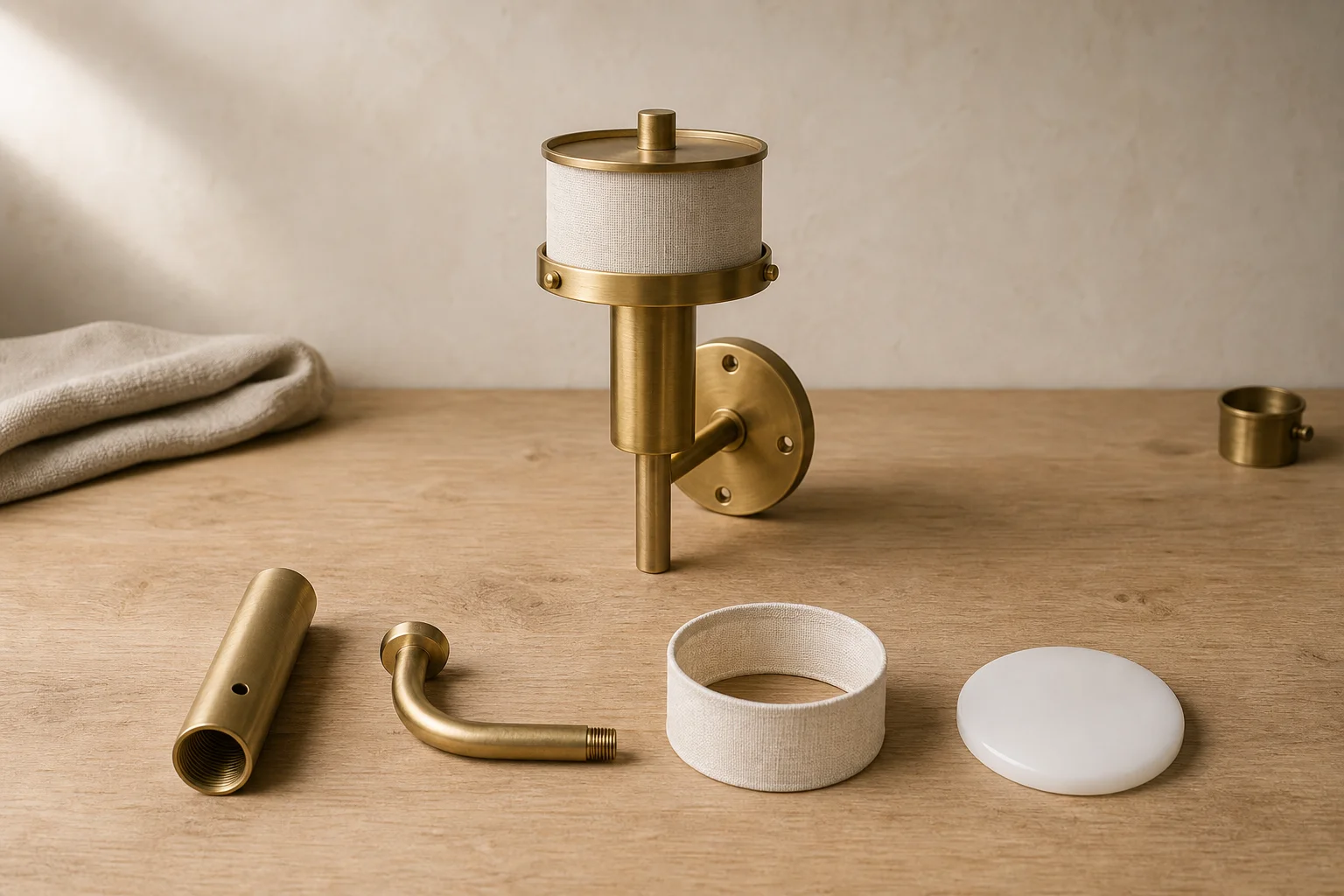 |
| A custom fixture spends most of its development as a set of separate parts. The decisions made at each stage are what keep them together. |
Why a custom fixture is a development project, not a purchase
A catalogue fitting is selected. A custom fitting is developed. The difference is not the drawing but the number of decisions still open when it arrives, most of which belong to someone other than the supplier.
The chain runs in a fixed order: brief, shop drawing, sample, production release, delivery. Each stage closes options that were open before. Projects that lose time on custom lighting almost always skipped a gate rather than made a mistake at one.
Gate 1: the brief a factory can actually build from
The concept drawing shows what the fixture looks like. The brief is what it has to do. Six items carry most of the risk, and none is a matter of taste.
| What the brief must state | What it prevents when it is left late |
|---|---|
| The mounting substrate and the real wall build-up | A backplate that cannot be fixed to what is on site |
| Critical dimensions, and the tolerance that matters | A fitting that clashes with joinery after it is made |
| How the fixture is switched, dimmed and controlled | Decorative lighting that cannot talk to the control system |
| A physical finish reference, not a name | A batch that matches a screen but not the approved sample |
| The access route for service and replacement | Control gear reachable only by opening the wall |
| Quantity per phase and the required-on-site date | A delivery date that suits neither the site nor the programme |
Two lines deserve emphasis. A finish described as antique brass or brushed nickel is not a reference, because two suppliers read the same two words differently. And the service route is decided at this gate or not at all: once control gear is sealed inside a fixture, no later conversation makes it maintainable.
Gate 2: the shop drawing is where the design becomes buildable
A concept drawing describes an appearance. A shop drawing describes how one particular fixture will be built: how the arm is jointed, how thick the material is, how the shade sits on its ring, where the fixing centres fall, where the driver lives, and how the cable leaves the fixture.
At this gate the useful review is not aesthetic but a check of interfaces, every point where your fixture meets somebody else's work: the backplate against the substrate, the shade against the joinery beside it, the cable exit against the electrician's first fix.
One rule saves argument later: anything agreed verbally at this gate does not exist. If the approved drawing says one thing and a message thread another, the drawing is what the factory builds to.
Gate 3: what a one-piece sample proves, and what it does not
Custom work normally begins with a one-piece sample against the drawing. The sample is where the fixture stops being lines and becomes an object, and the first honest look at proportions, weight and finish under real light.
What a sample does not prove is worth saying too. It does not prove consistency across a batch, which is process control rather than one good unit. It does not prove the driver behaves the same near the bottom of its dimming range unless the sample is dimmed to the level the room will run at. And it does not prove the fixture arrives intact, because packing is a separate skill from making.
Keep the sample itself. A photograph is useful in a report and useless for matching a finish three years later, when the question is whether a new part belongs beside the old.
Gate 4: releasing to production without losing what the sample decided
The gap between an approved sample and a production run is where custom work quietly drifts. The fixture passes from a person to a set of instructions, and anything agreed by eye must be written down or it does not survive.
- The finish reference. A physical panel approved with the sample and kept with the project record.
- The named components. Driver, control gear, connector and diffuser identified by reference, so a later order has something to match.
- The batch note. How colour and finish are held consistent across a run, and what happens if a component is superseded.
- The packing method. Agreed before despatch, not improvised on the day.
One caution applies to every custom order: the sample is approved as a whole, not only as a shape. If a driver, connector or diffuser is substituted afterwards, that is a new decision rather than a manufacturing detail.
Where custom lighting projects lose time
Delays rarely come from the workshop. They come from a gate opened late, and each has an owner.
- Substrate confirmed late. The backplate is designed against a drawing of the wall rather than the wall. Owner: the project team, before the shop drawing is approved.
- Control interface left to the last minute. Owner: the lighting designer and the controls contractor, together.
- Finish described in words. The sample and the batch disagree, and the argument is about vocabulary. Owner: whoever signs the finish reference.
- Sample reviewed in the wrong place. Approved on a screen instead of in the room. Owner: the reviewing party.
- Site dimensions measured too early. Take-off drawings used after the joinery is set out. Owner: the main contractor's programme.
- Access decided by default. Control gear ends up where it can be built rather than where it can be serviced. Owner: the shop-drawing reviewer, at that gate only.
What to record at each gate
A custom package is easier to live with when each gate leaves one document behind, and the set is handed over as a whole rather than scattered across inboxes.
| Gate | The record it should leave | Where it belongs |
|---|---|---|
| Brief | The signed brief, including the substrate confirmation | Project record, shared with the supplier |
| Shop drawing | The approved revision, with comments attached | Contractor and supplier, same revision number |
| Sample | The physical sample and a one-page approval note | Supplier until handover, then the property |
| Production release | Finish panel, component references, batch note, packing method | Production file, copied to the project record |
A custom fixture is not really bought. It is decided several times, and only the last decision reaches the loading dock.
FAQ
How long does a custom hotel lamp take to produce?
Two clocks run at once, and the workshop's is usually the shorter. Made-to-order work typically runs 25 to 35 days once the sample is approved, but the sample, the drawing review and the site measurements decide the real programme.
Does every fixture in a package need its own sample?
Every distinct fixture type does, but not every unit. Once finish, components and packing are recorded, identical repeats can be produced against that record.
Can a sample be fitted on site before the order is released?
It is the most useful thing a sample can do. One unit in its real position answers what a table review cannot: how the shade reads against the actual wall, whether the proportions suit the room, and whether service access works where it is needed.
What happens if the site dimensions change after approval?
It becomes a change rather than a correction, with a schedule and cost consequence that depends on how far production has advanced. That is why the release is worth holding until the joinery is set out.
What should we send to get a custom fixture quoted?
The concept drawing, the six brief items above, the quantity by phase and the date the fixtures are needed on site. With those, a supplier can quote and say early which parts will be hardest to hold consistent across a batch.
The takeaway
Custom hotel lighting goes wrong at gates, not at benches. Fix the substrate, the control interface and a physical finish reference before the shop drawing is approved; use the sample to settle what a drawing cannot; and turn everything agreed by eye into a written record before production begins. Treat the five gates as your decisions, and the fixtures that arrive will be the ones approved rather than the ones discussed.
Zerouno Lighting (ZeroUNO) manufactures hospitality decorative lighting in Zhongshan, China, and has developed project and custom fixtures since 2013. Custom enquiries normally begin with a one-piece sample built against the approved drawing, with made-to-order work typically running 25 to 35 days from that approval. Learn more at zerounolighting.com.
About the author
Sonny Yu is Sales Manager at Zerouno Lighting, working with designers, contractors and procurement teams on hospitality lighting packages. His days go on the gates between a drawing and a delivery: what the brief left open, which interface nobody checked, and which decision has to be written down before the order is released.



没有评论:
发表评论