A fixture fails at six in the evening, in room 412. Engineering finds a wall light that no longer lights, a shade that has come away from its frame, or a finish gone patchy after one housekeeping cycle too many. No single one of those is a crisis. What turns them into one is that nobody can say quickly which unit it is, whether a spare exists, who is cleared to work on it, or how long the position will be out of service.
This guide is for the people who take that call: facility managers, procurement teams, and owners' representatives holding a maintenance contract. It covers how to triage a failure, how to choose between repair, like-for-like replacement and retrofit, and what to record so the same failure does not surface in forty other rooms.
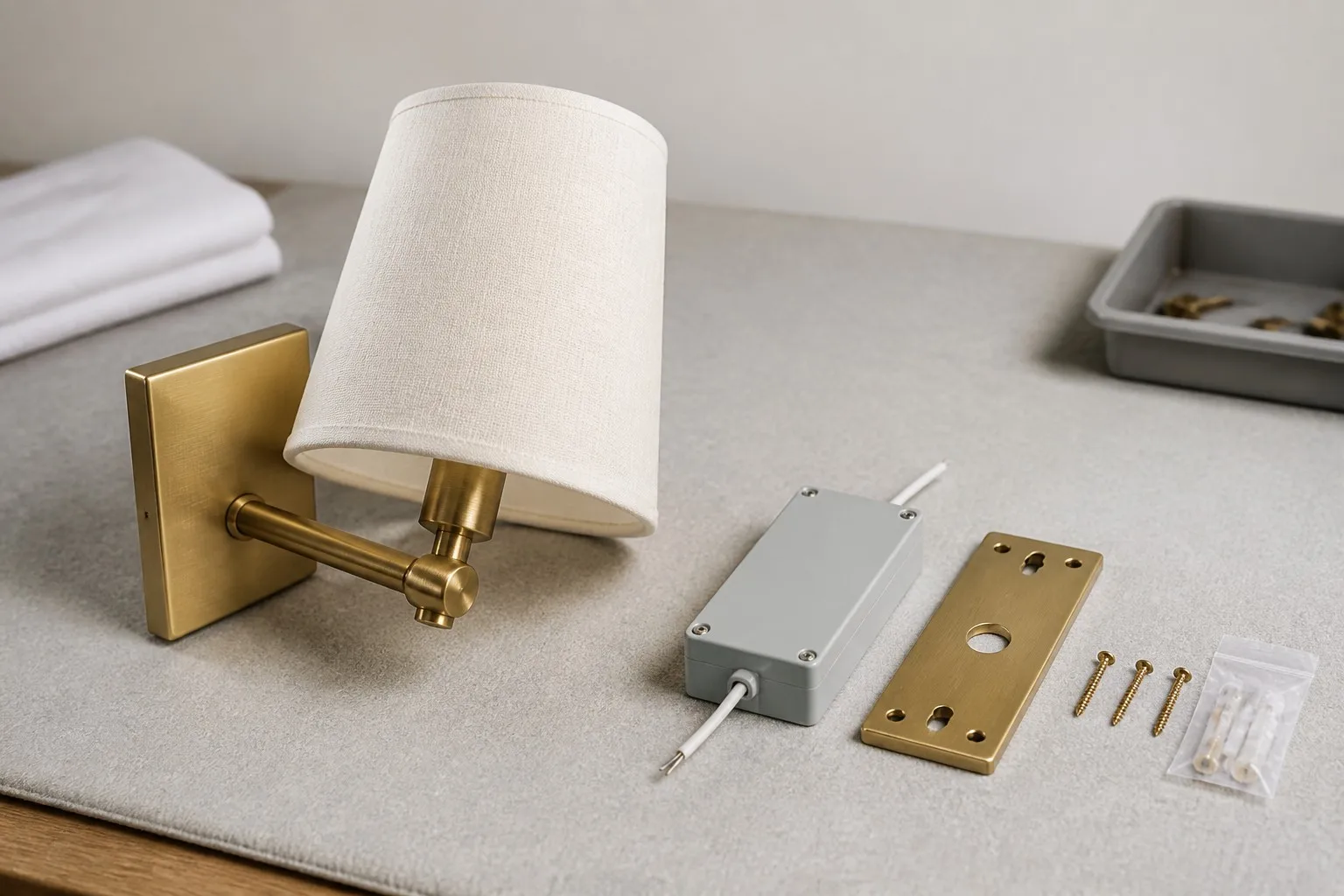 |
| A replacement is only quick when the unit can be identified from its position code and a matching spare is already in the store. |
Triage first: fixture, driver or circuit?
A dark position is rarely a failed fixture. Before ordering anything, place the failure in one of four families, because each is answered by a different person on a different timescale. Swapping a unit that only needed a driver re-terminated costs a fixture and a wasted visit; sending a spare where the circuit is at fault costs the trip twice.
Work outwards from the simplest check. Confirm the position is isolated correctly and supply is present at the fixture, confirm the control device is not holding the circuit at zero, and only then open the unit. Most dead wall lights are a driver, a connector or a scene left at the wrong state.
| What is reported | First check on site | Most common cause | Who attends |
|---|---|---|---|
| Nothing lights | Supply at the fixture, then scene and dimmer state | Driver at end of life, or a loosened connector | Maintenance electrician |
| Flicker or buzz | Dimmer type and load | Dimmer and driver on different protocols | Electrician plus supplier data |
| Shade or glass damaged | Whether the fixing or the substrate failed | Housekeeping impact, or a stressed joint | Maintenance, plus the supplier if a joint failed |
| Finish patchy or lifting | Cleaning routine and the agents in use | Coating attacked by the wrong chemical | Housekeeping, with the finish supplier |
The first two families usually close the same day. The last two become a replacement, a refinishing or a warranty conversation, and they are the reason this article exists.
Repair, like-for-like replacement, or retrofit the position?
Once the failure is understood there are three answers, and the cheapest is not always the fastest. The right one depends on whether the position is unique, whether the product is still available, and how much disruption the building will absorb.
| Option | Fits when | What it needs | Main risk |
|---|---|---|---|
| Repair in place | Failure is a driver, connector, joint or shade | A compatible part, and access without opening the wall | The rest of the unit is at end of life |
| Like-for-like replacement | Unit still in production, position standard | Original project reference, and the same drawing revision | A batch mismatch if the finish has moved on |
| Retrofit the position | Unit discontinued, or a whole floor failing | A new fixture, a mounting check and a fresh sign-off | Repeating a decision the operator never agreed to |
A replacement is only genuinely like-for-like if it comes from the same drawing revision and finish batch as the rest of the property. On a building a few years old that is a question for the supplier, not the site. Retrofit is the honest answer wherever a whole floor is failing, but it should be a decision rather than a drift.
Access, isolation and the working window
An operating hotel decides when the work happens, not the contractor. The window is usually a few hours in the afternoon, and it disappears the moment the room goes back into inventory.
- Confirm the position and its isolation before the room leaves inventory, not after.
- Book the room, not the fixture. A unit in an occupied room cannot be worked on.
- Protect the finishes below; a dropped backplate damages more than the wall it lands on.
- Refit, test the control scene, and photograph the finished position before releasing the room.
Matching a finish when the original is discontinued
This is where replacements go wrong, and the fault is usually upstream. Two units made to the same drawing a year apart can read differently if the finish is plated or hand-applied, because plating chemistry and clear lacquer are batch processes.
Plan for it rather than hope. Where a property is large, holding a small quantity of finished units from the original run is the only reliable way to match later. Where that did not happen, the options are to replace the whole grouping read together, or to accept the difference at a position never seen alongside its neighbours.
A single mismatched sconce in a corridor of identical sconces is more noticeable than a failed one. Replace in the grouping the eye reads at once, or leave the position alone.
Finish failure is also worth separating from product failure. A coating that fails under a cleaning agent the finish supplier rules out is not a manufacturing fault, and the cheapest fix is usually a housekeeping change.
What to document every time a fixture is replaced
The record matters more than the repair. Three failed units in one block stop being incidents and become a pattern, and a pattern is only visible if somebody wrote the details down.
- Position code, drawing number, and the date the failure was reported.
- What the failure was: driver, connector, joint, shade, glass or finish.
- What was fitted as the replacement, and from which batch.
- Who did the work, and whether it was warranty or chargeable.
- Photographs before and after, at the same distance and in the same light.
Kept in the maintenance file, those entries turn one-off repairs into a trend and answer the first question a supplier asks on a claim: which units, from which order, failing in which way.
Stopping the same failure from repeating across the property
A failure in one room is an event. The same failure in six rooms on one floor is a specification or an environment question, and replacing fixtures will not settle it.
Two causes account for most repeats. The first is an installation detail applied consistently: a connector type that cannot hold in a particular wall build-up, or a joint stressed every time the fixture is levelled.
The second is a local environment the specification did not account for. Both are diagnosed by looking at where failures cluster, not at the failed units.Where a cluster does point to a batch or a component, give the supplier the whole picture: positions, failure mode and dates. That is a stronger basis for a decision on the remaining units than claims raised one at a time.
The clauses that decide how fast a replacement happens
Most after-sales agreements promise a response. Far fewer say how a replacement reaches an open property, which is what decides whether a room is out of service for a day or a fortnight.
- Whether spare units are held from the original production run, and in what quantity.
- Whether the response window covers diagnosis only, or a replacement reaching site.
- How a unit is identified: position code, drawing number or order reference.
- Who carries freight and duty on a replacement going to an operating property.
- What happens when the finish is no longer reproducible, and who decides the substitution.
FAQ
How quickly should a failed hotel light be replaced?
It depends on the position. A guest-facing light in an occupied room is dealt with the same day, even if the answer is temporary; a service area can wait for the next planned visit.
Can one fixture be replaced without the rest of the grouping?
Physically yes, visually sometimes. If the finish is plated or hand-applied, a later unit may not match its neighbours under the same light. Where positions are read together, replace the grouping.
Is a failed driver a warranty issue?
Usually, if the unit is within warranty and the driver came with the fixture. It is not one if a non-compatible driver was fitted on site, or a dimmer was changed after handover.
What should a hotel hold in its own store?
At minimum one unit of each custom fixture type, from the original run, plus the hardware specific to it. Those cannot be bought locally on a Friday afternoon.
Who should be told when the same fixture fails three times?
The supplier, in writing, with the position codes and dates. Three failures of one type in a similar environment is the point at which a component or specification question is worth raising formally.
The takeaway
A failed fixture in an open hotel is a process problem before it is a product problem. Triage before ordering, choose between repair, like-for-like replacement and retrofit on the facts rather than the calendar, and accept that a finish matched today may not match one made three years ago. Then write down every replacement.
Zerouno Lighting (ZeroUNO) manufactures hospitality decorative lighting in Zhongshan, China, and has supplied project and custom fixtures since 2013. Its fixtures carry a two year warranty with a 48 hour service response. Learn more at zerounolighting.com.
About the author
Sonny Yu is Sales Manager at Zerouno Lighting, handling enquiries from designers, procurement teams and facility managers. Much of his week goes on the questions that surface after handover, when a specification meets an occupied building.



没有评论:
发表评论