Guest room lighting is the most used — and most complained about — lighting in any hotel. Guests judge it within minutes of check-in: can I read in bed without waking my partner, is the bathroom mirror light flattering or harsh, can I find the light switch in the dark?
Getting it right is not about buying brighter fixtures. It is about three decisions: how light is layered, which colour temperature each layer uses, and how the guest controls it.
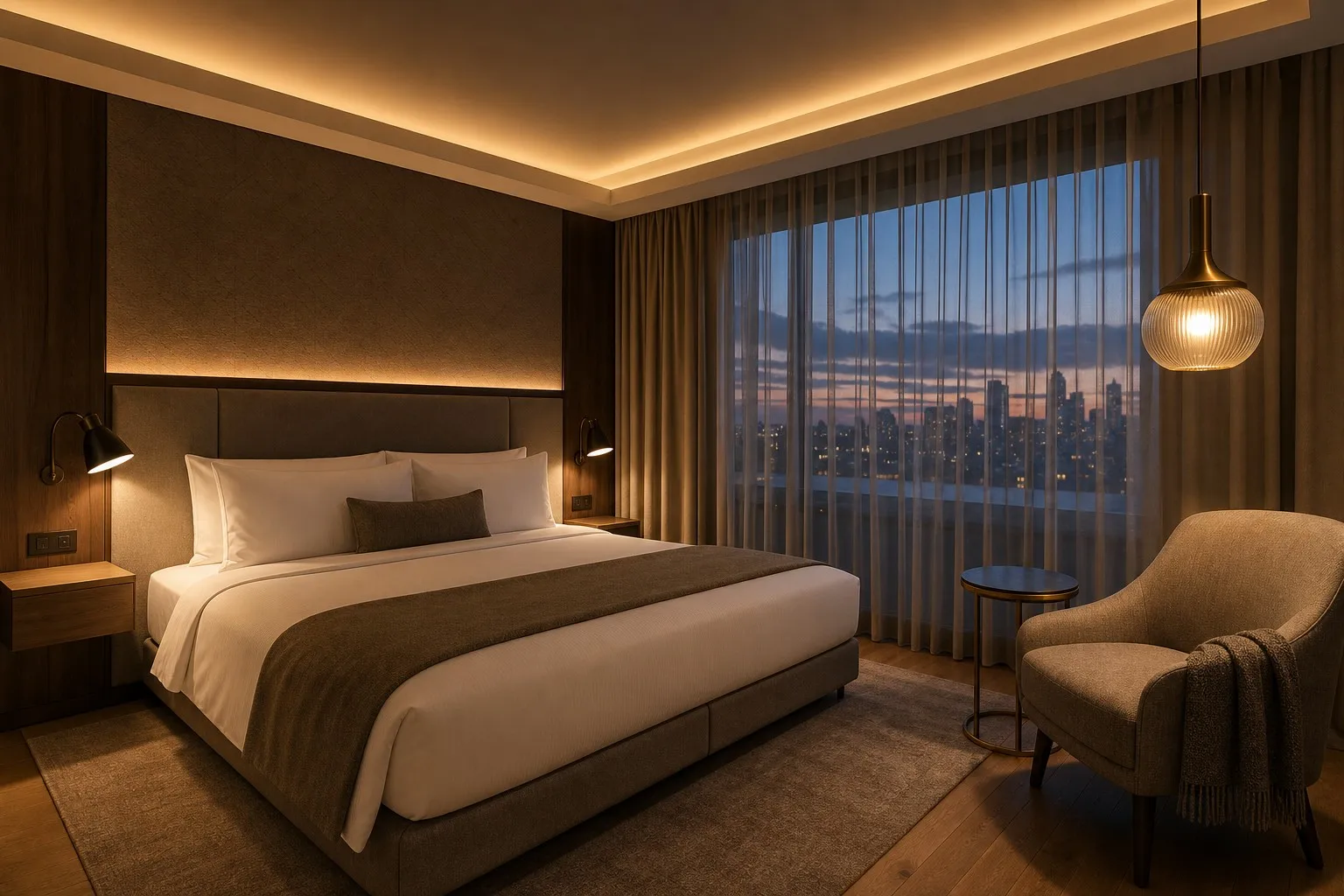 |
| The three layers in practice: ambient wash, aimed task light at the bedside, and decorative fixtures carrying the room's identity. |
Start with layers, not fixtures
Guest room lighting works best when it is planned in three layers, each with a different job.
Ambient layer — orientation and safety. This is the general light that lets a guest move around the room, find luggage and walk to the bathroom at night without switching on a floodlight. In hospitality projects, ambient light is usually delivered by recessed downlights, cove lighting or discreet wall-washing — not by the decorative fixtures themselves.
Task layer — reading, working, grooming. This is where guest satisfaction is won or lost. Bedside reading light, desk lighting and the bathroom mirror light all belong to this layer. Task light must be aimed, not just switched on: a well-designed bedside reading lamp puts light on the page and not in the sleeping partner's eyes.
Accent / decorative layer — identity. Chandeliers, table lamps, wall sconces, floor lamps and decorative pendants create the visual memory of the room and tie the lighting to the interior design. This is the layer hotels most often want customised, because it carries brand character.
A useful rule when talking to designers: decorative fixtures carry the identity; functional lighting carries the performance. Because decorative fixtures usually use shades and diffusers that reduce output, hotels normally keep them in the decorative layer and let discreet functional lighting meet the room's performance targets.
Colour temperature: pick by space, not by habit
Colour temperature is the emotional language of a hotel. The practical guidance used across hospitality projects:
| Space | Typical direction | Why |
|---|---|---|
| Guest room general + bedside | 2700K–3000K warm white | Relaxation, intimacy, and flattering light for skin tones and textiles |
| Bathroom vanity / mirror | 3000K–4000K | Crisper light for grooming and detail; pair with indirect light to avoid glare |
| Corridors / lift lobbies | 2700K–3000K, consistent with guest rooms | Warm continuity; abrupt colour shifts make a corridor feel clinical |
| Fitness / wellness areas | 4000K | Alertness and clean visual rendering |
| F&B — intimate dining | 2700K, warm and dimmable | Privacy and atmosphere |
| F&B — market-style / all-day dining | 3000K–3500K | Readable menus, energetic daytime feel |
Two practical points that come up on almost every project:
- Consistency beats variety. Guests notice when a corridor is 4000K and the room is 2700K; the contrast reads as a mistake rather than a design decision.
- Tunable white is worth discussing for multi-purpose spaces. Where a ballroom or meeting space hosts both daytime sessions and evening events, a 2700K–4000K tunable solution can replace two lighting scenes with one fixture set.
Colour rendering matters as much as colour temperature
For guest rooms, lobbies, and especially dining areas, CRI 90+ has become the practical expectation. High CRI keeps timber, stone, upholstery and food looking as the designer intended. In restaurants, low-CRI light is the fastest way to make a well-plated dish look tired.
Controls: design the switch experience, not just the circuit
Guests do not read instructions. The control design should be guessable within two seconds:
- Bedside control on both sides, reachable from lying down
- Dual reading lights so each guest can read independently
- Master off at the room entry and beside the bed
- Dimming on the ambient and decorative layers — full-brightness-only lighting is the single most common guest complaint
- Dark-room mode for night-time bathroom trips: a low-level path or bathroom night light, so the room stays dark
- Integrated charging — USB-A/USB-C modules built into bedside fixtures reduce the clutter of adapters and extension leads
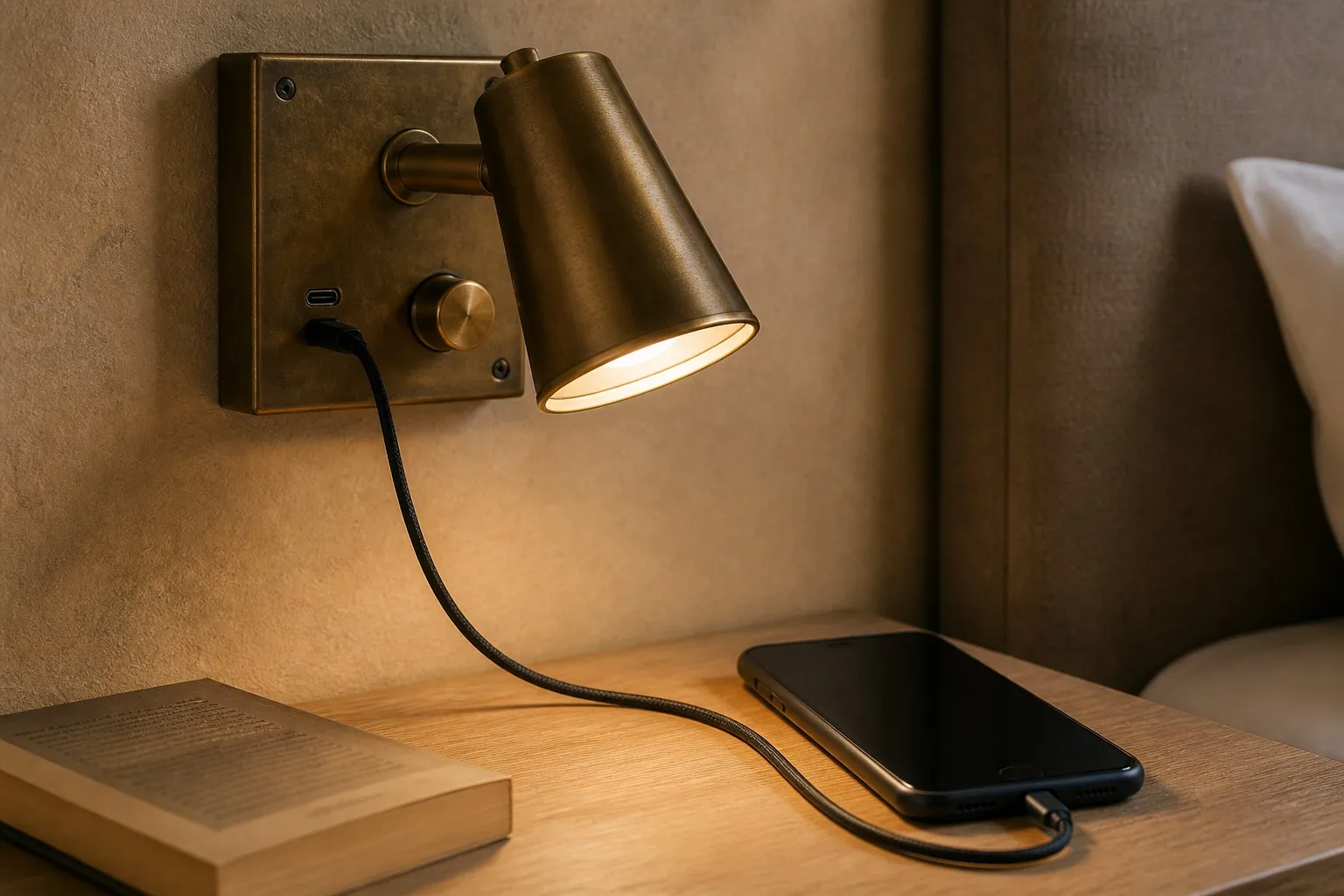 |
| Integrated charging and a reachable dimmer remove two of the most common guest complaints before they happen. |
Beside the bed: wall lamp or table lamp?
This is the decision that most affects the guest's daily experience.
Bedside wall lamps free up the nightstand for a phone, book and water glass, and keep light near the headboard where it is useful. Specify height carefully: the light source should sit just above shoulder level when the guest is seated, with the beam angled toward the page.
Table lamps give designers more decorative freedom and are easier to swap, but they consume nightstand space and can be knocked over. Where table lamps are used, choose shades that cut glare at seated eye level.
Headboard-integrated reading lights are common in higher-tier projects. They look clean and put light exactly where it is needed, but they must be planned early with the joinery package — retrofitting them later means cutting the headboard.
Retrofit cases: what to do when there is no wiring
Older properties and heritage buildings frequently cannot run new cabling to the headboard without invasive work. Two options appear in practice:
- Rechargeable battery wall sconces with remote or touch control — no new circuit required, installed in an afternoon, and removable for charging
- Plug-in wall lights discreetly routed to an existing socket
Both are compromises on wiring but can protect a renovation schedule. Where they are used, agree the charger management routine with housekeeping, because a flat fixture becomes a guest complaint.
Durability and maintenance: the unglamorous checklist
- Finish resistance — brushed brass, matt black and satin nickel all behave differently against cleaning agents; confirm the finish test standard with the manufacturer
- Replaceable components — drivers, LED modules and shades should be serviceable rather than throw-away
- Easy-clean geometry — avoid open tops where dust collects
- Consistency of supply — for multi-property groups, a manufacturer that can repeat the same finish years later is worth more than a marginally lower unit price
Why hotels customise guest room lighting
Customisation in hospitality is rarely about luxury budgets. It is driven by practical requirements: fixtures must match non-standard headboard dimensions, answer the interior's material palette, differentiate the property from the brand next door, and still be deliverable at every price tier (material substitution — composite in place of crystal, acrylic in place of glass — is a legitimate way to hold the design language at a lower price point).
That is also why mock-up rooms matter: a single-piece sample in the final finish, colour temperature and control protocol is the cheapest way to catch a mistake before it is reproduced across 300 rooms.
Guest room lighting specification checklist
| # | Check | Why it matters |
|---|---|---|
| 1 | Three layers defined (ambient / task / accent) | Prevents "too dark" and "too harsh" complaints |
| 2 | Colour temperature consistent room-to-corridor | Warm continuity; no clinical contrast |
| 3 | CRI 90+ for guest room and F&B | Textiles, timber and food render correctly |
| 4 | Reading light aimed, not just bright | Partner disturbance is the #1 bedside complaint |
| 5 | Controls on both sides of the bed + master off | Guessable in two seconds |
| 6 | Dimming on ambient and decorative layers | Comfort across day and night |
| 7 | Night-path lighting to the bathroom | Safety without waking the room |
| 8 | Integrated USB charging | Reduces clutter and adapter demand |
| 9 | Headboard integration planned with joinery | Avoids cutting headboards later |
| 10 | Finish and cleaning-agent compatibility confirmed | Protects appearance over years |
| 11 | Spare parts and repeatability for multi-property rollouts | Protects the brand standard |
| 12 | Mock-up room sample before bulk order | Catches problems at 1× cost, not 300× |
| 13 | Illuminance levels validated by the lighting designer | Project targets, not assumptions |
Point 13 is deliberately last: layer, colour temperature, control and glare decisions drive guest satisfaction, and the illuminance targets themselves should be confirmed by the project's lighting designer against the applicable standard for the property's location.
FAQ
What colour temperature should hotel guest room lighting use?
Warm white in the 2700K–3000K range is the mainstream choice for guest rooms and bedrooms, because it supports relaxation and flatters skin tones and textiles. Bathrooms often shift slightly cooler for grooming mirror light.
Should bedside lighting be wall-mounted or a table lamp?
Wall-mounted reading lamps keep the nightstand clear and put light close to the guest's book or phone; table lamps give more decorative freedom but consume surface space. Many projects use wall lamps for reading and table lamps for atmosphere.
Is high CRI really necessary in guest rooms?
CRI 90+ is now a practical expectation for guest rooms, lobbies and dining. Low-CRI light makes natural materials and food look dull, which undermines the interior design investment.
Can you retrofit bedside lighting without rewiring a hotel?
Yes — rechargeable battery wall sconces and plug-in wall lights avoid new cabling, which matters in heritage or fully occupied properties. Plan the charging routine with housekeeping so fixtures never reach a guest with a flat battery.
What should be tested in a mock-up room?
Finish colour against the joinery and textiles, colour temperature, glare from the bedside reading light at seated eye level, control placement and dimming range, and the charging module position. A mock-up caught early is the cheapest quality control in the project.
The takeaway
Guest room lighting succeeds when the layers are planned, colour temperature is chosen per space and kept consistent, and controls are designed for a guest who will never read the instructions. Fixtures come last — and the mock-up room proves them.
Zerouno Lighting (ZeroUNO) manufactures hospitality decorative lighting in Zhongshan, China — bedside reading lamps, wall sconces, table lamps, floor lamps and pendant lighting for hotel guest rooms and public areas, including rechargeable options for retrofit projects. Learn more at zerounolighting.com.
About the author
Sonny Yu is a Sales Manager at Zerouno Lighting, working with hotel developers, designers and procurement teams on decorative lighting packages for guest rooms and public areas.



没有评论:
发表评论