Most hotel lighting problems are decided long before anyone unpacks a crate. The fixture schedule says one thing, the ceiling goes up to another, and the decorative pendant arrives after the grid is closed and the fire damper has been set. By then the cheapest fix is a site modification, and the most expensive is a remade batch.
The document set that prevents this is the submittal. It is unglamorous, it is reviewed by people who are already overloaded, and it is the most reliable early warning system a project has. This guide is for the people who handle it: owner's representatives, interior designers, procurement teams and the contractor's project manager. It covers what each lighting submittal package has to contain, the order the packages must move in, and what each approval actually releases.
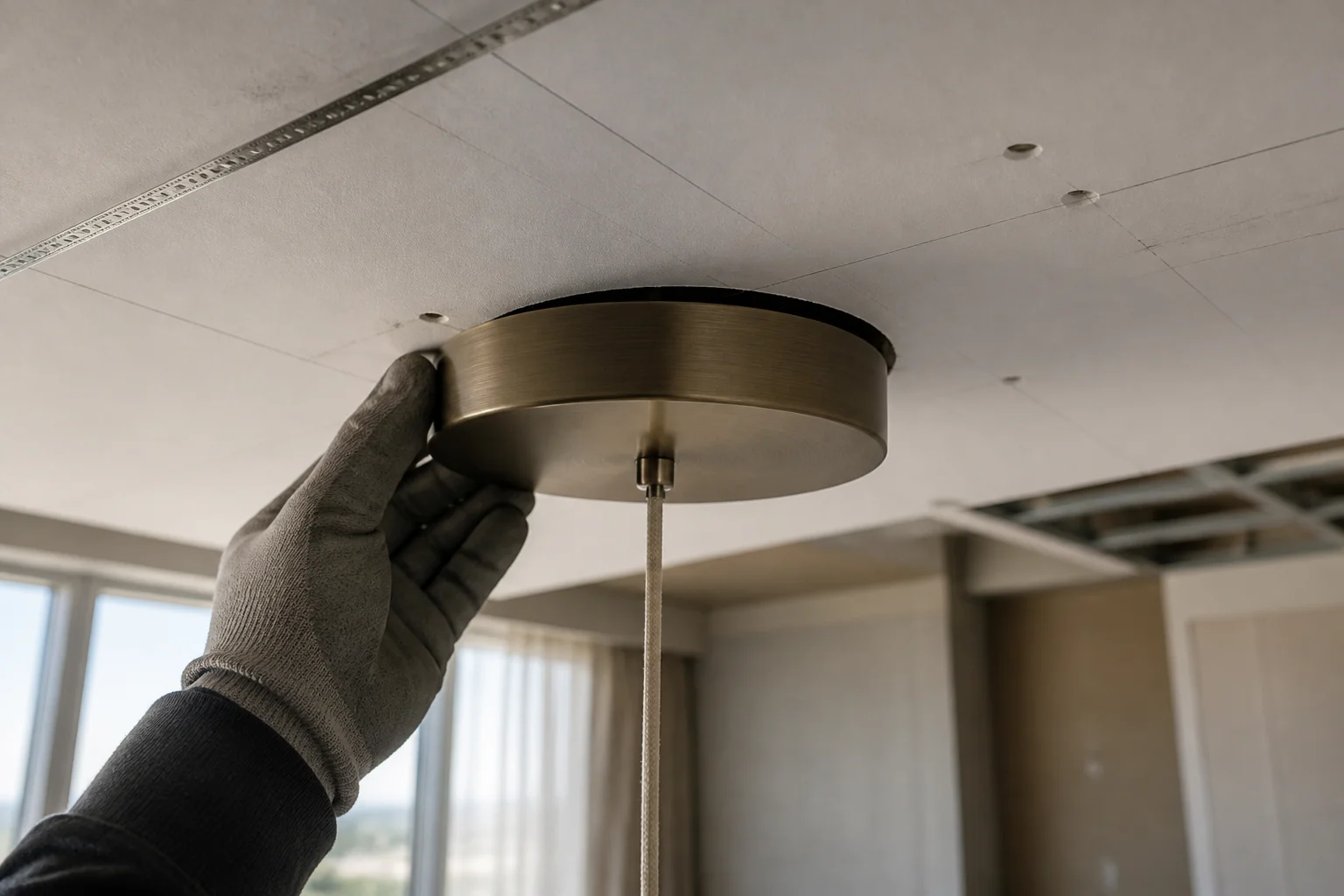 |
| Setting out the ceiling opening before the grid closes is the cheapest moment to fix a mismatch. |
What a Lighting Submittal Is, and What It Is Not
A submittal is a formal record that the product being proposed meets the specification, and that its interfaces with the building have been resolved. It is not a catalogue, not a quotation, and not a brochure with a cover sheet stapled on. Those documents answer the question "what can you sell me". A submittal answers a narrower and much harder question: will this exact fixture, at this exact revision, fit this exact opening and comply with this exact clause.
Three things make a submittal useful. It demonstrates compliance clause by clause, so the reviewer can follow the specification instead of hunting for evidence. It fixes the interfaces other trades are waiting on, so the ceiling contractor and the electrician work to the same dimensions. And it freezes a revision, so a later change can be traced to a dated document.
Keep four document types separate, even when they travel in the same envelope:
- Product data - datasheets, dimensions, materials, finishes, electrical characteristics.
- Shop drawings - setting out, suspension, cut-outs, fixing details, service access.
- Samples - physical finish, material and tone references, held against a retained control sample.
- Certification and test evidence - the declarations and reports the specification actually calls for.
If a reviewer has to open a second document to understand the first one, the submittal is not finished. One package should be readable on its own, in the order the specification is written.
The Five Packages, in the Order They Are Needed
Lighting submittals are usually described as a single deliverable. In practice they arrive as five distinct packages, and the sequence matters more than the contents. Skipping ahead produces approved fixtures nobody can install.
| Package | What it contains | Issued when | Approval releases |
|---|---|---|---|
| 1. Pre-order technical | Datasheets, overall dimensions, lamp and driver data, materials and finishes, weights, mounting method, IP rating, photometric files where specified | With the purchase order, before material or tooling release | The order |
| 2. Interface and setting-out | Shop drawings: ceiling template, canopy and rose dimensions, suspension points, structural fixings, cut-outs, driver access, cable entry | Before ceilings close and before first fix | Site work |
| 3. Sample and finish | Physical finish panels, material swatches, tone references for glass and stone, one retained control sample | Before batch production begins | Finishing |
| 4. Certification and test | Declarations for the destination market, test reports named in the specification, driver certificates, emergency variant evidence where required | Before shipment, or earlier if the client's QA gate demands it | Shipment |
| 5. Close-out | As-built revision, wiring diagrams, spare parts list, warranty statement, maintenance instructions | At handover | Retention |
Two of these are routinely skipped, and both are expensive. The interface package gets treated as the contractor's problem, which is how a 400 mm canopy ends up over a 300 mm ceiling opening. The sample package gets treated as a courtesy, which is how two batches carrying the same finish code arrive looking like different products.
What Reviewers Actually Check in Each Package
Rejection reasons are consistent across projects and regions. Most come from information that was available but not presented.
- Fixture tags that match the schedule exactly. Not "Type A pendant" but the tag as written, including sub-tags for variants.
- Finish by code and physical reference, not by name. "Bronze" is not a finish. A code plus a sample is.
- Weight, stated. A fixing detail cannot be checked against a weight that is missing.
- Driver location and access. Remote drivers need a marked, reachable position. Integral drivers need a removal path that does not involve dismantling the ceiling.
- Dimming compatibility, named as a protocol. Mains dimming, 0-10 V, DALI and wireless control are not interchangeable, and the control vendor belongs on the sheet.
- Cut-out against trim. Both numbers on the same drawing, with the tolerance.
- Lamp base and voltage. E26, E27 and B22 are not the same opening, and the destination market decides which one applies.
- Revision block completed. An unstamped revision is an unapproved revision, whatever the email said.
Anything that touches the ceiling should also carry a coordination note: who cuts the opening, who provides the backing, and what happens if the structural slab sits lower than assumed. That single note prevents more site instructions than any other line in the package.
Review Cycles, Approval Codes and What They Release
Most specifications define four review outcomes, and the difference between them is where schedules slip. Approved releases the next stage. Approved as noted releases nothing until the notes are closed and the sheet is reissued. Revise and resubmit returns the package to the supplier with comments. Rejected means the product does not meet the specification and a substitution is required.
The trap is "approved as noted". It reads like a green light, gets filed like one, and production then starts against a document nobody has closed out. Treat it as conditional: the notes must be answered in writing, the revision must be bumped, and the reissued sheet must be stamped before material is released.
Two disciplines shorten the cycle. First, one reviewer per discipline with a named deputy, so a package cannot sit unclaimed in a shared inbox. Second, a dated submittal log visible to every party, showing what was issued, what came back, and what is still open.
Sequence carries a commercial cost as well. Custom decorative lighting needs a production window measured in weeks, and every review cycle sits in front of that window rather than inside it. A late return moves the delivery date by the same number of days. Suppliers quoting a firm lead time are quoting from approval, not from order.
Who Owns the Submittal Log
The contractor usually owns the log, the designer owns the technical review, the owner's representative owns the decision record, and the supplier owns the response. What breaks is rarely the ownership. It is the handover between them: a comment given verbally on site, a sample approved in a corridor, a revision emailed to one person and never logged.
For a supplier, the useful public commitment is a stated response time for technical queries and revised drawings. Our own working standard is a 48 hour response on submittal comments, and a single piece sample before any custom run is confirmed. Both exist because the alternative costs more: a fast answer that is wrong, or a sample that arrives after the production slot is gone.
FAQ
Do stock fixtures need submittals too?
Yes, but a shorter set. For a catalogue item the pre-order package is often a datasheet plus a finish confirmation, and the interface package can be a single drawing. The two items you should never skip are the tag match and the fixing detail.
Can a supplier submit before the purchase order?
It is common and sensible for the pre-order technical package, because it clears compliance questions before commercial terms are fixed. Samples and interface drawings normally follow the order, since both carry real cost to produce.
How long should a review take?
Most specifications name a review period, often five to ten working days. The number that matters is the one in the contract, and it belongs in the submittal log so a late return is visible rather than remembered.
What if the ceiling is already closed?
Then the interface package becomes a survey. Measure the opening, void depth and fixing points as built, and issue a revised drawing against those measurements. Never approve a canopy detail against assumed dimensions.
Does a digital sample count for approval?
For colour it rarely does. Screens, files and print all shift tone, and translucent materials such as glass and stone shift further than most. A physical reference held by both parties is the only version that survives a dispute.
The takeaway
Submittals are not paperwork wrapped around a product. They are the mechanism that makes the product installable. Get the order right: technical compliance first, interfaces second, samples third, certification fourth, close-out last. Treat approved as noted as conditional until the notes are closed. Keep one dated log that every party can read. Do those four things and most of the site problems decorative lighting gets blamed for never happen.
Zerouno Lighting (ZeroUNO) manufactures hospitality decorative lighting in Zhongshan, China, including bespoke pendants, chandeliers, wall lights and bedside reading lights for hotel guestrooms and public areas. Founded in 2013, the company works with designers and procurement teams from first sample through to submittal, production and delivery. Learn more at zerounolighting.com.
About the author
Sonny Yu is Sales Manager at Zerouno Lighting, working with hotel owners, interior designers and procurement teams on decorative lighting specifications. He writes about the operational side of hotel lighting: how fixtures are specified, approved, manufactured and handed over.


没有评论:
发表评论