Your fixtures are finished, the packing date is fixed, and the shipping window is closing. Pre-shipment inspection is the last moment when a problem is still the supplier's problem instead of yours. For teams buying decorative lighting overseas, that visit protects the most expensive item on the programme: the installation window.
This guide covers what a lighting pre-shipment inspection should include, how to prepare the checklist before production starts, and what to do with what you find.
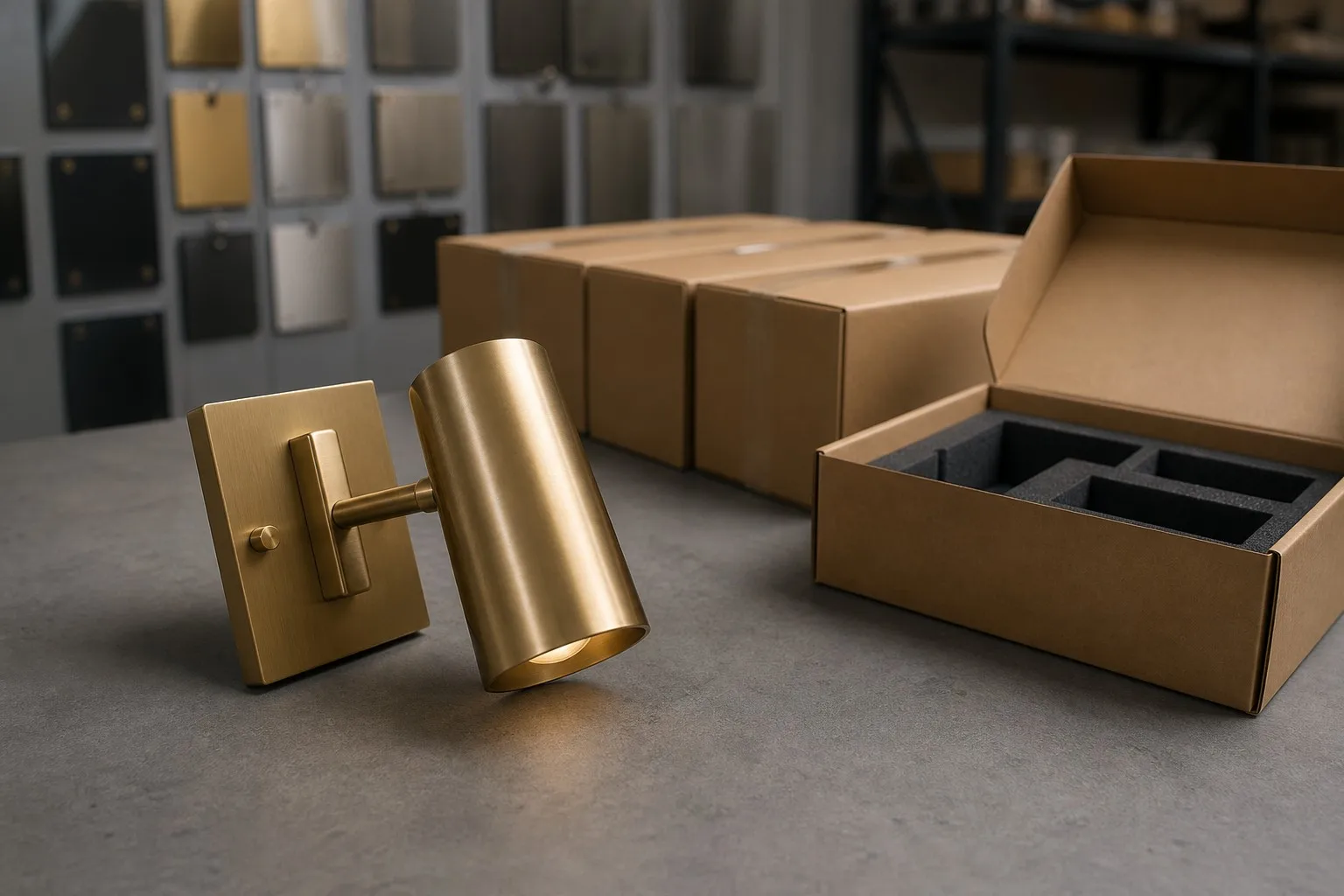 |
| Pre-shipment inspection starts at the bench: one finished fixture checked against the sealed reference before the cartons are closed. |
What a Pre-Shipment Inspection Should Actually Cover
A pre-shipment inspection is not a factory audit and it is not a quality certificate. It is a structured comparison between what was approved and what is about to be loaded. For decorative lighting it has six parts:
- Quantity and configuration – count by model, and confirm finish, size and lamp type against the approved schedule, not a general catalogue.
- Finish – colour, sheen and texture compared with the approved sample under consistent light.
- Dimensions and fit-critical geometry – overall sizes plus the interfaces that matter on site: backplate centres, stem lengths, shade clearance.
- Function – switching, dimming behaviour, driver compatibility, sensors and any integrated control feature.
- Wiring and construction integrity – terminations, strain relief, insulation and the security of moving joints.
- Packing and identification – carton condition, internal protection, and whether labels let a site team route each box without opening it.
What it does not cover matters just as much. An inspection cannot validate the installation environment, the installer's workmanship, or whether the right compliance documents exist for the destination market. Those are separate tasks with separate owners.
Prepare the Inspection Checklist Before Production Starts
The most common cause of a wasted inspection is a checklist written the week the goods are ready, when the only reference available is whatever the factory has on the floor. The checklist must come from documents frozen earlier: the approved sample, the signed drawing set, the finish reference and the control specification.
| Check | Reference document | How to record it |
|---|---|---|
| Finish colour and sheen | Sealed approved sample | Pass or deviation, photo including the sample |
| Overall dimensions | Signed drawing with revision number | Measured value against the drawing tolerance |
| Mounting interface | Installation drawing | Measured value, photo with a rule where critical |
| Colour consistency | Sample versus production piece, same driver | Side-by-side photo from a fixed position |
| Dimming behaviour | Project control protocol | Works or does not work, and on which dimmer |
| Carton labelling | Packing list keyed to room or floor | Present or missing, by carton number |
| Accessories and spares | Approved accessory list | Counted and listed per carton |
Two disciplines make this work. Every line needs a reference document with a revision number, because "looks the same as the sample" is not a test. And every finding needs a photograph taken under the same conditions as the reference, otherwise the discussion afterwards becomes a comparison of memories.
Sampling: How Much of the Order Should Be Opened
Inspection is a sampling exercise, not a full unpacking. A practical plan has three tiers.
- Every unit in the first production batch – checked for the errors that repeat: finish tone, hardware orientation, shade seating, label accuracy.
- A defined sample of the balance – drawn across cartons, pallets and production dates rather than from the top layer of one pallet.
- One fully assembled unit of each model – built and, where the project allows, dimmed and left running long enough to expose a failing driver that a five-second test misses.
Agree the sample size in writing before production, together with the defect level that triggers a hold. Deciding that threshold after the defects appear turns a technical question into a commercial argument.
The Finish Check Is Where Most Disputes Begin
Metal finishes are the least objective part of any lighting order and the most likely to be disputed at handover. Two pieces that left the same workshop on different days can read differently in a corridor, and in a hotel the guest sees them side by side.
Inspect finish under the light the guest will actually experience, and compare against the sealed sample, never against the piece in your other hand. If a supplier cannot show you a sealed, signed reference sample, you do not yet have a finish standard.
Keep a sealed and signed master sample with the specification, compare production pieces to it under a documented light source and viewing angle, and photograph the comparison with the sample in the same frame. When you find a deviation, it matters whether it is a batch-wide shift or a single-piece anomaly: batch-wide shifts usually point to a process change and may require reworking the run, while single-piece anomalies are handled by replacement. Record the batch identifier on each inspection sheet so consistency can be traced across deliveries.
Function, Controls and Driver Consistency
Function testing is where inspection failures are cheapest to fix and most often skipped. Test each model against the control method the project specifies, using a dimmer of the same type that will be installed. A fixture that dims smoothly on a workshop bench can behave differently on a shared circuit, so include one multi-fixture test per circuit group where the project allows.
Record the driver manufacturer, model and batch for each fixture family. Drivers are the component most likely to need replacement during a hotel's operating life, and that record is what makes a like-for-like replacement possible years later without dismantling a ceiling.
The Documentation That Should Travel With the Shipment
Inspection output is only useful if it reaches the site. Ask for a documentation pack attached to the shipment, not emailed separately later:
- Inspection report with date, inspector name and the reference revisions used.
- Photographs of each finding, including comparison shots and closed carton labels.
- Packing list keyed to the room, floor or riser schedule, with carton numbers.
- Accessory and spare parts list with quantities per carton, and which carton holds the spares.
- Driver schedule by fixture model, including batch identifiers.
Site teams work from paperwork. A carton labelled by model only will be opened, guessed at and moved twice; a carton labelled by level and room goes straight to the right floor intact.
What to Do With the Findings
Sort findings before you negotiate them, because the right response differs by type.
- Cosmetic deviations across a batch – ask for rework against the sealed sample, and get a revised packing date in writing before the container is booked.
- Isolated defects – replace from the production overage, or add the units to the spare parts allowance.
- Fit-critical dimensional errors – stop and resolve against the installation drawing; these cannot be corrected on site without cutting into a finished wall or ceiling.
- Function failures – treat as a release blocker for the affected batch, because a driver or dimming fault at scale becomes a maintenance obligation after handover.
Agree in the purchase order who carries the cost of a hold and how a rework round affects the delivery schedule. Framed before production, that is a two-line clause; framed while goods sit in a packing area, it is a dispute.
FAQ
Should a third party carry out the inspection, or can the factory's own QC do it?
For a first order with a new supplier, a third party who reports to you is worth the cost, particularly for finish and function. For repeat orders of an unchanged product, the supplier's own records are usually sufficient, provided you receive photographs following the same checklist.
Can pre-shipment inspection replace a mock-up room sign-off?
No, because they answer different questions. A mock-up confirms how the design behaves in the real room, including reflections, control scenes and guest sightlines. Pre-shipment inspection confirms that production units match the approved sample and specification. A hotel project needs both, mock-up first.
Is inspection worth it for a small order?
It depends on what the order can break. A short run of standard stock items shipped from inventory usually does not justify it. A small quantity of fit-critical or finish-matched fixtures for a lobby or a suite does, because replacing them after handover costs far more than the check.
How far in advance should the inspection be booked?
Book the date when production is confirmed, not when it finishes. Inspection needs fixtures packed or packable, all references on site, and time for a rework decision before the shipping window closes.
The takeaway
Pre-shipment inspection is a comparison exercise, and it only works when the references were locked before production: a sealed finish sample, a signed drawing set, an agreed sampling plan and a documented control protocol. Check finish and function hardest, because those two areas generate the most disputes and the most expensive site fixes. Record everything with photographs and batch identifiers so the pack serves both the installer and whoever replaces a driver later. And decide the consequences of a failed check in the purchase order, while the conversation is still calm.
Zerouno Lighting (ZeroUNO) manufactures hospitality decorative lighting in Zhongshan, China. The company produces made-to-order and bespoke fixtures for hotel projects, samples a single piece for approval before a run begins, and backs its output with a two-year warranty and a 48-hour response commitment. Learn more at zerounolighting.com.
About the author
Sonny Yu is Sales Manager at Zerouno Lighting, working with hotel owners, interior designers and procurement teams on decorative lighting packages. He writes about the practical side of specifying custom fixtures, from sampling and pre-shipment inspection through to delivery and after-sales support.



没有评论:
发表评论