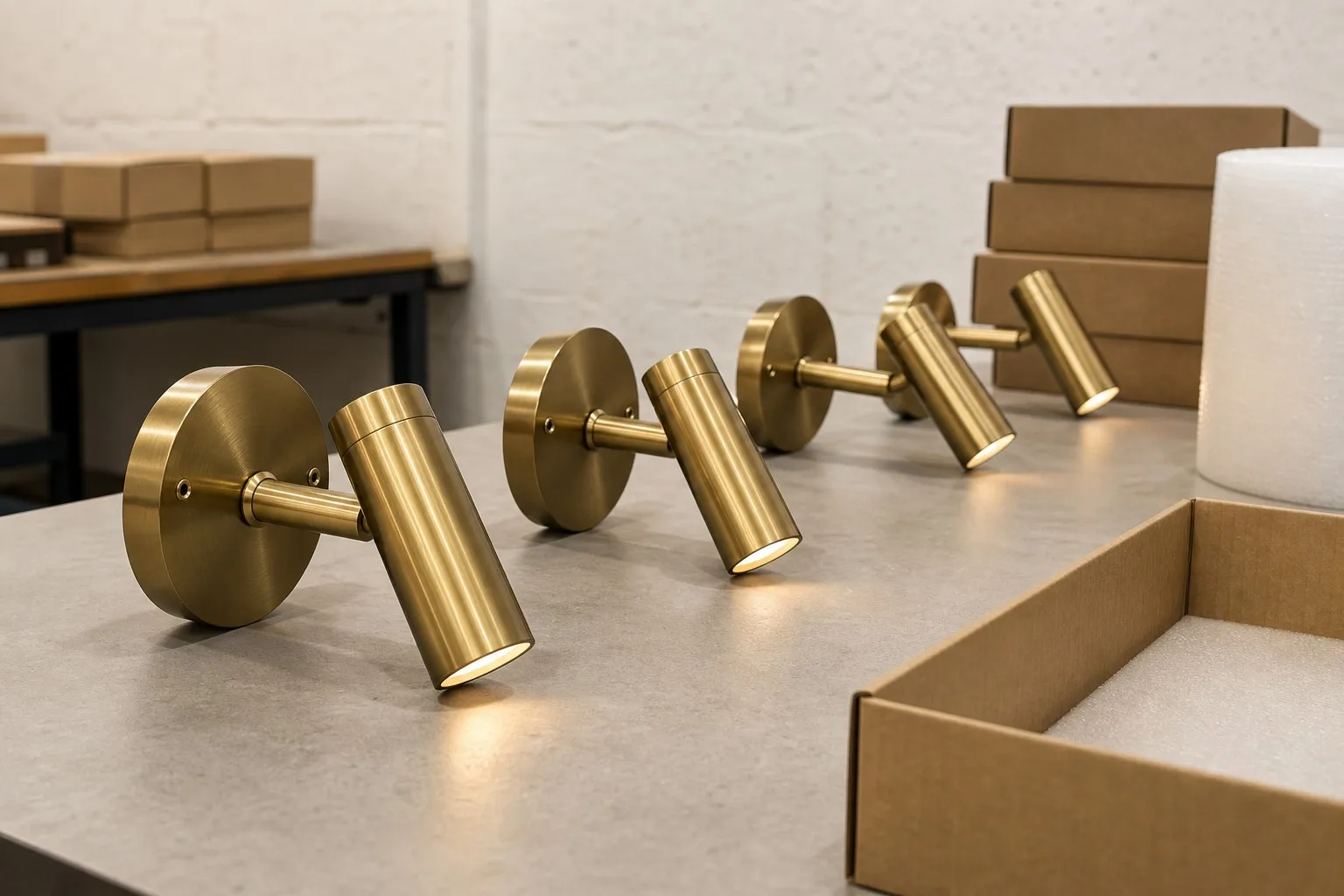
 |
| Pre-shipment checking on a made-to-order run. These days are predictable; the days spent waiting on an approval are the ones that move the date. |
Lead time on decorative lighting is rarely decided by how fast a factory can bend brass. It is decided by how many things have to be true before the factory can start, and how many are still moving after it already has. On a hotel project that distinction matters, because the lighting package sits late in the fit-out sequence and public areas are often finished against a published soft-opening date.
This guide is for the people who carry that date: project managers, procurement coordinators and FF&E teams. It separates the clock into three order types, shows where the days genuinely go, and sets out a schedule you can defend in a progress meeting instead of hoping for.
The Three Clocks: Stock, Made to Order, and Urgent
Most schedule arguments come from mixing three different clocks into one word. A catalogue fixture and a bespoke headboard light are not the same promise, and a recovery shipment is not a normal order with the volume turned up. Agree which clock you are buying before you agree a date.
| Order type | Typical production time | What must be frozen first | Where it usually slips |
|---|---|---|---|
| Stock finish | 1 to 2 days | Confirmed order and shipping details | Almost nothing, if the finish is genuinely held rather than "usually stocked" |
| Made to order | 25 to 35 days | Signed drawings, approved finish sample, confirmed electrical and control specification | Approval rounds, bought-in fabric or diffuser, specification changes raised mid-production |
| Urgent recovery | Around 5 days | A completely frozen specification and a priority workshop slot | The trade-off. Nothing may change, and fewer designs can be built this way |
The made-to-order clock does not start when the deposit clears. It starts when the last approval stops moving. A project that signs drawings quickly and then reopens the finish two weeks later has not bought 25 to 35 days. It has bought 25 to 35 days plus the interval it spent changing its mind.
Where the Days Actually Go
When a date slides, the workshop is the first suspect and usually the wrong one. On a decorative lighting package the calendar is consumed by a handful of steps, and only some belong to the supplier.
| Stage | Why it costs days | The lever that shortens it |
|---|---|---|
| Drawing approval | Each markup round travels between designer, owner and supplier | One consolidated markup; freeze the specification before the deposit |
| Finish and material samples | A physical sample must be produced, shipped and accepted, often across time zones | Run sample approval in parallel with drawings, not after |
| Custom tooling or profile | A new forming tool must be made before the first part exists | Reuse an existing profile wherever the design allows |
| Bought-in components | Shades, diffusers, glass and control gear are purchased per order | Specify from available ranges rather than an open library |
| Dimming compatibility | A mismatch found late forces re-specification after production | Confirm the site protocol at specification stage |
| Inspection and packing | Fixtures must be checked and protected to survive a container and a site | Agree the standard up front so nothing is re-opened at the end |
Two of those six rows sit with the supplier. Four sit with the project. That ratio is the most useful thing to know when you are asked to explain a delay.
The Approval Loop Is Usually the Delay, Not the Factory
Ask what actually pushed a project past its date and the answer is rarely a machine breakdown. It is a signature. A drawing that sat in an inbox for nine days. A finish approved by email but never formally recorded. A shade changed from linen to a heavier weave after the frames were already cut.
- Freeze the specification before the deposit, and treat later changes as a new order, not an amendment.
- Give each approval a named owner and a hard date, not a shared inbox.
- Record sample decisions in writing. "Looks fine" is not a release to produce.
- Run drawings, finishes and control specifications in parallel, not as a queue.
- Keep one master fixture schedule so a change in one room type does not drift from the others.
The supplier controls roughly half of the calendar. The other half is approvals, samples and site readiness, and those sit in the project's own hands. Projects that finish on time are rarely the ones with the fastest factory. They are the ones that treated their own approval loop as part of the lead time.
Building a Schedule You Can Defend
A defensible schedule is one where every date has a reason attached. Build it backwards from the installation window, not forwards from the order date.
- Fix the install date first, then work back through delivery, consolidation, production and approval.
- Date every approval milestone. Drawings, finish sample and control specification each get a calendar date, not a phase name.
- Place float before production, not after it. A week of contingency is worth more at the approval stage than at the port.
- Agree room-type priority. Decide which floors must be complete for the opening and which can follow.
- Publish one change cut-off. After it, changes move to a later phase and are quoted separately.
- Review open approvals weekly, not just production percentage.
Written this way the schedule becomes a tool for the progress meeting. When a date moves, it is visible which milestone moved it, and whether that milestone was the supplier's to hold.
What Belongs in the Purchase Order, and What Phasing Changes
The purchase order is where a schedule either survives or quietly dies. Undefined packaging instructions and an unstated delivery point are two of the most common causes of a last-minute site problem that looks like a production delay but is not one.
- The approved drawing revision, referenced by number and date.
- The approved finish and material references, recorded in writing.
- The electrical and dimming specification, including the site control protocol.
- Packing standard and unit labelling by room type.
- Delivery point, Incoterms, and who clears what.
- The phase plan: which quantities ship together and in what sequence.
- The change cut-off date and how later changes are quoted.
- The inspection and acceptance method, agreed before production starts.
Phasing deserves its own line, because it buys schedule without buying capacity. On a multi-floor fit-out, splitting the order so the first floors ship complete and the rest follow is often faster than waiting for one consolidated shipment. It reduces site congestion, lets installation begin while production continues, and limits the damage when a single room type is still in approval. The cost is more paperwork and more than one shipment, which is usually a better trade than slippage on every floor at once.
FAQ
How long does hotel lighting take from order to delivery?
For made-to-order decorative lighting, 25 to 35 days of production is a realistic working range once the specification is frozen. Stock-finish items typically move in 1 to 2 days, and an urgent recovery order can be compressed to around 5 days. Transit sits on top of production.
What counts as day one of the lead time?
Day one is the date the last approval lands, not the date the order is placed. If a finish sample is still travelling, the production clock has not meaningfully started. Treat open approvals as lead time and the numbers stop being a surprise.
Can a custom fixture be delivered faster than 25 to 35 days?
Sometimes, but the trade is flexibility rather than money. An urgent run works when the design can be built from existing profiles and available materials, and when the specification is completely frozen. A bespoke profile needing a new forming tool is not a candidate.
Does changing a finish mid-production restart the clock?
It can reset part of it, and that is worth stating at the outset. Once frames are cut or plated, a finish change affects work in progress, not a line on a drawing. Better to quote the change, move it to a later phase and keep the original shipment on its date.
What if the installation date is already fixed?
Work backwards from the install window, put approval milestones on the calendar with named owners, and settle the phase plan before production starts. If the dates do not close, the useful conversation is about which rooms ship first, not about asking for a shorter production time the design cannot support.
The takeaway
Hotel lighting lead time is a project number, not a factory number. The production window is real and reasonably predictable, but it starts only when the approvals stop moving, and on most projects that is the part nobody has scheduled. Freeze the specification early, run approvals in parallel, date every milestone with an owner, and phase delivery so the first floors can be installed while the rest is still being built. Those four habits turn the delivery date from a hope into something you can defend. Planning a schedule now? zerounolighting.com
Zerouno Lighting (ZeroUNO) manufactures hospitality decorative lighting in Zhongshan, China, working with hotel owners, interior designers and FF&E buyers on guest room and public area fixtures. Production planning starts from a signed drawing and an approved finish, with sampling available before a full run. Learn more at zerounolighting.com.
About the author
Sonny Yu is Sales Manager at Zerouno Lighting, a hospitality lighting manufacturer based in Zhongshan, China. He works with hotel owners, designers and procurement teams on decorative lighting packages, and writes about the practical side of specifying, scheduling and receiving custom fixtures for hospitality projects.



没有评论:
发表评论