Every hotel carries a short list of lighting complaints that no snagging process ever caught. The bedside light that only responds if you press the switch twice. The mirror light that makes guests look tired in photographs. The reading lamp that hums whenever the dimmer sits in one particular position. None of these surface at pre-opening inspection, because the room is empty.
This guide is for the people who receive those reports: facility and engineering teams, duty managers, and the procurement staff who end up chasing the original lighting supplier. The goal is to separate faults you can fix in the room from problems that are really specification decisions, and to capture evidence that makes the second visit cheaper than the first.
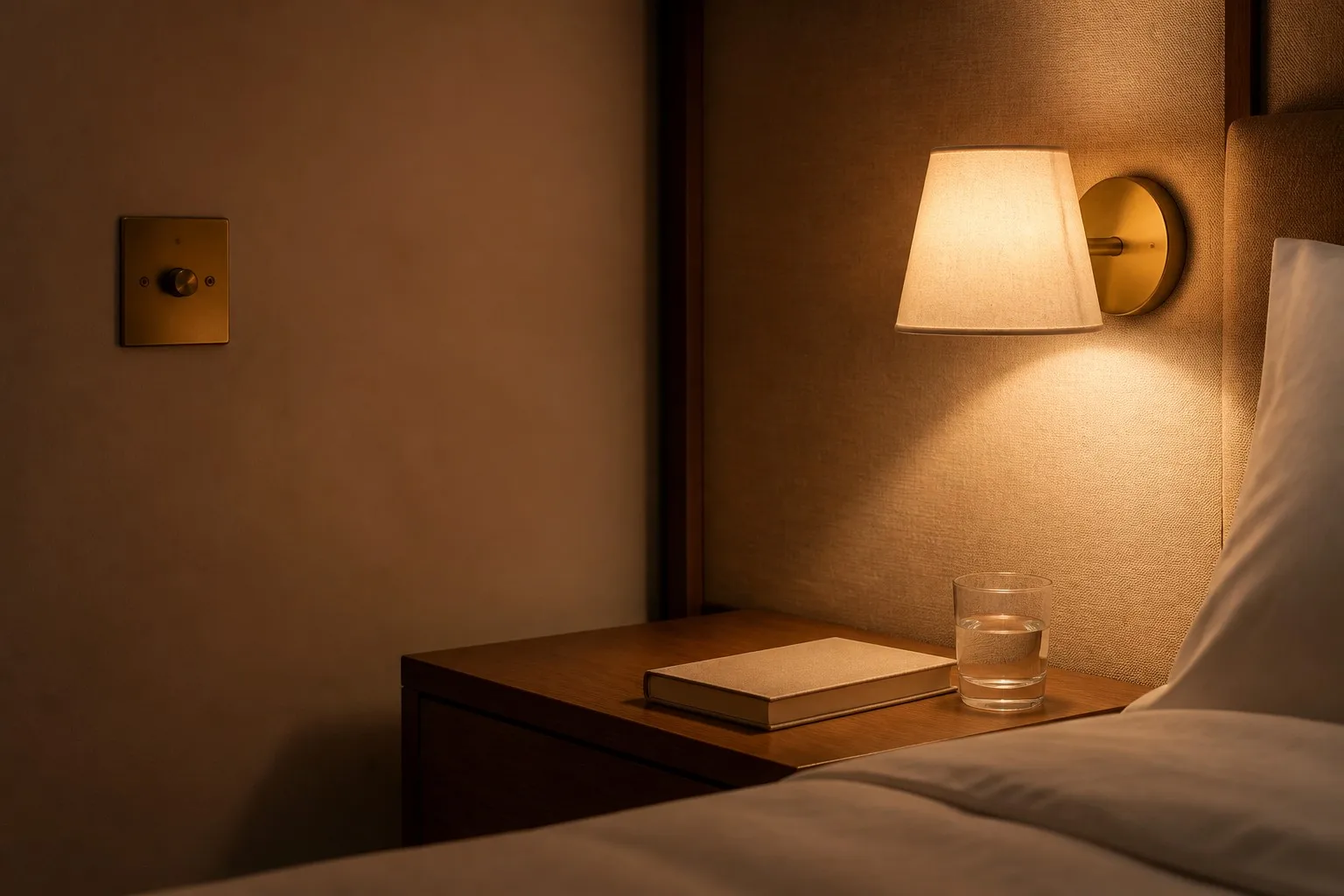 |
| The complaint usually starts at the spot in the frame: a bedside lamp, a nightstand, and a dimmer plate the guest has to find in the dark. |
Complaint language tells you which fault family you are dealing with
Guests do not report dimming incompatibility or driver failure. They report outcomes, and the wording is a useful first filter. It is too dark in here is rarely a dead lamp. It flickers when I turn it down almost always points at the control side. It buzzes is a compatibility symptom. I could not find the switch is a layout problem, not an electrical one.
A complaint phrased as a preference, such as too dim or not enough light at the mirror, usually survives a repair visit untouched. A complaint phrased as a defect, such as dead, flickering, buzzing or loose, usually does not.
The four fault families behind most guest room lighting complaints
Almost every report traces back to one of four families. Sorting the report into the right family is most of the diagnostic work; the repair itself is usually the easy part.
- Design-level. The fixture works as specified and the guest still dislikes it: one central ceiling light in a room that needed layers, a mirror light mounted directly overhead, or a switch panel nobody can read in the dark.
- Control and programming. The hardware is fine but the behaviour confuses: scenes that do not match their labels, a master switch that kills the reading light, or key-card logic that resets to an uncomfortable default.
- Electrical and dimming compatibility. Flicker, buzz, a drop-out at the low end, or a faint glow with the circuit off. These are normally mismatches between dimmer, driver and circuit load rather than a failed component.
- Hardware wear and installation. A wedged shade, a loose backplate, a cracked diffuser, an over-tightened lamp, or a connector never fully seated.
A triage table for the five most common reports
Use the table as a first-pass router. It does not replace an electrical inspection, but it prevents the most common misrouting: sending a maintenance ticket to a problem that only a specification change will solve.
| What the guest reports | Most likely family | First check in the room | Who should own it |
|---|---|---|---|
| Too dim or too bright | Design-level | Confirm the fixture reaches its intended output and no scene caps it | Design team, with engineering evidence |
| Flickers when dimmed | Electrical and dimming | Reproduce it, record the dimmer position, test the circuit load | Engineering, then the supplier |
| Lamp buzzes | Electrical and dimming | Note whether noise comes from fixture, driver or wall dimmer | Engineering, then the supplier |
| Cannot work the switches | Control and programming | Walk the room at night and try every panel in darkness | Engineering and the programmer |
| Mirror light is unflattering | Design-level | Photograph a person at the mirror from the guest's position | Design team, logged for refurbishment |
Running a fifteen-minute in-room triage
The goal is not to fix the report immediately but to identify its family with enough confidence that the right person is sent. This sequence fits inside a normal shift.
- Reproduce it in the guest's position. Sit on the bed, stand at the mirror, and walk in from the corridor with the lights off. Complaints often turn into a different complaint once the room is used the way it is actually used.
- Test every control state, not just on. Full brightness, minimum brightness, each scene, master off, and key card reinserted. Note which states misbehave.
- Isolate the layer. Where several lights share a circuit, switch each on alone to see whether the fault follows the fixture or the circuit.
- Check the electrical signatures. Buzz, flicker, low-end drop-out and faint glow with the circuit off all point at the dimmer and driver pairing rather than a dead LED.
- Inspect the physical install. Backplate tightness, shade alignment, diffuser seating and connector depth.
- Name an owner before closing the ticket. A ticket that ends with monitor will be reopened; one that ends with a named owner and a next action usually will not.
Rule of thumb: if the same complaint arrives from two different guests in the same room type within a month, stop treating it as a maintenance ticket and treat it as a specification note. Maintenance fixes one room. Specification fixes the next hundred.
When the problem is specification, not repair
Some complaints return however many times the fixture is replaced, because the fixture was never the problem. Two signals identify that case. The first is consistency across a room type: the same report from several rooms with the same layout and fixture schedule. The second is phrasing: when guests describe a preference rather than a defect, they are telling you the room performs as designed and the design is what they dislike.
The honest response is to stop repairing and start logging. Record design-level reports against the room type, with the date and the guest's wording, and hand the record to the project team before the next refurbishment window is scoped. A refurbishment can absorb a switch reposition, an extra lighting layer or a different fixture family. A maintenance budget cannot.
What to capture before you contact the lighting supplier
A supplier who receives a usable report can usually answer in one exchange. A supplier who receives the light is broken cannot answer at all. Collect the following before raising the request.
- Room number and room type, plus how many rooms share the report.
- Fixture reference, any batch or delivery marking, and installation date.
- A photograph of the fixture in place and one of its label or driver marking.
- A short video with sound if the fault is flicker or buzz, which written descriptions rarely capture well.
- The dimmer position, scene and control state in which the fault appears.
- What has already been swapped or tested, and what changed as a result.
Reducing the next wave of complaints
Most of the cost here is not the repair, it is the repetition.
- Label controls in the guest's language, not the programmer's. Reading is usable at two in the morning; a circuit number is not.
- Keep a small critical spares set per room type: diffusers, shades, drivers and connectors for the fixture families that dominate the property.
- Keep a one-page dimmer compatibility record, so a replacement driver is never chosen by whatever is in the van that day.
FAQ
The guest says the room is too dark. Is that a fault?
Usually not. A room can be fully functional and still read as dark to a guest arriving from a bright corridor. Confirm that every fixture reaches its intended output and that no scene is capping the level, then file the report as a design note. It becomes a maintenance issue only if a fixture measures below its siblings in the same room type.
Why does an LED fixture flicker only at certain dimmer positions?
Flicker across part of the dimming range is a compatibility symptom rather than a failure. The dimmer, the driver and the circuit load are not working well together, and it often appears only on lightly loaded circuits. Reproducing it at the exact dimmer position is far more useful to a supplier than a general report of flicker.
How quickly should a lighting fault be resolved?
That depends on the fault. A room that cannot be lit safely should be dealt with the same day, even if only by moving the guest or providing a temporary lamp. A flicker or buzz that does not affect safety can follow a normal maintenance cycle, provided the room is not sold as fault-free.
Is a buzzing bedside lamp dangerous?
Buzz is normally an annoyance rather than a hazard, and it usually originates at the dimmer or the driver rather than the LED itself. It should still be logged, because the same mismatch that produces noise can shorten component life. If it comes with heat or a burning smell, treat it as an electrical fault.
The takeaway
Guest room lighting complaints are rarely mysteries once they are sorted into the right family. The ones that keep coming back are almost never repaired badly; they were never maintenance problems to begin with. Separate the fault from the preference, reproduce the report the way the guest experienced it, and log the design-level issues while they are fresh.
Zerouno Lighting (ZeroUNO) manufactures hospitality decorative lighting in Zhongshan, China, working with hotel owners, interior designers and procurement teams on guest room, corridor and public area fixtures. Sampling starts from a single piece, and made-to-order programmes are backed by a two-year warranty with a 48-hour response commitment. Learn more at zerounolighting.com.
About the author
Sonny Yu is Sales Manager at Zerouno Lighting, where he works with hotel owners, interior designers and contractors on decorative lighting packages for new builds and refurbishments. He writes about the practical side of hospitality lighting: how fixtures are specified, how they are made, and what happens to them once the hotel is open.



没有评论:
发表评论